
Pallet racking installation is the process of assembling, anchoring, and validating industrial steel storage racks in a warehouse, starting with a site survey and floor layout, proceeding through upright placement, beam installation, and concrete anchoring, and concluding with alignment checks, safety accessory fitting, and load testing. When done correctly, it creates a storage system that maximizes vertical space, supports safe material handling, and remains stable under load for years. When done poorly, it becomes a structural liability that endangers workers and inventory.
But here is what most installation guides miss entirely: the quality of your installation depends partly on what you plan to put on those racks. A perfectly plumb, properly torqued racking system can still underperform if the pallets you load are warped, inconsistently sized, or structurally compromised. At Shandong Lile, we have supplied rackable plastic pallets to warehouses across 108 countries. We have seen installations that looked flawless on day one require constant adjustment six months later, not because of the steel, but because wooden pallets swelled, splintered, and shifted under load.
This pallet rack installation guide covers every step of pallet racking installation, from pre-installation planning to the final torque check. We have included torque specifications, seismic requirements, troubleshooting tips, and a perspective you will not find in other guides: how your pallet choice should shape your installation plan from the very beginning.
Key Takeaways
- Proper pallet racking installation follows eight sequential steps: site survey, layout marking, upright placement, beam installation, floor anchoring, bracing, safety accessories, and final inspection with load testing.
- A two-person crew can install 80 to 120 linear feet of selective pallet racking per day, with professional installation costing 3to3to8 per pallet position.
- ANSI MH16.1 requires racking to remain plumb within 1/4 inch per 10 feet of height, with standard wedge anchors torqued to 90 foot-pounds.
- The pallets you choose should determine your beam spacing and upright configuration, because consistent pallet dimensions eliminate post-installation rack adjustments.
- Seismic zones, cold storage environments, and mixed-manufacturer systems each require specialized installation procedures that standard guides often omit.
Pre-Installation Planning: What to Know Before the First Bolt
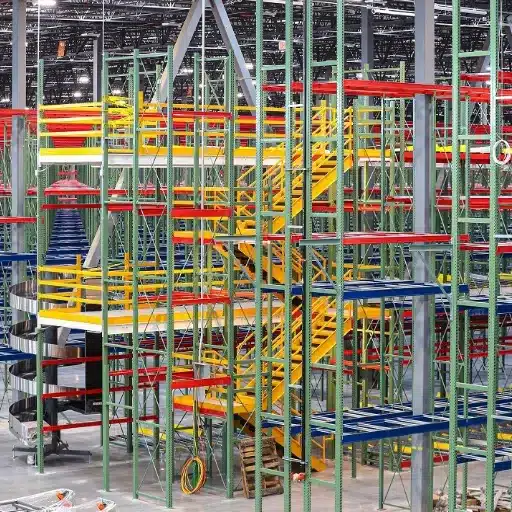
Every successful warehouse racking installation begins days before the first upright touches the warehouse floor. The planning phase determines whether your system fits your space, supports your inventory, and complies with local codes.
Start with a thorough site survey. Measure the exact dimensions of your warehouse, including ceiling height, column spacing, door locations, and fire suppression systems. Note the floor condition. Is it level? Is the concrete rated for at least 2,500 psi compressive strength? Are there expansion joints, drains, or existing anchor points that could interfere with new installations? A floor that slopes more than 1/8 inch per 10 feet will require shimming, and floors with significant damage may need repair before anchoring.
Next, determine your rack configuration. How many pallet positions do you need? What are the dimensions and weight of your typical loads? What type of forklift or material handling equipment will operate in the aisles? These answers determine beam length, beam capacity, upright height, and aisle width. Most selective pallet racking uses beams between 96 and 144 inches long, with upright heights ranging from 8 to 24 feet or more.
Why Pallet Specifications Should Drive Your Installation Plan
This is where most installation guides go silent. They treat pallets as an afterthought, something you worry about after the steel is in place. That is backwards.
Your pallet dimensions directly determine beam length. A 1200 by 1000 millimeter pallet requires a different beam configuration than a 48 by 40 inch pallet. Your pallet weight, both empty and at maximum load, determines beam capacity selection. And your pallet base design, whether three-runner, full-perimeter, or picture-frame, affects how the load transfers to the beams.
Here is the advantage plastic pallets bring to installation planning. Injection-molded HDPE and polypropylene pallets maintain dimensional consistency within plus or minus 1 millimeter, batch after batch. Wooden pallets can vary by 5 to 10 millimeters due to moisture absorption, grain variation, and wear. When you install racking for plastic pallets, you can set precise beam elevations and trust they will remain correct. With wood, you are planning for a moving target.
At Shandong Lile, we have worked with warehouse engineers who discovered this the hard way. They installed selective racking to exact specifications, only to find that seasonal humidity caused their wooden pallets to swell. Beams that had been perfectly aligned in winter were suddenly too tight in summer, forcing costly mid-year adjustments.
Tools and Equipment Checklist
Before installation day, gather the following:
- Tape measure, laser level, and chalk line reel
- Torque wrench calibrated in foot-pounds
- Hammer drill with masonry bits (minimum 1/2 inch diameter)
- Socket set matching your anchor bolt heads
- Shims (metal or composite, various thicknesses)
- Safety clips and beam locks (verify compatibility with your rack manufacturer)
- Post protectors and end-of-aisle guards
- Personal protective equipment: hard hats, steel-toe boots, safety glasses, and high-visibility vests
- Load capacity plaques and signage
Safety Equipment and PPE Requirements
Pallet racking installation involves heavy steel components, power tools, and overhead work. At minimum, every installer should wear a hard hat, steel-toe boots, cut-resistant gloves, and safety glasses. When working above shoulder height or on tall racks, add a safety harness tethered to an approved anchor point. Never work beneath suspended loads, and always use a team of at least two people for upright placement.
Step 1: Layout and Floor Marking for Pallet Racking Installation
With your plan finalized and tools ready, begin by marking the warehouse floor. This step prevents the costly error of installing an entire row only to discover it is six inches off from your intended aisle width.
Start from a fixed reference point, typically a warehouse wall or an established column line. Measure and mark the starting position of your first starter bay using a chalk line. A starter bay consists of two upright frames connected by beams. All subsequent add-on bays share one upright with the previous bay, saving both material and floor space.
Mark every upright location, every aisle centerline, and every cross-aisle dimension. Account for forklift turning radius. A standard counterbalance forklift needs an aisle width of approximately 12 feet for selective racking. Narrow-aisle trucks can operate in 8 feet or less, but this affects your equipment procurement, not just your layout.
Verify your marks with a second measurement. One of the most common installation errors is a mismeasured chalk line that cascades through an entire row. Take the time to check diagonals. In a square bay, the diagonal measurements from opposite corners must be equal. If they differ by more than 1/4 inch, your layout is not square.
Sample Bay Strategy: Why Install One Bay First
Before committing to a full row, install one complete starter bay exactly to specification. Use this sample bay as your physical reference. Check plumb, verify beam elevations, confirm aisle width, and test anchor torque. Only when the sample bay meets every specification should you proceed with the full installation.
This strategy is especially valuable when installing racking for plastic pallets with tight dimensional tolerances. A sample bay lets you verify that your chosen beam spacing matches your actual pallet height plus required lift clearance before you lock in dozens of identical bays.
Step 2: Upright Frame Placement and Leveling
Set your first upright frame on the marked floor position. This frame is your anchor for the entire row, so its placement and plumb must be exact.
Begin with the lower beam level. It is always easier to align and level a frame when it is connected to a horizontal beam than when it stands alone. Install the lowest beam pair first, then stand the frame upright. Check plumb in both directions using a long level or a laser plumb bob. ANSI MH16.1 requires frames to be plumb within 1/4 inch per 10 feet of height. For a 20-foot upright, that means no more than 1/2 inch of lean in any direction.
If your floor is not perfectly level, and most warehouse floors are not, use shims under the baseplate to achieve level. Place shims at the bolt holes, not at the edges, so the full baseplate bears evenly on the floor. Never stack shims more than three high without consulting the rack manufacturer, as excessive shim height can create a pivot point under load.
Once the first frame is plumb and level, connect the second frame of your starter bay with the lowest beam pair. Check that the bay is square by measuring diagonals. Equal diagonals mean square corners. Only then should you proceed to higher beam levels.
Troubleshooting: What to Do When the Floor Is Not Flat
Warehouse floors, especially in older buildings, often have high and low spots that exceed the 1/8 inch per 10 feet tolerance ideal for racking. When you encounter uneven floors, you have three options.
First, use shims of graduated thickness to bring each upright to level. This is the fastest solution and works well for minor irregularities. Second, grind down high spots in the concrete. This requires specialized equipment and creates dust, but it produces a flatter surface for anchoring. Third, pour a leveling compound over the entire installation area. This is the most expensive option but creates the best long-term foundation, especially for high-bay or automated systems where precision matters most.
Step 3: Beam Installation
With your starter bay uprights in place and leveled, install the remaining beam levels. Always work from the bottom up. Lower beams provide structural stability that makes higher beam installation safer and more accurate.
Each beam end connects to the upright through a locking mechanism. The most common system is teardrop punching, where a beam connector with a rounded tab engages a teardrop-shaped hole in the upright column. Insert the connector, drop it into the locked position, and verify that the safety clip or locking pin is fully engaged. This clip is not optional. It prevents beam disengagement under load or impact, and its absence is a leading cause of rack collapse.
As you install each beam level, verify that both ends sit at the same elevation. A beam that is one notch higher on one end creates an angled shelf that destabilizes pallets and stresses the upright. Use a level across the beam pair, and measure from the floor to the beam top at both ends.
Mark beam elevations with a permanent marker on the upright as you go. This simple step saves enormous time during add-on bay installation, because installers can quickly align beams without rechecking every measurement.
Beam Level Spacing Based on Pallet Height and Lift Clearance
Your beam spacing must accommodate your tallest pallet plus forklift lift-off clearance. A typical rule is to allow 4 to 6 inches of vertical clearance between the top of the pallet load and the bottom of the next beam level. This gives the forklift operator room to maneuver without striking the beam above.
If your pallets vary in height, plan your beam spacing for the tallest pallet you will store in that bay. Do not assume average height will work. A single oversized load that does not fit creates an operational headache and tempts operators to improvise unsafe storage methods.
Step 4: Pallet Rack Anchoring to the Concrete Floor
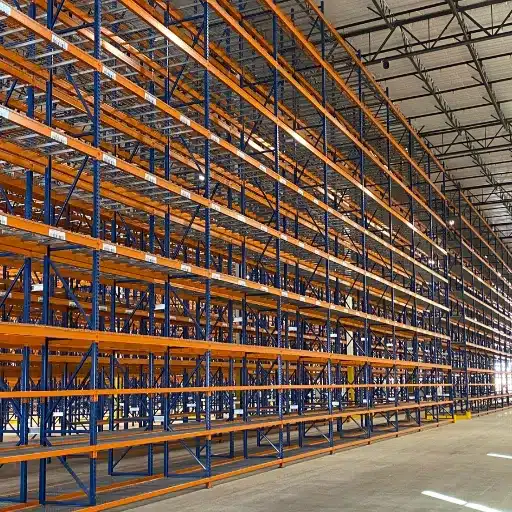
Pallet rack anchoring is the most critical safety step in any pallet racking installation. An unanchored rack is a rack waiting to collapse. Every upright frame must be secured to the concrete floor with anchors rated for the specific load and environment.
The most common anchor type for warehouse racking is the heavy-duty wedge anchor. These consist of a threaded rod, a wedge clip, and a nut and washer. The anchor is inserted into a pre-drilled hole, and as the nut is tightened, the wedge expands against the concrete walls of the hole, creating a secure mechanical bond.
Drill anchor holes to the depth specified by the rack manufacturer, typically 3 to 4 inches of embedment into concrete with a minimum compressive strength of 2,500 psi. Use a hammer drill with a carbide-tipped masonry bit matching the anchor diameter exactly. A hole that is too large reduces holding strength. A hole that is too small makes anchor insertion difficult and can damage the threads.
Blow out drilled holes with compressed air before inserting anchors. Concrete dust in the hole prevents proper wedge expansion and dramatically reduces holding capacity. This step takes seconds and is skipped more often than it should be.
Torque each anchor to the manufacturer’s specification. For standard wedge anchors in selective racking, this is typically 90 foot-pounds. For adjustable pallet racking systems or heavier-duty structural racks, torque may increase to 110 foot-pounds. Use a calibrated torque wrench and check it periodically for accuracy.
Seismic Installation Requirements by Zone
If your facility is in a seismic zone, standard anchoring is not enough. Seismic-rated installations require specialized baseplates, additional anchors, and often overhead ties or cross-aisle bracing.
In high seismic zones like California, rack baseplates typically require four-anchor patterns instead of the standard two-anchor pattern. Seismic anchors must achieve higher embedment depths and may require epoxy adhesive in addition to mechanical wedge action. Overhead ties connect the tops of back-to-back rack rows, preventing the sway and buckling that earthquakes induce.
Seismic installation must be engineered by a licensed professional. Do not attempt to self-engineer seismic racking. The liability is enormous, and the codes are complex. If your warehouse is in a seismic zone, engage a structural engineer familiar with local building codes and ANSI MH16. 1 seismic provisions.
Troubleshooting: Hitting Rebar, Anchor Spinning, or Cracked Concrete
Three field problems dominate anchor installation.
First, you hit rebar while drilling. When your drill bit stops at metal, do not force it. Move the hole location if possible, or use a rebar cutter to pass through the steel and continue drilling. Some manufacturers allow slight hole relocation without engineering review. Others require recalculation. Check your rack documentation.
Second, the anchor spins when you try to torque it. This happens when the wedge fails to grip, usually because of concrete dust in the hole or a hole diameter that is too large. Remove the anchor, clean the hole thoroughly, and try again. If the hole is oversized, move to a larger diameter anchor or relocate the hole.
Third, the concrete cracks around the anchor. This indicates insufficient concrete thickness or strength. In a slab-on-grade warehouse, this rarely happens if you have verified the slab depth and strength beforehand. If it does occur, consult a structural engineer before proceeding.
Step 5: Row Spacers, Cross-Aisle Ties, and Bracing
Individual rack bays are stable in the cross-aisle direction because beams connect the uprights. But in the down-aisle direction, without bracing, upright frames can rack sideways under load or impact.
Row spacers connect back-to-back rows of racking at regular intervals, typically every 6 to 10 feet vertically depending on rack height. They maintain consistent spacing between rows and transfer lateral forces from one row to the other. Install row spacers at every beam level or as specified by the manufacturer.
For tall racks, typically over 15 feet, overhead ties or cross-aisle bracing may be required. These steel channels or rods connect the tops of adjacent upright frames, preventing top sway. In seismic zones, overhead ties are often mandatory.
Cross-bracing, usually diagonal steel rods or cables within the upright frame itself, provides additional stability. Do not remove or modify factory-installed bracing. It is part of the engineered structural system, and altering it voids the load rating.
Stability Best Practices for Multi-Row Configurations
When installing multiple rows of racking, work systematically. Complete one full row before starting the next. This gives you a stable reference against which to align subsequent rows. Check that all rows are parallel and that aisle widths are consistent. Aisle width variation of more than 2 inches can cause forklift operators to strike rack corners, creating the exact impact damage your installation is trying to prevent.
Step 6: Safety Accessories Installation
With the main structure assembled and anchored, install safety accessories. These are not decorative add-ons. They are engineered components that protect your investment and your people.
Post protectors, also called column guards, bolt to the floor at the base of each end-aisle upright. They absorb forklift impact that would otherwise dent, bend, or collapse the upright. Install them at every end-of-row position and anywhere a forklift turns into or out of an aisle. The cost of a post protector is a fraction of the cost of replacing a damaged upright.
Wire mesh decking installs on top of beam pairs to create a flat shelf surface. It is essential if you store pallets that are smaller than the beam length, pallets that might sag between beams, or loose items that could fall through. Decking also improves fire safety by allowing sprinkler water to penetrate downward through the rack.
Pallet stops or back stops prevent pallets from being pushed too far into the rack, which can cause them to fall out the back side into an adjacent aisle. Install them on all beam levels where back-loaded pallets are a risk.
Finally, install load capacity plaques at the end of every aisle. These plaques must display the maximum uniformly distributed load per beam level and the total maximum bay load. They are required by ANSI MH16.1 and by OSHA under the General Duty Clause. Without them, your operators have no reference for safe loading limits.
Why Proper Safety Clip Installation Prevents Catastrophic Failure
Beam safety clips, also called beam locks or J-bolts, are small metal pieces that prevent beams from disengaging from uprights under load or impact. They cost pennies and take seconds to install. Yet missing safety clips are one of the most common deficiencies found during rack inspections.
When a forklift strikes a beam, the impact can pop the beam connector out of the upright punching. A properly installed safety clip prevents this disengagement. Without it, a single forklift bump can drop an entire pallet load onto the operator below. Install safety clips on every beam end, verify they are fully seated, and include clip inspection in your routine maintenance.
Step 7: Squaring, Leveling, and Final Alignment
Before you declare the installation complete, perform a final alignment check on every bay.
Check plumb on every upright frame using a level or laser plumb bob. Recheck the 1/4 inch per 10 feet tolerance. Racks can shift slightly during beam installation and anchoring, so this final verification catches drift before loading begins.
Check square by measuring diagonals on representative bays throughout the installation. If diagonals differ by more than 1/4 inch, the bay is out of square. Adjust by loosening beam connections, squaring the frame, and retightening.
Check level across beam pairs with a long level or laser. Beams that are not level cause pallets to slide, loads to concentrate on one beam end, and visual cues that suggest the entire rack is poorly installed even when the uprights are plumb.
Walk every aisle. Look for consistent spacing, aligned beam elevations, and properly installed safety clips and accessories. This five-minute walkthrough often catches issues that are invisible when focused on a single bay but obvious when viewed across the entire system.
Step 8: Post-Installation Inspection and Load Testing
With the structure complete and aligned, perform a formal post-installation inspection before putting the rack into service.
Start with a visual inspection. Verify that every anchor is torqued to specification. Check that every safety clip is installed and seated. Confirm that load capacity plaques are in place and legible. Inspect all welds, bolted connections, and painted surfaces for damage that may have occurred during installation. Document any defects with photographs and written notes.
Next, perform a load test. Load a representative sample of bays with the maximum weight you intend to store, distributed across the beam levels as it will be in actual use. Observe beam deflection under load. ANSI MH16. 1 allows beam deflection of up to 1/180 of the beam length. For a standard 96-inch beam, that means deflection should not exceed approximately 1/2 inch at midspan under full load.
Testing with Your Actual Pallets
Here is where Shandong Lile’s experience matters most. Many load tests use sandbags or steel plates of equivalent weight. These simulate the mass but not the behavior of your actual pallets.
When you load your rack with real pallets, you test the entire system: beam engagement, load distribution, pallet stability, and interaction between pallet base and beam surface. A sandbag test cannot reveal whether your pallet overhangs the beam edge, whether its base engages properly with the beam profile, or whether it slides under vibration.
When a pharmaceutical distributor in the Netherlands installed new selective racking last year, they insisted on load testing with their actual production pallets, which were 1200 by 1000 millimeter rackable plastic pallets. The test confirmed that their chosen beam spacing provided optimal engagement with the pallet’s three-runner base. It also revealed that their previous wooden pallet supplier had been delivering pallets that were consistently 8 millimeters oversized, which explained why their old rack system had required three mid-year adjustment cycles. Switching to dimensionally consistent plastic pallets eliminated the problem entirely.
Document your load test results. Include bay numbers, load weights, beam deflection measurements, and observations. This documentation becomes your baseline for future inspections and provides evidence of proper installation if questions arise later.
Common Installation Mistakes and How to Avoid Them
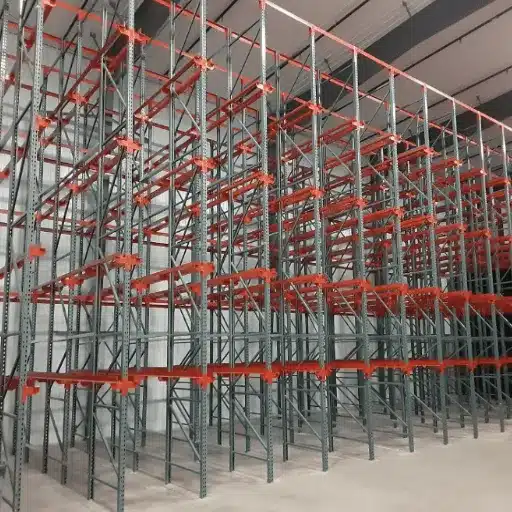
Even experienced installers make errors. Here are the most common mistakes we see in the field, and how to prevent them.
Inadequate anchoring. Installing fewer anchors than specified, using the wrong anchor type, or failing to torque to specification creates a rack that can tip under load or forklift impact. Follow the manufacturer’s anchor schedule exactly. Torque every anchor. Document the torque values.
Ignoring floor level tolerances. A rack installed on an unlevel floor without shimming will lean, creating uneven load distribution and premature beam fatigue. Always check floor level before installation, and shim every upright that needs it.
Mixing incompatible components. Beam connectors from one manufacturer rarely fit upright punch patterns from another. Even when they appear to fit, the load ratings and safety factors are different. Never mix components from different rack systems unless an engineer has verified compatibility.
Missing safety clips. This is the easiest mistake to prevent and the most dangerous to overlook. Every beam end needs a safety clip. No exceptions. Make clip installation part of your beam installation checklist, not a separate afterthought.
Overloading during the test phase. Some operators see a new rack and assume they can test it with whatever is handy, including loads that exceed the rated capacity. Load testing should use the maximum intended load, not random heavy items. Exceeding rated capacity during testing risks permanent deformation.
The Hidden Cost of Installing for the Wrong Pallet Type
When Ahmed, a warehouse manager at a food distribution center in Dubai, installed new selective racking, he sized his beams for standard wooden pallets. Six months later, his operation switched to hygienic plastic pallets for food-grade compliance. The new pallets were 10 millimeters narrower than the old wooden ones. Pallets that had been stable on the wider beam spacing now had insufficient engagement, creating a persistent risk of pallets sliding sideways during forklift placement.
The fix required either replacing all the beam pairs with shorter ones or adding pallet supports, neither of which was cheap. If Ahmed had planned for pallet flexibility during installation, he could have chosen a beam length and accessories that accommodated both pallet types, or at least anticipated the change.
When to Call a Professional Installer
DIY pallet racking installation is feasible for simple selective systems in small warehouses with level floors and experienced crews. But certain situations demand professional installation:
- Seismic zones requiring engineered anchoring
- Rack systems over 20 feet tall
- Drive-in or push-back racking with complex rail systems
- Cold storage or freezer installations with brittle steel considerations
- Mixed-manufacturer or used rack systems with unknown compatibility
- Facilities with damaged or questionable concrete floors
Professional installers bring calibrated tools, engineering knowledge, and liability insurance. For a typical selective racking system, professional installation costs 3to3to8 per pallet position. When weighed against the cost of a single installation error, that investment is often the most cost-effective decision you can make.
Pallet Racking Installation for Special Environments
Standard installation procedures work for ambient warehouses with level floors and new equipment. But many operations face conditions that require specialized approaches.
Cold Storage and Freezer Installations
Installing racking in a -25 degree Celsius freezer presents challenges that ambient guides rarely address. Steel becomes more brittle at low temperatures, so impact from forklifts or dropped components creates a higher risk of crack propagation. Handle steel components carefully, and never strike cold steel with hammers or hard tools.
Freezer floors often have insulated sections with different expansion characteristics than standard concrete. Anchor embedment depths and holding values may differ from ambient specifications. Consult the freezer floor manufacturer before drilling.
Condensation is another factor. When warm outside air enters the freezer during door openings, moisture condenses on cold rack surfaces. Over time, this can corrode unprotected steel and affect anchor integrity. Specify galvanized or powder-coated racking for freezer environments, and inspect anchors annually for corrosion.
For pallet choice in cold storage, HDPE plastic pallets maintain structural integrity at temperatures well below freezing, while wooden pallets absorb moisture, freeze, and splinter. The dimensional stability of plastic pallets in cold environments is one reason they dominate food and pharmaceutical cold chains worldwide.
Seismic Zone Requirements
We covered seismic anchoring in Step 4, but seismic considerations extend beyond bolts. In seismic zones, rack configuration matters too. Taller, narrower rack rows are more susceptible to sway than shorter, wider configurations. Engineers may specify heavier baseplates, additional bracing, or reduced height-to-depth ratios.
Building permits are typically required for pallet racking installation in seismic zones. The permitting process may require stamped engineering drawings, load calculations, and inspection by a city engineer. Start the permit process early. It can add two to four weeks to your timeline.
High-Turnover Automated Warehouses
Automated storage and retrieval systems demand installation precision that exceeds manual racking tolerances. A shuttle that travels on rails or a stacker crane that deposits pallets automatically cannot compensate for a rack that is out of plumb by even 1/8 inch. Automated rack installations often require laser alignment, specialized shimming systems, and tolerance checks at every beam level rather than representative sampling.
If your facility plans to automate in the future, install racking that meets automation-grade tolerances now. Retrofitting an existing manual rack for automation is far more expensive than installing to the tighter standard from the start.
Installation Timeline and Cost Expectations
Understanding realistic timelines and costs helps you plan your project and set appropriate expectations with stakeholders.
A two-person crew with experience can typically install 80 to 120 linear feet of selective pallet racking per day, assuming level floors, standard heights, and no complications. Drive-in racking, with its rail systems and tighter tolerances, installs at roughly half that rate. Tall racks requiring lifts or scaffolding extend timelines proportionally.
For cost planning, professional installation of selective pallet racking typically ranges from 3to3to8 per pallet position. Drive-in and push-back systems cost more, often 8to8to15 per position, due to complexity. DIY installation saves 30 to 50 percent on labor but increases risk. Factor in the cost of tools, equipment rental, and the value of your own team’s time.
Several factors extend both timeline and cost:
- Uneven floors requiring extensive shimming or grinding
- Seismic zones requiring engineering and specialized anchoring
- Permitting delays, especially in jurisdictions with complex building departments
- Mixed new and used equipment requiring compatibility verification
- Restricted work hours, such as installations in active warehouses that must maintain operations
Getting the Best ROI from Your Installation Investment
The cheapest installation is not always the most cost-effective. A professionally installed system that is plumb, properly anchored, and accessorized with post protectors will outlast a budget installation by years. When you calculate total cost of ownership over a ten-year rack lifespan, the difference between a 5perpositioninstallationanda5perpositioninstallationanda3 per position installation is negligible compared to the cost of replacing damaged components, adjusting misaligned bays, or worse, dealing with a collapse.
Frequently Asked Questions About Pallet Racking Installation
How long does pallet racking installation take?
A two-person crew can typically install 80 to 120 linear feet of selective pallet racking per day under normal conditions. Complex systems like drive-in or push-back racking install at roughly half that rate. Tall racks, uneven floors, seismic requirements, or restricted work hours can extend the timeline. For a typical 5,000-square-foot warehouse with selective racking, expect two to three days for a professional crew.
Do I need a permit to install pallet racking?
Permit requirements vary by jurisdiction. In the United States, most local building departments require permits for pallet racking installation, particularly in seismic zones or when racks exceed a certain height (often 12 feet). In Europe, FEM standards and local building codes govern permitting. Always check with your local building department before installation begins. The permitting process can add two to four weeks to your project timeline.
Can I install pallet racking myself, or should I hire professionals?
DIY pallet racking installation is feasible for simple selective systems in small warehouses with level floors, new equipment from a single manufacturer, and experienced crews. However, professional installation is strongly recommended for seismic zones, racks over 20 feet tall, drive-in or push-back systems, cold storage environments, mixed or used equipment, and facilities with damaged or questionable concrete. Professional installation typically costs 3to3to8 per pallet position for selective racking.
What tools do I need for pallet racking installation?
Essential tools include a tape measure, laser level, chalk line reel, torque wrench calibrated in foot-pounds, hammer drill with masonry bits, socket set, shims, and personal protective equipment (hard hat, steel-toe boots, safety glasses). Optional but recommended tools include a laser plumb bob for tall racks and a come-along or strap for upright positioning.
How do I anchor pallet racking to concrete?
Use heavy-duty wedge anchors drilled into concrete with at least 2,500 psi compressive strength. Drill holes to the manufacturer’s specified embedment depth, typically 3 to 4 inches. Clean dust from holes with compressed air before inserting anchors. Torque standard wedge anchors to 90 foot-pounds, or 110 foot-pounds for adjustable systems. In seismic zones, use four-anchor baseplates and consult a structural engineer.
What are the OSHA requirements for pallet racking installation?
OSHA does not have a dedicated pallet racking standard. Enforcement falls under the General Duty Clause, which requires a workplace free from recognized hazards. For racking, this means proper anchoring, load capacity signage, damage-free components, and adequate aisle clearances. OSHA also references 29 CFR 1910.176 for material handling and storage safety. The technical engineering standard is ANSI MH16.1, published by the Rack Manufacturers Institute.
How much does pallet racking installation cost?
Professional pallet racking installation typically costs 3to3to8 per pallet position for selective racking. Drive-in and push-back systems cost 8to8to15 per position due to complexity. DIY installation saves 30 to 50 percent on labor but increases risk. Factors that raise costs include uneven floors, seismic engineering, tall racks requiring lifts, permitting delays, and mixed or used equipment requiring compatibility verification.
Can pallet racking be installed on uneven floors?
Yes, but shimming is required. Use metal or composite shims under baseplates to bring each upright to level. Do not stack shims more than three high without manufacturer approval. For severe unevenness, grind high spots or pour a leveling compound. Racks installed on unlevel floors without shimming will lean, creating uneven load distribution and premature beam fatigue.
Conclusion
Pallet racking installation is not merely an assembly task. It is the foundation of your warehouse’s safety, efficiency, and capacity for years to come. Every step, from the initial site survey to the final torque check, contributes to a system that either performs flawlessly or creates problems that compound over time.
The eight steps we have covered, planning, layout, upright placement, beam installation, anchoring, bracing, safety accessories, and inspection, provide a comprehensive framework for any installation project. But the best installation in the world will underperform if the pallets you load are inconsistent, damaged, or incompatible with your beam configuration.
At Shandong Lile, we engineer rackable plastic pallets with the dimensional consistency, load distribution, and material stability that complement a well-installed racking system. Our pallets maintain their specifications across temperature ranges, humidity levels, and thousands of use cycles. When your racks are installed to exacting standards and your pallets perform with equal precision, your warehouse operates at its full potential.
Here is what to do next:
- Download our Pallet Racking Installation Checklist to ensure nothing is missed on your next project
- Review your current pallet specifications against your rack configuration to identify compatibility gaps
- Contact our team for rackable plastic pallets engineered to match your exact racking requirements
A racking system is only as good as what you put on it. Install with precision. Load with confidence.