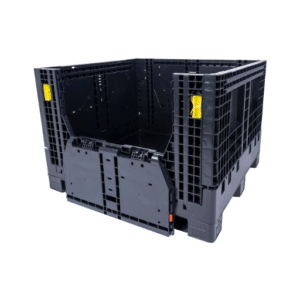
Durable plastic pallets maintain the required load capacity, shape, and handling safety across repeated trips under defined operating conditions. The right choice depends on the load, support method, handling impacts, environment, time under load, and return loop, not on one large capacity number.
The cheapest pallet can become the most expensive option in your warehouse. A model may hold a test load on the floor yet bow on rack beams, jam a conveyor, or crack after repeated cold-room impacts. You already know durability matters. The harder question is how to specify it before placing an order.
This guide gives logistics managers, warehouse engineers, and procurement teams a practical way to compare materials, designs, load ratings, service life, and cost per trip. It also shows which documents to request from a supplier and why a real pilot test is often more useful than a broad lifespan promise.
Key Takeaways
- Durability depends on six factors: load, support, handling, environment, time, and the recovery loop.
- Static, dynamic, and racking ratings are not interchangeable; each describes a different support condition.
- HDPE often suits impact and cold exposure, while PP often provides greater stiffness and heat resistance, but the product datasheet must confirm suitability.
- Compare pallets with cost per successful trip, including cleaning, damage, losses, and recovery value, instead of purchase price alone.
- Request model-specific drawings, test conditions, temperature guidance, material declarations, and inspection criteria before approving a pallet.
Need to compare real models? Explore Lile’s durable plastic pallet range or send our team your load, rack, temperature, and handling requirements for a focused recommendation.
What Makes Durable Plastic Pallets Truly Durable?

A durable pallet does more than survive a single heavy load. It must remain safe and functional through the operating cycle you expect it to complete.
That cycle may include forklift impacts, conveyor transfers, washdowns, freezer storage, long rack dwell times, outdoor staging, and a return trip. Each condition creates a different type of stress.
Six factors define durability
- Load: The payload weight, shape, and distribution across the deck.
- Support: Whether the pallet sits on a floor, fork tines, another load, conveyor rollers, or rack beams.
- Handling: The frequency and severity of forklift entries, drops, turns, stops, and transfers.
- Environment: Temperature, moisture, chemicals, ultraviolet exposure, and cleaning process.
- Time: How long the load remains on the pallet, especially in unsupported racking.
- Recovery loop: The number of completed returns, loss rate, inspections, repairs, and retirement rules.
A material name or maximum load cannot answer all six questions. Two HDPE pallets can perform differently because their deck geometry, wall thickness, runners, molding process, reinforcement, and resin formulation differ.
Strength is only one part of service life
Buyers often use “strong” and “durable” as if they mean the same thing. They do not.
Strength is the ability to resist a defined load. Impact resistance matters when a fork tine strikes a runner. Stiffness controls bending.
Creep is slow deformation under a sustained load. Service life shows how these properties hold up over repeated cycles.
Elena manages a fictional beverage warehouse. Her team stores 900 kg loads for six hours before dispatch. They select a pallet using its high floor-load rating.
During the pilot, the deck sags between wide conveyor rollers and trips a sensor. It works on the floor, but not on that support pattern. Elena adds roller spacing and allowable deflection to the specification before testing the next model.
The lesson is simple: durability must be defined in the same conditions in which the pallet will work.
How to Read Durable Plastic Pallet Load Ratings
Plastic pallet load capacity usually appears as static, dynamic, and racking values. These labels describe different test and support conditions. Never substitute one for another.
| Rating | Typical support condition | What buyers should verify |
|---|---|---|
| Static load | Pallet rests on a flat, level surface | Load distribution, temperature, duration, and stacking arrangement |
| Dynamic load | Pallet moves on forklift or pallet-jack forks | Fork spacing, travel conditions, impact, payload stability, and equipment type |
| Racking load | Pallet spans rack beams with limited support | Beam span, pallet orientation, load distribution, deflection, temperature, and dwell time |
A pallet may carry more weight on a floor than in motion. It may carry less again when bridging open rack beams. Rack performance is often the most demanding because the pallet has less support and remains loaded for longer.
Test conditions matter as much as the number
Ask these questions when reading a specification:
- Was the payload a uniformly distributed load, or was it concentrated in a few points?
- What rack span and beam profile supported the pallet?
- Was the pallet tested at room temperature or at the operating temperature?
- How long did it remain under load?
- What deflection limit defined a pass?
- Did the test use a new pallet or one subjected to impacts and cycles?
- Does the rating apply to every size and reinforcement option?
The international ISO 8611-1:2021 test-method standard addresses testing of flat pallets for materials handling. ISO 8611-2:2021 addresses performance requirements and selection of tests. A supplier’s reference to ISO 8611 is useful only when it connects to the exact model, test configuration, report, and intended application.
For a deeper explanation, review our guide to plastic pallet load capacity.
Why the largest rating may be the wrong choice
A bigger rating can look safer, but it may describe an irrelevant condition. A 6,000 kg static rating does not demonstrate a 1,200 kg rack load across your beam span.
Capacity also does not prove compatibility with automated storage and retrieval systems (AS/RS). Automation requires stable dimensions, controlled deflection, appropriate deck openings, clean interfaces, and predictable contact with sensors and conveyors.
The safest approach is to specify every support condition, then require a matching rating for each one. Add an application margin based on your engineering and safety process. Do not invent a universal margin because the correct value depends on the load, system, consequences of failure, and applicable rules.
Materials and Designs for Long-Lasting Plastic Pallets

Most industrial plastic pallets use high-density polyethylene (HDPE), polypropylene (PP), or formulations that contain recycled material. Material selection affects impact behavior, stiffness, heat response, chemical compatibility, and long-term deformation. Design then determines how those properties work in the finished pallet.
HDPE vs. polypropylene
The table below is a selection guide, not a substitute for a model datasheet.
| Consideration | HDPE | Polypropylene |
|---|---|---|
| Impact and cold conditions | Often favored where impact and lower temperatures matter | Can become less forgiving in cold conditions, depending on grade and formulation |
| Stiffness | Generally more flexible | Generally stiffer, which can help control deflection |
| Heat | Product-specific limit required | Often selected for higher-temperature exposure or washing |
| Chemicals | Broad resistance, but compatibility must be checked | Broad resistance, but compatibility must be checked |
| Common fit | Repeated handling, cold-chain, and general return loops | Racking, high-temperature processes, and applications needing greater stiffness |
Additives, fillers, recycled content, molding quality, and wall design can change performance. Therefore, “HDPE” is not a complete cold-storage specification, and “PP” is not a guarantee of rackability.
Use our detailed HDPE vs. polypropylene pallet comparison when material selection is a primary decision.
When steel reinforcement helps
Steel bars can increase stiffness and reduce deflection in heavy duty plastic pallets built for long beam spans, dense loads, or extended dwell times.
However, it adds questions that buyers should resolve:
- Where are the bars located?
- What steel grade and corrosion protection are used?
- Can inspectors see damage or movement around the reinforcement?
- How does embedded metal affect pallet weight and recycling?
- Does the stated rack rating require every reinforcement bar?
Lile’s steel-reinforced plastic pallet page lists manufacturer-stated capacities of up to 6,000 kg static, 3,000 kg dynamic, and 1,750 kg racking, depending on the model. Before selection, confirm the exact model, load distribution, support geometry, temperature, and test conditions.
Deck, runner, and entry design
Design choices change both performance and operational fit:
- Closed decks can simplify cleaning and help contain small debris, but water drainage and weight still matter.
- Open decks reduce material and allow airflow, yet openings must fit the load and conveyor contact points.
- Three-runner and six-runner bases provide different floor, stacking, and racking behavior.
- Four-way entry improves access, while the fork-entry zones still need protection from repeated impacts.
- Anti-slip surfaces and inserts help stabilize loads but require wear inspection.
- Nestable pallets save empty-return space, while many heavy rack applications need a runner-based structure.
There is no universally best design. The best option is the one that matches the unit load and every interface in the route.
Ready to narrow the options? Share your payload, dimensions, fork equipment, rack span, conveyor layout, and temperature range with Lile. We can help identify whether a standard or custom design deserves a pilot.
Durable Plastic Pallets in Demanding Environments
Industrial plastic pallets face more than weight. A suitable design must also tolerate the environment without losing the properties your operation relies on.
Warehouse racking and automation
Rackable plastic pallets need a model-specific rack rating. They also need the correct orientation and support.
For automation, create an interface map that records:
- Rack beam and conveyor roller spacing.
- Pallet stops, guides, centering devices, and transfer points.
- Sensor locations and required target surfaces.
- Fork and shuttle entry dimensions.
- Maximum deck and runner deflection.
- Load overhang and center-of-gravity limits.
Our guide to rackable plastic pallets explains these warehouse-specific requirements in greater depth.
Marcus is an automation engineer at a fictional components plant. He needs 1,100 pallets for a new AS/RS cell. An empty sample moves well, but its runner bows under the actual 780 kg load and catches at a transfer.
Marcus gives the supplier the roller spacing, loaded deflection limit, fork pattern, and 12-hour dwell time. A revised reinforced model completes the pilot without transfer faults.
The outcome did not come from choosing the highest headline capacity. It came from testing the exact interface.
Cold, heat, chemicals, and outdoor exposure
Temperature changes how polymers behave. Cold can reduce impact tolerance in some formulations. Heat can increase deformation under sustained load. UV exposure can age an unstabilized material, while chemicals may attack a resin or additive package over time.
Ask the supplier for product-specific guidance covering:
- Minimum and maximum operating temperatures.
- Load derating, if any, at temperature extremes.
- Wash temperature, pressure, detergent, and cycle frequency.
- Chemical concentration, contact time, and rinse process.
- UV stabilization and expected outdoor exposure.
- Storage method when the pallet is empty.
Then test samples after realistic conditioning. A room-temperature load test cannot prove freezer impact performance or years of outdoor use.
Food, pharmaceutical, and export operations
A smooth, nonporous design may be easier to wash than damaged wood, but material alone does not create a sanitary program. The wash method, soil load, drainage, drying, inspection, and storage controls remain essential.
Under 21 CFR §1.906, vehicles and transportation equipment used for food must be appropriately designed, cleanable for their intended use, and maintained in sanitary condition. The regulation does not specifically approve plastic pallets. Buyers should verify relevant material and food-contact documentation for the exact use.
For exports, ISPM 15 regulates wood packaging material in international trade. All-plastic pallets are outside a wood-packaging treatment standard, but that does not remove every import requirement. Confirm the destination country, commodity, carrier, customer, and labeling rules before shipping.
Plastic vs. Wood: Lifespan and Cost per Trip
Plastic can deliver a long service life in a controlled return loop, but it is not always stronger, cheaper, or more sustainable than wood. Wood can be economical, widely repairable, and practical for open-loop or one-way distribution. Plastic becomes more attractive when consistency, washing, moisture resistance, automation, and repeated recovery create measurable value.
| Factor | Plastic pallet | Wood pallet |
|---|---|---|
| Initial cost | Usually higher | Usually lower |
| Dimensional consistency | Molded and generally consistent | Can vary with boards, fasteners, moisture, and repairs |
| Moisture | Does not absorb water like wood | Can absorb moisture and change weight |
| Repair | Depends on design and supplier program | Often repairable with established networks |
| Hygiene | Smooth designs can support repeatable washing | Cleaning depends on condition and construction |
| Export treatment | ISPM 15 does not regulate all-plastic pallets | Regulated wood packaging may require approved treatment and marking |
| Recovery economics | Strong when pallets return reliably | Can suit both pooled and one-way systems |
| End of life | Depends on resin, contamination, reinforcement, and local recycler | Depends on damage, treatment, reuse, recycling, and local outlets |
Do not promise a universal lifespan
Some suppliers publish years or trip counts, but no neutral universal lifespan applies to every plastic pallet. A lightly handled closed-loop pallet and an export pallet lost after one shipment have completely different economics.
Service life depends on:
- Payload and load distribution.
- Forklift discipline and impact frequency.
- Rack and conveyor interfaces.
- Temperature, chemicals, and wash cycles.
- Inspection and retirement criteria.
- Theft, loss, and return rate.
Our article on plastic pallet lifespan explores these factors in more detail.
Calculate cost per successful trip
Use this formula:
Cost per successful trip = (purchase + cleaning + repair + repositioning + tracking − recovery value) ÷ completed trips
Add loss costs separately or include replacement purchases in the numerator. Use completed, usable trips rather than theoretical cycles.
Suppose a fictional logistics team led by Aisha compares two options:
- Wood pallet: 24purchase,24purchase,3 average repair and handling cost, 6 completed trips.
- Plastic pallet: 92purchase,92purchase,14 total cleaning and repositioning cost, $8 end-of-life recovery value, 42 completed trips.
In this illustration, wood costs 4.50per trip ,while plastic costs about 4.50pert rip ,while plastic costs about 2.33 per trip. Change the plastic return rate or completed trips, and the result changes quickly. These figures are hypothetical; use your quotes and fleet data.
A pilot should record purchase price, completed trips, losses, damage, cleaning labor, freight effects, downtime, and disposal or recovery value. That evidence supports a better decision than a generic “lasts 10 times longer” statement.
How to Choose and Verify Durable Plastic Pallets

A disciplined selection process turns “durable” from a marketing word into an operating specification.
1. Define the unit load
Record the maximum payload, dimensions, center of gravity, packaging stiffness, overhang, point loads, and stability requirements. A 1,000 kg liquid container and 1,000 kg of boxed goods stress a deck differently.
2. Map every support condition
Document the floor, fork tines, pallet jack, stacked load, conveyor rollers, rack beams, shuttle, and AS/RS interface. Include dimensions and orientation.
3. Record the operating environment
Specify normal and extreme temperatures, chemical contact, UV exposure, wash method, humidity, dwell time, and indoor or outdoor storage.
4. Select the design and resin
Use the operating profile to compare HDPE, PP, recycled-content formulations, reinforcement, deck pattern, runner configuration, and entry design. Do not choose material before defining the job.
5. Request model-specific evidence
A useful supplier package should include:
- Exact model, revision, dimensions, and tolerance drawing.
- Pallet weight and material declaration.
- Static, dynamic, and rack ratings with definitions.
- Load distribution and support diagrams.
- Rack span, orientation, temperature, and test duration.
- Test method, date, and laboratory or internal quality record.
- Cleaning, chemical, UV, and temperature guidance.
- Warranty terms and exclusions.
- Inspection and removal-from-service criteria.
- Recycled-content and end-of-life information where relevant.
6. Run a realistic pilot
Test more than an empty pallet. Use representative loads, worst-case rack positions, real forklifts, full conveyor routes, temperature conditioning, and typical dwell times.
Set pass/fail criteria before the trial. Examples include allowable deflection, transfer reliability, load stability, visible damage, wash results, and completed cycles.
7. Inspect and measure
Create a repeatable inspection process for cracks, sharp edges, bowed decks, fork tine damage, damaged runners, loose inserts, and exposed reinforcement. Remove questionable pallets from service until a qualified person assesses them.
Track:
- Completed trips.
- Damage type and location.
- Repairs and retirements.
- Pallet losses.
- Cleaning time and cost.
- Handling or automation disruptions.
- Cost per successful trip.
8. Approve the complete specification
Your purchase order should identify the exact model, material, reinforcement, color, markings, accepted drawing, performance ratings, documentation, and change-control requirement. This prevents a seemingly small substitution from changing performance.
Durability Review Checklist
- Payload, distribution, and overhang documented.
- Every support span and handling interface measured.
- Temperature, chemicals, washing, UV, and dwell time specified.
- Model-specific load ratings and conditions received.
- Material, reinforcement, and drawings approved.
- Pilot completed with predefined acceptance criteria.
- Inspection, tracking, and retirement process ready.
Frequently Asked Questions About Durable Plastic Pallets
How long do durable plastic pallets last?
There is no universal number. Plastic pallet lifespan depends on the model, load, support method, impacts, temperature, chemicals, cleaning, inspection, and recovery rate. Measure completed trips and damage in your operation, then calculate cost per successful trip. Treat supplier lifespan figures as application-specific claims that need supporting conditions.
Are plastic pallets stronger than wood pallets?
Not in every case. Strength depends on pallet design, material, support, and load. Plastic can provide consistent dimensions, moisture resistance, and repeatable cleaning.
Wood can offer a lower entry price and broad repair networks. Compare model-specific ratings and lifecycle costs rather than materials in the abstract.
What is the most durable plastic pallet material?
No single resin wins every application. HDPE often fits impact-heavy and cold environments. PP often provides greater stiffness and heat resistance. Resin grade, additives, recycled content, geometry, molding, and reinforcement can change performance, so verify the finished pallet’s data.
How much weight can a plastic pallet hold?
Capacity varies widely by model and support condition. The same pallet has different static, dynamic, and racking ratings. Use the rating that matches your floor, forks, stack, conveyor, or rack, and verify load distribution, span, temperature, duration, and orientation.
Are steel-reinforced plastic pallets worth it?
They can be worthwhile when rack span, load, or dwell time demands greater stiffness. Compare the reinforced model’s verified rack performance, weight, handling, inspection needs, corrosion protection, recycling route, and cost per trip with an unreinforced alternative.
Can plastic pallets be stored outdoors?
Some can, but outdoor suitability requires product-specific UV and temperature guidance. Exposure time, climate, load, color, additives, drainage, and storage method all matter. Do not assume every HDPE or PP pallet is designed for long-term outdoor use.
Are plastic pallets exempt from ISPM 15?
ISPM 15 applies to wood packaging material in international trade, so an all-plastic pallet is outside that wood-treatment standard. Buyers must still confirm destination-country, commodity, carrier, customer, cleanliness, and labeling requirements.
Specify Durability, Do Not Assume It
Durable plastic pallets deliver value when their design matches the real operating cycle. Start with the payload and every support condition. Then add handling impacts, temperature, chemicals, dwell time, automation interfaces, and the return loop.
Use model-specific evidence instead of broad material claims. Compare static, dynamic, and racking ratings correctly. Pilot the pallet in the actual system, inspect it consistently, and calculate cost per successful trip with losses and cleaning included.
That process gives procurement teams a defensible specification and gives operators a pallet designed for their work. It also helps manufacturers recommend the right solution rather than the largest number on a datasheet.
Ready to specify durable plastic pallets for your operation? Send Shandong Lile your payload, pallet dimensions, rack or conveyor details, temperature range, handling equipment, destination, and expected annual volume. Request a tailored pallet recommendation →