The importance of proper chemical storage extends beyond ensuring safety at the place of work as legislations and policies have also been put in place for practice. In terms of operations, spill containment pallets act as a critical tool in the prevention of hazardous cleanups allowing safe containment and storage of chemical substances. These requirements should be recognized by organizations to create safe work environments that will keep the organization out of any violations. This comprehensive guide covers the OSHA compliance standards regarding the use of containment pallets for containing spills and will also provide tools for risk assessment and compliance internal procedures that ensure that the organization’s activities do not violate any environmental regulations.
Understanding Spill Containment Pallets
What are Spill Containment Pallets?
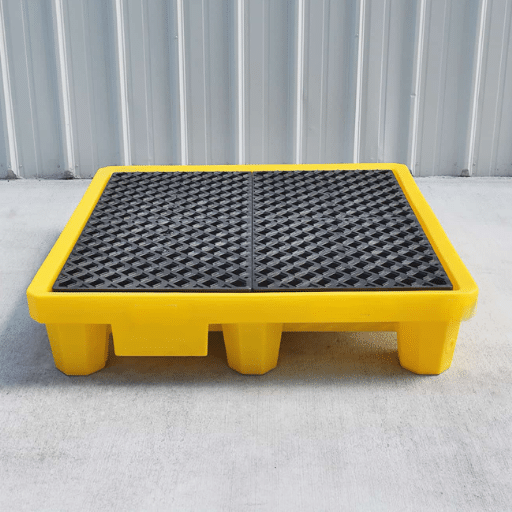
There are receptacles produced and applied in various situations for the storage of certain dangerous or combustible liquids, such as chemicals and oils, using pockets, towers or barrels. These also help prevent the spread of contaminants or substances should a pit or any other such situation be omitted and occurred for such materials in a place of work, or at an institution endangering the environment. The sump around the storage area as a part is used to protect from any leakage that may come out of the hazardous liquid filled containers in case of a mishap.
This is important because it helps companies comply with both OSHA 29 CFR 1910 and SPCC requirements from EPA by improving the safety of handling hazardous materials.
Types of Spill Pallets
Spill pallets typically fall into two main categories based on design and application:
- Single-Drum Pallets: These compact containment systems provide effective solutions for storing one drum, ideal for facilities with limited storage capacity.
- Multi-Drum Pallets: These systems enable industrial facilities to scale operations by supporting two to four or more drum containers simultaneously.
Additional design variations include covered designs that protect containers from rain and debris, plus modular configurations allowing operators to create customized spill containment areas. Each design type improves workplace safety while achieving full compliance with spill prevention regulations.
Benefits of Using Spill Containment Pallets
✓ Key Advantages
- Effective management of hazardous materials meeting EPA SPCC Rule requirements
- Built-in sump functionality captures liquids, protecting against environmental contamination
- Creates secure workplace environments by keeping floors dry, preventing slips and chemical exposure incidents
- Chemical-resistant, long-lasting equipment enables sustainable solutions for industrial spill management
Regulations and Compliance
OSHA Requirements for Spill Containment
In order for organizations to help ensure the safety of their employees and the environment, Occupational Safety and Health Administration (OSHA) is made an integral party to the operations. Some of the critical areas that require proper regulations include:
| OSHA Standard | Requirements |
|---|---|
| 29 CFR 1910.120 (HAZWOPER) |
Requires systems for controlling and managing hazardous material spills |
| 29 CFR 1910.1200 (Hazard Communication) |
Mandates proper labeling and handling methods to prevent accidental material spills |
| 29 CFR 1910.106 | Covers flammable and combustible liquids storage requirements |
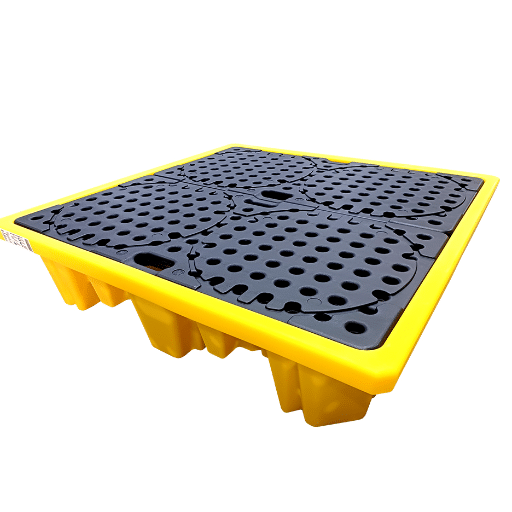
In facilities with a high level of dangerous substances, it is necessary to enact the secondary containment concept, which includes spill pallets and berms, the aspect which is vital for the health of workers, as well as to the environment in general.
Understanding Spill Pallet Regulations
The operation of spill pallets is in compliance with the Spill Prevention Control and Countermeasure, SPCC, Rule by the US Environmental Protection Agency, EPA, although, all businesses must apply the Occupational Health and Safety (OSHA) regulations requiring companies to contain hazardous substances properly and prevent their possible impact on soil.
⚠️ Critical Containment Capacity Requirements
Designs of sudden spill pallets need to be within a range that will ensure the presence of storage equal to that of the largest container on the pallet or 10 percent of the aggregate volume of containers. It is also unallowable to preserve chemicals adversely affecting the material composition of such pallets.
By meeting these standards, organizations are liable to trim down the chances of spills, whilst acting in accordance with the legislation of environmental standards and keeping all the staff provided with safety.
Importance of Compliance in Chemical Storage
Chemical storage systems must follow regulations to protect people, prevent environmental damage, and help companies avoid substantial fines. Guidelines require:
- Proper labeling systems for all stored materials
- Secondary containment systems implementation
- Regular inspections of storage areas detecting hazardous conditions like leaks and corrosion
- Current knowledge maintenance regarding OSHA and EPA regulations
Organizations achieve human health protection and environmental safeguarding through compliance while preserving operational functions and preventing expensive accidents and legal issues.
Key Features of IBC Spill Containment

IBCs and Spill Containment Pallets
Intermediate Bulk Containers (IBCs) and spill containment pallets are extremely useful equipments when it comes to managing hazardous liquids during storage and transportation. For IBCs, they are regular use containers with significant amounts of liquid. Opposite of that, Spill containment pallets entails secondary containment systems to prevent leakages and guard against environmental pollution.
The most current spill pallets are fashioned from heavy duty and resistant materials whose design complies with the set standards as provided by the Occupational Safety and Health Administration (OSHA) and the United States Environmental Protection Agency (EPA). Again, these are workplace specific controls for two reasons: improvement of safety as well as reduction of the likelihood of spill events in the course of the storage and handling of material.
Capacity and Size Considerations
Spill pallets require specific capacity and size measurements complying with both operational requirements and regulatory standards.
📏 Regulatory Capacity Requirements
According to OSHA and EPA regulations, spill pallets must hold:
- At least 10% of total volume of stored containers, OR
- 100% of the largest container (whichever is greater)
Standard system sizes range from single-drum to multiple-drum configurations. Users can select between low-profile and high-capacity models based on operational needs. Correct size selection helps achieve compliance requirements while increasing operational efficiency through better container management, preventing overflow situations, and simplifying container storage.
Drainage and Grate Options
Modern spill pallets include advanced drainage technology and grate systems providing enhanced safety protection and workplace efficiency. Grated surfaces use high-strength materials—such as polyethylene and steel—creating stable platforms allowing successful spill containment and safe container storage.
Environmental laws are mainly focused on the creation as well as the adherence to the regulations concerning the use of removable grates for the safety and prevention of environmental hazards. Particular exits possess drainage interconnected into the grid that allows rational waste disposal via the built-in valves in the system after debris reception process to ionant. Moreover these reduce inconviniencies as less manual notation is required but moreso acts as a safety net that ensures that the work is conducted effectively within existing OSHA and EPA guidlines.
Choosing the Right Spill Containment Solution
Steel Spill Pallets vs. Plastic Options
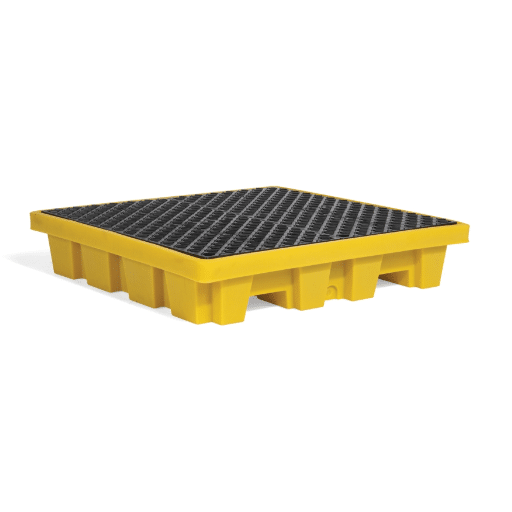
Selecting spill pallets requires choosing between steel or plastic materials depending on specific usage needs.
| Material Type | Advantages | Best Applications |
|---|---|---|
| Steel Spill Pallets | • Exceptional durability • Fire safety compliance • Heavy load capacity |
Industrial applications, heavy-duty work, flammable material storage |
| Plastic (Polyethylene) Pallets | • Lightweight design • Corrosion resistance • Superior outdoor performance |
Outdoor usage, non-corrosive chemical handling, frequent relocation needs |
Assessment of storage chemical type, environmental conditions, and load capacity requirements ensures selection guarantees compliance with safety and environmental regulations.
Low Profile vs. Modular Spill Pallets
Low Profile Spill Pallets
Designed for environments where space efficiency and access ease are priorities. Reduced height makes manual drum handling easier in spaces with insufficient vertical clearance.
Modular Spill Pallets
Allow users to create larger containment systems through pallet connections, providing scalability and flexible design options. Particularly beneficial in facilities with evolving storage needs.
Selection between low-profile and modular spill pallets requires operators to assess operational needs based on current workspace conditions, hazardous material inventory, and future development plans.
Accessories for Spill Containment Pallets
Spill containment pallet accessories enhance operational capability and protection measures while maintaining environmental compliance:
- 🔧 Drip Trays: Capture minor leaks preventing spills from reaching ground surfaces
- 🚧 Ramp Attachments: Facilitate loading and unloading of heavy containers
- ⬜ Polyethylene Grates: Provide container support while allowing spill flow into sump below for quick cleanup
- ☂️ Tarps and Covers: Shield pallets and stored items from weather damage
- 🔌 Drain Plugs: Enable easy removal of stored liquids
Selecting appropriate accessories requires consideration of storage needs and application requirements.
Compliance with Spill Containment Regulations

OSHA Standards and Guidelines
According to rules of the Occupational Safety and Health Administration every employer should assure protection against spillage of hazardous and flammable fluid s . This is in compliance with 29 C. F. R. 1010.106; 29 C. F. R. 1910.120 requirements. The requirements of the guidelines are aimed at minimizing environmental and workplace disasters through the installation of sources on the premises which allow for kit chemical containment and a spill containment pallet and a berm.
🛑 OSHA Containment System Capacity
All containment systems must hold either 10 percent of total container volume OR 110 percent of largest container volume (whichever is greater). Standards protect employees while diminishing chances of environmental contamination and financial penalties from regulators.
Best Practices for Spill Tray Installation
✓ Installation Best Practices Checklist
Preparing: Cover concrete surfaces and wrap up columns to avoid contact with zinc. Coat tops or edges of brick ledges to eliminate contact with zinc.
Right Dimension: Fit end pieces to abate dimensions of oversized containers below top edge of trays with allowance to facilitate handling of containers or install larger trays.
Compatibility: Ensure that the tray materials are appropriate for the product so that no chemical action can occur.
Periodic Testing: Have scheduled inspections checking the systems for damage, corrosion, erosion, loss of material or caulking, dislocation of particles, including items, and the chimney opening wearing away, including cracks, or reduction of structural integrity of the chimney.
Strategic Location: Stop – include drains or allow runoff from the trays thereby minimising pollution and meeting the relevant environment and health and safety requirements.
Understanding Steel Spill Pallets
An example of a sound secondary containment measure is steel spill pallets. They are designed and used in preventing chemical and fuel leaks in work and warehouse premises. The same resistance present in them which enables fulfilling proper retention standardsdecreases the load bearing capacity of the dike will oncomance the separation of liquid entity soaked by the containment system.
Environmental regulations require organizations to use these spill pallets because they contain leaks and prevent pollution from spreading to nearby areas. Steel spill pallets maintain usability through extreme conditions due to fire resistance capabilities. Proper usage requires users to check for corrosion while confirming all stored materials have steel compatibility to ensure safe and effective operation.
Frequently Asked Questions (FAQ)
What are spill containment pallets and how do they provide secondary containment?
A spill pallet, most commonly used for storage containment purposes, is placed underneath the primary container to provide a secondary barrier containment in case of a drum, tote, or IBC breakdown, or more appropriately, in order to capture any container liquid spillage which goes beneath its sturdiest surface. It is made of galvanised steel framing and high density polyethylene (HDPE) content. Given that the risk is quite high and the fact that the companies would prepare for such an occurrence, the pallets protect the area from the risk posed by materials such as acids and pesticides, by ensuring that the containment method in the case of spillage is one that prevents the materials from causing any harm to the environment within the establishment. The pallet ensures compatibility with spill containment regulations one of which is provision of fork pockets, other is designing it in such a way it can be handled by a forklift and the third is a mesh bottom to ease cleaning.
Which type of pallet is best for an IBC tote spill or tote spill containment?
The single-unit designed IBC spill containment pallet can contain IBC totes which are the full IBC size makes the perfect totes spill containments in form of IBC spill pallets. By defining the gallons and selecting the right chemical resistant materials which support the containment capacity, IBC spill pallets should come with large sump. polyethylene spill pallets IBC “contain” the corrosion problem, and galvanized containment is a whereas better option for the heavier loads. Plus, these flatter grating and also removable grating methods of cleaning can be employed after an IBC tote to had broken and spilled.
Can spill containment pallets store 55-gallon drums and how do drum spill containment pallets work?
Certainly—an alternative unit in use for 55 gallons is the use of drum bunds. It has been customary especially in chemical facilities to have spill bunds made of Cellular or marine grade timber. Such spill prohibitions host either one or more drums at the centre and are completed by containment areas. The arrangement also includes slips for easy removal of liquids, spouts to handle the drums with care, and substructuring to make it possible to stack the equines. The drum rest is divided into two portions by walls above the grating. The body is made up of two layers of lower and upper high-density polyethylene and galvanised steel from outside. CppMethodanical materials of high-density polyethene (HDPE) and galvanised steel are used to ensure full capacity protection against spillage of both acidic and hazardous substances.
What accessories and features should I look for (e.g., grating, forklift pockets, enpac spill kits)?
Key components of the spill pallets which are a top flat grating, a removable grating for for ease in cleaning, fork-lifting pockets and fork-liftable bases in preventing spilling in case of movement and lastly a spill containment tray which is used for containing few drops of liquid. Enpac spill kits are to be included in addition to spill containment products which comprise of products such as absorbents, drain plugs and secondary trays that are used in providing immediate solutions with respect tote or drum spills. Also, Eagle Company also offers extensive spill pallet accessories for example spill and leak management services as well as storage gears and response furniture in various areas.
Are spill containment pallets suitable for indoors and for storing acids, corrosives or other chemicals?
Yes—spill containment pallets allow safe indoor operations and safe storage of hazardous chemicals when you choose appropriate materials and design elements. High-density polyethylene (poly/HDPE) pallets provide outstanding chemical resistance against various spilled liquids including acids and corrosives, while galvanized steel options deliver robust, long-lasting performance. You must verify sump capacity together with containment solutions meets your required gallon capacity and compliance standards—including 40 CFR 264.175, SPCC, and EPA guidance—before storing hazardous materials in indoor areas.
How do spill containment pallets help facilities meet regulations like SPCC and 40 CFR 264.175?
Spill containment pallets help facilities meet regulatory requirements through their capacity to provide secondary containment protecting against environmental spills and their ability to document containment methods used for drum, tote, and IBC storage. Pallet selection requires proper sump volume matching stored unit sizes because 55-gallon drums require specific volumes, IBC tote spills require specific volumes, and spill decks must remain accessible through forklift pockets. Combining spill pallets and spill containment products together with proper labeling and response plans enables organizations to follow SPCC and EPA regulations, including 40 CFR 264.175 for managing hazardous waste.
References
-
BMPs for Chemical Storage
This document discusses best management practices for chemical storage, including the use of spill containment pallets.
Read more here -
Secondary Containment and Catchment
A guide from the University of Michigan’s Environmental Health and Safety department on secondary containment, including spill pallets.
Read more here -
LEAD GUIDANCE FOR CONTRACTORS – Yale EHS
Yale’s Environmental Health and Safety guidance for contractors, which includes information on spill containment pallets.
Read more here
Key Takeaways
Proper spill containment pallet selection and implementation ensures workplace safety, environmental protection, and regulatory compliance. Understanding OSHA and EPA requirements, choosing appropriate materials and sizes, and maintaining regular inspections creates comprehensive hazardous material management programs protecting both people and the environment.