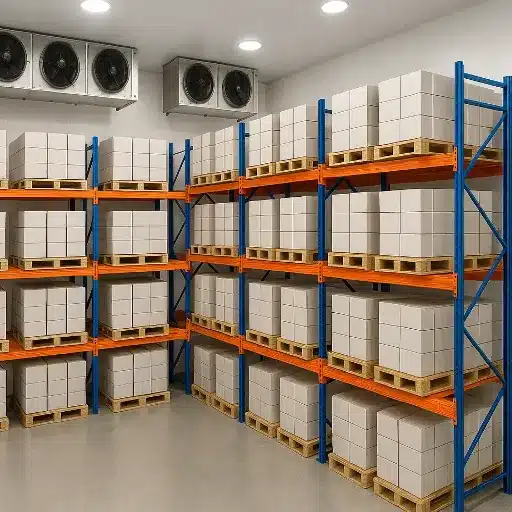

Selective racking is the best choice for cold storage operations that manage high-SKU inventory and require direct access to every pallet. It provides 100% selectivity and supports FIFO inventory rotation, though it delivers lower storage density than drive-in or push-back alternatives. The real efficiency of any selective racking system depends on a factor most warehouse managers overlook: the pallets that sit on those racks.
When warehouse managers think about selective racking for cold storage, they focus on steel type, beam height, and aisle width. They call racking engineers, spec galvanized frames, and calculate load ratings. But they rarely ask the most important question: Are the pallets going on those racks designed to perform in sub-zero temperatures? The wrong pallet does not just waste space. It can invalidate your rack’s safety rating entirely.
You already know cold storage is expensive. Every square foot of refrigerated space costs three to four times more than ambient warehouse space. The global market is projected to exceed $214 billion by 2026.
This guide will show you how to select, configure, and optimize selective racking specifically for cold storage. More importantly, it will explain why your pallet selection is the foundational layer that determines your racking performance, safety, and long-term ROI. We will cover system comparisons, material specifications, design considerations, and the critical pallet-rack connection that most guides ignore.
Key Takeaways
- Selective racking provides 100% pallet selectivity and FIFO rotation, making it ideal for high-SKU cold storage operations.
- Cold storage racking demands structural or galvanized steel rated for temperatures below -18°C, with load capacities verified under ANSI MH16.1 standards.
- HDPE plastic pallets outperform polypropylene in freezing environments and provide consistent load distribution that protects rack beam integrity.
- The pallet-rack interface determines actual load capacity, safety compliance, and energy efficiency in cold storage warehouses.
- A hybrid layout combining selective racking for fast-moving SKUs with drive-in racks for bulk reserve delivers the best ROI for most cold storage operations.
What Is Selective Pallet Racking in Cold Storage?
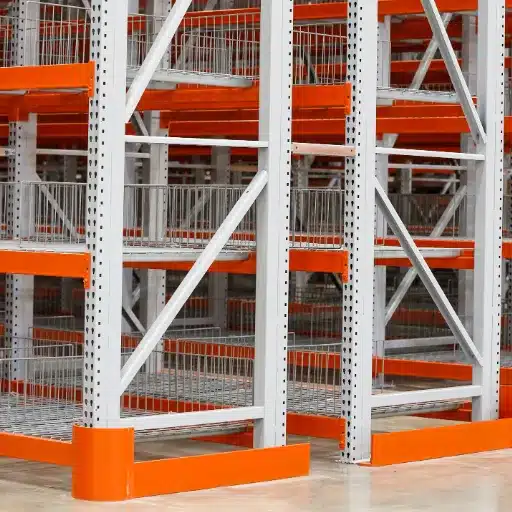
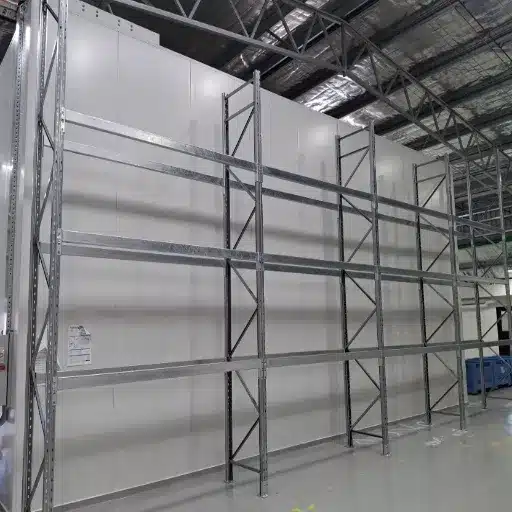
Selective pallet racking is the most common warehouse storage system in the world. It consists of vertical upright frames connected by horizontal load beams. Pallets rest on these beam pairs. Every pallet position is directly accessible from an aisle.
In a cold storage environment, selective racking serves the same fundamental purpose. It stores palletized inventory at controlled temperatures ranging from chilled conditions around 0°C to deep-freeze environments at -25°C or lower. The open structure allows cold air to circulate around inventory. Workers can locate and retrieve any pallet quickly without entering deep rack lanes.
This direct-access design makes selective racking the default choice for food distribution centers, pharmaceutical warehouses, and third-party logistics providers. These facilities handle diverse SKUs with frequent picking cycles. Selective racking is also the most cost-effective system to install and reconfigure. When your product mix changes, you simply adjust beam heights. No structural overhaul required.
Why Selective Racking Matters for Cold Storage Operations
Cold storage warehouses face a unique cost equation. Energy consumption, space utilization, and labor efficiency all compound under extreme temperature conditions. Selective racking impacts each of these factors in ways that high-density alternatives do not.
Energy costs dominate cold storage economics. Refrigeration systems consume 60% to 70% of total facility energy. Because selective racking requires more aisles than high-density systems, it increases the total air volume that must be cooled.
This is the primary criticism leveled against selective racking in freezer environments. Drive-in racking, by contrast, eliminates most aisles and reduces cooled air volume by up to 30%.
But density is not the only variable that matters. Operations with high SKU variety and frequent order picking actually waste more energy when workers spend extra time searching through dense storage lanes. Every minute a forklift operates inside a freezer burns energy and exposes workers to cold stress. Selective racking minimizes retrieval time because every pallet is visible and reachable from the aisle.
When Marcus Chen took over as operations director at a frozen food distribution center in Qingdao, he inherited a warehouse outfitted entirely with drive-in racking. The facility stored bulk frozen seafood for export. It looked efficient on paper.
But Marcus discovered a problem. 40% of his SKUs turned fewer than four times per year. His team spent an average of twelve minutes locating and retrieving slow-moving pallets from deep drive-in lanes. The energy savings from dense storage vanished under the weight of labor inefficiency.
After reconfiguring 30% of the facility to selective racking for fast-moving and seasonal SKUs, average retrieval time dropped to under three minutes. Labor costs fell 18% in the first quarter.
The lesson is straightforward. Selective racking is not the wrong choice for cold storage. It is the wrong choice for bulk, low-rotation inventory. For operations with SKU diversity and frequent picking, it often delivers better total cost of ownership than denser alternatives.
Want to see how the right pallets can extend the performance of your selective racking system? Explore our HDPE plastic pallets engineered for freezing temperatures.
Selective Racking vs. Other Cold Storage Racking Systems
There’s no one-size-fits-all racking system for cold storage operations. What works best depends on the number of SKUs, how you rotate stock, what temperatures you need to maintain, and your budget constraints. Below is a practical comparison of the six most common systems used in temperature-controlled warehouses.
| System | Density | Selectivity | Inventory Method | Best For | Cold Storage Advantage |
|---|---|---|---|---|---|
| Selective | Low | Very High | FIFO or LIFO | High-SKU variety, frequent picking | Direct access reduces search time; open design promotes airflow |
| Drive-In | High | Low | LIFO | Bulk frozen goods, long shelf life | Eliminates aisles; reduces cooled air volume by up to 30% |
| Drive-Through | High | Low | FIFO | Bulk frozen with date rotation | Same density as drive-in with enforced FIFO |
| Push-Back | Medium-High | Medium | LIFO | Packaged frozen foods, fast turnover | Single-aisle access; 90% more storage than selective |
| Pallet Flow | Medium-High | Medium | FIFO | Perishables, dairy, produce, pharma | Automatic rotation; reduces handling time in freezer |
| Mobile | Very High | Medium | Either | Energy-cost-constrained cold stores | Eliminates permanent aisles; minimizes refrigerated volume |
Selective vs. Drive-In Racking
Drive-in racking stores pallets on rails in deep lanes. Forklifts enter the rack structure to load and retrieve. This design can hold up to 75% more pallets than selective racking in the same footprint. It is the go-to recommendation for bulk cold storage of homogeneous products with long shelf lives.
The trade-off is accessibility. Drive-in racking operates on a last-in-first-out basis in most configurations. Retrieving a pallet from the back of a lane requires moving every pallet in front of it. Forklift operators must enter the rack structure, which increases collision risk and accelerates rack damage. In cold storage, where condensation makes surfaces slippery and confined spaces amplify impact forces, this risk is magnified.
Selective vs. Push-Back Racking
Push-back racking uses nested carts on angled rails. A new pallet pushes existing pallets deeper. Gravity brings the next pallet forward when one is removed. This system delivers two to six pallets deep per lane with access from a single aisle.
For cold storage, push-back offers a middle ground. It increases density over selective racking while keeping retrieval faster than drive-in. Front-loading means racks can sit against walls.
The downside is LIFO-only rotation. This makes push-back unsuitable for dated perishables. Cart mechanisms also require freezer-rated components. Standard lubricants can gum up, and plastics can crack at deep-freeze temperatures.
Selective vs. Pallet Flow Racking
Pallet flow racking uses gravity-fed inclined lanes with rollers. Pallets load from one side and retrieve from the other. This enforces automatic FIFO, which is critical for dairy, produce, packaged foods, and pharmaceuticals.
In cold storage, pallet flow reduces forklift travel and worker handling time inside the freezer. But the upfront cost is significantly higher than selective racking. Freezer-rated rollers are mandatory. Standard components will jam or fail below -18°C.
If your operation handles date-sensitive inventory at scale, pallet flow may justify the investment. For moderate volumes, selective racking with disciplined FIFO picking often delivers comparable results at lower cost.
When to Choose Selective: A Decision Framework
Choose selective racking for your cold storage facility if you answer yes to most of these questions:
- Do you manage more than fifty active SKUs?
- Do you pick individual pallets more than three times per week?
- Does your inventory require FIFO rotation?
- Do pallet dimensions vary across your product range?
- Is worker safety and fast retrieval a higher priority than maximum density?
If you answered no to most questions, drive-in or push-back racking will likely deliver better ROI. Many facilities benefit from a hybrid approach. Use selective racking for fast-moving, high-SKU picking zones. Use drive-in racks for bulk reserve storage of homogeneous products.
Critical Design Considerations for Cold Storage Selective Racking
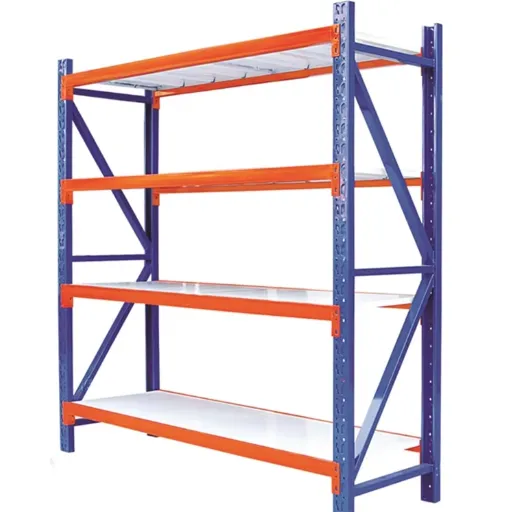
Designing selective racking for cold storage involves more than specifying beam lengths and frame heights. Temperature extremes, condensation cycles, and material behavior at low temperatures all affect system performance and safety.
Structural Steel vs. Roll-Formed Steel
Cold storage racking typically uses one of two steel constructions. Roll-formed steel is cold-rolled from coil stock. It uses clip or tab connectors. It is lighter, less expensive, and easy to reconfigure.
Structural steel is hot-rolled into heavy-duty shapes with welded or bolted connections. It handles higher loads and absorbs impact better. For freezer environments below -18°C, structural steel is the recommended choice.
Low temperatures can make steel more brittle. Roll-formed clip connectors are particularly vulnerable to fracture in the cold-brittle transition range. Structural steel with bolted beam connections maintains integrity under forklift impacts and thermal cycling. For operations below -25°C, structural steel with hot-dip galvanizing becomes effectively mandatory.
Galvanization and Corrosion Resistance
Cold storage facilities generate condensation. Warm, humid air enters every time a door opens. Moisture settles on rack surfaces. Over time, standard painted steel corrodes. Rust weakens load-bearing capacity and creates contamination risk for food and pharmaceutical products.
Galvanized steel provides a zinc coating that resists rust far longer than paint. Hot-dip galvanizing delivers the thickest, most durable protection. It is the standard specification for food-grade cold storage in North America and Europe.
Powder-coated epoxy finishes offer a lower-cost alternative. They work for chilled environments above 0°C. But they degrade faster in deep-freeze cycles.
Load Capacity in Low Temperatures
Steel properties change at low temperatures. Yield strength and impact resistance both shift. The Rack Manufacturers Institute acknowledges this in ANSI MH16.1, the primary design standard for industrial pallet racking. Load capacity plaques posted on rack installations must reflect the actual operating environment.
Standard selective racking accommodates 2,500 to 4,500 pounds per pallet position. In cold storage, these ratings require verification by a qualified engineer who accounts for temperature effects, seismic factors, and the specific rack geometry. Never assume a room-temperature load rating applies in a freezer without engineering review.
Aisle Width Optimization
Aisle width directly impacts both storage density and equipment requirements. Three configurations dominate cold storage design:
- Wide Aisle (3.5 to 4.0 meters): Standard configuration for counterbalance forklifts. Floor utilization runs 42% to 48%. Simplest and most flexible.
- Narrow Aisle (2.4 to 2.8 meters): Requires reach trucks. Floor utilization improves to 55% to 60%. Popular in mid-size cold storage facilities.
- Very Narrow Aisle (1.5 to 1.8 meters): Requires turret trucks with wire or floor guidance. Floor utilization reaches 65% to 70%. Best for high-value cold rooms where space is at an absolute premium.
Airflow and Temperature Consistency
The open design of selective racking naturally promotes air circulation. Cold air flows between pallet positions, helping maintain consistent temperatures throughout the facility. This is a genuine advantage over dense systems like drive-in, where product blocks can create warm spots and temperature stratification.
To maximize this benefit, avoid overloading beam levels. Leave adequate clearance above each pallet for air movement. Uniform pallet dimensions help here. Inconsistent pallet heights create gaps that disrupt airflow or cause uneven loading that stresses rack beams.
Seismic and Safety Compliance
ANSI MH16.1, developed by the Rack Manufacturers Institute and referenced by the International Building Code, governs selective racking design in North America. The 2021 revision introduced stricter seismic provisions, impact load calculations, and documentation requirements.
Every rack installation must display visible load capacity plaques. Load Application and Rack Configuration drawings must detail maximum safe loads and allowable beam elevations. In cold storage, thermal stresses and forklift impacts make regular inspections especially important. OSHA enforces rack safety under the General Duty Clause and 29 CFR 1910.176.
The Overlooked Factor: How Your Pallet Choice Affects Racking Performance
Here is what no racking manufacturer will tell you. The pallet is the interface between your product and your rack. Its material, dimensions, and load distribution characteristics determine whether your rack performs at its engineered capacity or fails under load. In cold storage, where safety margins matter more and material behavior changes with temperature, this interface becomes even more critical.
Why Pallet Selection Should Come Before Racking Design
Racking engineers calculate beam spans, upright capacities, and frame stability based on assumed load distributions. These calculations assume pallets sit flat. They assume even weight distribution across both beam pairs. They assume pallets maintain their dimensions under load.
When pallets warp, sag, or crack, the actual load on rack components shifts. Beams experience point loads instead of distributed loads. Upright frames twist under eccentric loading.
This is not a theoretical concern. RMI safety bulletins document numerous incidents where pallet failure triggered rack collapse. In cold storage, where workers cannot easily detect hairline cracks through freezer gloves and condensation reduces visibility, the risk is elevated. The safest racking system in the world cannot protect you from a pallet that fails under load.
Ready to protect your racking investment with pallets engineered for cold storage performance? Contact our team for custom pallet solutions tailored to your rack configuration.
HDPE vs. Polypropylene Pallets in Cold Storage Racking
Not all plastic pallets perform equally at low temperatures. The two most common materials behave very differently as temperatures drop.
High-density polyethylene, or HDPE, maintains flexibility and impact resistance down to approximately -45°C. It is the standard material for cold chain logistics worldwide.
At freezer temperatures, HDPE becomes slightly harder. It does not turn brittle. It continues to absorb forklift impacts without cracking.
Polypropylene, or PP, performs well at room temperature. It offers higher stiffness. But it transitions to a brittle state much sooner as temperatures drop. Below approximately -10°C, PP pallets become prone to cracking under impact. A fork tine strike that an HDPE pallet would absorb can shatter a PP pallet in a freezer.
For selective racking specifically, this brittleness creates a hidden danger. A cracked PP pallet may still appear to sit normally on rack beams. But its load distribution changes. Weight shifts to undamaged corners, creating point loads that stress beam connectors. Over time, this uneven loading can deform beams or loosen connections without any obvious cause.
Steel-Reinforced Pallets for Racked Cold Storage
Selective racking load ratings assume that pallet loads distribute evenly across the full beam length. When a pallet sags in the center, weight concentrates at the beam ends near the upright connections. This is the worst possible loading condition for a rack beam.
Steel-reinforced plastic pallets solve this problem. Internal steel tubes or bars provide rigidity that prevents sagging under heavy loads. The pallet maintains a flat profile even when loaded to capacity. Weight distributes evenly across the entire beam span, which is exactly what the rack engineer calculated.
In cold storage, steel reinforcement delivers another benefit. It compensates for the slight stiffness increase that all plastics experience at low temperatures. The steel maintains consistent mechanical properties across the full temperature range. Combined with HDPE construction, steel-reinforced pallets provide the most predictable load behavior for racked freezer applications.
At Shandong Lile, our steel-reinforced HDPE pallets are engineered specifically for racked storage environments. They maintain dimensional stability from -45°C to +60°C and support dynamic loads up to 2,000 kilograms. For operations running selective pallet racking in cold storage, this consistency protects both inventory and rack infrastructure.
Uniform Dimensions: The Key to Maximizing Rack Utilization
Selective racking is designed around standard pallet footprints. Most systems accommodate 1,200 by 1,000 millimeter or 1,200 by 800 millimeter pallets. Beam lengths are engineered for specific pallet widths with defined overhang tolerances.
When pallet dimensions vary, even by small margins, rack utilization suffers. A pallet that is too short leaves beam length unused. A pallet that is too long overhangs excessively, creating forklift clearance issues and uneven loading. Mixed pallet sizes in the same rack bay force compromises in beam spacing that waste vertical space.
This is why standardization matters. Facilities that use a single pallet specification across their entire cold storage operation achieve maximum rack density. Every beam level is optimized. Every vertical inch is productive.
For operations that cannot standardize on one size, custom pallet manufacturing is the answer. It ensures each specification matches its intended rack bay precisely.
Open-Deck vs. Solid-Deck Pallets for Air Circulation
Deck design affects how cold air moves through a rack system. Open-deck pallets, with their grid or slotted surface patterns, allow air to flow through the pallet itself. Cold air reaches the underside of products and circulates between stacked layers. Solid-deck pallets block this airflow, creating temperature pockets that can deviate from setpoints.
In selective racking, where open rack structures already promote circulation, this effect is moderate but not negligible. For temperature-sensitive products like pharmaceuticals or fresh produce, even small temperature variations matter. Open-deck HDPE pallets provide the best combination of airflow, hygiene, and load distribution for selective racking in cold storage.
Best Practices for Operating Selective Racking in Cold Storage
Even the best-designed system requires disciplined operation. These practices protect safety, maintain efficiency, and extend equipment life in sub-zero environments.
Inventory Management: FIFO in Cold Environments
First-in-first-out rotation is non-negotiable for perishables. Selective racking makes FIFO straightforward because every pallet is independently accessible. But discipline matters. Without systematic put-away and picking procedures, older inventory gets buried behind newer pallets even in selective racks.
Implement location-based inventory management. Assign every pallet position a unique address. Scan pallet barcodes during put-away and retrieval. Use warehouse management software to enforce rotation rules automatically. The technology investment pays for itself in reduced spoilage and simplified audits.
Minimizing Labor Time in Freezers
Worker exposure to sub-zero temperatures is a safety and efficiency concern. Every minute spent inside a freezer increases cold stress risk and energy consumption from open doors. Selective racking supports zone-picking strategies that minimize travel time.
Group fast-moving SKUs in zones closest to dock doors. Batch multiple orders into single picking trips. Use voice-picking or wearable scanners so workers keep hands free and eyes forward.
Pre-stage outbound pallets in a transition zone at the freezer threshold. Final loading then happens in ambient conditions. This simple change reduces freezer exposure time significantly.
Temperature Zoning Within Selective Rack Areas
Not all cold storage operates at the same temperature. Frozen goods need -18°C to -25°C. Chilled dairy requires 0°C to 4°C. Fresh produce might need 8°C to 12°C.
If your facility handles multiple temperature classes, segregate selective rack areas into distinct zones. Use insulated curtains or temporary walls to separate zones within a single rack array. This prevents warm air migration and allows each zone to operate at its optimal setpoint.
Position the coldest zones deepest in the facility, farthest from doors. This minimizes warm air infiltration.
Regular Inspection Protocols for Cold Storage Racks
Cold storage accelerates certain types of rack wear. Condensation causes corrosion. Thermal cycling loosens bolted connections. Slippery surfaces increase forklift impact frequency.
Institute a formal inspection program. It pays for itself in prevented incidents.
Inspect racks monthly for beam deflection, upright plumb, connector damage, and anchor integrity. Look for rust on galvanized surfaces, which indicates coating failure. Check load capacity plaques to confirm they match current configurations. Document every inspection and address deficiencies within forty-eight hours. ANSI MH16.1 requires this documentation as part of safe use practices.
Load Capacity Compliance and Placard Requirements
Every rack bay must display a visible load capacity plaque. This is not a suggestion. It is a requirement under ANSI MH16.1 Section 4.5, and OSHA references this standard when evaluating warehouse safety. The plaque must indicate maximum permissible loads per beam level and per bay.
In cold storage, ensure plaques are printed on materials that withstand low temperatures and moisture. Standard paper labels degrade quickly. Use metal or high-grade synthetic tags. Update plaques whenever rack configurations change. A beam level raised or lowered by even one notch changes the frame’s load capacity.
Need pallets that maintain consistent load distribution for your rack system? Learn about our hygienic, easy-to-clean plastic pallets designed for cold chain compliance.
Cost Analysis: Total Cost of Ownership for Selective Racking and Pallets
Cold storage operators often evaluate racking and pallets as separate purchases. This is a mistake. The two systems interact in ways that affect total cost over a ten to fifteen year lifespan.
Racking Cost Per Pallet Position
Selective racking costs approximately 50to50to100 per pallet position installed, depending on height, load capacity, and steel specification. Galvanized structural steel sits at the high end of this range. Roll-formed painted steel sits at the low end. For a 5,000-position cold storage facility, expect 250,000to250,000to500,000 in racking investment.
Pallet Cost Amortized Over Lifespan
Wooden pallets cost 15to15to25 each but last one to two years in cold storage before moisture, mold, and impact damage render them unusable. Plastic pallets cost 40to40to120 depending on specifications but last seven to ten years in freezer environments. Over a decade, the plastic pallet investment breaks even or wins on cost alone.
But the real savings come from operational efficiency. Plastic pallets do not splinter, so they reduce product damage and worker injury claims. They maintain consistent dimensions, so rack utilization stays optimal. They resist moisture, so they do not harbor bacteria or mold that threaten food safety compliance.
Energy Cost Implications
High-density racking reduces cooled air volume and lowers refrigeration load. For bulk storage of homogeneous products, this is a genuine advantage. But selective racking with open-deck HDPE pallets promotes superior air circulation. Temperature stays consistent with less fan energy. The net energy difference between a well-operated selective system and a drive-in system is often smaller than simple air-volume calculations suggest.
Maintenance and Replacement Cost Factors
Rack damage is the hidden cost driver in cold storage. Forklift collisions with rack uprights cost an average of 2,000to2,000to5,000 per incident to repair. Severe impacts can require rack replacement and load redistribution across entire aisles.
Steel-reinforced HDPE pallets absorb impacts better than wood or brittle plastics. They reduce the frequency of pallet failure events that lead to dropped loads and rack collisions.
ROI Calculation Framework
To calculate true ROI, combine these elements over your planning horizon:
- Initial racking and pallet investment
- Annual pallet replacement costs
- Rack maintenance and repair expenses
- Energy costs attributed to storage configuration
- Labor costs for picking and retrieval
- Product damage and spoilage costs
- Compliance and safety incident costs
Facilities with high SKU variety and moderate turnover typically find that selective racking with quality HDPE pallets delivers the lowest total cost of ownership. Facilities with low SKU counts and high volume usually benefit from high-density systems.
Industry Applications: Selective Racking by Cold Storage Segment
Different industries impose different requirements on cold storage design. Selective racking adapts to all of them, but configuration details vary.
Food and Beverage
The food and beverage sector accounts for approximately 77% of global cold storage revenue. Frozen foods, fresh meat, seafood, dairy, and beverages all require temperature control. Food distribution centers typically handle hundreds or thousands of SKUs with varying turnover rates.
Selective racking dominates this segment. It supports the SKU diversity and FIFO discipline that food safety regulations demand.
Open-deck HDPE pallets are the standard in food cold storage. They resist moisture. They clean easily. They meet FDA and HACCP requirements. Steel-reinforced options handle the heavy loads typical of beverage cases and bulk frozen commodities.
Pharmaceuticals and Biologics
Pharmaceutical cold storage operates under stricter regulations than food. Good Distribution Practice requires temperature validation, batch traceability, and documented inventory rotation. Selective racking supports these requirements because every pallet is individually accessible and traceable.
Pharmaceutical pallets often require specific dimensions to match automated handling equipment. Custom plastic pallet manufacturing ensures compatibility with both selective racking and automated storage and retrieval systems.
Dairy and Produce
Dairy products and fresh produce have shorter shelf lives than frozen goods. FIFO rotation is critical. Selective racking enforces disciplined rotation because workers can always reach the oldest pallet first. Temperature requirements are less extreme than frozen storage, typically 0°C to 8°C, which broadens material options slightly. Even so, HDPE remains the preferred material for hygiene and durability.
Frozen Foods and Seafood
Frozen food warehouses operate at -18°C to -25°C. Seafood operations sometimes reach -30°C for long-term storage. At these temperatures, material selection becomes critical. Structural steel racking with hot-dip galvanizing is effectively mandatory. HDPE pallets with steel reinforcement provide the only reliable combination of low-temperature performance and load capacity.
E-Commerce and Third-Party Logistics
E-commerce grocery and meal-kit services are the fastest-growing cold storage segment. These operations require rapid order fulfillment from diverse SKU catalogs. A typical e-commerce cold storage facility might pick hundreds of individual orders per hour.
Selective racking supports this velocity. It enables direct access without deep-lane retrieval delays.
3PL providers serving multiple clients face additional complexity. Each client may use different pallet sizes. Custom pallet programs that standardize on one or two specifications per client simplify rack configuration and maximize utilization.
Conclusion
Selective racking for cold storage is not a simple purchase decision. It is a system design challenge that connects rack engineering, material science, operational workflow, and total cost analysis. The racking structure matters. Steel grade, galvanization, beam spacing, and aisle width all affect performance and safety. But the pallet sitting on those beams matters just as much.
Your pallet material determines whether loads distribute evenly or concentrate at failure points. Your pallet dimensions determine whether you maximize every rack position or waste space on compromises. Your pallet deck design affects air circulation, temperature consistency, and hygiene compliance. In cold storage, where safety margins are thinner and material behavior changes with temperature, these factors compound.
The facilities that get this right do not treat racking and pallets as separate purchases. They design the complete storage stack as an integrated system. They specify HDPE construction for low-temperature performance. They choose steel reinforcement for predictable load distribution. They standardize dimensions for maximum rack utilization. They inspect regularly and document everything.
The global cold storage market is growing at nearly 10% per year. Competition is intensifying. Energy costs are rising. Regulatory scrutiny is increasing. The operators who thrive will be the ones who optimize every layer of their cold storage system, starting with the foundation that most competitors overlook.
Partner with a global leader serving over 108 countries. At Shandong Lile Holding Group, we engineer HDPE plastic pallets and steel-reinforced solutions designed for the demands of selective racking in cold storage. From custom dimensions to freezer-rated materials, we deliver the pallet foundation your racking system depends on. Contact us today for a quote tailored to your operation.
Frequently Asked Questions
What is selective racking in cold storage?
Selective racking in cold storage is a pallet storage system where every pallet position is directly accessible from an aisle. Upright frames support horizontal beams that hold pallets at controlled temperatures, typically from 0°C down to -25°C or lower. This design supports FIFO inventory rotation and works best for high-SKU operations with frequent picking cycles.
Is selective racking good for cold storage?
Selective racking is good for cold storage when your operation manages diverse SKUs with frequent pallet access. It provides 100% selectivity, supports FIFO rotation, and promotes air circulation. However, it offers lower storage density than drive-in or mobile systems. For bulk storage of homogeneous products, high-density alternatives typically deliver better space efficiency.
What type of steel is best for cold storage racking?
Structural steel with hot-dip galvanizing is the best choice for cold storage racking, especially below -18°C. Structural steel withstands forklift impacts and thermal cycling better than roll-formed steel. Hot-dip galvanizing provides superior corrosion resistance against condensation and moisture in freezer environments.
How much weight can selective racking hold in a freezer?
Standard selective racking accommodates 2,500 to 4,500 pounds per pallet position. In freezer environments, load ratings must be verified by a qualified engineer who accounts for temperature effects on steel properties. ANSI MH16.1 requires that load capacity plaques reflect actual operating conditions, not just room-temperature specifications.
What is the difference between selective and drive-in racking for cold storage?
Selective racking provides direct access to every pallet but requires more aisle space. Drive-in racking stores pallets in deep lanes for higher density but offers limited accessibility and typically operates on LIFO rotation. Selective racking suits high-SKU, frequent-picking operations. Drive-in racking suits bulk storage of homogeneous products with low turnover.
Do I need galvanized racking for cold storage?
Yes, galvanized racking is strongly recommended for cold storage. The condensation generated by door openings and thermal cycling causes standard painted steel to rust. Galvanized steel resists corrosion and maintains structural integrity longer. Hot-dip galvanizing is the most durable option and is considered mandatory for food-grade and pharmaceutical cold storage.
What pallets work best with selective racking in cold storage?
HDPE plastic pallets with steel reinforcement work best with selective racking in cold storage. HDPE maintains flexibility down to -45°C. Steel reinforcement prevents sagging and ensures even load distribution across rack beams. Open-deck designs promote air circulation. Uniform dimensions maximize rack position utilization.
How does cold temperature affect pallet rack load capacity?
Low temperatures can increase steel brittleness and alter material properties. The 2021 ANSI MH16.1 revision requires that load capacity calculations account for the specific operating environment, including temperature range. Rack systems in freezers below -18°C require engineering review to confirm that standard load ratings remain valid under actual conditions.