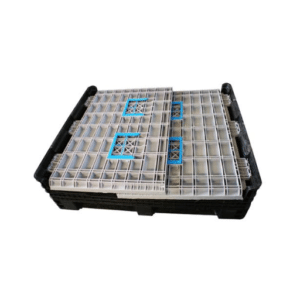
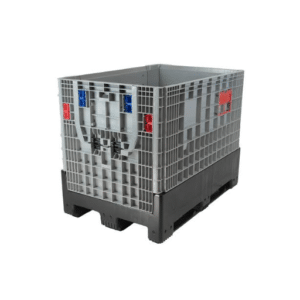
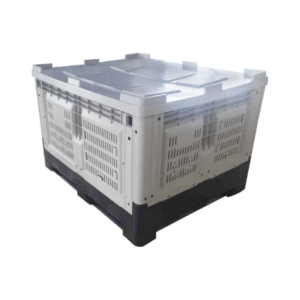
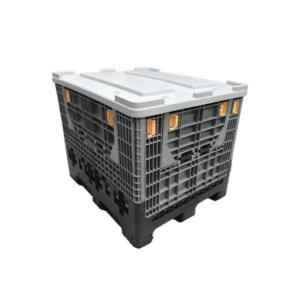
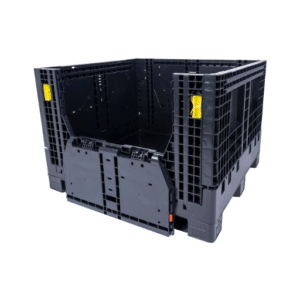
Collapsible pallet boxes for agriculture are foldable, ventilated bulk containers that carry fresh produce from field to packhouse and then fold flat for cheap return freight and compact off-season storage. Built from food-grade HDPE or polypropylene, they combine the airflow that keeps crops from spoiling with the space savings that make a seasonal fleet economical.
Rosa manages a tomato and pepper operation in Almería, Spain. Every August, her packhouse scrambles for bulk containers just as the harvest peaks, then watches those same bins sit empty for eight months, blocking forklift lanes and eating warehouse rent. She switched to vented collapsible pallet boxes and solved both problems at once. The ventilated walls kept the crop from sweating in transit, and the bins folded flat the moment the season ended.
If you run a farm, a packhouse, or a produce distribution network, you already feel that seasonal squeeze. This guide explains what makes a collapsible pallet box right for agriculture, how ventilation protects fresh produce, which sizes and materials fit your crop, and how fold-flat design turns a seasonal cost into a year-round saving. We will also show where these boxes fit alongside our full collapsible plastic pallet boxes range.
Key Takeaways
- Ventilation is the point: vented, perforated, or mesh walls cut the moisture that feeds spoilage, and fruit and vegetables account for over half of all food loss.
- Collapsible boxes fold to roughly a third of their height, reclaiming 60 to 80% of empty-return space and off-season warehouse room.
- Field-grade boxes use UV-stabilized HDPE that works from -40°C to +70°C, from outdoor harvest to blast-freezer storage.
- Agriculture’s incumbent field bins are rigid, and folding empties is the one advantage a rigid box can never offer.
- For crops like potatoes and onions, a collapsible box holds 350 to 500 kg, stacks four to six high, and washes clean between uses.
What Are Collapsible Pallet Boxes for Agriculture?

A collapsible pallet box for agriculture is a foldable bulk container on a pallet footprint, sized to move produce through harvesting, packing, storage, and transport. The walls hinge or slot onto a pallet base and fold down when empty, so the box collapses to a fraction of its erected height. In farm language, it is a reusable field bin that folds flat.
Three features separate an agriculture box from a general storage box. First, ventilation: vented or perforated walls let air circulate through the crop. Second, field durability: UV-stabilized resin survives sun, rain, and fertilizer contact. Third, food-safe hygiene: smooth, non-porous walls and drain holes make the box easy to wash between crops.
Farms have used rigid plastic pallet boxes for decades because they are easy to clean, robust, and reusable season after season. What collapsible design adds is the return trip. A rigid bin costs full freight and full warehouse space when it sits empty; a collapsible bin folds flat. For a seasonal business, that changes the whole economics.
Not sure whether collapsible or rigid fits your field? Talk to our team and we will help you compare the two designs for your operation.
Ventilation: Why Airflow Keeps Produce Fresh
The single most important spec on an agriculture box is airflow. Fresh produce breathes after harvest, releasing heat and moisture. Trap that moisture against the crop and you feed the mold and bacteria that drive spoilage. Ventilated walls let air move through, which keeps the crop dry and delays decay.
The scale of the problem is enormous. The FAO reports that 13.2% of food is lost between harvest and retail, and fruit and vegetables account for more than half of all food loss because they perish quickly. In developed markets, an estimated 20 to 25% of harvested produce is lost to microbial spoilage during post-harvest handling. A vented box attacks that loss directly.
Ventilation comes in three common forms:
| Wall Type | How It Works | Best For |
|---|---|---|
| Solid | Sealed walls, no airflow | Potatoes, onions, and grains that need darkness and stable humidity |
| Vented | Perforated holes or slots in the walls and base | Most fresh produce, berries, leafy greens, and citrus |
| Mesh | Open grid or wire-mesh panels for maximum airflow | High-respiration crops, forced-air cooling, hot harvest conditions |
Some vented boxes offer sliding or modular panels, so you can switch between breathable and sealed modes as the crop or season demands. That flexibility matters when one fleet serves both field harvesting and longer cold storage.
Priya grows soft fruit in Kent, England. Her wooden crates absorbed water, picked up splinters, and held dampness against the berries, and the mold that followed was eating a visible share of every harvest. She moved to vented HDPE collapsible boxes with drain holes. The washdown time dropped, and the spoilage rate on the packing line fell enough that the fleet paid for itself within two seasons.
Moving perishable produce? See our vented collapsible pallet boxes and match the wall type to your crop.
Harvest-Season Fleets and Fold-Flat Seasonal Storage
Agriculture runs on a calendar, and that calendar creates a brutal container problem. A fleet sized for peak harvest sits mostly idle for the rest of the year. Every rigid bin occupies a full pallet position whether it is full of potatoes or full of air.
Collapsible boxes fold to roughly a third of their erected height, a 3:1 ratio or better. In real terms, that reclaims 60 to 80% of the space an empty fleet would otherwise occupy. The Inka FPB1210-1050V, the largest folding ventilated box on the market, stands over a meter tall when erected and folds down to 315 millimeters when empty.
Think about what that means across a season. A grower with 500 bins stores them at full volume for six to eight months if they are rigid. The same fleet, folded, takes a quarter of the warehouse floor. That is rented space, heated space, and forklift lanes you get back every single year.
Jonas runs a potato co-op in Idaho. His operation filled 600 rigid bins at harvest, then paid to store and heat them through a six-month winter. When he replaced half the fleet with collapsible vented boxes, the folded empties stacked in a corner of one bay instead of filling two full rows. The warehouse space he reclaimed paid for the new boxes in under three seasons, before the return-freight savings were even counted.
This is the point the rigid-box market leader cannot argue against. Dolav, the long-standing name in agriculture box pallets, builds rigid Type 1200 boxes that hold 1,030 liters and stack eight high in cold storage. They are excellent bins. But they do not fold, so a grower pays full freight and full warehouse rent on every empty box all season long. Fold-flat design is the one advantage a rigid box can never match.
Sizes, Volumes, and Fold Ratios for Agricultural Use
Agriculture boxes cluster around a few standard footprints, which keeps them compatible with the pallets, trucks, and racking you already run. The most common base is 1200 by 1000 millimeters, the Euro pallet footprint, with heights from around 740 to 1,100 millimeters.
| Box | Footprint (mm) | Height (mm) | Volume | Folded Height | Notes |
|---|---|---|---|---|---|
| Vented collapsible, standard | 1200 × 1000 | 810 | ~600 L | ~300 mm | Most common field and packhouse size |
| Vented collapsible, tall | 1200 × 1000 | 1,100 | ~1,050 L | 315 mm | Largest folding vented option |
| Rigid reference (Dolav Type 1200) | 1200 × 1200 | 1,000 | 1,030 L | Does not fold | Agriculture incumbent, for comparison |
Volumes from 600 to 1,050 liters cover most produce flows. A 600-liter box handles a pallet of soft fruit or leafy greens, while a 1,050-liter box suits potatoes, onions, and root crops that pack densely.
Folded height drives your export economics too. A foldable HDPE box around 810 millimeters tall ships about 75 units in a 20-foot container and 210 in a 40-foot high cube, because the folded units stack tight. A rigid box ships a fraction of that, since you pay for the empty air inside every one. For the full range of footprints, see our plastic pallet boxes and match the size to your existing fleet.
Hygiene, Drainage, and Washdown for Produce

A produce box has to be clean, fast, and often. Between crops, and sometimes between batches, the fleet needs washing, and the design decides how long that takes.
Smooth, non-porous HDPE walls leave bacteria nowhere to settle. Rounded corners stop residue from collecting in sharp angles. Sealed edges keep moisture and product from seeping into joints. And drain holes, the detail buyers forget, let wash water escape instead of pooling at the bottom, where it breeds mold.
Wooden crates fail this test badly. They absorb water, harbor splinters, and hold dampness against the crop. Plastic boxes wash clean with high-pressure water and dry ready for the next load. For an organic or food-safety certified operation, that difference is the difference between passing an audit and explaining a contamination risk.
Hygiene is also why food-grade resin matters even for produce that gets washed later. Virgin HDPE carries no odors and resists the acids and plant residues that soak into lesser plastics. The same food-safety discipline we apply to our FDA-compliant food grade pallets carries straight through to our collapsible agriculture boxes.
Materials: UV-Stabilized HDPE vs PP for Field and Cold Storage
Agriculture boxes live outdoors, which changes the material question. A warehouse container never sees direct sun; a field bin sits in it for weeks at harvest.
UV-stabilized HDPE is the default for field use. The additive protects the resin from the sun damage that makes untreated plastic turn brittle, and the material shrugs off fertilizer, crop-protection agents, moisture, and corrosion. HDPE also keeps its strength down to about -40°C, so the same box can move from a hot field into a blast freezer without turning brittle.
Polypropylene is stiffer and lighter, which suits automated packhouses, but it derates below about -20°C and is less forgiving of repeated outdoor exposure. For most field-to-cold-storage flows, HDPE is the safer choice.
| Material | Best For | Temperature Range | Field Notes |
|---|---|---|---|
| UV-stabilized HDPE | Field harvest, cold storage, wet crops | -40°C to +70°C | Resists sun, fertilizer, acids, and moisture |
| PP | Packhouse automation, ambient lines | -20°C to +40°C | Lighter and stiffer, not for freezers or heavy sun |
| Recycled HDPE | Logistics, non-contact transport | Reduced | Sustainable, but confirm food-contact status |
The temperature range matters because produce moves from a 35°C field to a 2°C cold store and sometimes a -25°C freezer in the same day. A box that cannot survive that swing fails mid-season, when there is no time to replace it. For a deeper dive on the resins, see our HDPE vs polypropylene comparison.
Collapsible vs. Rigid Field Bins: The Agriculture Decision
The choice between collapsible and rigid comes down to one question: how much does your fleet travel empty?
Rigid bins, like the Dolav Type 1200, are the proven workhorse. They hold 1,030 liters, stack eight high in cold storage, and survive decades of hard use. Dolav’s own Cyprus potato case study shows boxes holding 350 to 400 kilograms of potatoes, stacked four to five high in refrigerated storage for up to five months, with some boxes from the 1980s still in service. If your fleet never leaves your own site and storage space is not a constraint, rigid is hard to beat.
Collapsible boxes win the moment the empty fleet has to move or be stored. Every return trip from packhouse to farm, every empty bin sitting in a warehouse through the winter, costs real money. A collapsible box folds to a quarter of its volume, so the same truck carries four empties in the space of one.
Choose collapsible when your boxes travel empty between farm, packer, and distribution center, when storage space is tight, or when your demand is sharply seasonal. Choose rigid when the fleet stays on one site, never returns empty, and lives under constant load. For most produce operations, the seasonal and return logistics point to collapsible.
Crop Applications and Use Cases
Collapsible pallet boxes for agriculture serve a wide range of crops, and the right configuration changes with the product:
- Potatoes and root crops want solid or lightly vented walls, high volume, and dark, stable storage.
- Onions and bulbs need airflow to prevent sprouting and rot, plus UV-stabilized walls for outdoor curing.
- Soft fruit and berries need maximum ventilation and drain holes to keep moisture away from delicate skin.
- Leafy greens need fast cooling and high airflow, often with forced-air ventilation.
- Citrus and tree fruit need vented walls and smooth interiors that will not bruise or mark the skin.
- Flower bulbs and niche crops like insect farming use collapsible boxes as a seasonal, returnable alternative to one-way corrugated.
Each crop maps to a slightly different box, which is why customization matters more in agriculture than in most industries. A potato fleet and a berry fleet should not look the same. For produce moving from harvest into food-grade processing, our collapsible pallet boxes for food storage guide covers the next step in the chain.
Choosing and Customizing an Agriculture Collapsible Box

Work through this checklist before you commit, and you will avoid the most common specification mistakes:
- What crop? This sets your wall type, solid or vented, and how much airflow you need.
- What volume? Match the box to your pallet footprint and your truck and racking dimensions.
- Field or cold storage? Field use needs UV-stabilized HDPE, and freezer use needs the same material for -40°C performance.
- How will you wash it? Spec drain holes, sealed edges, and rounded corners if the fleet gets washed between crops.
- How far does it travel empty? If the fleet returns to the farm or sits off-season, fold-flat design pays for itself.
- Do you need traceability? Spec RFID slots or barcode plates for produce recall and lot tracking.
Where a standard box falls short, customization closes the gap. At Lile, we engineer collapsible boxes with vented or solid walls, UV-stabilized HDPE, drain holes, internal dividers, and RFID or barcode integration. Our OEM program covers dimensions, Pantone-matched colors for crop-zone coding, and branding, so the container becomes a working part of your operation rather than a generic off-the-shelf item. The fold-flat economics are laid out in full in our collapsible pallet box return logistics guide.
Ready to spec an agriculture box for your operation? Request a quote and tell us your crop, volume, and temperature range. We will recommend a vented collapsible pallet box built for agriculture.
Frequently Asked Questions
Are collapsible pallet boxes strong enough for potatoes and root crops?
Yes. A standard vented collapsible box carries around 1,000 kilograms dynamic load and stacks four to six high, while a potato operation typically loads 350 to 500 kilograms per box. The pallet base is designed for four-way forklift entry and heavy stacking.
Vented or solid walls for my crop?
Vented for most fresh produce that needs airflow, and solid for potatoes, onions, and grains that need darkness and stable humidity. If your fleet serves both, look for sliding or modular panels that switch between modes.
How do collapsible boxes handle cold storage?
Well, if you choose HDPE. UV-stabilized HDPE holds strength from -40°C to +70°C, so the same box moves from field to freezer. Polypropylene turns brittle below about -20°C, so frozen operations should default to HDPE.
Can collapsible boxes be used outdoors in the field?
Yes. UV-stabilized HDPE resists sun, rain, fertilizer, and crop-protection agents, which is what separates a field bin from a warehouse container. Confirm the resin is UV-stabilized before you buy.
How do collapsible boxes save money in the off-season?
They fold to roughly a third of their height, reclaiming 60 to 80% of the warehouse space an empty rigid fleet would occupy, and they cut return freight the same way. For a seasonal operation, that is the saving that pays for the fleet.
Conclusion
Collapsible pallet boxes for agriculture solve the seasonal problem that rigid bins cannot. They ventilate the crop to cut spoilage, survive the field and the freezer, wash clean between crops, and fold flat the moment the harvest ends. For a business that earns its money in a few short months, that last point is the one that changes the economics.
Start with four actions:
- Match the wall type to your crop, vented for airflow or solid for darkness and humidity control.
- Choose UV-stabilized HDPE if the fleet sees field sun or freezer cold.
- Insist on drain holes, sealed edges, and rounded corners if you wash the fleet.
- Run the return-freight and off-season storage numbers before you compare box prices, since fold-flat design usually wins there.
At Shandong Lile, we build vented collapsible pallet boxes from UV-stabilized HDPE and PP, backed by ISO 9001 quality control and 100% recyclable materials. Our custom program adds vented or solid walls, crop-zone color coding, and RFID tracking to fit your exact operation. Whether you are moving potatoes, berries, or flower bulbs, we can help you spec a container that keeps the crop fresh and pays for itself in the off-season. Get a free agriculture container consultation today.