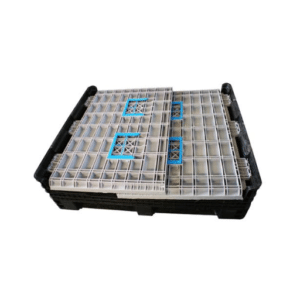
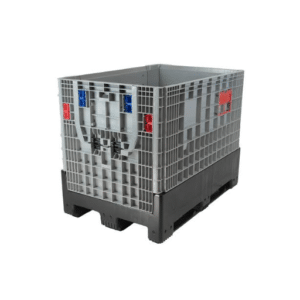
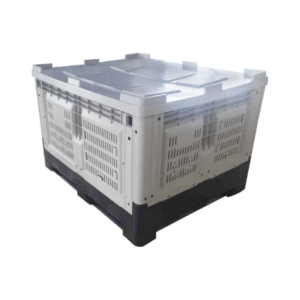
Food-grade collapsible pallet boxes for food storage are reusable, foldable bulk containers made from virgin HDPE or polypropylene that meet FDA or EU 10/2011 food-contact standards. They fold flat to save 75 to 82% of empty return space, stand up to high-pressure washdown, and hold temperatures from -40°C to +70°C depending on the material.
Marta runs quality assurance for a seafood processor in Vigo, Spain. For years her facility shipped frozen fillets in one-way insulated cartons. Every month the empty cartons came back to be broken down, and every audit, her team spent hours proving the containers had not introduced contamination. She switched to food-grade collapsible boxes and cut two problems at once: the boxes folded flat for the empty return leg, and the smooth HDPE walls washed clean in minutes.
If you handle food in bulk, you already know the container is the last link most audits inspect. This guide explains what actually makes a collapsible pallet box food-grade, how to navigate FDA and EU rules, which material fits your temperature range, and how to keep the fleet clean in a HACCP operation. We will also show where collapsible plastic pallet boxes fit into your wider food-logistics picture.
Key Takeaways
- Food-grade is not the same as food-contact. Some “food-grade” boxes are only rated for packaged goods, so confirm direct-contact status before you buy.
- Food safety rules split by market: FDA 21 CFR in the US, EU 10/2011 with a 10 mg/dm² migration limit in Europe, plus HACCP and GMP programs on both sides.
- Virgin HDPE is the cold-chain workhorse, holding strength to -40°C, while polypropylene turns brittle below about -20°C.
- Collapsible boxes fold to 75 to 82% of their empty volume, which cuts refrigerated return freight as much as it saves warehouse space.
- Insulated variants with PU-foam walls and phase-change plates can hold temperature for up to 92 hours on long-haul runs.
What Makes a Collapsible Pallet Box Food-Grade?

A food-grade collapsible pallet box is a foldable bulk container built from materials and in a design that will not contaminate food. In practice, that means two things: virgin, food-contact-approved plastic, and a smooth, non-porous surface with no crevices where bacteria can hide.
The distinction most buyers miss is between food-grade and food-contact. A food-grade box is made from safe, non-toxic resin but may only be rated for indirect contact, meaning it can carry packaged or wrapped product but should not touch bare food. A food-contact box is approved for direct contact with the food itself. Nelson Company, for example, marks many of its HDPE containers “Food Grade Non-contact”, suitable for packaged items only. If your operation tips loose product straight into the container, you need the direct-contact rating.
This distinction matters because recycled plastic can be food-grade for logistics but is almost never cleared for direct food contact under EU rules. Recycled resin from open collection systems needs separate EFSA authorization, and most buyers simply avoid it for anything touching food. Virgin HDPE and polypropylene from an approved positive list are the safe default.
At Shandong Lile, our food-grade boxes use virgin HDPE or PP, with a non-porous surface designed to prevent bacterial growth. We already apply the same standard to our FDA-compliant food grade pallets, and we carry it through to our collapsible box range.
Not sure whether your operation needs direct food-contact approval? Talk to our team and we will help you confirm the right rating for your product.
Food Safety Standards and Compliance for Collapsible Boxes
Food-contact packaging is regulated, and the rules differ by market. A box that passes one regime does not automatically pass another.
FDA Food-Contact (US)
In the United States, food-contact materials fall under FDA regulation, primarily 21 CFR Parts 170 to 199. The resin must be an approved food-contact substance, and the finished box must not transfer harmful amounts of anything to the food under normal use. For bulk containers, the practical test is migration: the FDA measures what leaches out of the plastic into food simulants.
EU 10/2011 (Europe)
Europe uses Regulation (EU) No 10/2011, which applies to plastic materials intended to come into contact with food. The headline requirement is the overall migration limit, or OML, of 10 mg of constituents per square decimeter of contact surface. There are also specific migration limits, or SMLs, for individual substances, and every compliant box should ship with a declaration of conformity under Annex IV.
Here is how the main regimes line up:
| Standard | Region | What It Governs | Key Requirement |
|---|---|---|---|
| FDA 21 CFR 170-199 | US | Food-contact substances and materials | Approved resin, safe migration |
| EU 10/2011 | EU | Plastic food-contact materials | OML of 10 mg/dm², SMLs, declaration of conformity |
| HACCP | Global | Hazard control in food operations | Container as a hygiene control point |
| GMP (EC 2023/2006) | EU | Good manufacturing practice | Clean, traceable production |
| FSMA | US | Food safety and traceability | Box-level tracking for recalls |
HACCP and GMP matter as much as the chemical rules. Under a HACCP plan, the storage container is a control point, and auditors will ask how you clean it, how you segregate raw from finished product, and how you document both. A collapsible box supports this with smooth walls, drain holes, and optional color coding, which we cover below.
Food-Grade Materials: HDPE vs Polypropylene
Material choice is the single biggest decision for food storage, because it sets both your hygiene performance and your temperature range.
High-density polyethylene, or HDPE, is the workhorse. It resists acids, fats, solvents, and odors, which is why it dominates dairy, meat, and seafood handling. It keeps its strength down to about -40°C, making it the right choice for blast freezers and frozen distribution. Its slightly softer surface also resists impact, so it survives forklift handling and repeated washdown.
Polypropylene, or PP, is stiffer and lighter. It is rigid enough for automated systems and cleanrooms, but it turns brittle below about -20°C, so it is not for freezer use. PP suits ambient and chilled food lines where weight matters more than extreme cold.
For cold storage, the choice is usually clear:
| Material | Best For | Temperature Range | Food-Safety Note |
|---|---|---|---|
| Virgin HDPE | Dairy, meat, seafood, frozen | -40°C to +70°C | Resists fats, acids, odors |
| Virgin PP | Ambient, chilled, cleanroom | -20°C to +40°C | Stiffer, lighter, not for freezers |
| Recycled HDPE | Logistics, indirect contact | Reduced | Food-grade but not direct-contact |
Color coding is part of the material decision, not just a branding choice. Many HACCP operations assign blue to raw zones and white to finished zones, or red to raw meat. Specifying the color up front turns the container itself into a segregation control that auditors can see at a glance. For a deeper look at the resins, see our HDPE vs polypropylene comparison.
Hygienic Design Features That Matter

A food-grade box is only as clean as its design allows. The features that separate a truly hygienic box from a standard one are invisible at first glance.
Smooth, non-porous surfaces leave bacteria nowhere to settle. Rounded corners eliminate the sharp internal angles where residue collects. Sealed edges stop moisture and product from seeping into wall joints. Drain holes, often overlooked, let wash water escape instead of pooling at the bottom where it breeds mold.
These details decide how fast you can clean the fleet. A box with cavities and seams needs manual scrubbing. A smooth HDPE box survives high-pressure, high-temperature washdown with food-grade detergents and comes out dry and ready in minutes.
Tomasz, a production manager at a dairy in Krakow, replaced wooden crates with collapsible HDPE boxes after a splinter contaminated a finished-cheese line. His team now washes each box in an industrial washer between uses. The non-porous walls cut washdown time by more than half, and the rounded corners stopped the residue buildup that had forced nightly deep cleans. For his auditors, the box itself became evidence of control rather than a risk to defend.
Want to cut washdown time without risking compliance? Explore our food-grade collapsible pallet boxes and see the hygienic design details for yourself.
Collapsible Pallet Boxes for Food Storage in the Cold Chain
Cold storage is where the collapsible design earns its keep, but it is also where material mistakes surface fastest.
Cold chain packaging is a 32to32to40 billion market growing roughly 10% a year, and insulated containers are over a third of it, according to Straits Research. Standard food-grade HDPE collapsible boxes hold up from -30°C to +70°C, and quality HDPE holds strength down to -40°C in blast freezers. Polypropylene derates below -20°C and can crack under impact in a freezer, so frozen operations should default to HDPE.
For temperature-controlled transport, insulated collapsible variants take this further. These use double-walled HDPE or PP with a polyurethane foam core, sometimes paired with phase-change material plates that absorb heat and hold a set temperature. ZAMKO’s insulated cold-chain box, for example, advertises temperature hold for up to 92 hours, enough for long-haul refrigerated or frozen runs without active power.
Diego runs a frozen fruit operation in Chile that ships to the US and EU. His first insulated boxes used PP walls, which cracked when the fleet hit the -25°C blast freezer during a peak harvest. He moved to HDPE with PU-foam insulation and phase-change plates, and the cracking stopped. The fold-flat design then let him ship four empties in the space of one on the refrigerated backhaul.
That is the real cold-chain payoff. An empty rigid insulated box still costs you a full refrigerated pallet position on the return leg. A collapsible box folds to a quarter of its volume, so you ship four empties in the space of one. That is the same empty-return math that makes collapsible boxes pay off in ambient logistics, applied to the most expensive freight there is: refrigerated truck space. Our collapsible pallet box return logistics guide walks through the full cost model.
Food Storage Use Cases for Collapsible Pallet Boxes
Collapsible pallet boxes serve almost every food category, but the configuration changes with the product.
- Fresh produce and dairy need vented or solid walls, moderate temperatures, and frequent washdown.
- Meat and seafood need virgin HDPE, easy drainage, and strict raw and finished segregation, often by color.
- Frozen goods need HDPE for -40°C performance and insulated variants for transport.
- Bakery and dry goods need odor-resistant, moisture-resistant walls to keep product from absorbing smells.
- Beverages need smooth walls that drain completely and resist citric and other food acids.
Each application maps to a different box. A produce operation might run vented collapsible boxes for air circulation, while a frozen seafood line runs solid, insulated HDPE boxes. That overlap is why we separate this food-safety guide from our collapsible pallet boxes for agriculture piece, which focuses on harvest fleets and produce ventilation. Pharmaceuticals, with their cleanroom and GMP demands, get their own treatment in our collapsible pallet boxes for pharmaceuticals guide.
Choosing and Customizing a Food-Grade Collapsible Box

Work through this checklist before you commit, and you will avoid most specification mistakes:
- Direct or indirect contact? Confirm whether product touches bare plastic or is packaged.
- What is your temperature range? Below -20°C means HDPE, full stop.
- How will you clean it? Washdown needs drain holes, sealed edges, and rounded corners.
- Vented or solid walls? Produce wants air, while meat and frozen want solid, sealed walls.
- What footprint and volume? Match the pallet base your warehouse and trucks already use.
- Do you need traceability? Spec RFID slots or barcode plates for FSMA-style tracking.
Where a standard box falls short, customization closes the gap. At Lile, we engineer collapsible boxes with insulated walls for cold chain, custom color coding for HACCP zones, internal dividers, drain taps, and RFID or barcode integration. Our OEM program covers dimensions, Pantone-matched colors, and branding, so the container becomes a working part of your compliance system rather than a generic off-the-shelf item.
Ready to spec a food-grade box for your operation? Request a quote and tell us your temperature range, washdown setup, and product. We will recommend a collapsible pallet box built for food storage.
Frequently Asked Questions
Are collapsible pallet boxes food safe?
Yes, when built from virgin HDPE or polypropylene that meets FDA or EU 10/2011 food-contact standards. Confirm whether you need direct food-contact approval or only food-grade for packaged goods, since not every food-grade box is cleared for bare food.
What does food grade vs food contact mean?
Food grade means the box is made from safe, non-toxic resin but may only be rated for packaged goods. Food contact means it is approved for direct contact with bare food. Recycled resin is often food-grade but rarely cleared for direct contact.
Can collapsible pallet boxes go in a freezer?
Yes, if you choose HDPE. Virgin HDPE holds strength down to -40°C, while polypropylene turns brittle below about -20°C and can crack under impact in a freezer.
HDPE or PP for cold storage?
HDPE. It performs down to -40°C and resists the fats, acids, and odors common in cold food handling. PP is fine for ambient and chilled lines but not for freezers.
How do you clean a collapsible pallet box?
Wash it with high-pressure, high-temperature water and food-grade detergent. Smooth HDPE walls, rounded corners, sealed edges, and drain holes let it come clean and dry quickly and prevent residue from pooling.
Conclusion
Food-grade collapsible pallet boxes for food storage solve two problems at once. They give you a hygienic, compliance-ready bulk container, and they fold flat to cut refrigerated return freight by up to 82%. The catch is that food-grade means different things in different markets, and the material you pick decides whether the box survives your freezer.
Start with four actions:
- Confirm direct-contact versus food-grade status with your supplier, in writing.
- Match the material to your coldest temperature, which usually means HDPE below -20°C.
- Insist on drain holes, sealed edges, and rounded corners if you wash the fleet.
- Ask for the migration test data and a declaration of conformity, not just a “food safe” label.
At Shandong Lile, we build food-grade collapsible boxes from virgin HDPE and PP, backed by ISO 9001 quality control and 100% recyclable materials. Our custom program adds insulated walls, color coding, and RFID tracking to fit your exact operation. Whether you are moving frozen seafood, raw meat, or dry bakery goods, we can help you spec a container that passes the audit and pays for itself on the return trip. Get a free food-grade container consultation today.