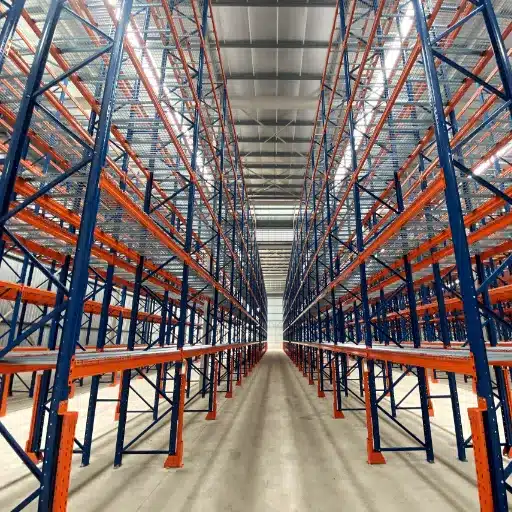

Quick Answer: Selective pallet racking is a warehouse storage system made of upright frames and horizontal beams that provides 100% direct access to every pallet from an aisle. It is the most common racking type globally, used in approximately 90% of palletized warehouses because it offers unmatched flexibility, compatibility with all pallet types, and efficient first-in, first-out inventory management.
Selective pallet racking is the most widely used warehouse storage system, offering direct, 100% access to every pallet from the aisle. If you have ever asked what is selective pallet racking and why it dominates warehouses worldwide, the answer starts with simplicity: it consists of vertical upright frames and horizontal load beams arranged in rows, allowing forklifts to reach any pallet individually without moving others. If you run a warehouse with diverse inventory, this system likely belongs at the top of your shortlist.
Here is the problem most warehouse managers face: they need storage that balances accessibility, flexibility, and cost. Stack pallets on the floor and you waste vertical space. Install a high-density system like drive-in racking and you sacrifice selectivity, turning simple stock retrieval into a logistical headache. Selective pallet racking solves this dilemma by giving you the best of both worlds: organized vertical storage with immediate access to every single item.
In this guide, you will learn exactly how this selective pallet racking system works, what components make up an adjustable pallet racking setup, how it compares to other pallet racking types, and—most importantly—how pairing it with the right pallet type can transform your operational efficiency. Whether you are designing a new warehouse or rethinking an existing layout, this article gives you the framework to make a confident decision.
Key Takeaways
- Selective pallet racking provides 100% selectivity, meaning forklifts can access every pallet directly without moving others.
- It is the most popular warehouse racking system globally, used in approximately 90% of palletized warehouses because of its flexibility and cost-effectiveness.
- The system works with all pallet types, but durable plastic pallets offer distinct advantages: consistent dimensions, moisture resistance, and longer lifespan.
- Standard configurations utilize about 40% of floor space for aisles, while narrow-aisle variants can increase storage density by up to 40%.
- Matching your pallet weight and dimensions to your racking load capacity is critical for safety and maximizing return on investment.
What Is Selective Pallet Racking?
The Core Concept
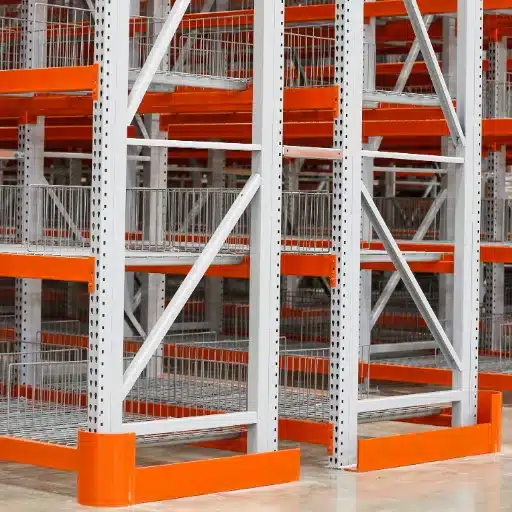
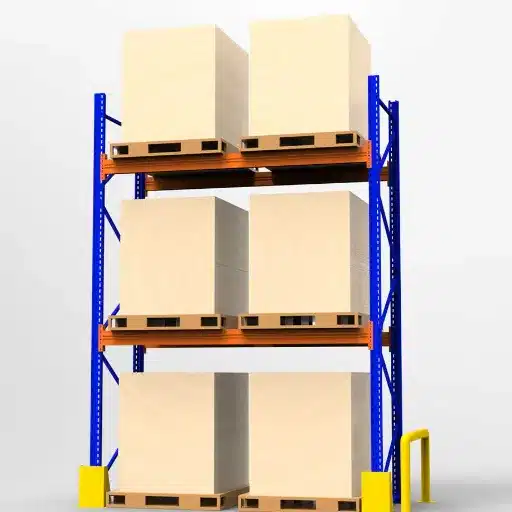
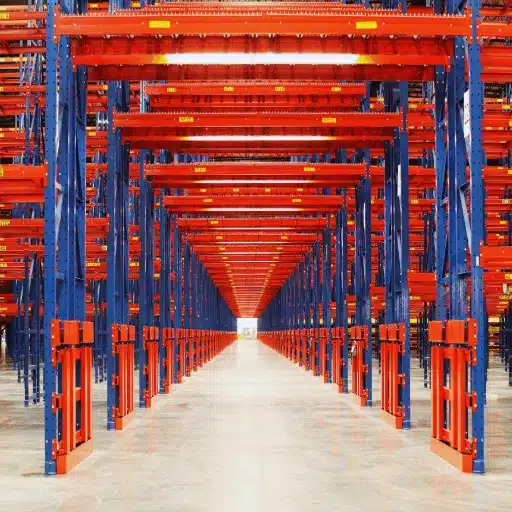
Selective pallet racking is a storage system built from two primary components: upright frames and horizontal load beams. These form individual bays, each designed to hold one or more pallets. The name “selective” comes from its defining feature: every pallet position is directly accessible from an aisle. This makes it fundamentally different from high-density systems like drive-in or push-back racking, where pallets are stored in deep lanes and access is sequential.
Consider that selective racking is an arrangement of shelves designed to accommodate industrial pallets. Each bay acts as an independent slot. A forklift driver can drive down an aisle, identify the exact pallet needed, and retrieve it immediately. No shuffling. No sequencing. No delay. This direct access is why selective racking dominates warehouses that handle a wide variety of SKUs, fluctuating inventory levels, or time-sensitive goods. Understanding what is selective pallet racking means recognizing that its core strength lies in immediate, unrestricted access to every stored item.
When Chen Wei, a logistics manager at a mid-sized electronics distributor in Shenzhen, replaced his floor-stacked storage with a warehouse selective racking system in early 2025, his picking time dropped by 35%. His team went from hunting through stacks of mixed products to pulling the right pallet in under 90 seconds. That speed translated directly into faster order fulfillment and happier customers.
Key Components of the System
Understanding the parts of selective pallet racking helps you evaluate quotes, plan layouts, and spot safety issues. Here are the essential components:
Upright Frames. These vertical steel columns form the backbone of the system. They include pre-punched holes at regular intervals (typically 50 mm or 2 inches apart) that allow beam height adjustment. Upright depth varies based on pallet dimensions, with common sizes ranging from 24 to 48 inches.
Load Beams. Horizontal steel beams connect the uprights and hold the pallets. They lock into the upright holes using safety clips or pins. Beam capacity depends on length and gauge, typically ranging from 2,000 to 12,000 pounds per pair. Longer beams mean lower capacity per level, so choosing the right span matters.
Wire Mesh Decking. Optional steel mesh panels sit on top of beams to provide a flat surface for non-standard loads or to improve fire safety by allowing sprinkler water to pass through. They add cost but increase versatility.
Row Spacers. These connect back-to-back rows of racking to maintain consistent spacing and structural stability. Proper spacing prevents racking from leaning or swaying under load.
Footplates and Anchors. Uprights bolt to the warehouse floor through steel footplates. Anchor bolts must meet specific torque and depth requirements based on racking height and seismic zone.
Safety Accessories. Column guards, rack end protectors, and back mesh panels shield the racking from forklift impacts. These small investments prevent catastrophic collapses.
How Selective Pallet Racking Works
First-In, First-Out Inventory Flow
Selective pallet racking naturally supports FIFO (first-in, first-out) inventory management. Because every pallet is independently accessible, workers can load new stock at one end of a bay and pick older stock from the other. This matters enormously for businesses handling perishable goods, pharmaceuticals, or any inventory with expiration dates.
In a food distribution warehouse, for example, a batch of rice arriving in March sits in a front position. When April stock arrives, it goes behind or in an adjacent bay. Pickers always grab the oldest batch first. No complex rotation systems. No manual tracking of which pallet went where. The physical layout enforces the right behavior.
Forklift Accessibility and Aisle Design
The effectiveness of selective racking depends heavily on aisle width. Standard counterbalance forklifts need aisles between 10 and 12 feet wide. Reach trucks can operate in 8- to 10-foot aisles. Very narrow aisle (VNA) forklifts, which run on guided rails or wire guidance, shrink that requirement to 5.5 to 6 feet.
Wider aisles mean easier maneuvering but less storage density. Narrower aisles pack more racks into the same footprint but require specialized equipment and trained operators. The right choice depends on your inventory turnover, available capital for equipment, and operator skill level.
A warehouse in Qingdao that ships automotive parts made a costly mistake in 2024. They installed standard selective racking with 9-foot aisles but continued using counterbalance forklifts designed for 12-foot aisles. The result: constant rack collisions, damaged inventory, and a $15,000 repair bill in the first six months. After widening key aisles and adding column guards, incident rates dropped by 80%.
Load Distribution Principles
Proper loading is not just about fitting pallets onto beams. Weight must distribute evenly across both beams in a pair. A pallet loaded off-center creates a torque force that can warp beams over time. Most racking systems specify a uniformly distributed load (UDL) rating, meaning the stated capacity assumes the weight spreads evenly.
Additionally, pallets should overhang beams by a standard amount—usually 3 inches front and back. Too little overhang risks pallets tipping. Too much overhang wastes vertical space and can interfere with adjacent pallets or sprinkler systems.
Types of Selective Pallet Racking
Selective racking systems are not always alike. Variants exist to match different space constraints, equipment, and throughput requirements.
Standard Selective Racking
This is the baseline configuration: single-deep pallets accessed from one side, with aisles sized for standard forklifts. It offers the greatest flexibility because any pallet type fits, and reconfiguration requires minimal effort. If your warehouse handles mixed inventory with unpredictable demand patterns, standard selective racking is usually the safest starting point.
Double-Deep Selective Racking
Double-deep configurations place two pallets back-to-back in each bay, effectively doubling storage density while maintaining the structural simplicity of selective racking. The trade-off: only the front pallet is directly accessible. A reach truck with telescopic forks is required to access the rear pallet. This setup works well when you have multiple pallets of the same SKU and can afford the slight delay of double handling.
Very Narrow Aisle (VNA) Selective Racking
VNA systems compress aisle width to roughly 5.5 feet, increasing storage capacity by up to 40% compared to standard layouts. Specialized turret trucks or swing-reach trucks operate in these tight spaces, often guided by floor-mounted rails or wire guidance systems. VNA requires smooth, flat floors and precise installation. The capital investment is higher, but for warehouses in expensive real estate markets, the space savings often justify the cost.
| Racking Type | Aisle Width | Storage Density | Equipment Required | Best For |
|---|---|---|---|---|
| Standard Selective | 10–12 ft | Baseline | Counterbalance forklift | Mixed SKUs, high selectivity |
| Double-Deep | 9–10 ft | +40–50% | Reach truck with telescopic forks | Multiple pallets per SKU |
| VNA Selective | 5.5–6 ft | +40% vs standard | Turret truck, wire guidance | High-cost real estate, high throughput |
Selective Rack Advantages: Why It Dominates Warehouses
100% Selectivity
No other pallet storage system offers direct access to every single pallet position. This selectivity eliminates the time and labor cost of moving pallets to reach the one you need. In a busy e-commerce fulfillment center where order accuracy and speed directly affect customer satisfaction, this advantage is hard to overstate.
Flexible Configuration
Beam levels adjust in minutes. Need taller bays for seasonal inventory? Raise the beams. Adding a new product line with different pallet dimensions? Reconfigure a section. This adaptability means your racking evolves with your business rather than constraining it.
Cost-Effective for Most Operations
Selective racking has lower upfront costs than automated storage systems, mobile racking, or high-density alternatives. Installation is easy. It doesn’t require much maintenance. And because it works with standard forklifts, you avoid investing in specialized equipment unless you choose a VNA or double-deep variant.
Compatibility with All Pallet Types
Wood, plastic, metal, or composite—selective racking accommodates them all. This universal compatibility across all pallet racking types is a major reason for its popularity. However, not all pallets perform equally within the system. We will explore that critical distinction in the next section.
Easy Installation and Expansion
Modular design means you can start with a small section and add bays as your business grows. No need to rip out and replace an entire system. Additional uprights, beams, and accessories bolt on using standard tools. For growing businesses, this scalability protects capital and reduces risk.
Limitations and Considerations
Selective pallet racking is not perfect for every situation. Understanding its limitations helps you make an honest assessment.
Lower Storage Density
The aisles required for forklift access consume significant floor space. In a standard layout, roughly 40% of your warehouse footprint goes to aisles, not storage. If you handle massive volumes of identical products—think bottled water distribution or raw material stockpiling—a high-density system like drive-in racking might store twice as many pallets in the same area.
Aisle Space Requirements
The need for aisles is non-negotiable. In a 10,000-square-foot warehouse, selective racking might yield 6,000 square feet of actual pallet positions. If your real estate costs are high, this inefficiency hurts. VNA configurations help but add equipment and training costs.
Not Ideal for Homogeneous, High-Volume Products
If you store 5,000 identical pallets of the same SKU and rarely need to access specific ones, selective racking is overkill. You are paying for selectivity you do not use. Drive-in, push-back, or flow-rack systems would store more product in less space at lower cost.
Weight Capacity Limits
Every beam pair has a maximum load. Exceeding that limit—whether through heavy pallets or improper loading—creates a serious safety hazard. Regular inspections and clear labeling of weight limits are essential. We will cover safety in detail later.
Pallet Compatibility: Choosing the Right Pallet for Your Racking
Here is where Shandong Lile’s expertise becomes directly relevant. The racking system is only as good as the pallets that sit on it. A mismatch between pallet characteristics and racking design creates instability, reduces load capacity, and increases long-term costs.
Wooden Pallets: Pros and Cons with Selective Racking
Wooden pallets remain the most common choice globally, largely due to low upfront cost. They work adequately with selective racking in dry, stable environments. However, wood introduces significant drawbacks:
- Dimensional inconsistency. Wood swells, warps, and splinters. A pallet that measured 48 by 40 inches when new might be slightly larger or smaller six months later. On a racking system with tight tolerances, this variability causes pallets to hang unevenly or jam between beams.
- Moisture vulnerability. In humid warehouses or cold storage, wood absorbs water. A wet wooden pallet can gain significant weight, potentially exceeding beam ratings. Worse, weakened wood can collapse under load.
- Short lifespan. The average wooden pallet lasts 3 to 5 trips in a closed-loop system and fewer in harsh conditions. Constant replacement disrupts operations and increases total cost of ownership.
For warehouses with dry environments, light loads, and tight budgets, wooden pallets suffice. For most modern operations, they are a compromise.
Plastic Pallets: Advantages for Selective Racking
Plastic pallets offer distinct advantages that directly enhance selective racking performance. At Shandong Lile, we engineer our durable plastic pallets from high-density polyethylene (HDPE) and polypropylene (PP) to deliver consistent, long-lasting performance.
Consistent dimensions. Unlike wood, plastic does not warp, swell, or splinter. A 48-by-40-inch plastic pallet maintains those exact dimensions for its entire lifespan. This precision ensures every pallet sits flat and stable on racking beams, eliminating the wobble and misalignment that cause safety issues with wood.
Moisture and chemical resistance. Plastic pallets perform flawlessly in humid warehouses, cold storage, and environments exposed to chemicals or cleaning agents. They do not absorb water, so their weight remains predictable. Your beam load calculations stay accurate year after year.
Long-term durability. A quality plastic pallet lasts 10 to 15 times longer than a wooden equivalent. In a selective racking system where pallets are repeatedly placed and retrieved, this durability translates to fewer replacements, less downtime, and lower total cost of ownership.
Lighter weight. Plastic pallets typically weigh 30% to 50% less than wooden pallets of equivalent size. This reduction makes handling easier for forklift operators and can marginally reduce fuel or electricity consumption in high-throughput operations.
Hygienic for food and pharma. Smooth, non-porous surfaces resist bacteria and are easy to sanitize. For warehouses storing food, beverages, or pharmaceuticals, plastic pallets help meet strict hygiene standards that wooden pallets cannot satisfy.
Metal Pallets: When to Consider
Steel pallets excel in extreme conditions: very heavy loads, high-temperature environments, or applications requiring fire resistance. They are expensive, heavy, and can damage racking beams if not properly designed. For most standard selective racking applications, metal is over-engineered and cost-prohibitive.
Load Capacity Matching: Pallet Plus Racking System
The most overlooked aspect of warehouse design is the relationship between pallet weight and racking capacity. A common error: purchasing racking rated for 5,000 pounds per beam pair, then loading it with pallets that each weigh 2,500 pounds. Two pallets per level seems fine—until you account for dynamic loads during placement, potential overhang issues, or the fact that weight distribution is rarely perfectly uniform.
Best practice: keep your typical pallet load at 80% or less of the rated beam capacity. If your pallets weigh 2,000 pounds each, specify beams rated for at least 5,000 pounds per pair for single-pallet levels, or 6,000+ pounds for double-pallet configurations. This buffer accommodates real-world variability and protects against accidental overload.
When Maria Santos, operations director at a pharmaceutical distributor in Brazil, upgraded her warehouse in 2025, she paired new selective racking with HDPE plastic pallets from Shandong Lile. Her average pallet weight was 1,800 pounds. She specified 5,500-pound beam capacity—well above her needs. Eighteen months later, she has had zero beam deflection issues, zero pallet failures, and her insurance auditor specifically praised the safety margin she built into the system.
Industry Applications
Selective pallet racking serves virtually every industry that stores palletized goods. Here is how different sectors leverage the system:
Food and Beverage
FIFO compliance is critical for perishables. Selective racking ensures oldest stock ships first. Plastic pallets are increasingly preferred in this sector because they resist moisture, do not harbor bacteria, and withstand the harsh cleaning protocols required by FDA and HACCP standards.
Pharmaceuticals
Regulatory compliance demands traceability and contamination control. Selective racking allows precise lot tracking because every pallet is individually accessible. Plastic pallets support cleanroom requirements and can be embossed with tracking codes for full supply chain visibility.
Retail and E-Commerce
High SKU counts and volatile demand define modern retail. Selective racking accommodates constant product turnover. During peak seasons like Black Friday, retailers can reconfigure beam heights overnight to handle oversized promotional pallets. During slow periods, they consolidate inventory and free up bays for other uses.
Agriculture
Seed, fertilizer, and equipment distributors use selective racking to organize seasonal inventory. The ability to access any pallet quickly matters when planting season demand surges and delays cost farmers critical growing time.
Manufacturing
Just-in-time manufacturing requires components available at a moment’s notice. Selective racking organizes raw materials, work-in-progress, and finished goods in one coordinated system. Manufacturers often integrate racking with production lines for seamless material flow.
Cold Storage
Temperature-controlled warehouses face unique challenges: condensation, frost buildup, and limited space due to expensive climate control. Selective racking maximizes vertical space in expensive cubic footage. Plastic pallets resist moisture and thermal cycling far better than wood, making them the clear choice for cold storage applications.
Racking Safety: Best Practices for Selective Pallet Racking
A racking collapse is catastrophic: injuries, inventory loss, operational shutdown, and regulatory penalties. Prevention is far cheaper than response.
Regular Inspection Protocols
Schedule professional racking inspections at least annually. In high-throughput facilities, quarterly inspections are prudent. Trained inspectors look for:
- Beam deflection or bending
- Upright damage, dents, or twisting
- Missing or damaged safety clips
- Corrosion, especially in humid or cold storage environments
- Floor anchor integrity
- Proper load labeling and weight compliance
Load Capacity Compliance
Post weight limits at every bay. Train forklift operators to respect them. Never assume operators know the rating. A sticker costs pennies. A collapsed rack costs thousands—or worse.
Proper Forklift Training
Operator error causes the majority of racking damage. Ensure all drivers are certified for the specific equipment they operate, whether counterbalance trucks, reach trucks, or VNA turret trucks. Aisle Discipline – center your travel, maintain proper speed, and always know your location within the racks.
Racking Protection Accessories
Column protection is used to withstand minor impacts that might otherwise damage vertical structures. End-aisle protection offers additional safety for the weakest rack points. Rear screen protection prevents pallet loads from moving through into adjoining aisle sections. These protective devices often repay their cost within one event.
Industry Safety Standards
Familiarize yourself with applicable standards:
- American National Standards Institute MH16.1: Design, testing and use of industrial steel storage racks
- European Federation of Materials Handling FEM 10.2.02: European design guide for static steel storage structures
- Storage Equipment Manufacturers Association SEMA (UK): Health and safety codes for inspection
- Occupational Safety and Health Administration 1910.176: Material Handling and Storage
Compliance is not optional. In many jurisdictions, failure to maintain racking safety can result in fines, insurance denial, and criminal liability in the event of an accident. For detailed regulatory guidance, refer to OSHA’s material handling and storage standards and MHI’s racking safety resources.
How to Choose the Right Selective Pallet Racking System
Selecting racking is not a catalog exercise. It requires aligning your operational reality with the right configuration. Use this framework:
Assess Your Inventory Profile
Start with data. How many SKUs do you handle? What is the average and peak pallet count? How fast does inventory turn? High SKU diversity and medium turnover strongly favor standard selective racking. Low SKU count with massive volume might point toward double-deep or even non-selective alternatives.
Calculate Space and Aisle Requirements
Measure your available floor space and ceiling height. Standard selective racking with counterbalance forklifts needs 10- to 12-foot aisles. If space is tight, model whether VNA or double-deep configurations would unlock enough extra capacity to justify the equipment investment. A warehouse layout consultant can model this in CAD software, showing exactly how many pallet positions each configuration yields.
Determine Load Capacity Needs
Weigh your heaviest typical pallet. Add a 20% safety margin. Specify beam capacity accordingly. Remember: beam capacity decreases as beam length increases. A 96-inch beam pair rated for 5,000 pounds drops to roughly 3,500 pounds at 144 inches. Do not assume capacity is constant across all sizes.
Consider Future Expansion
Buy modular. Choose a manufacturer whose components are compatible with future additions. Standardized hole patterns and beam connectors make expansion seamless. Avoid proprietary systems that lock you into a single supplier.
Factor in Pallet Type Compatibility
This step is often skipped, and it is a costly oversight. If you currently use wood but are considering switching to plastic, specify racking with slightly wider beam spacing to accommodate both during transition. Better yet, standardize on plastic pallets from the start and design your racking for optimal compatibility.
At Shandong Lile, we frequently consult with clients on this exact question. Our engineering team can review your racking specifications and recommend plastic pallet dimensions, materials, and load ratings that maximize both safety and efficiency.
Budget Considerations
Selective racking pricing varies by region, steel grade, and load rating. As a rough guide in 2026:
- Standard selective racking: 45to45to75 per pallet position installed
- Double-deep selective: 55to55to85 per pallet position
- VNA selective: 70to70to120 per pallet position (including guidance system)
These figures exclude forklifts, flooring modifications, and design consulting. Always get multiple quotes and verify that installers are certified by the racking manufacturer.
Frequently Asked Questions About Selective Pallet Racking
What is selective pallet racking used for?
Selective pallet racking is used for storing palletized inventory in warehouses where direct access to every item is essential. It supports first-in, first-out inventory management and works across industries including food and beverage, pharmaceuticals, retail, manufacturing, agriculture, and cold storage. Any operation that handles diverse SKUs benefits from the 100% selectivity this system provides.
How much weight can selective pallet racking hold?
Standard selective pallet racking beam pairs typically support between 2,000 and 12,000 pounds, depending on beam length and steel gauge. Shorter beams handle heavier loads. Longer beams (144 inches or more) may drop to 3,500 pounds per pair. Always include a 20% safety margin below the rated capacity and account for dynamic loading during forklift placement.
What are the different pallet racking types?
The main pallet racking types include selective racking (most common, 100% access), drive-in racking (high density, low selectivity), push-back racking (last-in, first-out), cantilever racking (for long items), pallet flow racking (gravity-fed FIFO), and mobile racking (rails-mounted for density). Selective racking remains the default choice for operations with varied inventory.
Is selective racking better than drive-in racking?
Selective racking is better for operations requiring access to every pallet individually, handling diverse SKUs, or needing FIFO inventory rotation. Drive-in racking is better for storing large quantities of identical products where selectivity matters less. Choose selective when flexibility and access speed are priorities; choose drive-in when maximizing storage density for homogeneous goods is the goal.
Can selective pallet racking be adjusted?
Yes. Selective pallet racking is highly adjustable. Upright frames include pre-punched holes at regular intervals (typically 50 mm or 2 inches apart), allowing beam heights to change in minutes without special tools. This adjustability lets warehouses reconfigure bays for seasonal inventory, new product lines, or changing pallet dimensions without replacing the entire system.
What is the standard aisle width for selective pallet racking?
Standard selective pallet racking requires aisles between 10 and 12 feet wide for counterbalance forklifts. Reach trucks can operate in 8- to 10-foot aisles. Very narrow aisle (VNA) configurations reduce aisle width to 5.5 or 6 feet but require specialized turret trucks and often wire guidance systems.
Conclusion
So, what is selective pallet racking at its core? It is the world’s most popular warehouse storage system because it offers unmatched selectivity, flexible configuration, and broad compatibility with every pallet type on the market. For warehouses handling diverse inventory, fluctuating demand, or time-sensitive goods, a well-designed selective pallet racking system is often the smartest foundation you can build.
Yet the racking itself is only half the equation. The pallets that sit on those beams determine stability, safety, and total cost of ownership. Wooden pallets may look cheaper on paper, but their dimensional inconsistency, moisture vulnerability, and short lifespan create hidden costs that compound over time. Plastic pallets engineered from durable HDPE or PP deliver the dimensional precision, moisture resistance, and longevity that selective racking was designed to support.
At Shandong Lile Holding Group, we have spent over 14 years manufacturing plastic pallets that meet the exacting demands of modern warehouse operations. Our products serve clients in 108 countries, from pharmaceutical cleanrooms to agricultural distribution centers. We understand that your storage system is an integrated ecosystem, and every component—from rack to pallet—must perform in harmony.
Ready to optimize your warehouse from the ground up? Contact our team for a free consultation on pallet selection tailored to your selective racking system. We will review your specifications, recommend the right pallet dimensions and materials, and provide a detailed quote with no obligation.
Because when your racking and durable plastic pallets work together, your entire operation moves faster, safer, and more profitably. That is the Shandong Lile difference.