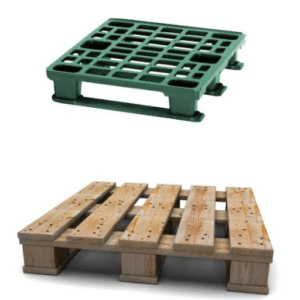
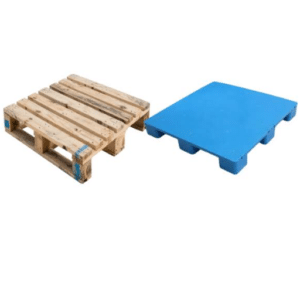
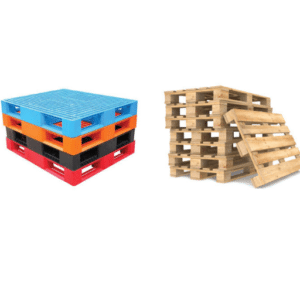
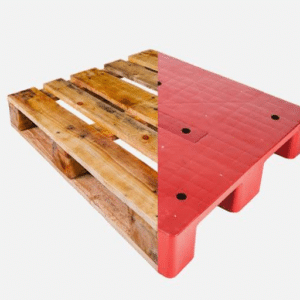
Custom durable plastic pallets are purpose-built pallets, injection-molded or rotationally molded to non-standard dimensions, materials, or reinforcements, engineered to survive repeated trips under loads and conditions that a standard plastic pallet cannot handle. You specify the exact size, deck, resin, steel reinforcement, and features, and the manufacturer molds to your requirements.
What if the “durable” pallet in your catalog is actually the most fragile link in your supply chain? That happens more often than buyers expect. A standard pallet rated for 1,000 kg racking load quietly fails the moment your parts weigh 1,400 kg, your beams span wider than the catalog assumes, or your washdown line hits temperatures the resin was never tested for.
This guide shows you how to decide whether to customize for durability, which design levers actually add strength, and what a custom build costs to spec, tool, and run. You will leave with a checklist you can hand to any supplier.
Key Takeaways
- Custom durable plastic pallets combine a non-standard size, resin, or reinforcement with repeat-trip strength, so they make sense only when a standard pallet genuinely falls short.
- The levers that add durability are material selection, deck and rib geometry, steel reinforcement, and the molding method itself.
- Custom builds routinely exceed standard ratings. One manufacturer’s thickened-deck HDPE pallet reached 2,500 kg dynamic and 10,000 kg static load.
- Mold tooling is the hidden cost. Expect roughly 3,000–3,000–10,000 for a prototype mold and $50,000+ for a multi-cavity steel production mold.
- Shandong Lile engineers custom pallets to exact dimensions, resins, steel layouts, and features, then validates them before production.
What Are Custom Durable Plastic Pallets?

A custom durable plastic pallet is a pallet molded to a specification that sits outside a standard catalog. The “custom” part covers dimensions, deck design, resin, reinforcement, or added features. The “durable” part means it survives many trips under defined load and environmental conditions.
These two ideas often travel together. When your load, rack span, temperature, or automation system is itself non-standard, durability is no longer a generic property. It becomes a specification problem. A pallet that is strong enough at 20°C may crack at -30°C. A deck that holds 1,000 kg on a short beam span may deflect badly on a longer one.
Rajesh, a plant engineer at an automotive components supplier, hit this exact wall. His injection-molded parts line needed pallets for a 1,400 kg stack of castings stored on unusually wide rack beams. Every standard pallet he tested sagged visibly within three months. He worked with a manufacturer to design a custom steel-reinforced pallet with a thicker deck and six runners. Deflection disappeared, and the pallets lasted through two years of daily cycles without a single failure.
The distinction matters because most buyers start from the wrong question. They ask “what is the most durable pallet?” when the real question is “what specification does my operation require?” Our custom plastic pallet design guide walks through that design process in detail.
When to Choose Custom Over a Standard Durable Pallet
Custom is not automatically better. It’s better only when a standard pallet fails to fit. Run through this decision checklist before you invest in tooling.
- Non-standard footprint. Your product, rack, or container needs a size no catalog carries.
- Load or rack span beyond standard ratings. Your static, dynamic, or racking load exceeds what off-the-shelf models publish.
- Demanding environment. Cold storage, washdown, chemical exposure, or outdoor UV requires a resin or design a catalog pallet doesn’t offer.
- Automation fit. An AS/RS or conveyor needs dimensional tolerance near ±2 mm, which may require a custom mold.
- Feature requirements. RFID, anti-slip surfaces, ESD protection, or molded branding.
- Enough volume to amortize tooling. A production mold is a real investment, so the order volume must justify it.
If a standard durable pallet already meets your spec, buy it. It’s cheaper, faster, and proven. Custom earns its cost only when the catalog genuinely comes up short.
Not sure whether your operation needs custom? Compare our standard and heavy-duty pallet range first →
Design Levers That Increase Durability
Four engineering levers determine how durable a custom pallet becomes. Pull the right ones, and you get repeat-trip strength without overbuilding.
Material Selection
The resin is the foundation. HDPE offers impact toughness and low-temperature flexibility, which makes it the usual choice for heavy loads and freezer work. PP is stiffer and tolerates higher temperatures, which suits steam cleaning and autoclave environments. LLDPE delivers heavy-duty hygienic performance.
Virgin resin provides the most predictable wall thickness and load ratings. Recycled resin can be durable, but “recycled” alone does not guarantee extreme-load performance. For a deeper comparison, see our custom plastic pallet materials guide.
Geometry and Structure
How a pallet is shaped matters as much as what it is made of. A thicker deck resists point loads. Reinforced ribs spread stress across the platform. An optimized runner and base geometry controls how the pallet sits on beams and forks.
Deck type changes behavior too. An open deck drains well and stays light. A closed deck is easier to clean. A ventilated deck balances the two. Four-way entry and reinforced fork-impact zones reduce the handling damage that shortens service life.
Steel Reinforcement
When static or racking loads climb, internal steel tubes or cores carry the stress that plastic alone cannot. Galvanized steel resists corrosion. The number, thickness, and placement of tubes determine the final rating. For the mechanics of this, read our steel reinforced plastic pallet page.
Molding Method
The manufacturing process shapes what is possible.
| Method | Best for | Trade-off |
|---|---|---|
| Injection molding | High volume, tight tolerance, heavy duty | Higher mold cost |
| Structural foam | Lighter parts (20–30% lighter) | Wider tolerances |
| Rotational molding | Seamless, large, low-volume designs | Slower, thicker walls |
| Blow molding | Lightweight nestable pallets | Lower load ratings |
Injection molding is the workhorse for custom durable pallets because it delivers the dimensional consistency and structural integrity that automation and racking demand. Rotational molding suits large one-piece designs where a lower tooling cost matters more than tight tolerance.
Lena, a cold-chain logistics manager, learned the difference firsthand. Her frozen-food operation needed a washdown-safe pallet rated to -30°C that would not trap water. She chose a closed-deck, HDPE injection-molded design with drainage channels and stainless-adjacent hygiene features. The custom mold cost more up front, but the pallets eliminated contamination risk and outlasted her previous wood and standard plastic fleet by a wide margin.
How Custom Pallets Are Engineered and Validated

A credible custom build follows a structured path. It starts with requirements and ends with proof.
- Needs alignment. Define industry, cargo weight, load types, and how the pallet interfaces with forklifts, conveyors, and racks.
- Feasibility study. Evaluate materials, loading, cost, and lifecycle.
- CAD and finite element analysis (FEA). Simulate how the design behaves under static, dynamic, and racking loads before cutting steel.
- Mold design and fabrication. Build the tooling that will form the pallet.
- Prototyping. Validate the design with 3D-printed, CNC-machined, or short-run prototype molds.
- Validation. Confirm performance against a standard such as ISO 8611, which defines test methods for flat pallets.
- Production. Run full production with quality assurance in place.
FEA is the step that separates engineered pallets from guesswork. It predicts deflection and stress concentration before a single mold is cut, which is far cheaper than discovering a weakness in a finished tool. TriEnda’s design-input guidance is a useful reference for the information a manufacturer should ask for up front.
For automation, dimensional verification with a coordinate measuring machine and a test on the actual conveyor route matter more than a paper spec. A pallet that is 2 mm out of tolerance can jam an AS/RS and stop a line.
Load Ratings for Custom Durable Pallets
Custom builds earn their keep in the load numbers. Standard plastic pallets commonly rate 1,000–2,500 kg dynamic and 3,000–10,000 kg static. A custom heavy-duty design can exceed those limits.
ThoYu documents a custom HDPE pallet that reached 2,500 kg dynamic and 10,000 kg static by thickening the deck, reinforcing the ribs, and optimizing the base. The pallet weighed 26 kg versus 18 kg for a standard model. That extra mass was the price of the added capacity.
Ratings only mean something when you know the test conditions. Ask for beam span, load footprint, temperature, and safety margin. A static rating tested on a full-support floor tells you little about racking behavior on a wide span. For the full vocabulary of load types, see our plastic pallet load capacity guide.
A good rule is to operate below the published rating. Uneven loads, wear, and minor damage all eat into headroom, so a working limit of two-thirds of the rated racking load is a sound default.
What a Custom Build Costs: Mold, MOQ, and Lead Time
Mold tooling is the cost most suppliers avoid discussing, and it’s the number a bottom-funnel buyer most needs. Expect roughly 3,000–3,000–10,000 for an aluminum prototype mold and $50,000+ for a multi-cavity steel production mold. Cavity count, part size, and complexity push the figure higher.
Minimum order quantities and lead times vary by manufacturer and design. Many custom programs start around 50–300 pieces for color and branding changes, with production lead times in the 5–20 day range once tooling is complete. These are ranges, not Lile pricing, so confirm specifics with each supplier.
Priya, a procurement lead at a mid-sized industrial distributor, did the math before committing. Her team needed a custom 1200×1100 mm pallet with RFID pockets and an anti-slip deck. The steel mold quote was 55,000.Spreadacrossanexpected50,000palletsoverfiveyears,toolingaddedroughly55,000.Spreadacrossanexpected50,000palletsoverfiveyears,toolingaddedroughly1.10 per pallet, a small premium against the elimination of load shift and the drop in product damage. She approved the build, and the mold paid for itself within the first two years.
The payback question is always the same: does the avoided damage, longer life, and automation uptime exceed the tooling cost? If volume is low, a rotational mold or a modified standard design may be the cheaper path.
Ready to cost out a custom build? Request a custom pallet engineering review with our OEM team →
How to Spec a Custom Durable Plastic Pallet

A clear specification is what separates a smooth custom program from a failed one. Hand your supplier these inputs.
- Dimensions. Exact footprint, height, and any non-standard geometry.
- Load types. Static, dynamic, and racking loads, plus beam span and load distribution.
- Environment. Temperature range, washdown or chemical exposure, UV, and dwell time.
- Handling interface. Forklift type, conveyor, AS/RS, and any sensor requirements.
- Volume and timeline. Annual quantity and target delivery dates.
- Features. RFID, anti-slip, ESD, color, or molded branding.
Then ask the supplier for the evidence, not just the promise. Request test reports to ISO 8611, FEA results, a material declaration, and warranty terms. A manufacturer that can’t produce these for the exact model you’re ordering isn’t ready for a custom program.
Frequently Asked Questions
How much weight can a custom plastic pallet hold?
It depends on the design. Standard plastic pallets commonly rate 1,000–2,500 kg dynamic and 3,000–10,000 kg static. Custom reinforced designs can exceed these, with documented examples reaching 2,500 kg dynamic and 10,000 kg static.
How much does a custom plastic pallet mold cost?
Expect roughly 3,000–3,000–10,000 for a prototype mold and $50,000+ for a multi-cavity steel production mold. Size, complexity, and cavity count drive the final price.
What is the minimum order quantity for custom plastic pallets?
Many programs start around 50–300 pieces, depending on the manufacturer and the extent of customization. Larger tooling investments typically require larger volumes to amortize.
HDPE or PP for a custom durable pallet?
HDPE for impact toughness and low-temperature work. PP for stiffness, heat, and washdown or autoclave environments. The choice depends on your specific load and environment.
Can custom pallets include steel reinforcement?
Yes. Internal steel tubes or cores are a common way to boost racking and static load capacity on a custom build.
Can custom pallets be made for cold storage or washdown?
Yes. Closed-deck HDPE designs with drainage channels and temperature-rated resin are standard for freezer and washdown applications.
Conclusion
Custom durable plastic pallets are not a status upgrade. They are an engineering answer to a specific problem, the moment when a standard pallet’s size, resin, or rating stops matching your operation. The skill is knowing when that moment has arrived and which lever to pull.
Start with the load and environment, not the catalog. Decide whether a standard pallet fits. If it doesn’t, choose the material, geometry, reinforcement, and molding method that close the gap. Then validate the design with FEA and testing, and cost the tooling honestly against volume.
At Shandong Lile, we help logistics and manufacturing teams make that call. We hold ISO 9001 certification, serve more than 108 countries, and mold custom pallets to exact dimensions, resins, steel layouts, and features. We would rather ask the right questions up front than sell you a pallet that fails quietly later.