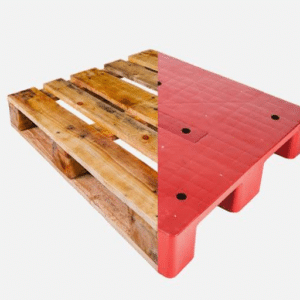
Plastic pallets typically weigh 15 to 22 kg (33 to 48 lb), while a standard wood pallet weighs 24 to 30 kg (53 to 66 lb), roughly 25% to 33% heavier. If you only need the quick number, there it is.
But the plastic vs wood pallet weight question is never settled by a single figure. The weight on the scale is only half the story. The other half is what that weight does to your freight bill, your payload, and your workers’ backs, every single trip.
Key Takeaways
- A standard wood pallet weighs 24 to 30 kg (53 to 66 lb); a comparable plastic pallet weighs 15 to 22 kg (33 to 48 lb), about 25% to 33% lighter.
- Wood absorbs moisture, so its tare weight shifts with humidity, from roughly 40 lb kiln-dried to 70 lb green. Plastic tare weight stays fixed for the life of the pallet.
- Lighter tare weight frees payload: a 12 lb plastic pallet versus a 60 lb wood pallet lets you ship 48 lb more product on the same load.
- Heavy-duty rackable plastic pallets can match or exceed wood weight, so compare model to model at your required load rating.
- For empty return trips, nesting matters more than raw weight: nestable plastic pallets load about twice as many empties per trailer.
Maria runs dispatch for a regional food distributor in Ohio. Every week her fleet moves about 40 truckloads of palletized goods, and every week the freight invoices arrive a little different. It took her a year to realize why.
“The pallets themselves,” she told us. “I was shipping wood pallets that soaked up water in the cooler, and I was paying freight on that water.” She switched her closed-loop routes to plastic and cut roughly 200 kg of dead weight per truckload. That one change paid for itself in a single quarter.
Here’s the full breakdown, from exact weights by pallet type to the freight math that turns pounds into dollars.
Why Pallet Weight Matters More Than You Think

Pallet weight is easy to ignore because it sounds like a small number. A few kilograms here, a few pounds there. Over a year of truckloads, those small numbers compound into real money and real safety risk.
Freight is billed on shipment weight, not product weight. The pallet is part of that shipment. A lighter pallet means the carrier bills you for less dead weight and leaves more capacity for the product you actually sell. That’s the whole freight argument in one sentence.
There are three places pallet weight hits your operation:
- Freight cost. Shipment weight includes the tare weight of every pallet. Lighter pallets lower the billable weight on every load.
- Payload. A lighter pallet frees load capacity, so the same truck can legally carry more product before hitting weight limits.
- Ergonomics and safety. Workers lift empty pallets constantly. OSHA and manual-handling guidelines favor lighter loads, and a 30 lb pallet is far easier to reposition than a 65 lb one.
Automation adds a fourth dimension. Automated storage and retrieval systems and conveyors are calibrated for consistent dimensions and weight. A pallet that weighs a predictable amount keeps those systems running smoothly, while a pallet whose weight drifts with the weather can throw off sensors and tolerances.
The takeaway is simple. Weight isn’t a cosmetic spec. It’s a cost line and a safety line hiding in plain sight.
Want to see how lightweight designs hold up in real handling? Explore our plastic pallet range and compare load ratings across nestable, rackable, and export models.
How Much Does a Wood Pallet Weigh?
A standard 48 by 40 inch GMA wood pallet usually weighs between 33 and 48 lb (15 to 22 kg), according to pallet manufacturers. Block pallets run heavier, from 55 to 75 lb (25 to 34 kg), because they use more lumber.
The number varies widely for three reasons. Construction type matters first. Stringer pallets use less wood than block pallets, so they weigh less. Softwood pallets made from pine or spruce average 30 to 50 lb, while hardwood pallets made from oak or maple average 40 to 70 lb.
Moisture matters second, and this is the part most buyers overlook. Wood is porous. A freshly cut, green hardwood pallet can weigh close to 70 lb, while the same pallet kiln-dried might drop to 40 lb. The pallet didn’t shrink. It just held less water.
Age and condition matter third. A wood pallet accumulates nails, patches, and absorbed liquids over its working life, all of which add weight a spec sheet will never show.
So when you ask how much a wood pallet weighs, the honest answer is a range, not a number. And the range moves with the weather and the warehouse.
How Much Does a Plastic Pallet Weigh?
A plastic pallet weighs anywhere from 13 to 50 lb (6 to 23 kg), depending on its design and duty rating. The design is what drives the spread.
- One-way export pallets are the lightest, often 13 to 15 lb (6 to 7 kg). They are built to ship product once and be handed off.
- Nestable pallets weigh roughly 15 to 30 lb (7 to 14 kg). They sacrifice some strength for the ability to stack into each other when empty.
- Rackable pallets are the heaviest, typically 40 to 50 lb (18 to 23 kg), because they are reinforced to sit on warehouse racking beams without a center support.
The material is high-density polyethylene (HDPE) or polypropylene (PP). Both are lighter than comparable wood for the same footprint, and neither absorbs moisture. That means a plastic pallet’s tare weight is the same on day one and day one thousand.
Lightweight plastic pallets are the fastest-growing segment precisely because they pair low weight with durability. They are popular in food, pharma, and e-commerce where clean handling and easy lifting matter as much as the freight math.
The trade-off is load rating. The lightest plastic pallets hold less weight than a heavy rackable model, so weight and capacity must be chosen together, not separately.
The Moisture Variable: Why Wood Weight Fluctuates

Here is the difference that no competitor article emphasizes, and it is the single most useful thing to understand about plastic vs wood pallet weight.
Wood is hygroscopic. It absorbs and releases moisture from the air around it. Store a wood pallet in a humid cooler in Miami and it can weigh 75 lb. Ship that same pallet to a dry warehouse in Phoenix and it might weigh 68 lb. The pallet did not change. Its water content did.
Because freight is billed on actual shipment weight, that means the same wood pallet can cost a different amount to ship on different days. You can’t forecast it precisely. You can only estimate it and absorb the variance.
Plastic does not absorb moisture. A plastic pallet’s tare weight is fixed for its entire service life. You know exactly what you are shipping, every time, which makes freight costs predictable and lets you quote accurately to your own customers.
This consistency is one of the quiet advantages logistics managers cite most after switching. It’s not flashy, but it removes a variable from the math, and logistics runs on removing variables.
Plastic vs Wood Pallet Weight: The Full Comparison Table
Here is the side-by-side, model by model, so you can compare like with like rather than a best-case plastic against a worst-case wood.
| Pallet type | Typical weight (lb) | Typical weight (kg) | Notes |
|---|---|---|---|
| Wood stringer (GMA 48×40) | 33 to 48 | 15 to 22 | Softwood lighter, hardwood heavier |
| Wood block pallet | 55 to 75 | 25 to 34 | More lumber, higher load rating |
| Plastic one-way export | 13 to 15 | 6 to 7 | Lightest, single-trip use |
| Plastic nestable | 15 to 30 | 7 to 14 | Stacks into itself when empty |
| Plastic rackable | 40 to 50 | 18 to 23 | Reinforced for racking, similar to wood |
Read the table honestly and you will notice something. Plastic is usually lighter, but not always. A rackable plastic pallet engineered to hold 2,800 lb on racking can weigh about as much as a wood pallet. The meaningful comparison is always model to model, at the load rating your operation actually needs.
The rule of thumb that survives the nuance: for a standard, comparable footprint, plastic runs about a quarter to a third lighter than wood. Mecalux puts wood at around 25 kg versus plastic as light as 15 kg. Warehouse and Logistics News describes plastic as lighter “almost by a third.”
What Lighter Tare Weight Actually Saves You in Freight
Numbers on a scale are abstract until you convert them into money. Let us do that.
A 12 lb plastic pallet versus a 60 lb wood pallet frees 48 lb of payload per pallet. Fill a 53-foot trailer with 26 pallets and that is over 1,200 lb of extra product capacity on a single load, product you were previously leaving on the dock.
The fleet-level math is bigger. iGPS estimates that replacing the roughly one billion wood pallets in U. S. circulation would remove more than 28 billion pounds of non-value freight from the road. That is freight carriers haul, and shippers pay for, that contributes nothing to the bottom line.
A real-world trial by German express carrier trans-o-flex measured the difference directly. Switching a route from 24 kg wood pallets to 18 kg plastic pallets cut a full articulated truck’s transport weight by over 200 kg per journey. Over a year of daily runs, that is tens of thousands of kilograms of dead weight that no longer needs fuel to move.
Marcus manages a regional beverage distributor in Texas. He ran the numbers on one lane, Atlanta to Dallas, and found his 48 by 40 wood pallets were adding roughly 1,800 kg of tare weight per truckload across the trailer. Switching to nestable plastic cut that by a third and let him add two more pallet positions per trailer without exceeding weight limits. “I did not buy lighter pallets to save fuel,” he said. “I bought them to fit more product. The fuel was the bonus.”
It is worth restating the caveat. If your loads are heavy and you need rackable pallets, the weight advantage shrinks. The freight win belongs to operations that can use nestable or standard-duty plastic. Match the pallet to the load first, then count the freight savings.
If you are calculating total cost, weight is only one line. See the full picture in our plastic pallets vs wood pallets comparison, which covers cost, lifespan, and load capacity together.
Nesting: The Bigger Lever for Empty-Trip Logistics
For return trips, raw weight is not the biggest lever. Nesting is.
Nestable plastic pallets slide into each other when empty, at roughly a 2.25 to 1 ratio. That means a trailer can carry about twice as many empty plastic pallets as it can stacked wood pallets. Wood pallets do not nest. They stack flat, taking up the same room empty as they do full.
If you run a closed loop where trucks return empty pallets to the warehouse, nesting compounds your savings far faster than the weight difference alone. You are moving fewer trailers, or fitting more returns per trailer, on every cycle.
How to Choose the Right Pallet for Your Operation

Weight should not be the only deciding factor, but it should be a conscious one. Here is a simple way to work through it.
- One-way shipping or export. Choose a lightweight plastic export pallet, around 13 to 15 lb. You get the weight savings without the return-trip cost, and you avoid the wood pallet treatment and customs requirements.
- Closed-loop distribution with returns. Choose a nestable plastic pallet. The weight savings help, and the nesting ratio is where the real return-trip economics live.
- Heavy loads or racking. Choose a rackable plastic pallet and accept that its weight is close to wood. Capacity and racking safety outweigh the freight math here.
- Food, pharma, or clean environments. Choose plastic for the washability and consistent weight. These sectors value predictable, hygienic handling above all.
Weight is one input in a larger decision. It belongs alongside load capacity, lifespan, hygiene, and total cost of ownership. Our plastic pallet load capacity guide covers the strength side, and our lightweight pallets article goes deeper on low-weight designs.
For bulk and heavy-load handling, plastic pallet boxes are worth considering in the same evaluation.
Conclusion
Plastic pallets are generally lighter than wood, about 25% to 33% for a standard footprint. But the more valuable insight is that plastic weight is consistent while wood weight fluctuates with moisture, and consistency is what makes freight costs predictable.
Here is what to remember:
- A standard wood pallet weighs 24 to 30 kg; a comparable plastic pallet weighs 15 to 22 kg.
- Wood absorbs moisture, so its weight shifts with humidity. Plastic stays fixed for life.
- Lighter tare weight frees payload and lowers freight, fleet-wide and over time.
- Rackable plastic pallets can match wood weight, so compare model to model.
- For empty return trips, nesting saves more than raw weight.
At Shandong Lile, we engineer plastic pallets across the full weight and duty spectrum, from 6 kg export pallets to reinforced rackable models, with ISO 9001 quality and a presence in over 108 countries. Whether you need to cut freight weight or handle heavy loads, we can tailor a solution to your exact operation.
Get a free quote and we will help you calculate the real freight and payload impact of switching your pallet fleet.