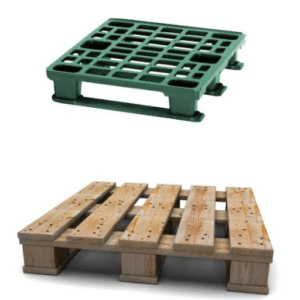
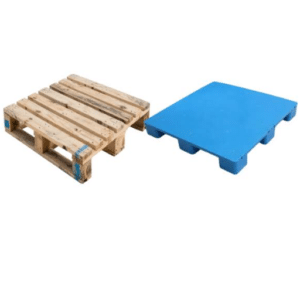
Here is the honest answer up front: neither material is universally greener. Wood pallets carry a lower carbon footprint at the point of manufacture, but plastic pallets win on durability, recyclability, and hygiene, and their per-trip impact often comes out ahead once reuse and recycling are counted.
Ask ten supply chain managers which pallet is greener and you will get ten different answers, most of them built on a half-truth. Wood is natural, so it must be better, right? Not exactly.
It is a fair instinct. Wood is renewable, biodegradable, and stores carbon as it grows. But the real answer to plastic vs wood pallets environmental impact depends on how you measure it: one pallet made, or one pallet used for a decade. That distinction changes everything.
This guide breaks down the actual life-cycle data, the durability gap, the recycling story, and the export rules most comparisons ignore. By the end, you will be able to make a decision you can defend to your CFO and your sustainability team.
Key Takeaways
- Wood pallets use less energy to produce, roughly 4 kg versus 39 kg of CO2e per pallet at the factory gate.
- Over a full service life the gap narrows sharply. A plastic pallet completing 100 to 200 trips often beats wood on a per-trip basis.
- Plastic pallets are 100% recyclable. Damaged units can be ground down and remolded into new pallets in a closed loop.
- Wood pallets need ISPM-15 treatment for international shipping. Plastic pallets are exempt, with no chemical fumigation.
- The right choice depends on your operation. Closed-loop, hygienic, and export-heavy supply chains generally favor plastic.
What Is the Environmental Impact of Plastic vs Wood Pallets?

The environmental impact of plastic vs wood pallets comes down to five measurable factors: carbon footprint, durability, recyclability, hygiene, and regulatory compliance. Wood tends to score better on raw production emissions and biodegradability. Plastic tends to score better on lifespan, reuse, cleanliness, and circularity.
| Factor | Wood Pallet | Plastic Pallet |
|---|---|---|
| Production carbon | ~4 kg CO2e | ~39 kg CO2e |
| Typical trips | 5 to 30 | 100 to 200+ |
| Lifespan | 3 to 4 years | 10 to 15 years |
| Recyclability | Repairable, then mulch or fuel | 100% recyclable into new pallets |
| Export treatment | ISPM-15 required | Exempt, no fumigation |
| Hygiene | Absorbs moisture, can harbor pests | Non-porous, washable |
The table makes the tradeoff clear. Wood is cheaper to produce and easier to discard. Plastic is more durable and cleaner, and it keeps material in use far longer. Which side you weight more heavily depends on how your pallets actually move through your operation.
Want to see how a durable plastic pallet performs in a real supply chain before you commit? Explore our plastic pallet range →
Carbon Footprint: Where Wood Wins, Where the Gap Narrows
This is the section where most “which is greener” articles quietly pick a side and stop being fair. We will not do that, because the data is clear in both directions.
Production: Where Wood Has the Edge
At the point of manufacture, wood pallets are lighter on carbon. A 2022 Chilean study measured wood pallets at roughly 4.12 kg of CO2 equivalent each, against 38.85 kg for a plastic pallet, nearly a nine-to-one gap. The difference comes mostly from the raw material: virgin resin production for plastic is energy intensive, while a wooden pallet starts with a tree that already captured carbon.
If your only question is “what is cheaper to produce in carbon terms,” wood wins this round, and it is not close.
Full Life Cycle: How the Gap Narrows
That production number is not the whole story. A 2022 Australian study tracked both materials across 100 trips and found a plastic pallet generated about 216 kg of CO2e versus 144 kg for wood, roughly one and a half times higher rather than nine times. The gap shrinks because a single plastic pallet replaces several wooden ones over the same number of shipments.
Why the “Functional Unit” Changes Everything
Here is the key idea most comparisons skip. An environmental impact statement is only meaningful if you define what one “unit” of comparison is. Compare one pallet against one pallet, and wood looks unbeatable. Compare the pallets needed to complete 100 trips, and plastic closes most of the gap. Compare across a decade of service, and the picture shifts again.
Think of it like two cars. One burns less fuel per mile, but it needs replacing every three years. The other costs more up front but runs for a decade. The honest comparison is total cost per mile over the vehicle’s life, not the sticker price.
Durability and Lifespan: Why More Trips Mean Less Waste

The single biggest environmental argument for plastic is also the simplest: it lasts far longer.
Trip Counts: 200 Versus 11
A widely cited study from the Center for Packaging and Unit Load Design at Virginia Tech put a plastic pallet through 200 cycles without failure, while a wood pallet in the same conditions showed damage after just 11 trips. Not every operation will hit 200 trips, but the direction is consistent across studies.
Lifespan: A Decade Versus a Few Years
Plastic pallets typically last 10 to 15 years. Wood pallets average 3 to 4 years before they need significant repair or replacement. That difference is not just about budget. Every wooden pallet that gets built, shipped, broken, and discarded is a fresh draw on timber, nails, energy, and transport.
The Material Throughput Argument
Consider this: if one plastic pallet does the work of ten wooden pallets over its life, you are manufacturing, shipping, and disposing of a fraction of the total material. That is the environmental win most people overlook when they fixate on the production number.
Marcus runs a regional distribution center in Ohio. Every month he tracked pallet damage and replacements on a whiteboard. When he switched his closed-loop warehouse runs to durable plastic pallets, his replacement orders dropped from a steady trickle to near zero over two years. “The plastic pallets cost more on the invoice,” he said, “but I stopped thinking about pallets entirely. That was the real savings.” Fewer pallets ordered meant fewer trucks, fewer trees, and less waste, all at once.
Curious how many years you can realistically expect from a plastic pallet? See our plastic pallet lifespan breakdown →
Recyclability and the Circular Economy
Wood gets praised for being biodegradable. Plastic gets praised for being recyclable. Both claims are true, but they lead to very different outcomes.
100% Recyclable, Again and Again
Plastic pallets are typically made from high-density polyethylene (HDPE) or polypropylene (PP), and both are 100% recyclable. When a pallet finally reaches the end of its working life, it is not landfilled. It is ground into flakes, melted down, and molded into a new pallet. The material keeps working.
This is more than a nice slogan. A 2024 study from Chalmers University found that continuously recycled plastic pallets can reach net-negative emissions in a closed loop, because recycling keeps carbon locked in the material instead of releasing it through incineration or new production.
What Happens to a Wood Pallet
A wood pallet can be repaired, which is a genuine strength, but repair has limits. Once a pallet is too damaged or contaminated, it becomes mulch, animal bedding, or fuel. Those are useful outlets, but they release the stored carbon rather than keeping it in circulation. A wood pallet’s end of life is usually a one-way trip.
A Note on Fairness
For the record, wood has a circular lever too. Studies show that using recycled wood waste instead of virgin softwood can cut a wooden pallet’s footprint by about 13%. Both materials improve with circularity. The difference is that plastic circularity is built into the material itself, not added at the margins.
A cold-chain food distributor in the Southeast made recycled HDPE pallets the backbone of its internal loop. Damaged pallets went back to the supplier, came back as new pallets, and the company stopped buying virgin material almost entirely. Their sustainability report framed it simply: “We did not buy pallets this year. We rented the same material over and over.”
Export Compliance: ISPM-15 and the Hidden Cost of Wood
Here is a factor that rarely appears in environmental comparisons, even though it has real environmental weight for any company shipping across borders.
What ISPM-15 Requires
ISPM-15 is the international standard for wood packaging material. To move untreated wood across most international borders, pallets must be treated, either with heat treatment or with methyl bromide fumigation, and stamped with the ISPM-15 mark. Methyl bromide is a fumigant being phased out in several countries precisely because of its environmental and health impact.
Why Plastic Pallets Are Exempt
Plastic pallets are not made of raw wood, so they are exempt from ISPM-15 entirely. No fumigation, no heat treatment, no stamp, no risk of a container being held at customs because the mark was smudged. For a company exporting to 108 countries, as we do at Shandong Lile, that is not a trivial detail. It is the difference between a smooth clearance and a re-export.
The Compliance Ripple Effect
Priya is an export coordinator for a furniture manufacturer shipping to Australia and the EU. She watched a full container get flagged at a destination port because one pallet’s ISPM-15 mark had been damaged during handling. The container sat for three weeks, then had to be re-fumigated at the port. “The pallets were the cheapest line item on the invoice,” she said, “and they nearly cost us a customer.” Switching to plastic pallets removed the variable entirely.
Hygiene, Moisture, and Food Safety
Environmental impact is not only about carbon. Contamination and product loss are environmental issues too, and they are where the two materials diverge most sharply.
Wood is porous. It absorbs moisture, which can lead to mold, and it can harbor insects and splinters. In food, beverage, and pharmaceutical settings, that is a contamination risk. Plastic is non-porous. It does not absorb liquids, it resists pests, and it can be washed and sanitized between uses.
A plastic pallet that can be cleaned and reused a hundred times in a food plant is doing environmental work that never shows up in a carbon spreadsheet. It is preventing spoiled product, rejected shipments, and the waste of everything stacked on top of it.
The 2025 Shift: Reusability and the EU PPWR
The regulatory winds are now blowing toward plastic, or more precisely, toward reusability.
The European Union’s Packaging and Packaging Waste Regulation (PPWR), rolling out through 2025 and beyond, pushes hard toward reusable packaging formats. Reusable plastic pallets, especially those managed in pooling models, align directly with that direction. One industry study from ITENE and Miebach found that reusable plastic pallets in a pool delivered up to 30% fewer CO2 emissions and 67% lower water consumption compared with one-way alternatives.
The underlying logic is the same one we have been making throughout: the more times a pallet is used, the lower its per-trip impact, and plastic is simply built to be used more times.
Plastic vs Wood Pallets: How to Choose

So which should you pick? The honest answer is that it depends on your operation. Here is a decision framework you can use.
Choose plastic when:
- You run a closed-loop or returnable supply chain.
- You ship internationally and want to avoid ISPM-15 treatment.
- Hygiene matters, such as food, beverage, or pharmaceutical handling.
- You use automation, which rewards consistent dimensions.
- You operate in cold storage or high-moisture environments.
Choose wood when:
- You need one-way, outbound shipments where pallets will not return.
- Upfront budget is the single dominant constraint.
- You have an established repair and recovery program.
Most mixed operations land on a hybrid: plastic for the internal, high-turn, hygienic loop, and wood for the occasional outbound shipment. That is not a cop-out. It is the most accurate answer to the question.
At Shandong Lile, we have spent more than a decade engineering plastic pallets specifically for the reuse-heavy scenarios above. Our pallets are molded from 100% recyclable HDPE and PP, ISO 9001 certified, and built to last through years of trips rather than months. If your operation fits the “choose plastic” column, we would rather show you than tell you.
Request a free quote for custom plastic pallets →
Frequently Asked Questions
Are plastic pallets more environmentally friendly than wood?
It depends on how you measure. Wood pallets have a lower carbon footprint to produce, but plastic pallets last far longer, are 100% recyclable, and avoid ISPM-15 treatment. Over a full service life with reuse, plastic is often competitive or better.
Are plastic pallets recyclable?
Yes. Most plastic pallets are made from HDPE or PP, both 100% recyclable. At the end of their life, they are ground into flakes and remolded into new pallets, keeping the material in use in a closed loop.
What is the carbon footprint of a plastic pallet versus a wood pallet?
At production, wood is lower, roughly 4 kg versus 39 kg of CO2e per pallet. Across 100 trips, a plastic pallet emits about 216 kg versus 144 kg for wood, a much narrower gap.
Do plastic pallets need ISPM-15 treatment?
No. Plastic pallets are exempt from ISPM-15, the standard that requires wood packaging to be heat treated or fumigated before international shipping.
How long do plastic pallets last compared to wood?
Plastic pallets typically last 10 to 15 years, versus 3 to 4 years for wood. In controlled reuse, plastic can complete 100 to 200 trips, while wood often shows damage after 11.
Conclusion
The plastic vs wood pallets environmental impact question has no single right answer, but it does have a clearer one than most articles admit. Wood pallets win on production carbon and biodegradability. Plastic pallets win on durability, recyclability, hygiene, and export compliance, and their full-lifecycle impact is competitive or better once reuse is counted.
Here is what to remember:
- Compare per trip, not per pallet, and the carbon gap narrows dramatically.
- One plastic pallet often does the work of ten wooden ones over its life.
- Plastic is 100% recyclable and can be remolded into new pallets indefinitely.
- Export-heavy operations avoid ISPM-15 fumigation by choosing plastic.
- The EU PPWR is pushing the whole industry toward reuse, and plastic is built for it.
The greenest pallet is not the one with the smallest production footprint on paper. It is the one that stays in service the longest, wastes the least, and fits how you actually work. For a growing number of supply chains, that pallet is made of plastic.
Explore our recycled plastic pallets guide to see how circular, reusable pallets can work in your operation, or contact our team to talk through the right solution for your specific loads, routes, and standards.