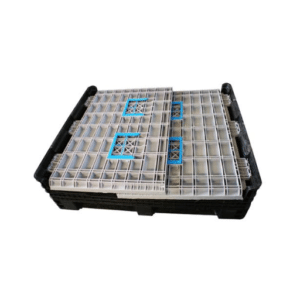
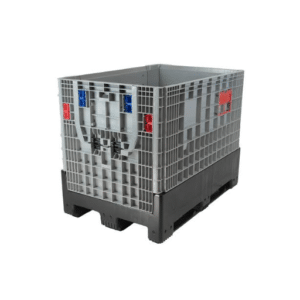
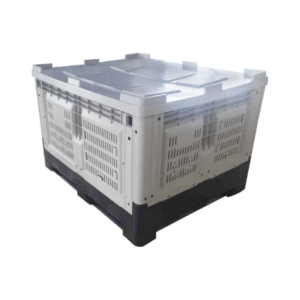
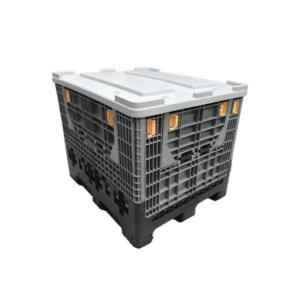
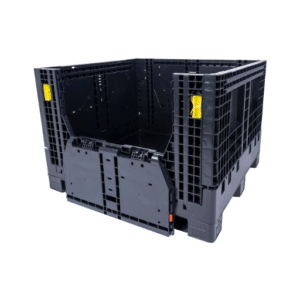
Custom plastic pallet design is the structured engineering process of turning operational requirements into a manufacturable pallet specification. It covers load analysis, material selection, and CAD modeling. It also includes mold-flow simulation, prototyping, and production tooling. The finished pallet fits your product, equipment, and compliance needs exactly.
Most supply-chain problems that look like “a pallet issue” are actually a custom plastic pallet design issue. A poorly specified pallet cracks in racking. It jams conveyors. It fails hygiene audits. Sometimes it forces you to pay for unused space in every truck.
When Marcus, a packaging engineer at a Midwest food processor, switched to a custom HDPE pallet with closed deck and color-coded corners, his team eliminated wood splinter contamination. Audit prep time dropped by 60%. The pallet itself did not change the business. The design did.
In this guide, you will learn how custom plastic pallet design works. You will discover how to brief a manufacturer, what engineering decisions matter most, and how to validate a design before committing to tooling. Whether you manage logistics, procurement, or product engineering, you will leave with a practical workflow you can use on your next pallet project.
Key Takeaways
- Custom plastic pallet design follows a six-step workflow: requirements, material selection, CAD/CAE, prototyping, production tooling, and smart-feature integration.
- HDPE handles most industrial and food applications, while PP suits higher temperatures; steel reinforcement can raise racking loads from 500 kg to over 2,000 kg.
- Mold investments typically range from 5,000to5,000to50,000+, but optimized designs often break even within 12–24 months through reduced damage, longer life, and better cube utilization.
- Automation-ready designs need tight tolerances (±0.1–2 mm), flat decks, consistent fork openings, and optional RFID or barcode tracking.
- A clear design brief saves time and rework by documenting load, environment, handling, compliance, and volume requirements before CAD work begins.
What Is Custom Plastic Pallet Design?
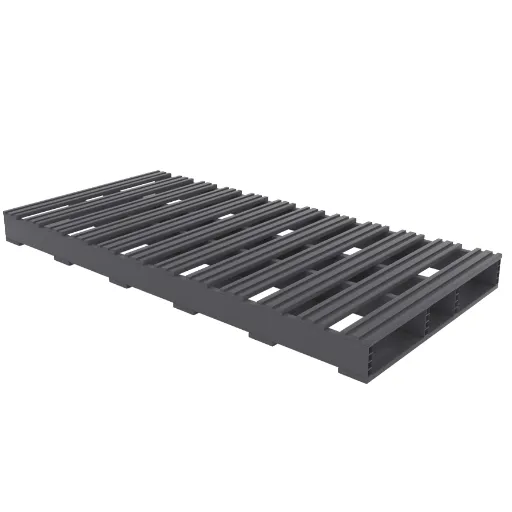
Custom plastic pallet design is the process of engineering a pallet from scratch. It can also mean adapting a near-standard platform so it matches a specific application. The outputs of custom plastic pallet design usually include a 3D CAD model, a mold-flow analysis, a material specification, a validated prototype, and a production mold plan.
This is different from selecting a stock pallet. Stock pallets are faster to source and cheaper per unit, but they force your operation to adapt to the pallet. A custom pallet design flips that relationship. Instead of fitting your operation to the pallet, custom plastic pallet design fits the pallet to your product footprint, racking system, conveyor spacing, cleaning protocol, and regulatory requirements.
A complete custom plastic pallet design package also answers questions most buyers do not think to ask until something fails. Will the material hold up in a -25°C freezer? Can the deck support an uneven load without sagging? Will the fork openings match your automated guided vehicles every time? Good design surfaces these issues before steel is cut.
When Custom Plastic Pallet Design Is the Right Choice
Not every operation needs a fully custom pallet. If your products fit standard dimensions and your handling equipment is forgiving, an off-the-shelf plastic pallet is usually the smarter choice. Custom plastic pallet design becomes worth the investment when at least one of the following is true.
| Factor | Standard Pallet | Custom Design |
|---|---|---|
| Lead time | 1–4 weeks | 30–90 days |
| Upfront tooling | None | 5,000–5,000–50,000+ |
| Dimensional fit | Fixed sizes | Exact product footprint |
| Load optimization | Generic ratings | Static, dynamic, racking matched to load |
| Automation tolerance | ±3–5 mm typical | ±0.1–2 mm achievable |
| Traceability | Basic labels | RFID, barcode, color coding, embossing |
| Compliance | General use | FDA, GMP, ISPM-15, industry-specific |
Custom design is usually the right choice when:
- Your product dimensions differ more than 10% from standard pallet footprints.
- You use automated storage, retrieval, conveyor, or robotic systems.
- Loads are heavy, uneven, or stored in unsupported racking.
- You operate in extreme temperatures, wet environments, or washdown conditions.
- You need lot-level traceability, color coding, or branded identification.
- You ship internationally and want to avoid ISPM-15 treatment costs.
When Sarah took over automotive supply-chain operations for a tier-one supplier, she found that generic rackable pallets were flexing under engine blocks and damaging rack beams. A custom plastic pallet design with steel reinforcement and an exact part footprint reduced line-side damage by 40% and removed the quarterly rack repair bill.
Want to see how custom engineering fits your operation? Explore our custom plastic pallet design services or read our complete custom plastic pallets guide for sizing and procurement context.
Step 1: Define Requirements and Constraints
Before any CAD work begins, every successful custom plastic pallet design starts with a clear requirements brief. Vague inputs produce vague pallets. The more specific you are at this stage, the fewer prototypes and mold revisions you will need later.
Product and Load Requirements
Plastic pallet load capacity is the foundation of every design. Define three load types:
- Static load: weight the pallet supports while stationary on flat ground.
- Dynamic load: weight it supports while being moved by forklift or pallet jack.
- Racking load: weight it supports when stored on unsupported rack beams.
A common rule of thumb is that dynamic load is roughly one-third of static load, and racking load is one-half to one-sixth of static load depending on design. Always include a safety factor. Most industrial designs use 1.5× to 2× the expected maximum load.
Weight distribution matters as much as total weight. A 1,000 kg load concentrated in the center behaves differently from the same load spread evenly across the deck. Share your product footprint, center of gravity, and any point loads with your designer.
Environmental and Operational Conditions
Document the full operating environment:
- Temperature range, including freezer or oven exposure.
- Moisture, humidity, and chemical contact.
- UV exposure if pallets will sit outdoors.
- Cleaning methods, such as steam, pressure washing, or chemical sanitizers.
Handling and Automation Requirements
List every piece of equipment the pallet will encounter. Forklifts, pallet jacks, conveyors, shuttle systems, and robotic arms all impose different forces. They also impose different tolerances. For automation, specify required dimensional tolerances, deck flatness, and fork-entry dimensions in your pallet CAD design.
Compliance and Certification Needs
Common requirements include FDA and EU food contact. Pharmaceutical operations often need GMP compliance. Other standards include ISO 9001 for quality systems, ISPM-15 exemption for export, and RoHS/REACH for European markets. If you need certificates of conformity or material data sheets, state that upfront.
Step 2: Choose the Right Material for Custom Molded Plastic Pallets
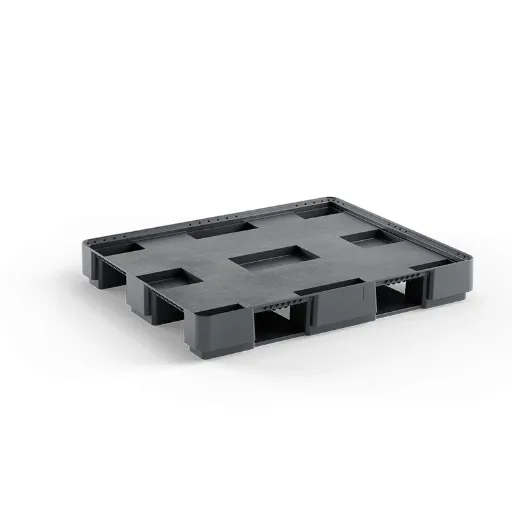
Once requirements are clear, material selection drives cost, durability, compliance, and sustainability for custom molded plastic pallets. The two most common base resins are high-density polyethylene (HDPE) and polypropylene (PP). Choosing the right material is a core decision in any custom plastic pallet design.
| Material | Best For | Key Properties |
|---|---|---|
| HDPE | General industrial, food and beverage | Impact resistant, moisture resistant, good low-temp performance |
| PP | Higher temperature, pharmaceutical | Stiffer, higher heat tolerance, chemical resistant |
| Virgin resin | Food, pharma, medical | Maximum strength, no contamination risk, longest life |
| 20% recycled blend | Moderate performance, sustainability | Balanced cost and quality |
| 50%+ recycled blend | Export, closed-loop, disposable | Lower cost, more variation in strength |
HDPE accounts for roughly 47% of plastic pallet material demand. It is the most common choice because it offers an excellent balance of toughness and cost. PP becomes the better choice when continuous operating temperatures exceed 60–70°C or when greater stiffness is required.
Specialty additives can be blended into either resin:
- UV stabilizers for outdoor storage.
- Flame retardants for safety-sensitive environments.
- Anti-static or ESD compounds for electronics.
- Color masterbatch for branding, SKU segregation, or allergen control.
At Lile, we guide customers through every stage of custom plastic pallet design. We use HDPE and PP sourced to meet ISO 9001 standards. We also offer recycled-content options for customers with closed-loop or sustainability targets. The right choice depends on load, environment, compliance, and budget. It should never be a one-size-fits-all default.
Step 3: Structural and CAD Design
After material selection, the focus shifts to structure. This stage of custom plastic pallet design determines how the pallet carries load, how it interacts with equipment, and how it will be molded. Plastic pallet engineering at this stage separates a durable design from one that fails prematurely.
Pallet Configuration Options
- Nestable: tapered legs stack inside each other for empty-return efficiency.
- Stackable: flat reinforced top deck supports vertical stacking.
- Rackable: reinforced for unsupported beam racking.
- Block design: four-way entry, heavy loads, automation friendly.
- Stringer design: lighter, often two-way entry, lower cost.
Deck Design
An open deck drains well and weighs less. A closed deck is easier to clean and protects smaller products. Anti-slip pads, drainage channels, and recessed tie-down points can be added where needed.
Reinforcement Strategies
Steel tubes increase racking capacity dramatically. A standard plastic pallet might rack 500–1,000 kg. With steel reinforcement, steel reinforced plastic pallets can exceed 2,000 kg racking loads. Ribs, wall thickness, and corner geometry also spread impact and point loads.
CAD Modeling and Mold Flow Analysis
Engineers model the pallet in 3D using software such as UG, SolidWorks, or PROE. They then run mold-flow analysis to simulate how molten plastic will move through the mold. This computer-aided engineering step, often called plastic pallet mold design simulation, reveals potential problems before any steel is cut:
- Fill time shows whether the mold fills evenly.
- Pressure distribution highlights thin or weak sections.
- Temperature mapping prevents material degradation.
- Weld-line prediction identifies where flow fronts meet and may create weak points.
Gate placement and cooling-channel design are also optimized at this stage. For large pallets, multi-point hot-runner systems maintain consistent flow and reduce cycle times. This is where plastic pallet engineering separates a durable design from one that fails prematurely.
Step 4: Plastic Pallet Prototyping and Load Validation
With the CAD model complete, the next phase of custom plastic pallet design is physical validation. Virtual simulation is essential, but plastic pallet prototyping is non-negotiable. Methods include 3D-printed samples, CNC-machined prototypes, and short-run prototype molds.
Load Testing Protocols
Every custom design should pass three core tests:
- Static load test: an evenly distributed load is applied for 24 hours to measure deflection and recovery.
- Dynamic load test: the pallet is moved over obstacles or dropped to simulate forklift handling.
- Racking load test: the pallet spans two rack beams with a centered load to verify beam deflection limits.
Dimensional verification using a coordinate measuring machine (CMM) confirms that the prototype matches the CAD model within tolerance. If the pallet is destined for automation, fork-entry width, deck flatness, and overall height are checked repeatedly.
Design Iteration
Rarely does the first prototype pass every test. Wall thickness, rib placement, or steel-tube location may need adjustment. Iterating on a prototype mold is far cheaper than modifying a production mold after launch.
Step 5: Production Mold and Manufacturing
After the prototype passes validation, the production mold is machined. Mold material and cavitation depend on volume and budget. This step turns your custom plastic pallet design into a repeatable manufacturing process.
| Mold Type | Cost Range | Best For |
|---|---|---|
| Aluminum prototype mold | 3,000–3,000–10,000 | Low-volume validation |
| Steel production mold | 10,000–10,000–50,000+ | High-volume, long life |
| Multi-cavity steel mold | 50,000–50,000–100,000+ | Very high volumes |
The manufacturing method also affects design choices:
- Injection molding: highest precision, fastest cycle, best for volume.
- Structural foam molding: lighter weight with rigid cellular core.
- Blow molding: excellent impact resistance, double-wall hollow structure.
- Thermoforming: lower tooling cost, ideal for short runs and nestable designs.
- Rotational molding: best for large, specialty, or low-volume pallets.
Quality control during production includes raw-material inspection, in-process dimension checks, visual inspection, and lot sampling for load verification. At Lile, custom plastic pallet design moves into production on 18 large-scale machines with strict QC at every stage, from resin batch to final packing.
Step 6: Smart Features and Branding
Finally, consider the data layer in your custom plastic pallet design. Modern custom pallets do more than carry loads. They can carry data. RFID plastic pallets and barcode-integrated designs turn each unit into a traceable asset.
- RFID tags enable real-time location, trip counting, and lifecycle management.
- Barcodes offer a lower-cost tracking alternative.
- Color coding supports SKU segregation, allergen control, and safety zones.
- Logo embossing or hot stamping reinforces brand identity in retail or OEM supply chains.
- Serialization creates lot-level traceability for pharmaceuticals and food recalls.
A pharmaceutical distributor Lile worked with embedded RFID chips into a closed-deck, FDA-compliant pallet. The result was full cold-chain traceability and automated inventory reconciliation that cut manual scanning by 80%.
Design for Automation: Tolerances and Integration
Automation is one of the strongest drivers of custom plastic pallet design investment. Conveyors, automated storage and retrieval systems (AS/RS), and robotic arms demand consistency that generic pallets cannot always deliver.
Key automation design requirements include:
- Dimensional tolerances of ±0.1–2 mm, depending on equipment.
- Deck flatness to prevent product shift and sensor misreads.
- Consistent fork openings for automated forklifts and pallet jacks.
- Smooth, burr-free edges to protect sensors and belts.
- Integrated tracking for warehouse management systems.
If your operation runs lights-out or plans to, involve your automation vendor in the design review. A pallet that works perfectly for manual forklifts can still shut down a conveyor line if fork pockets are 3 mm out of spec.
Cost, Mold Investment, and ROI
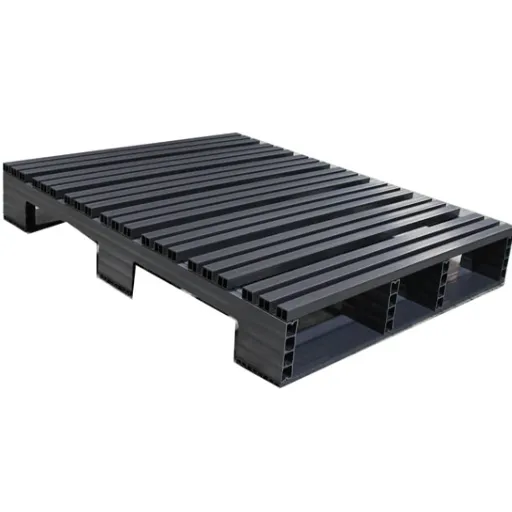
The biggest objection to custom plastic pallet design is upfront cost. A production mold can range from 5,000forasimplethermoformedtoolto5,000forasimplethermoformedtoolto50,000+ for a complex steel injection mold. Per-unit pricing depends on material, size, features, and volume.
However, focusing only on the mold misses the full picture. Plastic pallets commonly last 8–15+ years or 200–250+ trips. Wood pallets often last only 1–5 years or 10–215 trips. Wood pallets are also linked to 3–5% of product damage from nails and splinters. When you add ISPM-15 treatment costs of 2–2–8 per wood pallet per crossing, the economics shift quickly. For a deeper comparison, see our plastic pallets vs. wood pallets cost analysis.
Custom designs amplify the savings of custom plastic pallet design by:
- Reducing product damage through precise fit.
- Maximizing truck and container cube utilization.
- Eliminating conveyor jams and automation downtime.
- Extending service life with material matched to the environment.
- Removing fumigation and repair costs.
Most high-volume operations see break-even within 12–24 months. The key is to model total cost of ownership, not just the mold invoice.
Ready to run the numbers for your project? Request a design consultation and our engineering team will review your load, environment, and volume requirements.
How to Brief a Custom Plastic Pallet Manufacturer
Choosing the right partner is part of custom plastic pallet design. A strong design brief saves weeks of back-and-forth when you work with a custom plastic pallet manufacturer. Bring the following to your first conversation:
- Product details: dimensions, weight, footprint, center of gravity, packaging type.
- Load requirements: static, dynamic, and racking loads with safety factor.
- Environment: temperature, moisture, chemicals, UV, cleaning method.
- Handling equipment: forklift, pallet jack, conveyor, AS/RS, robotic systems.
- Compliance: FDA, GMP, ISO, ISPM-15, RoHS/REACH, or customer-specific standards.
- Volume forecast: annual quantity, expected trips per pallet, target lifespan.
- Special features: RFID, barcode, color, logo, steel reinforcement, anti-slip.
- Budget and timeline: target mold investment, per-unit cost, launch date.
Ask potential manufacturers about their CAD and mold-flow capabilities, sample policy, tooling ownership, quality certifications, and experience with your industry. Our buyer’s checklist for choosing a plastic pallet manufacturer covers these questions in detail.
Conclusion
In summary, custom plastic pallet design is not a luxury reserved for massive enterprises. It is a structured engineering process that solves real operational problems. These include damaged products, automation downtime, failed audits, and unnecessary freight costs. By following a clear custom plastic pallet design workflow from requirements through CAD, prototyping, and production tooling, you can specify a pallet that fits your product, equipment, and compliance needs exactly.
The global plastic pallets market is projected to reach roughly 9.4–9.4–9.6 billion in 2026. This growth is driven by e-commerce, sustainability mandates, and automation. Companies that invest in custom plastic pallet design and treat pallets as engineered components rather than disposable commodities will capture the biggest share of that value. Partnering with an experienced custom plastic pallet manufacturer ensures that your design is validated, tooled, and produced to the standards your operation demands.
Start your next pallet project with a clear design brief. Contact the Shandong Lile engineering team for a free consultation and custom quote.