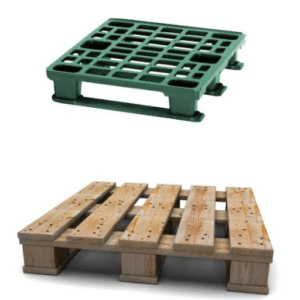
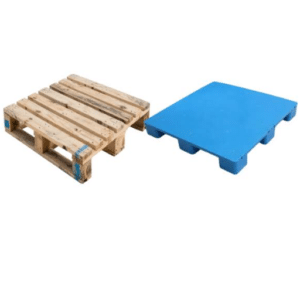
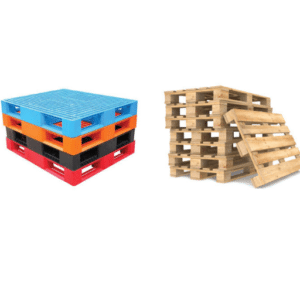
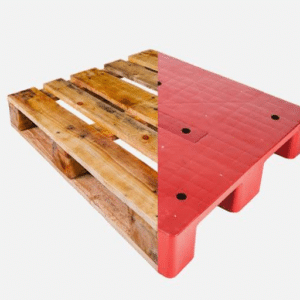
For automated warehouses and AS/RS systems, plastic pallets are the better choice over wood. Their dimensional consistency, clean non-porous surface, and predictable deflection are exactly what conveyors, sensors, and robotic pickers require.
That answer only became obvious to Marcus when it was too late. In March 2025, the distribution manager spent $4.2 million installing an automated storage and retrieval system at his Chicago facility. Three weeks after go-live, the system kept faulting.
Robotic arms mis-picked. Conveyor sensors triggered false stops. The culprit wasn’t the software or the robots. It was the $9 wooden pallets, warping under load and shedding splinters into the sensor arrays.
You probably already believe pallets are a “background” expense that doesn’t deserve much thought. Here’s the promise: by the end of this guide, you’ll know exactly when plastic beats wood, what the real cost difference is, and how to specify a pallet your automation won’t choke on. We’ll start with a side-by-side comparison, then dig into cost, durability, hygiene, and the automation-specific factors that flip the decision.
Key Takeaways
- In automation, dimensional consistency is the deciding factor: molded plastic holds tolerance, while wood warps and sheds debris that jams AS/RS and robotic picking.
- Plastic costs more upfront but wins on total cost of ownership in closed-loop, high-turn environments, with payback often in 1 to 3 years.
- Plastic pallets last roughly 200 cycles versus about 11 for wood, and are exempt from ISPM 15 export treatment.
- Wood stays the right call for one-way shipping, open-loop networks, and low-capital operations.
- Steel-reinforced and custom-spec plastic pallets are the strongest fit for high-bay racking and automated lines.
Plastic vs Wood Pallets at a Glance

Before we go deep, here is the honest comparison. Neither material wins every category.
| Factor | Plastic Pallets | Wood Pallets |
|---|---|---|
| Upfront cost | Higher | Lower |
| Total cost of ownership | Lower in closed-loop, high-turn use | Higher with frequent repair and replacement |
| Service life | 5 to 15+ years | 2 to 3 years in high-cycle use |
| Cycle count (LCA) | ~200 cycles | ~11 cycles |
| Dimensional consistency | High, molded precision | Variable, warps with moisture |
| Hygiene | Non-porous, washable | Porous, absorbs contaminants |
| Safety | No nails or splinters | Protruding nails, splinters |
| Export (ISPM 15) | Exempt | Requires treatment and marking |
| Weight stability | Fixed tare weight | Varies, absorbs water |
| Automation fit | Excellent | Poor to fair |
The rest of this article explains why each of those rows matters, and when each one decides the outcome for your operation.
Cost: Upfront Price vs. Total Cost of Ownership
On the purchase order, wood almost always wins. A basic wooden stringer pallet can cost a fraction of a molded plastic equivalent. That gap is real, and it matters in one specific situation: when the pallet is a one-way, lost asset.
Why Wood Wins on Purchase Price
Wood pallets are cheap to manufacture, easy to repair locally, and abundant. For a business shipping product out the door and never seeing the pallet again, that low price is hard to beat. If your pallet is leaving with the customer and not coming back, paying a premium for plastic rarely makes sense.
When Plastic Wins on Total Cost of Ownership
The math changes in a managed, closed-loop supply chain, where pallets circulate hundreds of times. Here, plastic pallets win on total cost of ownership (TCO). According to ORBIS, plastic pallets commonly pay back their higher initial cost within 1 to 3 years in high-utilization networks.
Why? Wood needs constant board and nail repair. It splinters. It absorbs water and gets heavier. Plastic needs almost no onsite repair, is refurbished centrally, and keeps a stable tare weight, which stabilizes freight costs.
The UK medical supplier Kimal lived this trade-off. When they switched from wooden Euro pallets to 100% recycled HDPE pallets, they cut annual pallet spend, saved about £20,000 in the first year, and eliminated the breakages that had been damaging automated equipment.
Start with the right pallet for your network. If your pallets come back to you and circulate repeatedly, our plastic pallets deliver the durability that shifts the economics in your favor. Request a free quote to model your payback.
Durability and Service Life
Durability is where the comparison starts to feel lopsided, especially in high-cycle operations.
Cycle Counts: Plastic vs Wood
A Virginia Tech life-cycle analysis found plastic pallets lasted roughly 200 cycles versus about 11 for wood, nearly 18 times longer. In day-to-day terms, industry sources put plastic pallet lifespan at up to 10 years, compared with 2 to 3 years for wood in demanding distribution environments.
That gap compounds. A wooden pallet that survives a dozen trips before repair might actually cost more per trip than a plastic pallet that lasts for years.
Racking Strength and Steel Reinforcement
Here is a common misconception: plastic is weaker than wood. The truth is more specific. Not all plastic pallets are rated for racking, so you have to check the spec. But heavy-duty plastic pallets, especially those with steel reinforcement, meet and exceed racking demands.
A purpose-built automation pallet like the ORBIS Odyssey 3-Runner handles 30,000 lb static and 6,000 lb dynamic loads. At Shandong Lile, our steel-reinforced pallets are engineered for high-bay racking, where deflection must stay within tight limits. If you need racking strength and dimensional stability, steel-reinforced plastic is the answer, not wood.
Hygiene, Safety, and Export Compliance

Three factors decide whether a pallet is even allowed in your facility, before cost is ever discussed.
Non-Porous vs. Porous
Plastic pallets are non-porous. They resist moisture, mold, and bacterial ingress, and they wash clean. That is why they are the standard in food, beverage, pharmaceutical, and cleanroom operations. Wood absorbs contaminants, can harbor mold and pests, and introduces splinters and nails into the workspace.
For any operation that touches food, medicine, or cosmetics, this single factor often settles the plastic vs wood pallets debate on its own.
ISPM 15: The Export Advantage of Plastic
Plastic pallets are exempt from ISPM 15, the international standard requiring solid-wood packaging to be heat-treated and marked. Wood pallets crossing borders need treatment, coordination, and paperwork, adding time and cost to every export shipment. Plastic sidesteps all of it.
If you ship internationally, plastic removes a recurring compliance headache.
Why Automation Changes the Pallet Decision
Here is the section most “plastic vs wood” guides gloss over, and it’s the one that matters most to you.
Dimensional Consistency: The Requirement AS/RS Can’t Ignore
Automated systems do not adapt. A conveyor, sensor array, or robotic gripper expects the pallet to be exactly where it should be, exactly the size it should be, every single time.
Molded plastic delivers that. According to Pearl River Plastics, plastic pallets maintain dimensional tolerance across production lots, with consistent decks, uniform runner geometry, and repeatable mass. Wood cannot promise any of that. It warps, swells with moisture, and varies from board to board.
That is why AS/RS environments specifically require the consistent dimensions and deflection limits of plastic.
Deflection, Sensor Detection, and Robotic Picking
A warped wooden deck throws off a robotic pick. A broken stringer jams a conveyor. A protruding nail wrecks a sensor. These are not hypotheticals; they are the top concerns reported by warehouse operators.
In the 2025 Pallet Report from Peerless Research Group, 75% of respondents listed broken or damaged components as a concern, and 63% flagged protruding nails and dimensional tolerances like squareness. Meanwhile, 89% said they want a minimum pallet specification in their facilities.
Automation doesn’t tolerate variance. It rewards consistency, and that is plastic’s home turf.
The Hidden Cost of Pallet Failure in Automation
Return to Marcus. His 4.2millionsystemwasidledby4.2millionsystemwasidledby9 pallets. Every false stop, every mis-pick, every jam ate into the productivity gains the automation was supposed to deliver. The cheapest pallet per unit became the most expensive pallet per operation.
The lesson: when you pair automation with a cheap, variable pallet, you undercut the very investment you just made. ORBIS puts it plainly: dimensional consistency reduces product damage in automated systems and supports repeatable positioning, fork access, and sensor detection.
Don’t let a 9palletidlea9palletidlea4 million system. Automation-ready plastic pallets hold their dimensions under load, protecting your robotics investment. Explore our plastic pallet solutions built for automated environments.
Choosing the Right Plastic Pallet for Automation
If you’re convinced plastic is right for your automated environment, the next step is specifying the right pallet. Not every plastic pallet is automation-ready.
What to Specify for Your Equipment
Work with your equipment supplier to define the limits your pallet must meet. The key specifications include:
- Exact deck dimensions and tolerances, so the pallet fits line-side guides and sensor paths.
- Permissible deflection at rated loads, so decks don’t sag under product weight.
- Fork-entry geometry, so automated forklifts and shuttles engage cleanly.
- Runner position tolerance, for conveyor and shuttle compatibility.
- RFID and label recesses, so tags sit flush and read reliably.
- Material choice: HDPE for low-temperature impact resistance, PP for rigidity and heat stability, and steel reinforcement for heavy loads.
A pilot run, often a few hundred pallets, lets you validate real-world performance before committing to bulk production.
Custom and Steel-Reinforced Pallets for High-Bay Racking
Off-the-shelf pallets rarely fit an automated system perfectly. That’s where custom specification matters. At Shandong Lile, we engineer plastic pallets to your exact dimensions, runner geometry, and load ratings, with ISO 9001 quality control at every stage.
For high-bay racking, where deflection limits are tightest, our steel-reinforced pallets deliver the rigidity automation demands without sacrificing the hygiene and consistency of plastic. Custom sizing and OEM capabilities mean the pallet is built around your equipment, not the other way around.
Wood vs Plastic: When Each Is the Better Choice

So which should you choose? The honest answer is: it depends on your operation.
Choose wood when:
- You ship one-way and the pallet is a lost asset.
- You run a low-capital or open-loop operation.
- You need heavy static load capacity at minimum cost.
- Local repair infrastructure is already in place.
Choose plastic when:
- You operate a closed-loop, returnable supply chain.
- You use automation, AS/RS, or robotic picking.
- You handle food, pharmaceuticals, or other hygiene-sensitive goods.
- You export internationally and want to avoid ISPM 15 paperwork.
- You need consistent freight weights and long service life.
For most companies investing in automation, the second list applies. And that means the plastic vs wood pallets decision tilts decisively toward plastic.
Frequently Asked Questions
Are plastic pallets better than wooden pallets?
Plastic pallets are better than wood in closed-loop supply chains, hygiene-sensitive industries, and automated warehouses. Wood remains the cheaper choice for one-way shipping. The right answer depends on whether your pallets return to you and what environment they run in.
Which pallet is best for an automated warehouse?
Plastic is the best pallet for an automated warehouse. Automated storage and retrieval systems require dimensional consistency, predictable deflection, and clean surfaces that wood cannot reliably provide. Molded plastic holds tolerance across every pallet, preventing jams and mis-picks.
How long do plastic pallets last compared to wood?
Plastic pallets typically last 5 to 15 years, or about 200 cycles, while wood lasts roughly 2 to 3 years, or about 11 cycles, in high-cycle use. That gap makes plastic cheaper over time in returnable, high-turn operations.
Do plastic pallets need ISPM 15 treatment?
No. Plastic pallets are exempt from ISPM 15 phytosanitary treatment because they are not solid wood packaging. This removes fumigation, heat-treatment, and marking requirements from your export process.
Conclusion
The pallet is the load-bearing interface between your product and your automation. Get it wrong, and every dollar you spent on robotics underperforms.
The key takeaways are straightforward. Plastic pallets win on total cost of ownership in closed-loop, high-turn networks. They last roughly 200 cycles versus 11 for wood. They are hygienic, splinter-free, and ISPM 15-exempt. And in automation, their dimensional consistency is the difference between smooth throughput and constant faults. Wood remains the right, economical choice for one-way and open-loop shipping, but it’s a poor partner for AS/RS and robotic systems.
Ready to protect your automation investment? Shandong Lile engineers steel-reinforced and custom-spec plastic pallets for automated warehouses, backed by ISO 9001 quality and a global reach spanning over 108 countries. Contact us to discuss your pallet specification and request a free quote today.