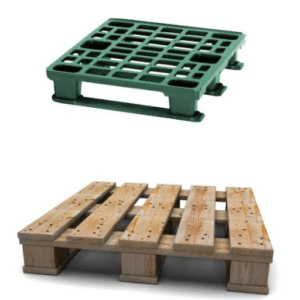
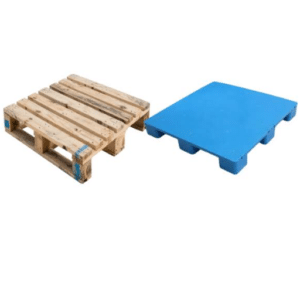
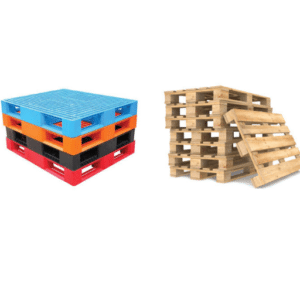
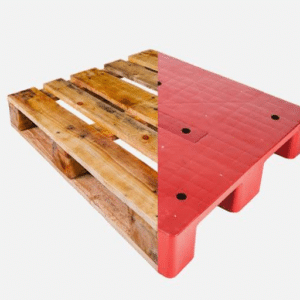
In most day-to-day warehouse conditions, plastic pallets are the safer choice: they eliminate nail and splinter injuries, they are lighter to handle, and they resist contamination. The one clear exception is fire, where wood burns more slowly and plastic pallets can intensify a blaze.
Still, “safer” depends entirely on what your operation actually does. A food processor worried about an audit and a chemical distributor worried about combustibility will reach opposite conclusions. This guide breaks plastic vs wood pallet safety into five dimensions, with real injury data behind each one, so you can make the call for your own facility.
Agree: Most operations treat the pallet as a commodity, bought on price and cycled until it falls apart. It rarely appears on a safety audit until something goes wrong.
Promise: By the end, you will know exactly where each material wins and loses on safety, and you will have a checklist to defend your decision to procurement, EHS, or a skeptical operations lead.
Key Takeaways
- Plastic pallets remove the leading handling hazards: no nails, no splinters, roughly 30 to 50 percent lighter than reusable wood block pallets.
- The wood pallet and container manufacturing industry has an injury rate 193 percent higher than all private industry, according to NIOSH.
- Hygiene is contested: plastic is easier to clean and non-porous, but bacteria transfer less easily from wood surfaces in some studies.
- Wood is clearly safer in a fire; plastic pallets can spread flame to a pallet above in about 18 minutes versus nearly 50 for wood.
- Choose by matching material to your dominant risk: handling and hygiene favor plastic, combustibility favors wood.
Are Plastic Pallets Safer Than Wood? The Short Answer

Plastic pallets are safer than wood pallets for worker handling, hygiene, and chemical exposure, while wood pallets are safer in a fire. For most warehouses, food plants, and pharmaceutical operations, plastic is the lower-risk option; for facilities with significant fire exposure, wood or a fire-rated plastic grade becomes the safer specification.
Here is the scorecard we will unpack throughout this article:
| Safety dimension | Wood pallet | Plastic pallet | Winner |
|---|---|---|---|
| Worker handling (nails, splinters, weight) | Splinters, protruding nails, 75 to 80 lb | No nails or splinters, under 50 lb | Plastic |
| Structural strength and load | Stronger in some load tests | Predictable, non-splintering failure | Mixed |
| Hygiene and contamination | Porous, absorbs moisture, harder to clean | Non-porous, washable, no mold absorption | Plastic (mostly) |
| Fire and combustibility | Slower spread, lower flame height | Faster spread, melts and pools | Wood |
| Chemical exposure | ISPM-15 treatment chemicals | Recyclable HDPE, no treatment | Plastic |
Safety Dimension 1: Worker Handling and Ergonomics
This is the dimension where the plastic vs wood pallet safety difference is most immediate, because it shows up as cuts, puncture wounds, and back injuries on the floor rather than as a policy debate.
Nails, Splinters, and Laceration Risk
Wood pallets fail in predictable, painful ways. Boards crack, nails work loose, and “shiner” nails point straight up out of the deck, waiting for a hand. OSHA has repeatedly cited employers for exactly this. One refurbisher was cited under 29 CFR 1910.138(a) after workers handling pallets with protruding nails and broken boards were exposed to cuts, lacerations, and puncture wounds. Another major retailer was cited under 29 CFR 1910.22(a)(3) for leaving pallets with exposed nails and damaged components in walking-working surfaces.
Plastic pallets simply do not have these failure modes. There are no nails to loosen and no wood fibers to split. When a plastic pallet is damaged, it usually cracks or deforms rather than producing a sharp edge that punctures skin.
Weight and Manual Handling
Weight is the quieter hazard. The number one cause of warehouse injuries is overexertion from manual material handling, according to the Bureau of Labor Statistics. Every extra pound on a lift counts toward that number.
A reusable wood block pallet typically weighs 75 to 80 pounds. Most plastic pallets come in under 50 pounds. Across a shift of repeated lifts, that 25 to 30 pound difference compounds into real back and shoulder strain. WorkSafe Victoria, which tracks warehouse injury data in Australia, flags manual lifting of hardwood pallets as a specific hazard to eliminate, with back injuries making up 28 percent of warehouse claims.
Marisol runs inbound receiving at a regional distribution center. Her team unloads and restacks roughly 300 pallets a day. When the center trialed plastic pallets for one product line, the same crew reported fewer hand injuries in a quarter, and the number of splinter-related first aid visits dropped to zero. The pallets cost more up front, but Marisol could point to the injury log, not a brochure, to justify the switch.
See the difference for your operation. Explore our plastic pallet options to compare weights, deck styles, and load ratings for your specific handling pattern.
Safety Dimension 2: Structural Strength and Load Integrity
Strength is where the plastic vs wood pallet safety story gets more interesting, because the materials fail in different ways.
Load Capacity and Racking Performance
Wood often wins on raw numbers. Load tests to BS ISO 8611, cited by the timber pallet industry, show timber pallets typically carrying 900 to 1,150 kg versus 600 to 610 kg for many plastic pallets. In a static or racking application where maximum load per pallet is the only metric that matters, wood can hold more.
But maximum load is not the same as safety margin. A pallet that is overloaded or past its useful life needs to fail predictably.
Sudden Failure vs. Predictable Wear
Wood fails suddenly and catastrophically. A weakened board gives way under a loaded forklift, and the entire deck collapses, dropping product and often the operator’s balance with it. Splintering turns that collapse into a laceration hazard in the same instant.
Plastic tends to wear visibly first: stress whitening, minor cracking, or a bent runner. A well-run plastic pallet program catches those signs during inspection and pulls the pallet before it fails under load. This is why a defined pallet durability testing protocol matters as much as the material itself. The material you can inspect and retire early is the safer material.
For a full breakdown of what your racks can actually hold, see our guide to plastic pallet load capacity, which covers static, dynamic, and racking limits.
Safety Dimension 3: Hygiene and Contamination Control
If you ship food, beverages, or pharmaceuticals, hygiene is likely your dominant safety concern, and it is where plastic pallets have their strongest commercial case.
Food and Pharmaceutical Compliance
Plastic is non-porous. It does not absorb water, oils, or chemicals, and it can be washed, steamed, or sanitized between uses. That predictability is exactly what auditors want to see in a food-grade or pharma operation. It is also why plastic pallets are the default in cold storage and cleanroom environments.
Wood is porous and absorbs whatever it touches. It holds moisture, which invites mold, and it is far harder to clean to a verifiable standard. For high-hygiene industries, this is the decisive safety argument for plastic.
Mold, Moisture, and the Honest Caveat
The nuance matters, and we will state it plainly: at least one peer-reviewed study, the 2010 Boersig and Cliver research cited by the FAO, found that bacteria transfer less easily from wood than from plastic. Wood absorbs microbes that cannot then be recovered alive from its surface, while bacteria on a new plastic surface can transfer to whatever touches it. Used plastic with surface scars can also harbor bacteria in those crevices.
So the honest position is not “plastic is sterile and wood is dirty.” It is that plastic is verifiably cleanable in a way wood is not, and it gives you control over a surface you can sanitize. Both materials require a real cleaning protocol.
A mid-sized food processor we work with kept failing its third-party audit on wooden pallet contact points in the packing area. Mold spores were showing up in swabs near the line. They moved that zone to washable HDPE pallets and passed the next audit without changing a single cleaning procedure on their equipment. The pallet material was the variable that had been dragging them down.
Shipping food or pharma? Our custom plastic pallet solutions are built in food-grade HDPE and PP, sized and branded to your spec.
Safety Dimension 4: Fire and Combustibility

Now the part most plastic pallet vendors would rather skip, and the reason we are being direct about it.
What the Fire Tests Show
Wood is the safer material in a fire, and the difference is significant. Testing reported by the Inland Marine Underwriters Association (IMUA) and summarized by the International Code Council shows:
- Plastic pallets can be ignited by a match; wood requires a far more energetic fuel source.
- Fire spreads to a pallet above an ignited one in roughly 18 minutes for plastic versus nearly 50 minutes for wood.
- Wood flames stay close to the stack, rarely exceeding a meter in height, while plastic pallet flames can exceed 6 meters.
- Burning plastic produces dense, more toxic smoke that hampers firefighting, and melted plastic can pool and carry fire across a floor.
For a high-bay warehouse with ceiling-level sprinklers, that difference can change insurance premiums and even require upgraded fire protection. In some cases, using plastic pallets raises a commodity’s hazard classification, which can cascade into a requirement for more aggressive sprinkler design.
Specifying Plastic Pallets Safely
This does not mean plastic is unsafe, it means it has to be specified correctly. A well-run operation using plastic pallets should:
- Confirm the facility’s sprinkler system is rated for the stored commodity class with plastic pallets in the load.
- Ask the manufacturer for fire performance data and any FM 4996 or equivalent ratings.
- Consider fire-retardant or composite grades for high-exposure environments.
- Keep plastic pallet storage in areas with appropriate clearance and fire suppression.
If your operation stores flammable goods or runs a high-bay, low-clearance rack, wood or a fire-rated composite may genuinely be the safer call, and a responsible supplier will tell you so.
Safety Dimension 5: Environmental and Chemical Exposure
The final dimension is about what the pallet is carrying into your facility and onto your product.
ISPM-15 vs. Recyclable HDPE
Wood pallets moving across borders are typically treated to meet ISPM-15, the international standard for preventing the spread of pests in wood packaging. That treatment can involve heat or chemicals, including methyl bromide in some regions, and burning treated wood releases toxic fumes. Wood dust itself is recognized by NIOSH as a potential occupational carcinogen in the pallet manufacturing industry.
Plastic pallets require no such treatment. They are molded from high-density polyethylene (HDPE) or polypropylene (PP), which are recyclable at end of life. There are no treatment chemicals to leach and no dust to generate during normal handling. For operations trying to reduce chemical exposure and keep their waste stream clean, that is a meaningful safety and sustainability advantage.
How to Choose: A Pallet Safety Selection Checklist

Run your facility against this list. Whichever material wins more rows is likely your safer default, provided you have addressed the fire dimension honestly.
- Handling frequency is high and workers lift pallets manually → plastic.
- Workers report splinters, cuts, or puncture wounds → plastic.
- You ship food, beverages, or pharmaceuticals and need washable, non-porous surfaces → plastic.
- You need maximum static or racking load per pallet and can inspect and repair wood properly → wood.
- You store flammable commodities or run a high-bay with limited clearance → wood, or fire-rated plastic with sprinkler verification.
- You move product across borders and want to avoid ISPM-15 treatment and dust → plastic.
- You want predictable, visible wear you can catch during inspection → plastic.
- Your insurance or AHJ has flagged pallet combustibility → confirm sprinkler design before committing to plastic.
The safest operation is rarely all one material. Many facilities run plastic in their hygiene-critical zones and keep wood in high-load or fire-exposed areas, and document the reasoning for each.
At one distribution network we support, that hybrid is exactly what happened. The safety lead wanted plastic everywhere for the injury data; the risk manager wanted wood everywhere for the fire rating. They met in the middle: plastic in the food-contact and hand-handled zones, wood in the high-bay combustible racking. Both concerns were documented, and the pallet program finally had a rationale that survived an audit.
Conclusion
Plastic vs wood pallet safety is not a simple either-or, and anyone selling it that way is selling something. Plastic pallets win on worker handling, hygiene, and chemical exposure. Wood wins on fire. Strength is a genuine trade-off that depends on how you inspect and retire pallets.
The right question is not “which material is safer” but “which material is safer for what we actually do here.” Match the material to your dominant risk, verify the fire dimension with your insurer, and document the decision.
If you are evaluating plastic pallets for a handling-heavy or hygiene-critical operation, Shandong Lile can help you specify the right deck, material grade, and load rating, built to ISO 9001 standards and shipped from Qingdao to over 108 countries. Request a quote and we will help you run the numbers for your facility.
Frequently Asked Questions
Are plastic pallets safer than wooden pallets?
For worker handling, hygiene, and chemical exposure, yes. For fire safety, no. Most warehouses and food or pharma operations find plastic the lower overall risk; facilities with significant fire exposure may prefer wood or fire-rated plastic.
Do plastic pallets splinter?
No. Plastic pallets have no wood fibers, nails, or boards to break. When they fail, they usually crack or deform rather than producing sharp edges that cut skin.
Are plastic pallets a fire hazard?
They are more combustible than wood. Plastic pallets ignite more easily and can spread fire faster, so they must be matched to an adequate sprinkler system and, in high-exposure facilities, a fire-rated grade.
What is the biggest safety risk with wood pallets?
Protruding nails, splinters, and broken boards are the leading direct hazards, driving OSHA citations and laceration and puncture injuries, while their weight contributes to overexertion injuries.