
The main types of warehouse racking are selective pallet racking, double-deep racking, drive-in racking, drive-through racking, push-back racking, pallet flow racking, cantilever racking, carton flow racking, and very narrow aisle (VNA) racking. Each system serves a different inventory profile, and choosing the wrong one costs warehouses thousands in lost space, damaged goods, and operational delays.
Warehouse space costs have jumped 25% globally since 2022. For logistics managers, the math is simple but brutal: expand your footprint and watch rent eat your margins, or optimize the space you already have. The right warehouse racking system can double — sometimes triple — your storage density without adding a single square meter.
But here is what most guides won’t tell you: your racking system is only as good as the pallets you put on it. A $300,000 drive-in installation becomes worthless if your pallets warp, splinter, or collapse under rack loads.
You already know that warehouse efficiency starts at the rack. By the end of this guide, you will understand all 9 major warehouse racking systems, know exactly which one fits your inventory profile, and learn which rackable plastic pallets maximize performance for each type.
Key Takeaways
- Selective pallet racking is the most versatile and cost-effective system at 45–45–80 per position, ideal for operations with high SKU variety.
- Drive-in and push-back racking deliver the highest density but require full-perimeter or steel-reinforced pallets to prevent collapse.
- Plastic pallets outperform wood in nearly every racking application due to consistent dimensions, moisture resistance, and a 1,500+ kg rack load capacity.
- The “best” racking system is not the most expensive one — it is the one matched to your pallets, inventory flow, and growth plans.
- Steel-reinforced plastic pallets reduce deflection by 40–60% under sustained rack loads, making them essential for high-bay and automated systems.
What Is Warehouse Racking?
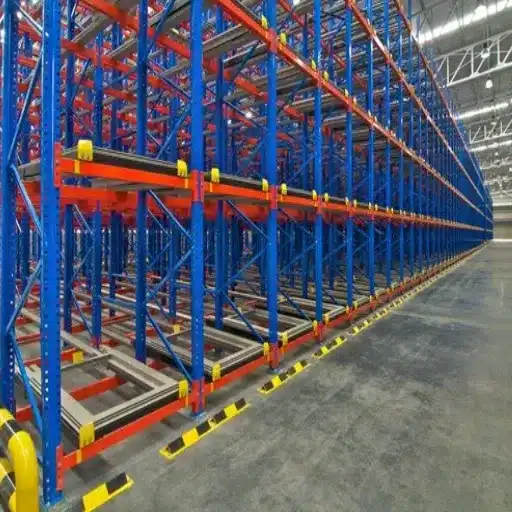
Warehouse racking is a storage system of upright steel frames and horizontal beams designed to hold palletized inventory in vertical columns. It transforms empty warehouse height into usable storage, and it is the backbone of every modern distribution center, manufacturing plant, and fulfillment operation worldwide.
The term “warehouse racking” is actually an umbrella category. It covers everything from forklift-accessed pallet racks to hand-loaded shelving, from gravity-fed flow systems to cantilever arms for lumber. Within that umbrella, “pallet racking” is the most common subtype — but it is not the only one.
Understanding the different types of warehouse racking matters because the wrong choice creates a cascade of problems. Narrow aisles that don’t match your forklifts. Racks rated for 1,000 kg that regularly see 1,400 kg. Wooden pallets that absorb moisture in cold storage and expand until they jam in flow lanes. These are not theoretical issues. They show up as daily friction in warehouses across the 108 countries we serve at Shandong Lile.
The 9 Types of Warehouse Racking Systems
1. Selective Pallet Racking
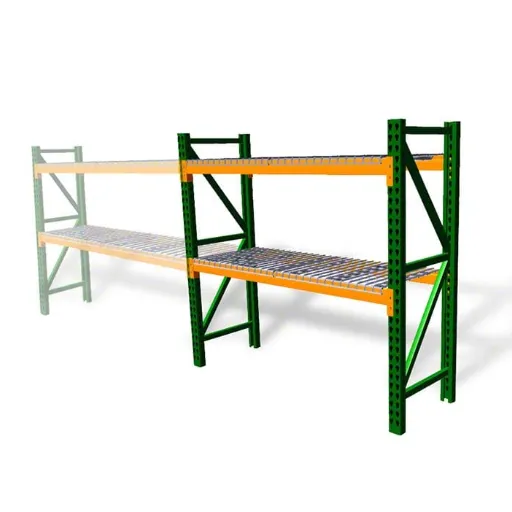
Selective pallet racking is the most common method in the world. It stores pallets on horizontal beams in single-deep rows, giving forklifts direct access to every single pallet without moving anything else.
This is the system you picture when someone says “warehouse racking.” It works with standard forklifts. It is easy to install and reconfigure. And it supports both FIFO (First-In, First-Out) and LIFO (Last-In, First-Out) inventory methods depending on how you manage your stock.
Selective racking costs 45–45–80 per pallet position, making it the most economical option upfront. The trade-off is lower storage density. Standard configurations require aisle widths of 3.0–3.5 meters, which means only about 40% of your floor space actually holds inventory.
For pallet compatibility, standard three-runner or full-perimeter rackable plastic pallets work perfectly. At Shandong Lile, we produce selective-rack-compatible pallets in 1200×1000 mm, 1200×800 mm, and 1100×1100 mm dimensions to match regional standards.
Best for: Operations with high SKU variety, medium turnover, and frequent picking. Food distribution, retail replenishment, and general warehousing.
2. Double-Deep Pallet Racking
Double-deep racking stores two pallets back-to-back in each position. This simple change increases storage capacity by 40–60% compared to single-deep selective racking.
The rear pallet is not directly accessible. You need a double-reach forklift with extended forks to retrieve it. That makes this system a LIFO configuration by default. The first pallet in the front should be taken out before you can access the one at the back.
This system costs 80–80–200 per pallet position. The higher price comes from specialized equipment requirements and the need for more precise pallet dimensions.
Full-perimeter rackable plastic pallets are strongly recommended here. Their consistent dimensions prevent the front pallet from shifting and blocking access to the rear. Steel reinforcement becomes valuable at rack heights above 6 meters, where deflection compounds over time.
Best for: Bulk storage of identical SKUs, seasonal inventory overflow, and operations that can tolerate LIFO workflows.
3. Drive-In Racking
Drive-in racks do not have conventional aisles anymore. Pallets rest on ledges along upright frames, creating deep lanes that forklifts drive directly into.
Access comes from one side only. The first pallet placed sits at the back of the lane. The next pallet will move in further. In order to access your stock, the front pallet has to be taken out. That makes drive-in a strict LIFO system.
Lanes typically hold 4–10 pallets deep. By removing most aisle space, drive-in racking can increase storage density by up to 75% compared to selective systems. But the trade-offs are significant: low selectivity, higher forklift damage risk, and no FIFO capability.
Pallet choice is critical here. Wooden pallets splinter under the repeated impact of forklifts entering and exiting lanes. Moisture absorption causes dimensional creep that can jam pallets in place. Full-deck plastic pallets with steel reinforcement are the standard for drive-in applications because they maintain consistent dimensions and resist impact damage.
Best for: Cold storage, seasonal goods, bulk chemicals, and any inventory where LIFO is acceptable and SKU variety is low.
4. Drive-Through Racking
Drive-through racking uses the same lane structure as drive-in, but with access from both front and back. This single change transforms it into a FIFO system.
Pallets load at the back and retrieve from the front. The lane acts like a conveyor belt made of steel. Forklifts never need to enter the lane from the same side, which reduces congestion and damage risk.
Drive-through costs are similar to drive-in at 115–115–140 per pallet position. The dual-access design requires more floor space than drive-in, but the FIFO capability makes it essential for perishables.
Chen Wei, a cold storage manager in Rotterdam, learned this the hard way. His facility used drive-in racking with wooden pallets for frozen seafood. The LIFO configuration meant product at the back of lanes sat for months. When moisture from condensation warped the wood, pallets jammed. His team spent 12 hours clearing a single lane. After switching to drive-through racking with HDPE plastic pallets, his rotation improved and jams disappeared entirely.
Best for: Perishables, beverages, food distribution, pharmaceutical cold storage, and any operation requiring strict FIFO rotation.
5. Push-Back Racking
Push-back racking involves nesting of carts in an inclined rail system. The moment a pallet is loaded at the entrance by a forklift, it forces other pallets further back in the aisle. Once you unload the pallet at the entrance, gravity moves it forward.
Lanes hold 2–6 pallets deep. The system operates on LIFO principles because the newest pallet always sits at the front. It offers higher density than selective racking while keeping all pick faces accessible from a single aisle.
At 275–275–295 per pallet position, push-back is the most expensive standard system. The inclined rails and cart mechanisms add mechanical complexity that selective racking simply doesn’t have.
Pallet tolerance matters enormously here. A warped pallet can derail a cart or prevent the next pallet from rolling forward. Plastic pallets maintain ±3 mm dimensional tolerance, which is critical for smooth push-back operation. Steel reinforcement reduces the risk of pallet deflection under the pushing force.
Best for: Frozen goods, medium-turnover inventory, and operations that need density but want to avoid the forklift damage risk of drive-in systems.
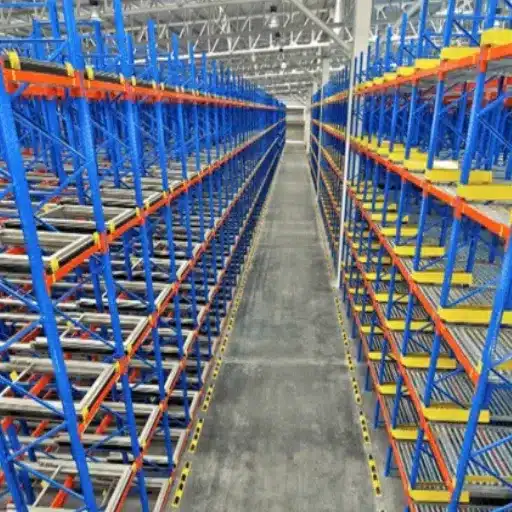
6. Pallet Flow (Gravity Flow) Racking
Pallet flow racking uses sloped lanes with rollers or wheels. Pallets load at the higher back end and roll by gravity to the lower front end. It is the most FIFO-friendly high-density system available.
Lanes can hold 20 or more pallets deep. The automatic rotation ensures that the oldest stock always presents at the pick face. Retrieval speed is fast because the forklift never needs to enter the lane.
Costs range from 170–170–500 per pallet position depending on lane depth and roller quality. Maintenance is higher than selective racking because rollers wear and need periodic replacement.
Pallet quality is non-negotiable in flow systems. Inconsistent dimensions cause pallets to jam mid-lane. A single jam can block 20 pallets. Splinters from wooden pallets can lodge in rollers. For this reason, flow system operators almost exclusively use plastic pallets with verified dimensional stability and smooth undersides.
Best for: Perishables, high-volume distribution, date-sensitive inventory, and operations where FIFO compliance is mandatory.
7. Cantilever Racking
Cantilever racking is built differently from every other system on this list. It has no front upright columns. Instead, vertical columns support horizontal arms that extend from one or both sides.
This open-front design is purpose-built for long, bulky, or irregularly shaped items. Lumber, steel pipes, carpet rolls, furniture, and appliances all store naturally on cantilever arms.
Arm height and angle are adjustable. Single-sided units mount against walls. Double-sided units create aisles of open storage. Load capacity per arm can exceed 30,000 lbs on heavy-duty systems.
Cantilever is not designed for standard palletized goods. It serves a completely different inventory profile. But it belongs in any complete guide to warehouse racking because most facilities eventually need to store something that won’t fit on a standard pallet.
Best for: Lumber yards, metal distributors, furniture warehouses, and any operation storing long or awkwardly shaped materials.
8. Carton Flow Racking
Carton flow uses the same gravity-fed principle as pallet flow, but for individual boxes and cartons rather than full pallets. Sloped shelves with rollers or skate wheels move boxes from the loading side to the picking side.
This system enables split-case picking without de-palletizing entire loads. Workers pick from the front while stockers replenish from the back. The separation of picking and restocking reduces congestion and improves accuracy.
Labor savings are substantial. According to industry data, carton flow systems reduce order picking labor by 25–75% compared to static shelving. The investment pays back quickly in high-volume fulfillment environments.
Carton flow operates on de-palletized inventory. Standard plastic pallets still play a role upstream — they deliver the initial full-pallet loads that get broken down into cartons for the flow system.
Best for: E-commerce fulfillment, order picking operations, retail distribution, and any warehouse processing high volumes of small orders.
9. Very Narrow Aisle (VNA) Racking
VNA racking is essentially selective racking with the aisles squeezed down. Standard selective aisles run 3.0–3.5 meters wide. VNA aisles shrink to 1.5–1.8 meters. That 40% reduction in aisle width translates directly into more rack rows per square meter.
The system maintains 100% selectivity. Every pallet remains directly accessible. But you need specialized equipment: turret trucks or articulated forklifts designed for tight turns.
VNA racking represents a middle ground between selective and high-density systems. It delivers better floor utilization than selective without sacrificing the flexibility that drive-in and push-back demand.
Standard rackable plastic pallets work well in VNA systems. The tight tolerances of plastic pallets actually help here because precise positioning matters more in narrow aisles where there is less margin for error.
Best for: Space-constrained urban warehouses, high-rent markets, and operations that need selectivity but cannot afford wide aisles.
Warehouse Racking Comparison: All 9 Types at a Glance
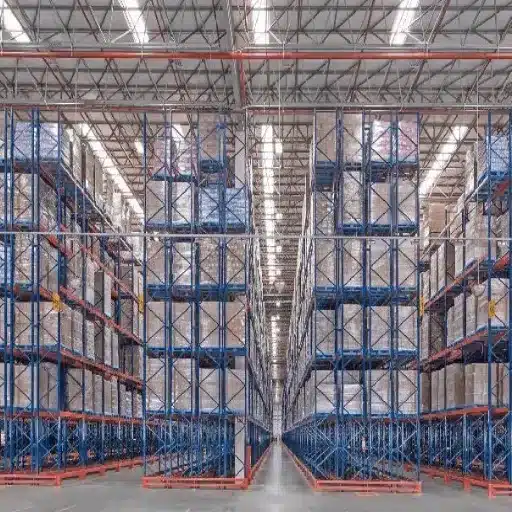
Choosing between warehouse racking systems comes down to a handful of variables: density, access, inventory method, cost, and pallet compatibility. Here is how the 9 types compare side by side.
| Racking Type | Storage Density | Access | Inventory Method | Cost per Position | Best For |
|---|---|---|---|---|---|
| Selective Pallet | Low-Medium | 100% direct | FIFO or LIFO | 45–45–80 | High SKU variety, general warehousing |
| Double-Deep | Medium | 50% direct | LIFO | 80–80–200 | Bulk storage, same SKU |
| Drive-In | Very High | Single aisle | LIFO | 115–115–140 | Cold storage, seasonal bulk |
| Drive-Through | Very High | Dual aisle | FIFO | 115–115–140 | Perishables, beverages |
| Push-Back | High | Front only | LIFO | 275–275–295 | Frozen goods, medium turnover |
| Pallet Flow | Very High | Front only | FIFO | 170–170–500 | Perishables, high-volume distro |
| Cantilever | N/A | Open front | Either | Variable | Long/bulky items |
| Carton Flow | Medium | Front only | FIFO | Variable | Order fulfillment, e-commerce |
| VNA | Medium-High | 100% direct | FIFO or LIFO | 50–50–60 | Space-constrained warehouses |
Use this table as a starting point, not a final answer. Your specific pallet type, SKU count, turnover rate, and forklift fleet will narrow the choice further.
How to Choose the Right Warehouse Racking System
The best warehouse racking system is not the one with the highest density or the lowest price. It is the one that matches your operational reality. Here are the eight factors that should drive your decision.
1. SKU variety and count. High SKU variety demands selectivity. If you stock 5,000 SKUs, drive-in racking will bury most of them in inaccessible lanes.
2. Inventory turnover rate. Fast-moving inventory benefits from systems that minimize forklift travel time. Slow-moving inventory can tolerate the extra handling that high-density systems require.
3. FIFO vs. LIFO requirements. Perishables and date-sensitive goods need FIFO. Bulk commodities and seasonal overflow can use LIFO.
4. Pallet type and dimensions. This factor is overlooked more than any other. Wooden pallets in flow systems jam. Lightweight nestable pallets in drive-in racks collapse. The pallet you choose constrains the rack you can use — and vice versa.
5. Forklift and equipment capabilities. Double-deep needs reach trucks. VNA needs turret trucks. Drive-in needs experienced operators. Your equipment budget is part of the racking decision.
6. Ceiling height and floor space. Tall warehouses benefit from vertical storage. Small footprints demand narrow aisles or high-density systems.
7. Budget and total cost of ownership. Upfront cost is only part of the equation. Factor in maintenance, pallet replacement, and reconfiguration labor over a 10-year lifespan.
8. Future scalability and automation readiness. If you plan to add AS/RS or shuttle systems in the next five years, choose racking that integrates with automated equipment.
When you map these eight factors against the comparison table above, your ideal system usually becomes obvious. If you need help matching pallet specifications to your chosen rack, explore our full range of rackable plastic pallets designed for every system on this list.
The Critical Role of Pallets in Racking Performance
Here is the truth that most warehouse racking guides bury in a footnote: your rack is only a frame. The pallet carries the load. And not all pallets perform equally in all racking systems.
There are three pallet categories, and only one belongs in a rack. Stackable pallets have nine legs designed for floor contact. They lack the runners needed to bridge rack beams. Nestable pallets are lightweight leg-based designs built for one-way shipping. They structurally cannot handle sustained rack loads. Only rackable pallets — with three runners, full-perimeter bases, or steel-reinforced frames — belong in racking systems.
Load capacity has three ratings, and most warehouse managers only know one. Static load is the weight a pallet holds on the floor. Dynamic load is the weight during forklift transport. Rack load is the weight supported by only two rack beams. For racking applications, only the rack load rating matters. Industry best practice applies a 1.5× safety factor to that number.
Standard rackable plastic pallets support 800–1,500 kg in rack applications. Steel-reinforced models handle 1,500–2,000+ kg. That reinforcement reduces deflection by 40–60%, which is essential for high-bay storage above 8 meters where beam sag compounds over time.
Plastic pallets offer distinct advantages over wood in racking contexts. They do not absorb moisture, so they won’t warp in cold storage or humid environments. Their dimensions stay consistent across temperature cycles. They weigh less, which reduces rack load and improves handling efficiency. And they are exempt from ISPM-15 fumigation requirements, making them ideal for international operations.
At Shandong Lile, we engineer rackable plastic pallets in HDPE for cold storage applications and PP for ambient environments. Our steel-reinforced options meet the demands of drive-in, push-back, and automated systems where deflection tolerance is measured in millimeters.
If your current racking system is underperforming, the problem might not be the rack. It might be the pallet. Request a free pallet specification review and we will match your racking system to the optimal pallet design.
Warehouse Racking Safety Standards and Compliance
Racking collapses are rare but catastrophic. The Rack Manufacturers Institute (RMI) estimates that most rack failures stem from three causes: overloading, impact damage, and inadequate inspection.
Every racking system must display load capacity labels on every beam level. These labels are not suggestions. They are engineered limits based on beam size, upright gauge, and configuration. Exceeding them voids warranties and creates liability.
Regular inspections should happen at least annually, and more frequently in high-traffic operations. Look for bent beams, damaged uprights, missing safety clips, and displaced loads. OSHA requires employers to maintain a safe workplace, and damaged racking is a documented violation.
Seismic considerations matter too. In earthquake-prone regions, footplates must be properly anchored, and beam connections must meet local building codes. The International Building Code (IBC) and RMI standards provide specific guidance for seismic zones.
Pallet choice affects safety outcomes. Wooden pallets splinter and shed debris that creates trip hazards. They can also fail catastrophically under overload, dropping inventory onto workers below. Plastic pallets fail more predictably, and their consistent dimensions reduce the risk of pallets sliding off beams.
Post protectors, rack guards, and safety netting add layers of protection. But the foundation of racking safety is choosing equipment — racks and pallets — that are rated for your actual loads.
Future Trends: Automation and Smart Racking
The warehouse racking of 2026 is not the warehouse racking of 2016. Three trends are reshaping how facilities think about storage.
Shuttle systems are replacing traditional forklifts in high-density zones. Automated shuttles travel along rack lanes, retrieving and depositing pallets without human operators. These systems integrate with warehouse management software (WMS) and can increase throughput by 200–400% compared to manual operations.
IoT-enabled racks use sensors to monitor load weight, detect deformation, and alert managers to impact events in real time. A rack that texts you when a forklift clips an upright prevents the small damage that leads to big failures.
Digital twin validation lets engineers model racking layouts, forklift paths, and pallet flows before installation. The days of discovering aisle-width problems after the rack is bolted down are ending.
Each of these trends raises the bar for pallet quality. Automated systems demand dimensional consistency within millimeters. Shuttles cannot correct for a pallet that sits crooked. IoT sensors generate meaningless data if pallet weight varies unpredictably.
At Shandong Lile, we design automation-grade plastic pallets with tighter tolerances, consistent tare weights, and validated deflection curves. If you are planning an automated upgrade, your pallet specification needs to happen before your rack design, not after.
Conclusion
The nine types of warehouse racking each solve a specific storage problem. Selective racking gives you flexibility. Drive-in and drive-through give you density. Pallet flow gives you automatic rotation. Cantilever gives you options for the products that refuse to fit on pallets.
The common thread is compatibility. Your racking system, your forklifts, your inventory, and your pallets must work as an integrated system. When one element is mismatched, the whole operation suffers.
At Shandong Lile, we have spent over 14 years engineering plastic pallets that perform in every racking system on this list. From standard three-runner pallets for selective racks to steel-reinforced designs for high-bay automation, we build for the specific demands of your warehouse.
If you are evaluating a new racking system or optimizing an existing one, start with the pallet. Contact our team for a free consultation. We will review your rack specifications and recommend the pallet design that maximizes safety, efficiency, and long-term value.
Your warehouse space is too expensive to waste. Let’s make every rack position count.