Recycled plastic pallets are reusable load platforms made from post-consumer or post-industrial plastic resins, most often high-density polyethylene (HDPE) or polypropylene (PP). They offer a durable, export-compliant, and circular alternative to wood pallets for general warehousing, distribution, and closed-loop logistics.
Sarah, a logistics manager for a mid-sized electronics exporter, was spending roughly $18,000 per year replacing damaged wood pallets and paying fumigation fees for international shipments. After switching to a closed-loop recycled plastic pallet program, her pallet replacement costs dropped by roughly 60% in the first two years. She also eliminated ISPM-15 heat-treatment documentation from her export workflow.
Her story is not unique. Procurement and sustainability teams around the world are under pressure to cut waste, reduce carbon footprints, and control total cost of ownership. Recycled plastic pallets check several of those boxes at once. But they are not the right choice for every application. This guide explains what recycled plastic pallets are, when they outperform virgin plastic or wood, and how to specify them for your operation.
Key Takeaways
- Recycled plastic pallets are typically made from recycled HDPE or PP and are 100% recyclable at end of life.
- They last 10+ years and can complete 100–250+ trips, compared with roughly 11–25 trips for standard wood pallets.
- Recycled pallets are generally not food-safe unless produced from food-contact-certified resin; virgin HDPE hygienic pallets are the safer choice for food and pharma.
- All plastic pallets are ISPM-15 exempt, so they require no fumigation or heat treatment for export.
- The recycled-content plastic pallet segment is forecast to grow at roughly 10.96% CAGR through 2031, outpacing the broader plastic pallet market.
What Are Recycled Plastic Pallets?

Recycled plastic pallets are shipping platforms manufactured using plastic that has already served another life. The feedstock usually comes from post-consumer sources such as milk jugs, detergent bottles, and industrial packaging, or from post-industrial scrap generated during plastic manufacturing.
The material is collected, sorted by resin type, shredded, washed, and melted into regranulate. That regranulate is then injection-molded into pallet forms. The result is a dark-colored pallet, most commonly black or dark gray, with a consistent finish and no need for paint, nails, or chemical treatments.
Most recycled plastic pallets use HDPE, PP, or a blend of the two. HDPE offers excellent impact resistance and performs well in cold environments. PP provides greater stiffness and heat resistance. Manufacturers often blend recycled resin with a percentage of virgin material to maintain consistent mechanical properties, especially for heavy-duty designs.
At the end of a recycled pallet’s useful life, it can be reground and remolded again. This closed-loop potential is what makes the category attractive to companies with stated sustainability targets or ESG reporting requirements.
Recycled vs. Virgin Plastic Pallets: What’s the Difference?
The main difference between recycled and virgin plastic pallets is the source of the resin. Virgin pallets are made from new, never-used plastic. Recycled pallets contain varying percentages of reprocessed material. That distinction affects performance, appearance, cost, and compliance.
Virgin HDPE or PP offers the highest consistency in strength, color, and impact resistance. For food-grade, pharmaceutical, or extremely demanding cold-chain applications, virgin resin is usually the safer specification.
Recycled resin can be slightly more variable from batch to batch. It may also have a lower impact strength than virgin material, particularly in sub-zero temperatures. However, modern recycling and blending processes have closed much of that gap. For general logistics, export, warehousing, and non-food industrial use, recycled plastic pallets perform exceptionally well.
Cost is another factor. Recycled resin is typically less expensive than virgin resin, which can make recycled pallets more cost-effective upfront while still delivering a long service life. The environmental story is equally important: using recycled material keeps plastic out of landfills and reduces demand for new petroleum-based resin.
| Factor | Recycled Plastic Pallets | Virgin Plastic Pallets |
|---|---|---|
| Raw material | Post-consumer or post-industrial recycled resin | New petroleum-based resin |
| Typical color | Black, dark gray, or dark blue | Wide range, including light colors |
| Impact resistance | Very good; slightly lower than virgin in extreme cold | Highest impact resistance |
| Food/pharma safety | Usually not food-contact certified | Can be certified for food/pharma contact |
| Cost | Lower material cost | Higher material cost |
| Sustainability profile | Strong circular-economy story | Higher virgin resin footprint |
When to choose recycled: general warehousing, export shipping, retail distribution, automotive parts, textiles, electronics, and sustainability-focused supply chains.
When to choose virgin: food and beverage direct contact, pharmaceuticals, cleanrooms, extreme cold impact applications, and any environment requiring color consistency or certified food-contact resin.
Benefits of Recycled Plastic Pallets

Recycled plastic pallets deliver value across three dimensions: environmental, operational, and economic.
Environmental benefits start with material diversion. According to iGPS, one recycled plastic pallet program diverted more than 285 million pounds of plastic from landfills and waterways between 2013 and 2025. Because recycled pallets can be recycled again at end of life, they support a circular material flow.
They also eliminate the need for chemical treatments. Wood pallets bound for export often require heat treatment or methyl bromide fumigation to comply with ISPM-15 regulations. Plastic pallets are exempt from ISPM-15, which removes both the environmental burden of those treatments and the associated paperwork.
Operational benefits are equally practical. Recycled plastic pallets resist moisture, rot, mold, insects, and most chemicals. They do not splinter, warp, or absorb odors. Their consistent weight and dimensions make them ideal for automated warehouses, conveyor systems, and high-bay racking.
Economic benefits come from lifespan. A recycled plastic pallet commonly lasts 10 or more years and can complete 100 to 250-plus trips. A standard wood pallet, by comparison, often completes only 11 to 25 trips before repair or replacement is needed. Fewer replacements mean lower purchasing volume, reduced pallet management labor, and less downtime.
Marcus ran export logistics for a consumer goods company in Shenzhen. His team shipped roughly 200 containers per year, each loaded on wood pallets that required fumigation certificates. After moving to nestable recycled plastic pallets, Marcus cut per-shipment pallet weight, improved container cube utilization, and removed fumigation from his compliance checklist. His finance team estimated annual savings of roughly $22,000 in treatment and replacement costs alone.
Want to see how recycled plastic pallets could reduce your logistics costs? Explore our plastic pallet range or request a custom quote from our team.
Load Capacity, Sizes, and Specifications
Load capacity for recycled plastic pallets depends on design, wall thickness, runner configuration, and the ratio of recycled to virgin resin. Always confirm ratings with the manufacturer for your specific model.
Three load types matter when specifying any pallet:
- Static load: The maximum weight a pallet can hold when stationary on a flat floor.
- Dynamic load: The maximum weight it can carry while being moved by forklift or pallet jack.
- Racking load: The maximum weight it can support in a rack system, typically measured as an evenly distributed load.
Representative ranges for recycled plastic pallets include:
| Pallet Type | Static Load | Dynamic Load | Racking Load |
|---|---|---|---|
| Lightweight nestable export | 1,500–2,000 kg | 400–500 kg | Not rated |
| Standard industrial recycled | 4,000–6,000 kg | 1,000–1,500 kg | 500–1,250 kg |
| Heavy-duty recycled rackable | 6,000–10,000 kg | 1,500–2,000 kg | 1,000–2,000 kg |
Common sizes mirror global shipping standards: 1200×1000 mm, 1200×800 mm, 1100×1100 mm, and the North American 48×40 inch format. For detailed load calculations and material guidance, see our heavy-duty plastic pallet load capacity guide.
Are Recycled Plastic Pallets Food-Safe?
This is one of the most common questions buyers ask, and the answer matters for compliance.
In general, recycled plastic pallets are not certified for direct food or pharmaceutical contact. Recycled resin can contain trace contaminants from prior uses, such as cleaning products, industrial chemicals, or mixed plastics. Regulatory bodies like the U.S. Food and Drug Administration (FDA) and the European Food Safety Authority (EFSA) impose strict requirements on food-contact materials. Meeting those requirements with recycled content is possible, but it requires documented, food-grade recycled resin streams and certified manufacturing processes.
For food processing, beverage, pharmaceutical, and cleanroom environments, specify virgin HDPE hygienic pallets instead. These are made from new resin, are non-porous, easy to sanitize, and can be supplied with food-contact compliance statements.
Recycled plastic pallets remain an excellent fit for the outer packaging and transport layers of the supply chain, where they do not touch finished food or drug products directly. They are widely used behind the scenes in distribution centers, export staging, and retail backrooms.
Industries and Use Cases
Recycled plastic pallets serve a wide range of industries where durability, hygiene, and export compliance matter.
General warehousing and distribution: Recycled pallets handle repeated forklift cycles, rack storage, and trailer loading without splintering or losing dimensional stability.
Export shipping: Because plastic pallets are ISPM-15 exempt, they move across borders without heat treatment or fumigation. This simplifies documentation and avoids delays at customs.
Retail and e-commerce: Lightweight nestable recycled pallets reduce freight weight and nest efficiently when empty, saving warehouse space and return-shipping cost.
Automotive and industrial parts: Heavy-duty recycled pallets manage components, tooling, and subassemblies with consistent tare weight and long service life.
Agriculture and outdoor storage: Weather resistance makes recycled pallets suitable for outdoor yards, greenhouses, and feed-storage environments.
Textiles, electronics, and consumer goods: Smooth decks protect products from snags, splinters, and contamination during handling.
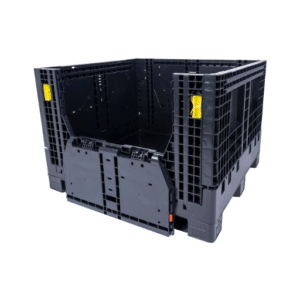
For bulk storage and transport, many operations pair pallets with plastic pallet boxes to create a complete reusable packaging system.
Environmental Impact: Recycled Plastic vs. Wood Pallets
The environmental comparison between recycled plastic and wood pallets is more nuanced than many buyers realize. The “greener” choice depends on trip count, transport distance, end-of-life handling, and whether the plastic is recycled or virgin.
Research published in the Journal of Cleaner Production found that a wooden pallet completing 100 trips generated roughly 144 kg of CO2-equivalent emissions, while a plastic pallet completing the same trips generated about 216 kg CO2-equivalent. On a per-trip basis, wood can have a lower carbon footprint, especially when sequestration from the wood itself is counted.
However, recycled plastic changes the equation. Using post-consumer or post-industrial resin avoids the upstream emissions of virgin plastic production. When a recycled plastic pallet completes a high number of trips and is recycled again at end of life, its lifetime impact can be competitive with or better than wood.
Plastic pallets also avoid the environmental costs of forest harvesting, chemical fumigation, and landfill disposal of broken wood pallets. According to a Penn State study summarized by Packaging Dive, roughly 700 million pallets are produced or recycled annually in the United States, with about 2 billion in use at any time. Small efficiency gains across that volume create meaningful environmental returns.
The honest takeaway: wood pallets can be sustainable when sourced responsibly, reused, and mulched at end of life. Recycled plastic pallets excel in durability, hygiene, closed-loop recycling, and export compliance. The best choice depends on your specific logistics system.
How to Choose the Right Recycled Plastic Pallet
Selecting the right recycled plastic pallet comes down to five factors.
1. Load requirements. Define your maximum static, dynamic, and racking loads. Choose a safety margin of at least 1.5 times your typical peak load.
2. Handling environment. Consider temperature extremes, chemical exposure, moisture, and whether the pallet will travel through automated systems. HDPE performs better in cold; PP handles heat and rigidity demands.
3. Compliance needs. Confirm whether you need food-contact certification, fire ratings, or other industry-specific approvals. If food contact is required, switch from recycled to virgin hygienic pallets.
4. Sustainability goals. Ask suppliers about recycled-content ratio, take-back programs, and end-of-life recyclability. A true closed-loop program is stronger than a simple recycled-content claim.
5. Budget and total cost of ownership. Include purchase price, expected lifespan, maintenance, replacement rate, shipping weight, and compliance costs in your model. Recycled plastic pallets often win on TCO even when the upfront cost is higher than wood.
When evaluating suppliers, request load-test reports, material certifications, and references from similar industries. A reputable manufacturer should provide clear specifications and stand behind them with quality assurance processes.
Ready to compare recycled pallet options for your operation? Contact our team for a free consultation and custom quote based on your load, environment, and volume requirements.
Customization and Supplier Selection

Not every supply chain fits a standard pallet size. Customization is where an experienced manufacturer adds real value.
Common custom options include:
- Non-standard dimensions for unique product footprints
- Custom colors for brand visibility or department coding
- Logo embossing or printed branding
- Anti-slip surfaces or grommets
- Reinforced feet or runners for heavier loads
- Steel reinforcement for high-bay racking
- RFID tags or barcode integration for asset tracking
When choosing a supplier, look beyond catalog photos. Ask about production capacity, quality control, in-house tooling, and global logistics experience. A manufacturer with direct factory pricing, ISO 9001 certification, and custom engineering capability can deliver both cost savings and a pallet that fits your operation precisely.
At Shandong Lile, we manufacture plastic pallets and pallet boxes using advanced injection molding equipment and strict quality control. With 16 subsidiaries, 18 large-scale production machines, and products serving more than 108 countries, we support clients who need everything from standard recycled pallets to fully custom OEM designs. Our team works directly with logistics managers, procurement directors, and sustainability officers to match pallet specifications to real operational demands.
Conclusion
Recycled plastic pallets are a practical step toward a more durable, compliant, and circular supply chain. They last longer than wood, resist the elements, simplify export documentation, and keep plastic waste in use rather than in landfills.
The key is matching the pallet to the job. Recycled resin is ideal for general logistics, export, warehousing, and sustainability programs. Virgin resin remains the right choice for food contact, pharma, and extreme performance requirements. And when standard sizes do not fit, custom manufacturing can deliver a purpose-built solution.
For logistics teams balancing cost control with environmental pressure, recycled plastic pallets offer a rare combination: lower total cost of ownership and a credible sustainability story.
Start building a more resilient pallet program today. Explore our plastic pallet solutions, compare plastic pallets vs. wood pallets, or request a custom quote and let our engineers recommend the right recycled or virgin pallet for your application.