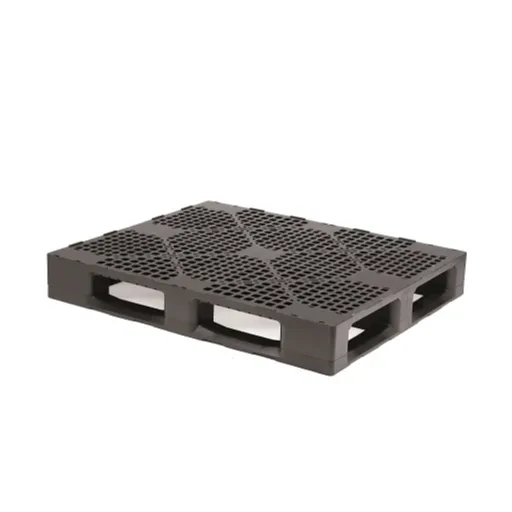

Heavy duty plastic pallets are reinforced HDPE or polypropylene platforms engineered for static loads of 4,000 to 7,000 kg, dynamic loads of 1,500 to 2,500 kg, and racking loads of 1,000 to 1,500 kg. They serve automated warehouses, heavy manufacturing, and export operations where standard pallets fail under cyclic stress.
A failed pallet four meters up in a racking system is rarely a packaging problem. It is a six-figure incident: damaged product, paused operations, and a safety review that ties up your team for weeks. Yet “heavy duty” remains one of the most casually used terms in pallet sales, often applied without quantified load data behind it.
This guide gives you a working engineer’s reference for heavy duty plastic pallets. You’ll learn how to read static, dynamic, and racking load ratings; how steel reinforcement actually works; which applications justify the upgrade; and how to verify supplier claims against ISO 8611 testing standards.
Here’s what we’ll cover: what makes a pallet truly heavy duty, load capacity explained, materials and reinforcement, pallet types, industry applications, a cost-per-trip example, testing standards, customization, and supplier evaluation.
Key Takeaways
- Heavy duty plastic pallets typically support 4,000 to 7,000 kg static, 1,500 to 2,500 kg dynamic, and 1,000 to 1,500 kg racking loads.
- Steel reinforcement reduces deflection under racking loads by roughly 40 to 60% compared with all-plastic equivalents.
- HDPE handles impact and cold (down to -40 °C); polypropylene delivers stiffness for racking and washdown environments.
- Over three years, heavy duty plastic pallets can cost about $3.40 less per trip than wood while cutting breakage roughly 25 times.
- Always verify load ratings against ISO 8611 or ASTM D1185 test reports, never accept generic “heavy duty” claims.
What Are Heavy Duty Plastic Pallets?
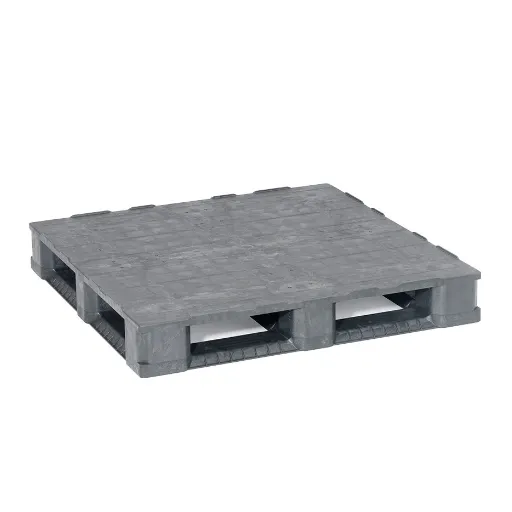
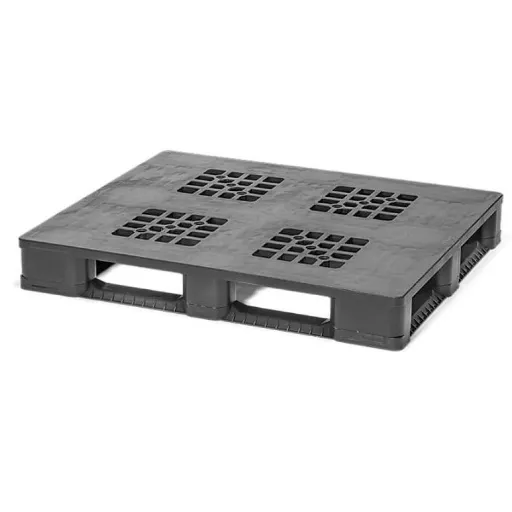
Heavy duty plastic pallets are injection-molded HDPE or polypropylene pallets engineered for sustained operation above standard pallet ratings. They typically incorporate thicker wall sections, deeper structural ribs, reinforced corner blocks, and in many cases internal steel runners cast directly into the molded body.
The “heavy duty” label is meaningful only when it points to specific numbers. A pallet rated for a 4,000 kg static load with 1,500 kg dynamic and 1,000 kg racking capacity is a credible heavy duty unit. A pallet marketed as “heavy duty” without those three values, plus a corresponding test report, is a marketing claim.
Three engineering features separate heavy duty from standard pallets. First, deck thickness and rib geometry resist deflection under concentrated loads. Second, reinforcement (steel rods, structural ribs, or composite inserts) supports the unit when racked beam-to-beam. Third, material specifications target impact resistance and cycle fatigue, not just static strength. For the broader picture of how heavy duty units fit into the wider product family, see our complete industrial plastic pallets guide.
Load Capacity Explained: Static, Dynamic & Racking
Reading a heavy duty plastic pallet specification sheet requires understanding three distinct load ratings. Mistakenly identifying them is the leading cause of pallet breakdown in storage facilities.
Static Load
The static load is the amount of weight that the pallet can take under stationary conditions and on a level floor. This is the highest load rating since the weight is evenly distributed on the pallet floor. The standard heavy-duty rating would be between 4,000 to 7,000 kg.
Dynamic Load
The dynamic load is the amount of weight that the pallet can take under motion or during lifting using a fork-lift truck. Factors such as the lift force, acceleration, and unlevel floor reduce the maximum load capability of the pallet. Standard heavy-duty ratings would be 1,500 to 2,500 kg.
Racking Load
Racking load refers to the amount of weight that the pallet can take where it receives support only at its sides. This is the most demanding scenario because the pallet must resist deflection across its unsupported center. Typical heavy duty range: 1,000 to 1,500 kg (2,200 to 3,300 lb).
Static Load
Static load is the weight a pallet can hold when stationary on a flat floor. This is the most generous rating because the load distributes evenly across the deck. Typical heavy duty range: 4,000 to 7,000 kg (8,800 to 15,400 lb).
Dynamic Load
Dynamic load is the weight a pallet can hold while moving on a forklift or pallet jack. Lift forces, acceleration, and uneven floors all reduce safe carrying capacity. Typical heavy duty range: 1,500 to 2,500 kg (3,300 to 5,500 lb).
Racking Load
Racking load is the weight a pallet can carry when supported only at its edges, as on warehouse rack beams. This is the most demanding scenario because the pallet must resist deflection across its unsupported center. Typical heavy duty range: 1,000 to 1,500 kg (2,200 to 3,300 lb).
Safety Factors
Rated load is not working load. Industry practice applies a safety factor of 1.5x, meaning a pallet rated for 1,500 kg racking should carry no more than 1,000 kg in continuous service. Reputable manufacturers disclose this in their technical sheets. If yours doesn’t, ask.
| Load Type | Standard Pallet | Heavy Duty Pallet | Reinforced HD Pallet |
|---|---|---|---|
| Static (kg) | 2,000 to 3,000 | 4,000 to 6,000 | 6,000 to 7,500 |
| Dynamic (kg) | 800 to 1,200 | 1,500 to 2,000 | 2,000 to 2,500 |
| Racking (kg) | 600 to 800 | 1,000 to 1,250 | 1,250 to 1,500 |
A quick story: When Marcus, a warehouse engineer at a midwestern food distributor, took over pallet procurement in 2024, he found his predecessor had ordered “heavy duty” pallets based on a single static load number. Three weeks after deployment, four pallets sagged on the racks at 1,200 kg, well above their actual 800 kg racking rating. The replacement project cost $42,000 and a near-miss safety report. Reading the full spec sheet on the first order would have prevented all of it.
For deeper testing methodology, our pallet capacity testing program documents how Lile validates each load rating in-house.
Materials & Reinforcement: HDPE, PP, and Steel
The material and reinforcement strategy you choose drives performance, lifespan, and cost. Three options matter for heavy duty applications.
HDPE for Impact and Cold
High-density polyethylene (HDPE) excels at impact resistance and cold-temperature performance. It remains flexible down to -40 °C, which means it absorbs forklift impacts and freezer cycles without cracking. HDPE is the default choice for cold storage, freezer logistics, and any operation where pallets see dropped loads or rough handling.
Polypropylene for Stiffness and Heat
Polypropylene (PP) is stiffer than HDPE and handles higher temperatures, typically up to +120 °C in short bursts. That stiffness translates to better racking performance because PP deflects less under edge support. PP is also easier to specify with chemical-resistant additives for washdown environments in food and pharma plants.
Steel-Reinforced Plastic Pallets
Steel rods cast into the pallet body during molding deliver the largest performance gain available. Typical placement runs longitudinal steel along the load-bearing zones under the top deck. The effect on deflection under racking loads is significant: roughly 40 to 60% less sag compared with the same pallet design in all-plastic form.
Lile manufactures steel-reinforced heavy duty plastic pallets on advanced injection molding lines that bond the steel and resin in a single shot, eliminating the weak points that retrofit reinforcement creates. We also offer custom HDPE and polypropylene blends with UV stabilizers, impact modifiers, and chemical-resistant additives for application-specific builds.
Choosing between materials?Talk to a Lile engineering specialist for a free material recommendation based on your load profile, temperature range, and chemical exposure.
Types of Heavy Duty Plastic Pallets
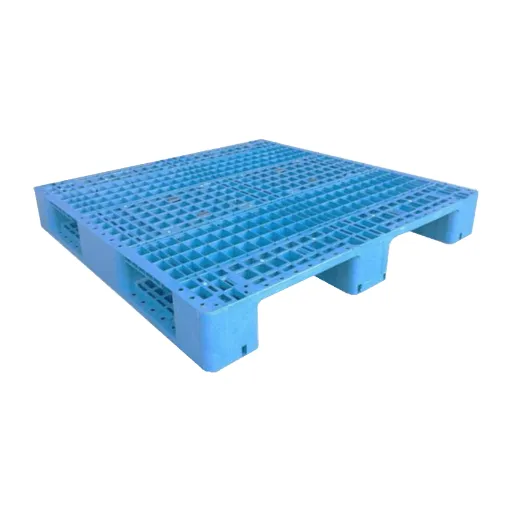
Heavy duty pallets come in four common configurations. Matching the configuration to your workflow is as important as matching the load rating.
Heavy Duty Rackable
Rackable heavy duty pallets feature reinforced edges and often steel runners that allow beam-to-beam racking at 1,000 kg or more. They are the standard for AS/RS (automated storage and retrieval systems), selective racking, drive-in racking, and push-back systems. If your warehouse uses any form of pallet racking, this is your default specification.
Heavy Duty Stackable
Stackable heavy duty pallets maintain consistent stacking dimensions, which simplifies block stacking and warehouse staging. They typically use reinforced corner blocks to distribute loads across multiple levels. This format is ideal for manufacturing buffer stock and high-throughput dispatch areas.
Heavy Duty Nestable
Nestable heavy duty pallets save space on the return leg, offering roughly a 3:1 stacking ratio when empty. They suit closed-loop networks where empty returns drive significant cost: beverage distribution, retail backhaul, and parts-pooling programs.
Heavy Duty Export Pallets
Export-focused heavy duty pallets are ISPM-15 exempt by default because plastic is not a wood pest carrier. They tend to use vented decks to reduce weight on air freight while preserving structural integrity. International auto parts and machinery exporters often standardize on this format.
Industries & Applications
Application drives specification. The wrong heavy duty pallet for the wrong application is almost as costly as no upgrade at all.
Automotive Manufacturing
Engine blocks, transmission cases, and body panel staging typically run 1,500 to 4,000 kg per pallet. Recommended specification: heavy duty rackable, 6,000 kg static rating, steel-reinforced for racking performance.
Beverage and Bottling
Filled keg distribution and glass-bottle case shipments demand closed-deck designs for stability and washdown compatibility for hygiene. Recommended specification: heavy duty rackable in polypropylene for stiffness and easy sanitation.
Chemical and Industrial Drums
Four 55-gallon drums of liquid run roughly 900 kg, with concentrated point loading on the pallet deck. Recommended specification: rackable HDPE with anti-slip surface, chemical-resistant resin grade, and reinforced corner support.
Cold Storage and Freezer Operations
Operations at -25 to -40 °C punish standard plastics. Recommended specification: impact-modified HDPE with vented deck for airflow during defrost cycles. Wooden alternatives absorb moisture and degrade fast in this environment.
Real-world example: A frozen seafood exporter in Qingdao switched from kiln-dried wood pallets to Lile heavy duty HDPE pallets in 2023. Over 18 months they cut pallet replacement costs by 71%, eliminated $18,000 in mold and ISPM-15 compliance overhead, and resolved a recurring product contamination issue tied to splinter damage on cardboard cartons. The team now standardizes the same HDPE specification across all five cold storage sites.
Heavy CPG and Building Materials
Bagged cement, fertilizer, tile, and similar bulk goods load pallets near maximum static capacity. Recommended specification: heavy duty stackable with reinforced corner blocks to prevent crush failure when units block-stack three high.
Pharmaceutical Bulk Handling
API drums and bulk ingredient totes require FDA-compliant resins, smooth-surface designs for cleaning, and often batch-traceable production. Recommended specification: heavy duty rackable in food-contact-grade polypropylene with optional RFID embedding. For full bulk-container coverage, see our plastic pallet boxes range.
Heavy Duty Plastic vs. Wood: Cost-per-Trip Worked Example
Procurement teams often anchor on upfront price and miss the larger cost-per-trip story. Here’s how a 500-pallet fleet compares over three years.
| Metric | Wood Pallet | Heavy Duty Plastic Pallet |
|---|---|---|
| Acquisition cost (per unit) | $45 | $115 |
| Average lifespan (trips) | 8 | 200 |
| Breakage rate | ~25% | ~1% |
| Total cost over 3 years (500 pallets, 30 trips/year) | $253,125 | $208,575 |
| Cost per trip | $11.25 | $7.85 |
Over three years, heavy duty plastic delivers about $3.40 lower cost per trip while reducing breakage incidents roughly 25 times over. The math assumes closed-loop operation: plastic captures full value when pallets return, so open-loop networks (one-way exports, retail dropoff) reduce the advantage.
The upfront capital is real. A 500-pallet conversion needs roughly $35,000 more on day one. For most closed-loop operators, payback runs 14 to 22 months. For comparison detail on the full plastic-vs-wood tradeoff, see our deep-dive on the economics of plastic versus wood pallets.
Testing Standards & How to Verify Load Ratings
A heavy duty load rating is only as credible as its test report. Two standards anchor the global market:
- ISO 8611 is the international standard for pallet performance testing. It defines static, dynamic, racking, and drop test procedures, along with conditioning requirements.
- ASTM D1185 is the equivalent North American reference, widely cited by US distributors and pooling operators.
When you evaluate a supplier, ask for three documents. First, the full ISO 8611 test report with raw deflection data. Second, a cycle-test report showing fatigue performance over at least 10,000 cycles. Third, a clear safety factor disclosure with the working load rating, not just the maximum tested load.
Red flags include load ratings without test conditions, missing safety factor disclosure, and generic “heavy duty” claims without numerical specifications. If a supplier hesitates to share test data, the rating is rarely defensible.
Customization for Heavy Duty Applications
Off-the-shelf heavy duty pallets cover roughly 70% of applications. The remaining 30% need custom engineering, and that’s where direct-from-manufacturer relationships pay off.
Common customization options include:
- Custom dimensions in ISO (1200×1000, 1200×800), GMA (48×40), and bespoke footprints for unique product geometries
- Steel reinforcement placement tailored to specific load paths and racking configurations
- Color coding for closed-loop tracking, dunnage management, or shift identification
- Anti-slip overlays in TPE or thermoplastic rubber for high-grip applications
- RFID embedding during molding for asset tracking integration
- Logo embossing and Pantone matching for branded pallet pools
Lile’s 18 large-scale injection molding machines support custom tooling for orders starting at 5,000 units, with shorter tooling lead times for repeat customers. Our engineering team works with procurement and operations leads on the specification before tooling, which keeps revision costs out of the project.
How to Choose a Heavy Duty Plastic Pallet Supplier
Supplier selection separates a successful conversion project from an expensive lesson. Use this short checklist when evaluating suppliers:
- ISO 9001 certification for quality management
- In-house tooling and mold design, not outsourced production
- Third-party load test reports under ISO 8611 or ASTM D1185
- Documented warranty terms with clear failure-mode coverage
- Repair or take-back program for end-of-life units
- Export logistics capability if you ship internationally
- Sample availability for in-field validation before bulk orders
Prepare a short RFQ that lists your application, load type and weight, racking system, washdown requirements, temperature exposure, expected trip count, and total fleet size. Suppliers who request all of that detail before quoting are usually the ones worth working with.
Lile operates as a factory-direct partner with ISO 9001 certification, in-house custom tooling, ISO 8611 load testing, and global logistics through Qingdao Port. We serve customers across 108 countries with 10,000+ tons of annual output. Ready to start a project? Request a custom quote and a Lile engineer will respond with a tailored recommendation within one business day.
Frequently Asked Questions
How much weight can a heavy duty plastic pallet hold?
A heavy duty plastic pallet typically holds 4,000 to 7,000 kg (8,800 to 15,400 lb) static, 1,500 to 2,500 kg (3,300 to 5,500 lb) dynamic, and 1,000 to 1,500 kg (2,200 to 3,300 lb) on warehouse racks. Steel reinforced versions will increase the upper limits of the above ranges.
What is the difference between heavy duty plastic pallets and standard plastic pallets?
Heavy duty plastic pallets use thicker walls, deeper structural ribs, reinforced corners, and often steel runners. They support roughly double the static and dynamic loads of standard pallets and are rated for warehouse racking, while most standard pallets are not.
Can heavy duty plastic pallets be rackable?
Most heavy duty plastic pallets are rackable, with racking loads of 1,000 kg or more. Always confirm the racking rating separately from the static rating because they are not interchangeable, and verify against an ISO 8611 test report.
Can heavy duty plastic pallets substitute steel pallets?
For loads below about 3,000 kg dynamic, heavy duty plastic with steel reinforcement matches steel pallet performance at roughly 30 to 50% lower cost and 60% lower weight. Above that threshold, steel or hybrid solutions remain the standard.
How durable are heavy duty plastic pallets?
Heavy duty plastic pallets typically last 100 to 500 trips in closed-loop operations, compared with 8 to 80 trips for wood. Longevity is based on the ability to manage discipline, temperatures, and consistent loads.
Is it true that heavy duty plastic pallets are FDA approved?
Yes, heavy duty pallets made from food-grade HDPE or Polypropylene will comply with the FDA standards for indirect contact with food. Remember always to have an FDA food contact certification provided by your supplier.
Are heavy duty plastic pallets required to have ISPM-15 compliance?
No. ISPM-15 compliance does not apply to plastic as it refers exclusively to wood products.
What is the standard size for heavy duty plastic pallets?
Common heavy duty sizes include 1200×1000 mm (ISO), 1200×800 mm (Euro), and 48×40 inches (GMA, North America). Custom sizes are widely available for OEM applications.
Conclusion: Specify by the Numbers, Not the Label
Heavy duty plastic pallets earn their name through verified numbers, not marketing language. Reading static, dynamic, and racking ratings independently, applying real safety factors, and matching material plus reinforcement to your application is how you avoid the expensive lessons.
Three takeaways to anchor your next procurement cycle:
- Read all three load ratings (static, dynamic, racking) and never operate at the rated maximum.
- Verify with ISO 8611 or ASTM D1185 test reports, not catalog claims.
- Match the material and reinforcement to your temperature range, chemical exposure, and racking configuration.
Heavy duty plastic pallets, properly specified, deliver measurable cost-per-trip savings, dramatically lower breakage rates, and reliable performance across automated warehouses, cold chains, and export operations.
Next step: Request a custom heavy duty pallet quote from Lile and receive a tailored recommendation with full load specifications, material options, and lead times. For deeper context, explore our complete industrial plastic pallets guide and review the pallet capacity testing program we run on every production batch.