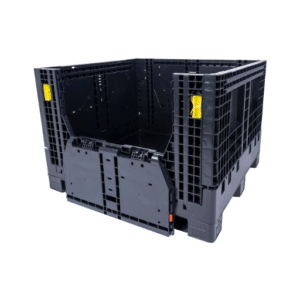
Plastic pallets typically last 10 to 15 years, or 100 to 250+ trips, while wood pallets last 1 to 3 years, or roughly 10 to 20 trips. In other words, plastic pallets outlast wood by roughly 5 to 10 times when you measure in the trips that actually matter.
But here’s the problem. Most buyers compare pallets in years, and that number hides almost everything. A wood pallet that sits in a clean, dry warehouse for a decade is a very different asset than one moving through a cold-storage loop 20 times a year. Calendar years are the wrong yardstick.
You probably already suspect that the higher upfront price of plastic is justified by longevity. You’re right, but not for the reason most people assume. The real story is about trips, failure modes, and how often you have to re-buy.
By the end of this guide, you’ll know exactly how long each material lasts, why the gap exists, and, just as important, when wood is still the smarter choice.
Key Takeaways
- Plastic pallets last roughly 5–10x longer than wood: 100–250+ trips versus 10–20 trips for wood.
- Measure lifespan in trips, not years. Trip count is what drives your replacement budget.
- Wood fails through moisture, splintering, and nail failure; plastic fails through predictable, slower modes like creep and impact cracks.
- Wood needs repair every 3–7 trips; quality plastic pallets need little to no repair over their service life.
- Plastic only pays back in closed-loop or high-turnover operations. For one-way shipping, wood is often still the right call.
How Long Do Plastic Pallets Last vs Wood?

Let’s answer the question directly. A quality plastic pallet lasts 8 to 15 years in a typical operation, according to manufacturer estimates from Pearl River Plastics, while wood pallets last 1 to 3 years before replacement. IPP Pooling notes that wood can reach up to 5 years, but only “with correct care and storage”, a condition that rarely holds in a busy distribution center.
The more useful comparison is trips. iGPS reports that plastic pallets can complete up to 100 trips, while wood block pallets manage 15 to 20 trips and standard stringer pallets often last just 1 to 3 turns before failing.
Independent testing widens that gap further. ORBIS cites Virginia Tech research showing plastic pallets completing 200+ cycles versus 11 cycles for wood before failure. One academic lifecycle study published in the International Journal of Life Cycle Assessment set the expected baseline at 66 cycles for plastic versus 20 for wood, with wood requiring repair every 7 cycles.
The exact number varies by source, operation, and pallet design. But the direction is consistent: plastic outlasts wood by a wide margin, and the gap shows up fastest when you count trips.
Plastic vs Wood Pallet Lifespan: The Comparison Table
Here is the side-by-side view, distilled from the sources above.
| Attribute | Wood Pallet | Plastic Pallet |
|---|---|---|
| Typical lifespan (years) | 1–3 (up to 5 with ideal care) | 8–15 |
| Typical trips / cycles | 10–20 (11 in independent testing) | 100–250+ (up to 400+) |
| Repair frequency | Every 3–7 trips | Minimal to none |
| Primary failure modes | Moisture, rot, splintering, nail failure | Creep, impact cracks, UV embrittlement |
| Performance over time | Declines as it absorbs moisture and breaks | Holds rated capacity for most of its life |
| Best fit | One-way shipping, low turnover, tight budget | Closed-loop, high turnover, hygiene-sensitive |
The trip column is the one to pay attention to. It explains a phenomenon almost every operations manager has seen: a wood fleet that looks fine on paper but quietly drains budget through constant replenishment.
Wondering how these numbers land in your own operation? Explore Lile’s plastic pallet range to see which designs match your trip count and load profile.
Why Wood Pallets Fail Faster
Wood is a remarkable material, but it has structural weaknesses that show up quickly in a supply chain. Understanding how it fails explains why its lifespan is so short.
Moisture, Mold, and Rot
Wood is porous. It absorbs water from humidity, rain, wash-downs, and condensation. In a cold-storage facility, pallets moving between freezer and dock soak up moisture every cycle. That moisture leads to mold, rot, and warping, and a warped pallet becomes a racking and handling hazard. Plastic is non-porous and simply doesn’t have this failure mode.
Splintering and Impact Damage
Forklift tines, pallet jacks, and drops chip and crack wood. Splinters break off, damaging product packaging and creating a worker-safety risk. Because wood is roughly 27 pounds heavier than a comparable plastic pallet, it gets handled more roughly in the first place, accelerating the damage.
Nail and Hardware Failure
Wood pallets are held together with nails or screws. Moisture rusts the fasteners, and repeated impact loosens them. A pallet with exposed or loose nails is a safety and product-damage risk, and once the fasteners go, the pallet is finished.
Repair Frequency
Wood is repairable, which sounds like an advantage. In practice, it means your team spends time pulling pallets off the line, swapping boards, and re-nailing, or paying a recycler to do it. iGPS and the LCA study both point to repair intervals of every 3 to 7 trips. That repair labor is a real cost most spreadsheets miss.
Why Plastic Pallets Last Longer

Plastic pallets aren’t simply “stronger.” They fail differently, and more slowly.
Material Science: HDPE and PP
Most plastic pallets use high-density polyethylene (HDPE) or polypropylene (PP). These polymers are immune to moisture, resistant to most chemicals, and dimensionally stable across a wide temperature range. They don’t absorb water, so they don’t rot, warp, or rust. For a deeper look at the material tradeoffs, see our HDPE vs. polypropylene comparison.
Unibody Construction
Quality plastic pallets are injection-molded as a single piece. There are no nails to rust, no boards to split, no seams for moisture to penetrate. That unibody design is why plastic tolerates the rough handling that destroys wood.
Predictable Failure Modes
Plastic fails through three main modes: creep (slow deformation under sustained load), impact cracks (from hard fork-tine strikes), and UV embrittlement (from long-term sun exposure outdoors). The key difference is that these are predictable and largely preventable through design and material selection, you can spec a UV-stabilized grade, a heavier deck, or steel reinforcement. Wood’s failure modes, by contrast, are environmental and largely out of your control.
This is why our durable plastic pallets guide frames the question differently: it’s not “will this pallet break?” but “when, and under what conditions?”
What Actually Determines Pallet Lifespan
Material sets the ceiling, but your operation sets the actual number. Five factors move the needle for both wood and plastic:
- Load and load distribution. Overloading or concentrating weight accelerates failure in both materials. Respect the rated capacity.
- Handling practices. Hard fork-tine strikes, drops, and dragging kill pallets faster than anything else. Operator training is the cheapest lifespan upgrade you can make.
- Environment. Indoor, dry warehouses maximize lifespan. Cold storage, moisture, UV exposure, and chemical wash cycles all shorten it, wood far more than plastic.
- Trip frequency. A pallet making 20 trips a year dies faster than one making 5. This is why trip count, not years, is the honest metric.
- Maintenance and inspection. Pulling damaged pallets out of circulation before they fail protects the rest of the fleet.
Here’s a concrete example of how these factors play out.
At a cold-storage facility in Texas, quality manager Ana fought a losing battle with wood. Pallets moving between the freezer and the wash-down dock soaked up condensation, and within weeks she was finding mold growth and splintering near the fork entries. A food-safety audit flagged the issue twice. Ana moved her hygienic lines to plastic pallets. The wash cycles that had been destroying wood became routine, and the audit findings disappeared. Same operation, same trip count, but a completely different lifespan, because the failure mode changed.
The Replacement-Frequency Math
The lifespan gap only matters financially when you count how many times you re-buy. Here’s a simple example.
Say your operation moves 2,000 trips a year. A wood pallet averaging 15 trips means you’re replacing roughly 133 pallets a year just to keep the fleet at 100%, and that’s before accounting for repairs. A plastic pallet averaging 150 trips covers that same demand with about 13 pallets.
Over a decade, one plastic pallet in a closed-loop operation can do the work of a whole stack of wood pallets. Craemer’s analysis put the per-trip cost at roughly 0.19forplasticversus0.19forplasticversus3 for wood, and ORBIS estimates about 6peryearforplasticversus6peryearforplasticversus10 per year for wood over a decade.
We won’t dive deeper into the numbers here, our plastic pallet total cost of ownership comparison breaks down the full math. The point is simpler: lifespan is the cost argument, because most of your spend over time is replacement and repair, not the initial purchase.
Ready to see your own numbers? Request a lifespan assessment from Lile’s team. We’ll model your trip count, load, and environment against real pallet specifications.
When Wood Pallets Still Make Sense

This is the part most plastic manufacturers skip, and it’s the part that builds trust. Plastic is not always the right answer.
For a one-way exporter shipping parts to Central America, wood is often still the smart choice. Those pallets leave the facility and never come back. Paying a premium for a plastic pallet that makes one trip and gets stranded abroad makes no sense. For a closed-loop operation, the math flips the other way.
Wood also makes sense for low-turnover domestic loops, a pallet that moves a handful of times a year and stays dry might last for years. And for businesses with a tight upfront budget and no recovery program, wood’s low entry price is hard to beat.
There’s also an environmental nuance worth stating honestly. A review of lifecycle assessment studies published by MDPI found that plastic pallets only outperform wood environmentally when they achieve high reuse intensity, roughly 30 cycles versus 4.4. Plastic’s production footprint is higher, so it earns its keep only through many trips. If your pallets don’t come back, that advantage never materializes.
The honest summary: plastic wins when your pallets circulate, and wood wins when they don’t.
Frequently Asked Questions
How long do plastic pallets last compared to wood?
Plastic pallets last 8 to 15 years, or 100 to 250+ trips. Wood pallets last 1 to 3 years, or 10 to 20 trips. Plastic outlasts wood by roughly 5 to 10 times.
How many trips does a wood pallet last?
A standard wood stringer pallet lasts 1 to 3 trips. A heavier block pallet lasts 15 to 20 trips. Independent testing puts wood’s average failure point at around 11 cycles.
How many trips does a plastic pallet last?
Quality plastic pallets complete 100 to 250+ trips, with heavy-duty and reinforced models demonstrating 400 or more cycles in testing.
Do plastic pallets really last 10 times longer than wood?
In trips, yes, often more. The 10x figure is a fair midpoint, though the exact ratio depends on your operation’s conditions and the pallet designs you compare.
What fails first on a wood pallet?
Moisture and impact. Wood absorbs water, leading to rot, mold, and warping, while fork-tine strikes cause splintering. Rusted or loosened nails are usually the final failure point.
Are plastic pallets worth the higher upfront cost?
In closed-loop or high-turnover operations, yes, the extended lifespan drives a much lower cost per trip. In one-way or very low-turnover applications, wood’s low entry price can win.
Conclusion: Count Trips, Not Years
The plastic vs wood pallet lifespan question has a clear answer: plastic lasts far longer, whether you measure in years or trips. But the number that should guide your decision is trips, because that’s what your replacement budget actually feels.
Here’s what to remember:
- Plastic pallets deliver 100 to 250+ trips versus 10 to 20 for wood.
- Wood fails through moisture, splintering, and nail failure; plastic fails through slower, more predictable modes.
- Wood needs repair every few trips; plastic largely doesn’t.
- The lifespan gap is the real cost argument, replacement and repair, not sticker price, drive your spend.
- Plastic wins in closed loops. Wood wins in one-way shipping.
At Shandong Lile, we don’t sell you a material, we help you predict service life. Tell us your trip count, your loads, and your environment, and we’ll match you with a pallet engineered to last in your operation.
Request a free quote today and get plastic pallets built for your specific conditions.