Collapsible pallet boxes cut empty-return freight by 50% to 85% because they fold down to a fraction of their erected volume, so the return truck carries more load and less air. If your fleet still ships rigid containers back empty at full freight, the return lane is almost certainly your biggest hidden logistics cost.
Here’s the number that should worry you: reverse logistics eats 40% to 60% of the total operating cost of any reusable packaging system, according to research on European return networks. A single empty leg on a 400 to 800 km route adds 7.50to7.50to12.00 per trip in reverse freight. Stretch that route to North American distances and the cost climbs to 11.00to11.00to18.00 per trip.
You probably already believe collapsible boxes cost more and are only worth it at huge volumes. That’s half true. The premium is real, but the break-even point is far lower than most procurement teams assume. This guide shows you exactly how collapsible pallet box return logistics works, how to run the numbers, and when the investment pays for itself.
Key Takeaways
- Collapsible pallet boxes reduce empty-return volume by 50% to 85%, with sleeve packs collapsing to about 15% of their assembled size.
- Reverse logistics is 40% to 60% of your reusable-packaging operating cost, so it is the first place to look for savings.
- A closed-loop HDPE foldable container lands at 0.85to0.85to1.40 per trip, compared to 5.50to5.50to9.50 for a one-way corrugated carton.
- Break-even typically arrives at 6 to 10 round trips per year; at 20+ trips, total cost of ownership runs 40% to 60% below rigid boxes.
- RFID tracking can cut container loss rates from 12% down to 0.5%, which protects the fleet you paid for.
Why Empty Returns Are the Hidden Cost of Rigid Boxes

A rigid pallet box takes up the same volume whether it’s full of parts or completely empty. On the forward trip, that volume earns its keep. On the return trip, it ships back as dead air, and you pay full freight for it.
Marcus, a logistics manager at an automotive supplier in the Midlands, discovered this the hard way. His plant ran 1,200 rigid bulk boxes on a two-day loop between his factory and a tier-one customer. Every box returned empty. “I was paying to ship 1,200 empty crates back every 48 hours,” he told us. When he calculated the reverse freight alone, it came to more than the boxes had cost to buy in the first year.
His story is not unusual. Transport accounts for roughly 80% of most logistics budgets, and empty returns are pure waste inside that number. The problem compounds with distance. On a short 50 km shuttle, the empty leg is annoying but cheap. On a 600 km route, it becomes the deciding factor in whether reusable packaging makes financial sense at all.
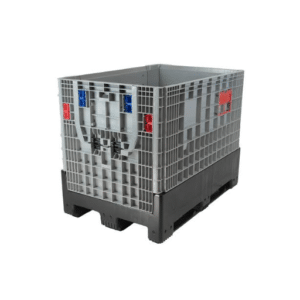
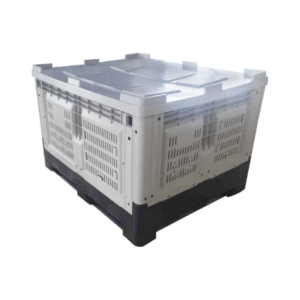
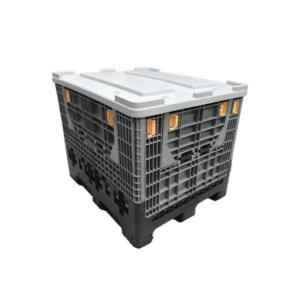
This is where collapsible plastic pallet boxes change the math. Instead of shipping the same empty volume back, they fold, nest, or disassemble so the return trip carries several empties in the space of one.
How Collapsible Boxes Slash Return Freight
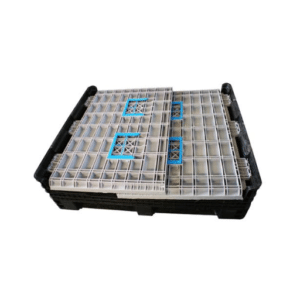
Collapsible pallet boxes cut return freight by shrinking the empty unit itself. A standard box collapses from around 800 mm high to roughly 250 mm, which removes 60% to 75% of its empty volume. Sleeve-pack systems, where the base, sleeve, and lid separate, push that saving as high as 87%.
The return ratio tells you how many folded boxes fit in the space of one erected box:
| Format | Return Ratio | Empty-Volume Savings |
|---|---|---|
| Wall-fold collapsible box | 1:1.9 to 1:3.2 | 50% to 70% |
| Sleeve pack (separate base, sleeve, lid) | up to 1:5.78 | up to 85% |
| Knock-down flat pack | up to 6:1 | up to 82% |
These ratios translate directly into truck fills. A folded fleet can fit roughly 300 units where a rigid fleet fits one, and a 53-foot trailer can carry 360 collapsed units versus 60 assembled ones.
Watch the principle in action: this collapsible pallet box folds flat in about 30 seconds, ready for its return trip.
The savings are not just on the truck. Folded boxes free warehouse floor space while they wait for their next cycle, which matters most in seasonal operations where the fleet sits idle for months.
Want to see how this compares across rigid and nestable designs before you commit? Our collapsible vs. rigid pallet boxes guide walks through the full decision.
The Cost-per-Trip Math for Return Logistics
To justify any reusable packaging investment, you need a defensible cost per trip. The formula that procurement teams use looks like this:
Cost per trip = (asset depreciation + cleaning + reverse freight + admin and tracking + loss write-off + labor + repair parts) ÷ trips per asset per year.
Run that math on a closed-loop HDPE foldable container over a five-year life at 70 trips per year, and you land at 0.85to0.85to1.40 per trip. A one-way corrugated carton, by contrast, runs 5.50to5.50to9.50 per carton every single time.
Here is how the per-trip cost breaks down by industry:
| Industry | Cost per Trip |
|---|---|
| Automotive tier-one | 0.78to0.78to1.05 |
| Food processing | 0.95to0.95to1.30 |
| Consumer electronics | 1.05to1.05to1.40 |
| Beverage pooling programs | 0.55to0.55to0.85 |
The two largest variables are depreciation and reverse freight. Reverse freight adds 7.50to7.50to12.00 per trip on European intra-plant routes and 11.00to11.00to18.00 on longer North American lanes, which is why folding the empty unit matters so much.
Alicia, a procurement lead at a food processor in Valencia, ran this calculation on 800 bulk boxes. Her reverse freight was eating 38% of her reusable-packaging budget. Switching to collapsible boxes cut the empty-return volume by roughly 70%, and the fleet paid for itself in 16 months. She now treats the return lane as a line item she can reduce, not a fixed cost.
These benchmarks come from detailed cost modeling by JOYREPAK on the cost-per-trip formula, which is worth reading in full before you build your own model.
Break-Even Analysis: When Collapsible Pays Off

Collapsible boxes cost 15% to 25% more upfront than rigid equivalents. The question is when that premium pays for itself. The answer depends on trip frequency, and it arrives sooner than most teams expect:
- Fewer than 6 trips per year: rigid boxes win. On one-way export or purely seasonal use, you never recoup the folding premium.
- 6 to 10 trips per year: collapsible boxes break even, typically within 18 to 24 months.
- 10 to 20 trips per year: sleeve packs start to outperform thanks to their higher return ratios.
- 20+ trips per year: sleeve packs dominate. At this frequency, total cost of ownership runs 40% to 60% below rigid boxes.
A useful rule of thumb we share with customers: if more than 40% of your container trips involve backhauling empties, collapsible boxes usually pay back within about 18 months.
The honest counterpoint is that folding mechanisms add mechanical complexity. Hinges and latches are wear points, and a box that folds 20 times a year ages faster than one that never folds. Service life for a well-made collapsible box is typically five to seven years depending on fold frequency, so factor repair and replacement into your model rather than assuming it lasts forever.
Not sure whether foldable or rigid is right for your specific loop? The bulk plastic pallet boxes guide covers the full sizing and selection picture.
Designing a Closed-Loop Return Process
The savings only materialize if the boxes actually come back. A closed loop needs a defined circuit: full delivery, empty pickup, reload, new delivery. That sounds obvious, but the loop breaks down in practice for two reasons.
First, sleeve packs have three separate components: base, sleeve, and lid. In a controlled single-site loop, that’s fine. In a multi-site or third-party flow, lids go missing and sleeves get mismatched. Lid loss is a real, recurring cost in high-volume returns.
Second, boxes are assets, not consumables, and assets drift. Without tracking, your fleet count slowly shrinks, and you end up buying more boxes to cover losses you can’t see.
The choice between formats maps to loop control:
- Controlled, single-site loops: sleeve packs work well, and individual damaged parts are cheap to replace.
- Multi-site or third-party returns: a folding large container (FLC) that collapses as one unit is easier to handle, with nothing to sort or match, though damage is more likely to need whole-unit replacement.
Whatever format you choose, standardize on a footprint that works with your forklifts, pallet trucks, racking, conveyors, and any automated guided vehicles. A box that doesn’t fit your existing handling equipment erases the freight savings in labor.
Tracking Your Fleet: Barcode, QR, and RFID
If you can’t see your fleet, you can’t control it. Returnable transport items (RTIs) cross multiple parties and don’t belong to any single system of record, so without serialization the only truth is a physical count. That’s expensive and late.
Most loops can start with barcode or QR scanning through a driver app, which covers the basics of dispatch, delivery, empty pickup, and return. RFID earns its cost at high-throughput points, like a gate that reads 20 stacked boxes at once as a truck leaves.
The payoff is real. One manufacturer’s RFID rollout cut container loss rates from 12% down to 0.5% at a tag cost of roughly €0.30 per unit. A logistics provider tracking 90,000 RTIs with a hybrid barcode and RFID system gained real-time pool control and measurably reduced its capital tied up in idle containers.
The fundamentals of serializing and tracking returnable assets are explained well in this Shipsy guide to returnable packaging material, which we recommend as a starting point before you spec tags.
At Shandong Lile, we build custom collapsible pallet boxes with RFID and barcode slots molded in, so you can track assets from day one without retrofitting. That’s part of our plastic pallet boxes range.
Pooling vs. Owning Your Collapsible Fleet
There are two ways to run a collapsible fleet: own it or rent it from a pool. Pooling providers like CHEP and IFCO handle the forward and return logistics, tracking, and maintenance for you. You pay per trip and never worry about asset recovery.
That convenience has a price. Pooling drops cost per trip to 0.55to0.55to0.85 because asset cost, reverse logistics, and cleaning are spread across many users, but it also means you surrender the margin and the control. You also depend on a provider’s network density, which works better in dense urban regions than sparse rural ones.
The trade-off is simple:
- Pool when your loops are irregular, your volumes are modest, or you lack the infrastructure to track and recover assets.
- Own when your loops are high-frequency, closed, and predictable, because at 20+ trips per year the savings you keep exceed the pooling fee.
A pooled IFCO container can circulate for up to 120 reuses over 25 years, which shows how durable a well-maintained returnable asset can be. That longevity is the whole point of the SmartCycle recollection model: the container returns, gets washed, and goes back out.
Sustainability and the Circular-Economy Payoff

Return logistics is not only a cost story; it’s a sustainability story. Reusable packaging only displaces single-use corrugated or wood when recovery rates stay high, typically above 65%. Foldable boxes help on both fronts: they cut the carbon of empty return trips and they make the return itself economical enough to keep doing.
That’s why regulation is pushing the same direction. The EU’s Packaging and Packaging Waste Regulation sets reuse targets of 40% by 2030 and 70% by 2040 for transport packaging in many categories. A collapsible return loop is one of the most direct ways to hit those targets while cutting cost.
Tomás, an operations director at a produce cooperative in southern Spain, runs a seasonal fleet of collapsible boxes for his harvest. In the off-season, the entire fleet folds flat and stores in a corner of one warehouse instead of three. When harvest returns, the boxes go back out on the same trucks that deliver. His freight invoices dropped 45% in the first full season, and his single-use corrugated spend fell to nearly zero.
That’s the circular-economy payoff in concrete terms: fewer empty trucks, less corrugated waste, and a fleet that pays for itself on the return lane.
Frequently Asked Questions
How do collapsible pallet boxes reduce return freight costs?
They fold, nest, or disassemble when empty, cutting their empty volume by 50% to 85%. More empties fit on each return trip, so you pay to ship containers, not air.
What is the fold ratio of a collapsible pallet box?
Fold ratio describes how many folded boxes fit in the space of one erected box. Wall-fold boxes typically reach 1:1.9 to 1:3.2, while sleeve packs can exceed 1:5.7, and flat knock-down systems reach up to 6:1.
Are collapsible pallet boxes worth the higher upfront cost?
Usually yes, if you run more than about 6 to 10 round trips per year. Below that, rigid boxes or one-way packaging often win. At 20+ trips per year, collapsible boxes run 40% to 60% cheaper over their lifetime.
Should I pool or own my collapsible pallet boxes?
Pool if your loops are irregular and you want simplicity. Own if your loops are high-frequency and predictable, because at scale the savings you keep outweigh the pooling fee.
How do I track collapsible pallet boxes in a return loop?
Start with barcode or QR scanning at each handoff, then add RFID at high-throughput gates if loss becomes a problem. Serializing every asset is the non-negotiable first step.
Cut the Cost You’re Already Paying
Return logistics is the least glamorous part of packaging and the most profitable place to find savings. Collapsible pallet boxes attack the single biggest line item, empty-return freight, by shrinking the empty unit itself. Run the cost-per-trip math, and the case usually makes itself.
The pattern that separates winners from the rest is discipline. Winners measure their empty-return rate, pick a fold format that matches their loop control, serialize every asset, and hold the return circuit to the same standard as the forward lane.
If you’re ready to put numbers on your return lane, we’ll help you run the math for your specific routes and volumes. Tell us your trip frequency, route distances, and fleet size, and we’ll model the payback on collapsible pallet boxes for your operation.