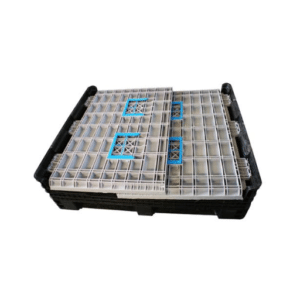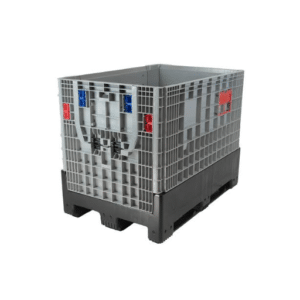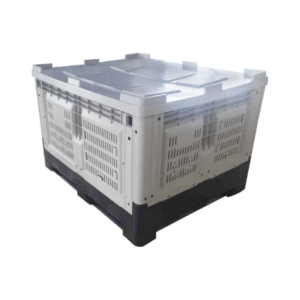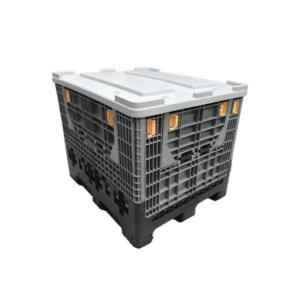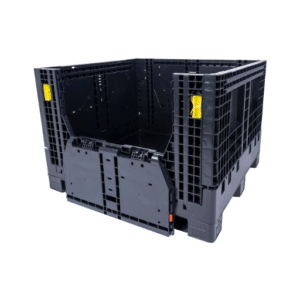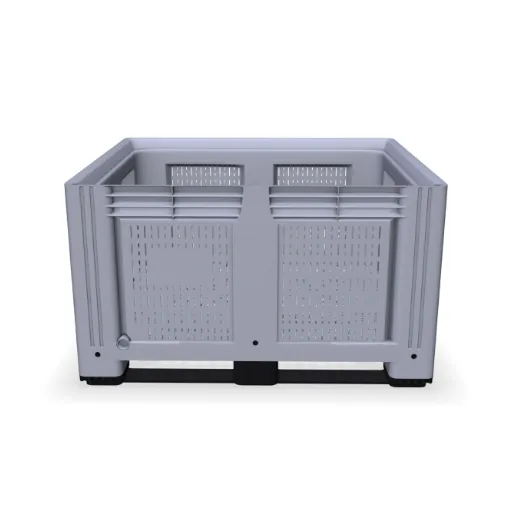

Knowing how to choose plastic pallet boxes consists of following seven steps: load, material, construction, regulations, cost, supplier, and personalization. To fail any of these steps might lead to an uncalled for expense or procurement of inappropriate boxes.
And this indeed happened in the last quarter of a calendar year, to a pharmaceutical distributor based in Rotterdam. The purchase office of that organization opted to purchase collapsible pallet boxes based solely on the cost per unit. After five months, their hinges collapsed due to excessive movement over time. This, in turn, saw the reorder price rise to 60% of the initial cost and left a two-week gap in the preoperative cold-chain schedule. In hindsight, opting for the cheap version was their worst spend of the year.
For those involved in purchasing, supply chain management, or fulfilling storage and inventory needs, there might have been instances of similar vendor assertions. Every vendor guarantees that their products are long-lasting. Every catalogue displays remarkable load cabilities.
This plastic pallet box buying manual will help you understand how to choose plastic pallet boxes, a 7-stage process that does not lead even the global corporations to any problems. You will understand how to use ISO 8611 to a reasonable degree from the beginning, to five years of total cost ownership and even know which supplies you shouldn’t look at. In conclusion, a tangible clip-board with points for the procurement within a particular period will be available to all.
Key Takeaways
- Choose HDPE for cold storage and chemical exposure; choose PP for ambient heavy loads at lower cost.
- Demand three separate load ratings from suppliers: static, dynamic, and racking, plus ISO 8611 test evidence.
- Collapsible boxes only pay off when your empty-return ratio exceeds 35-40% and you cycle the fleet 10 or more times per year.
- The cheapest unit price often costs 50% more over five years when replacement, downtime, and disposal are factored in.
- Always audit supplier manufacturing capabilities, batch material controls, and mold ownership before placing bulk orders.
What Are Plastic Pallet Boxes and Why Do You Need One?
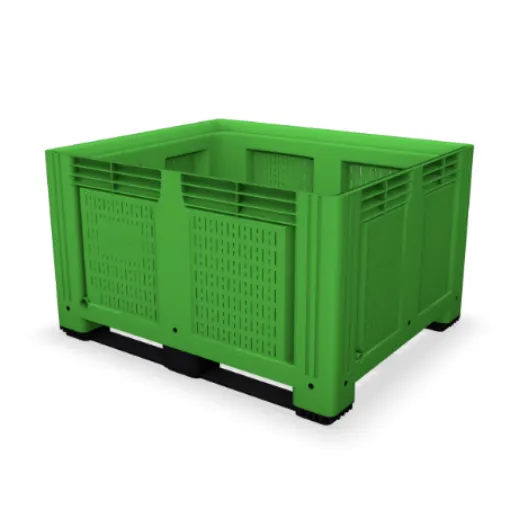
Plastic pallet boxes are products that allow large volumes of material to be stored in a palletized form, meeting the definition of a large-volume container built on a plastic pallet; it also goes without saying that they are manufactured either out of High Density Polyethylene (HDPE) or Polypropolene (PP). They have the advantage of high vertical storage capacity like bulk bins; at the same time, the ease of use and transport of a pallet so as to be easily moved by forklifts or pallets jacks in one piece is still available.
In contrast to standard pallets which permit goods to be placed on their tops only, pallet boxes have four more sides with the help of which all loose, granular or fragile contents are secure in place. Such containers do not absorb moisture, splinter or invite any pests as wooden crates do. Such containers can be used hundreds of times without damaging the structure, as it happens with gaylords made out of cardboard.
We specialize in manufacturing industrial scale plastic pallet boxes within Shandong Lile targeting such industries as Automotive and Pharmaceuticals Cold Chain practices. The past fourteen years have witnessed redundant procurement mistakes in most of our markets. The guide seeks outline resolution steps.
Step 1: Define Your Plastic Pallet Box Load and Handling Requirements
Before you compare materials or brands, you need hard numbers. Load capacity is not a single figure. Professional suppliers provide three distinct ratings, and understanding these plastic pallet box selection criteria protects you from catastrophic failures in your warehouse.
Understanding Load Capacity Ratings
Static load capacity refers to the maximum weight that a pallet box can accommodate without the need to move it, with the movement in this case being vertical. This is the highest of the three load ratings and is most big of a number ranging from a thousand to five thousand kilograms, especially for the industrial nature of these models.
Dynamic load relates to the maximum conveyable mass, controlled under the operation of the handling element such as a forklift, or a pallet jack. This coefficient amounts to 30 to 50 percent from the static load due to the fact that the transportation activities include vibration and impact resistant and load is not favorably distributed.
Racking load is the maximum weight the box can carry when it is placed on the support beams of the warehouse racks and having no support on the bottom. It is the most important as well as the most misunderstood among all three ratings. A box of physical likeness and weight of contains 2 metric tonnes (2000 kg) may be racked to a load of less than 800 kilograms.
Reliable companies test their pallets under ISO 8611 conditions and issue deflection graphs that quantify the extent of sagging for a given load for a specific period of time. If the manufacturer categorizes the box as turned out to be “capable” of being “rackable” or ‘duty’ rating is “heavy”, but she did not provide the camber data, this is inappropriate for the use in racking.
Matching Equipment Compatibility
Verify that your chosen box works with your existing material handling fleet. Four-way entry boxes allow forklift access from all sides, which reduces maneuvering time in tight aisles. Two-way entry costs less but limits flexibility.
If you operate automated guided vehicles (AGVs) or conveyor systems, dimensional tolerance becomes critical. Wooden pallets vary by millimeters between units, which can jam automated systems. Injection-molded plastic boxes maintain consistent dimensions within 0.1 millimeters, making them the standard for modern distribution centers.
Want to see how load capacity translates to real-world performance? Explore our heavy-duty plastic pallet boxes engineered for racking and automated handling systems.
Step 2: Choose the Right Material for Your Environment
HDPE and PP each dominate specific use cases. Selecting the wrong material for your environment guarantees premature failure, regardless of how well the box is designed.
HDPE vs. PP: When to Choose Each
Virgin HDPE remains the queen of types, when it comes to making and utilizing various materials. The inherent physical properties contribute to its strength: the enduring resistance to impact, performance assured to minus 40 degrees Celsius, and acids and alkalis as strong as they come. It is possible to expect six to eight years out of the average duty cycle for HDPE containers. Activities like cold chain management, chemicals storage, and distribution, including processing of food, call for the application of HDPE materials.
Virgin PP means higher stiffness and enhanced load-carrying capability very often within 10-15% price lower than comparable HDPE. It remains stable until 100 degrees of Celsius supporting stable storage at such temperatures. Polypropylene on the other hand, is not recommended for below minus 20 degrees Celsius as it embrittles. In consideration, a freezer warehouse, dropping a box of PP could cause cracks where boxes made of HDPE could have withstood the pressure.
Recycled mixes reduce the cost but typically last over only two or three years of usage. Such materials are suitable for very light use, during a short time, or storage where it is not critical how long they will be in use.
Industry-Specific Material Requirements
Food and pharmaceutical operations demand more than generic material claims. FDA 21 CFR compliance and EU 10/2011 food-contact certification must be documented in writing, not promised verbally. The material must be non-porous, with smooth internal walls and rounded corners that prevent bacterial harborage.
For lithium battery transport or electronics handling, modified materials with anti-static or flame-retardant additives are essential. Standard HDPE or PP will not suffice.
If you are sourcing for food processing or pharmaceutical applications, review our detailed guide on plastic pallet boxes for the food industry for compliance-specific requirements.
Step 3: Select the Optimal Plastic Pallet Box Design Type
The design type you choose has a larger impact on logistics cost than the material itself. The wrong design type can increase return freight costs by 30% or reduce warehouse density by half.
Rigid Plastic Pallet Boxes
Rigid boxes one-piece or welded construction because it has the best mechanical properties. They allow stacking four to five pieces vertically without deformation, they take the most weight, and they absolutely do not.
There is one however – the volume. Rigid boxes cannot be collapsed without cutting its sides or does not rest into itself one another after its internal content is completely consumed since it is solid – basically you pay for sending out and keeping air. You opt for rigid construction under three conditions: One or more boxes at the same places; stacking height a very significant factor; or automated processes in place which require geometry strict conformance.
Collapsible and Foldable Designs
Collapsible boxes such as pallet containers have vertically attached structures, which can be detached and collapsed for storage after use. This usually amounts to 60 to 70 % empty space saved which means period return freights are less and there shall be minimal warehouse space occupied in between cycles.
Nonetheless, the folding assembly has constituent parts subject to wear over time. Repetitive opening and closing cycles will cause the latches and hinges to degrade and even the capability of genuine workers may be compromised. A case to illustrate involved a beverage distribution business that in actual fact, incurred losses of 150,000 yuan, because the workers failed to fold the collapsible containers, which ended up damaging the mechanisms and wasting space.
The break-even policy remains very simple; do not choose collapsible boxes unless and until the ratio of the number of empty boxes returned exceeds 35-40% and also unless one has used one fleet ten times or more per year.
Sleeve Pack Systems
These systems consist of a base along with a collapsible structure and a removable top if desirable. They provide heights from 200 milimeters to 1200 milimeters and therefore are generally used for product lines that vary in height. The one way design is unusually effective : one load s of sleeves remove the need of eight loads of rigid boxes.
Life of the material is a concern. The sleeve folds at the corners and the joints at the hinges, in much the same way that a piece of paper in folded a few hundred times sooner or later wears out. Rigid or well collapsible roll container versions for example in a production line where roll containers are frequently operated, work out cheaper in the long run.
Vented vs. Solid Wall
Vented walls allow airflow for agricultural produce and prevent moisture buildup in humid environments. Solid walls protect powders, pharmaceuticals, and contamination-sensitive goods. The choice is straightforward once you know your product characteristics.
For a deeper comparison of design types, see our manufacturer’s analysis of collapsible vs rigid plastic pallet boxes with decision framework and TCO logic.
Step 4: Factor in Industry Compliance and Regulations
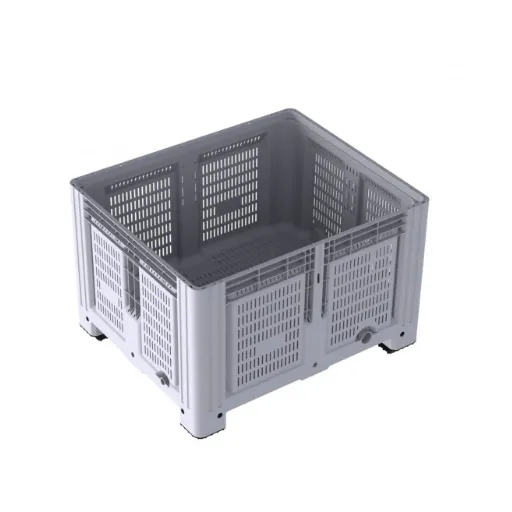
Compliance documentation is no longer a secondary consideration. In 2026, regulatory requirements are actively reshaping procurement decisions across every major market.
The European Union’s Packaging and Packaging Waste Regulation (PPWR) enters general application on August 12, 2026. Transport packaging reuse targets are set at 40% by 2030 and 70% by 2040. Buyers sourcing for EU markets now need reusability proof, material declarations, and traceability data from their suppliers.
In the United States, plastic pallet boxes remain exempt from ISPM-15 phytosanitary rules that govern wood packaging. This exemption eliminates heat treatment and fumigation delays, which can add two to three days to international shipments. For exporters, this alone justifies plastic over wood.
Food and pharmaceutical buyers must verify FDA 21 CFR compliance for direct food contact, HACCP alignment for processing environments, and GDP compliance for pharmaceutical distribution. Cold chain operators need validated sub-zero impact resistance, not generic temperature ratings. See our guide to plastic pallet boxes for cold storage for temperature-specific specifications.
Quality certifications matter beyond regulatory compliance. ISO 9001 demonstrates systematic quality management. ISO 8611 proves load testing methodology. CE and SGS certifications provide third-party verification. Demand documentation for every claim.
Step 5: Calculate Plastic Pallet Box Total Cost of Ownership, Not Just Purchase Price
The most expensive mistake in procurement is comparing unit prices on a spreadsheet. A box that costs 30% less upfront can cost 50% more over five years when replacement frequency, downtime, and disposal are included.
Total cost of ownership (TCO) follows this formula:
TCO = Acquisition Cost + Transport and Return Logistics + Maintenance + Disposal – Salvage Value
Here is a worked example based on lifecycle ROI modeling. A premium HDPE pallet box costs 75andlasts150dutycycles.Thatis75andlasts150dutycycles.Thatis0.50 per cycle. An economy box costs 45butlastsonly50cycles.Thatis45butlastsonly50cycles.Thatis0.90 per cycle. The premium option breaks even at approximately 72 cycles. Every cycle beyond that point is pure savings.
But cycle cost is only part of the equation. Consider the hidden costs:
- Space savings: Collapsible designs reduce empty volume by 40-70%, which directly lowers return freight and warehouse rental costs.
- Downtime: A failed pallet box in an automated system can stop a production line for hours. The cost of one stoppage often exceeds the price difference between premium and economy boxes.
- Rejected loads: Wooden packaging causes product damage and rejected shipments at rates of 2-3% in many industries. Plastic eliminates splinters, nails, and moisture contamination.
- Compliance penalties: Using non-compliant packaging in regulated industries can result in fines, shipment holds, or contract cancellations.
Ready to see how TCO calculations apply to your specific operation? Request a specification sheet or custom quote from our engineering team. We provide load-test data and projected lifecycle costs for every model.
Step 6: Vet Your Supplier Like an Engineer
Product specifications tell half the story. The other half is whether the supplier can consistently manufacture to those specifications, batch after batch, year after year.
Manufacturing Verification
Call for an inventory of injection machines with a breakdown by capacity in terms of number of units and tonnage. A plant with 18 sets of machines such as the one operating the Shandong Lile cannot only be consistent in delivery but can also take up huge orders without the need to outsource. If this is the case, could you also provide a video tour, particularly the production and inspection areas. Ask what the employer does with warpage and the freezing time given these two factors contribute significantly to irregularity in the dimensions of injection molded items.
It’s also important to mention to the customer that they should expect to receive a document, indicating the custom made mold remains the users property. In the case the client’s molds remain in the supplier’s facilities without possession of them, it is best to clear out how access and possession will be managed in advance.
Quality Assurance Protocols
Professional manufacturers operate three-stage quality control: incoming raw material inspection, in-process monitoring during production, and final inspection against acceptance quality limits (AQL). Ask for specific AQL standards and dimensional tolerance guarantees. A supplier who cannot describe their QC process in detail does not have a reliable one.
Documentation Requirements
Every claim must be written. Verbal promises are worthless in procurement. Require documentation for:
- Resin type and batch-to-batch consistency controls
- Recycled-content percentage range, if applicable
- Unit weight and dimensional tolerances
- Compliance certificates (FDA, EU 10/2011, ISO 9001, ISO 8611)
- Warranty terms and replacement policies
Red Flags to Avoid
- Suppliers who change raw material sources “depending on price”
- Claims of racking compatibility without deflection curves or test evidence
- Refusal to provide factory audit, video conference, or third-party inspection
- No written warranty or vague “satisfaction guaranteed” language
- Inability to explain ISO 8611 testing methodology
Step 7: Evaluate Customization and Long-Term Support
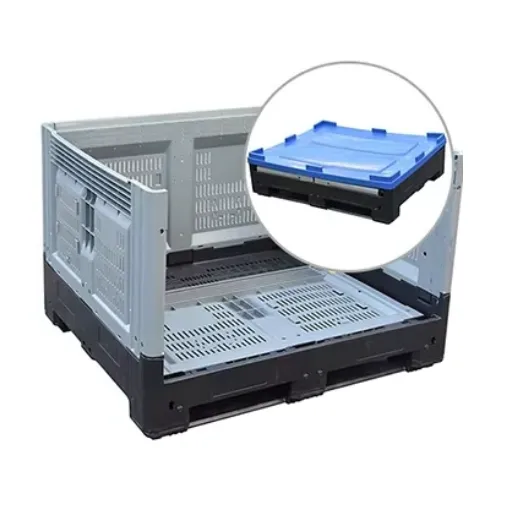
Standard catalog products meet roughly 80% of industrial needs. The remaining 20% requires customization that can deliver disproportionate operational value.
Color coding allows instant visual identification of product lines, expiration dates, or handling priorities. RFID integration enables real-time tracking through warehouse management systems. Internal dividers and dunnage protect fragile components during transport. Custom dimensions ensure optimal cube utilization in shipping containers.
At Shandong Lile, our custom plastic pallet box process moves from CAD design to mold fabrication to production sampling in a single workflow. This eliminates the miscommunication that occurs when design, tooling, and manufacturing are handled by separate vendors.
Customization is not always necessary. But when your product dimensions, handling equipment, or compliance requirements deviate from standard specifications, a tailored solution often pays for itself within the first production run.
Quick-Reference: Plastic Pallet Box Selection Checklist
Use this checklist during your next procurement cycle to ensure no critical factor is overlooked:
- Define maximum static, dynamic, and racking loads for your heaviest expected use case
- Confirm forklift, pallet jack, and AGV compatibility (verify 2-way vs. 4-way entry)
- Select material: HDPE for cold, chemical, and food applications; PP for ambient heavy loads
- Choose design type: rigid for durability and stacking; collapsible only if empty-return ratio exceeds 35-40%
- Verify industry compliance: FDA, EU PPWR, HACCP, GDP, or ISPM-15 as applicable
- Request ISO 8611 test evidence and deflection data for any racking application
- Calculate five-year TCO including acquisition, transport, maintenance, and disposal
- Audit supplier manufacturing capabilities, batch controls, and mold ownership
- Request 10-50 unit samples for three to six months of real-world testing before bulk ordering
- Write specific test conditions, AQL standards, and warranty terms into the purchase contract
Conclusion
Selecting the most suitable plastic pallet boxes is not a purchase transaction. It is a technical decision which will impact the filling capacity of storage facilities, costs of transportation, ever changing regulatory environment and operational maintenance long after the issued purchase order.
This guide is prepared to guide you in a seven step-by step process from just listening to various advertisements and suppliers’ claims to a productive and reliable method of how to choose plastic pallet boxes. You will evaluate the floors of the load you bring. Designate the suitable material in relation to the environment they are to be used. Choose the design that suits facilitates the cost logistics model. Check compliance. Identify actual five many products cost. Do a reconnaissance study on who the supplier is. And lastly decide whether the opportunity for customization is worth investing in.
Take for example, a wholesale distributor of pharmaceutical products in Rotterdam. The problem with them was hinged on refusing to accept collapsible boxes. The problem was buying because the price per box was cheap without taking into consideration cubed returns, the participation of workers or the cost of the box itself. This is the reason why the mentioned framework above exists.
The Shandong Lile company produces not just plastic pallet boxes – it is all about providing you with the solutions that will enhance your supply chain. We have been in existence for 14 years, have 16 subsidiaries and operate in 108 countries. Each product and the concepts surrounding it are designed to embody quality and creativity. Your problems are our problems. Come on, let’s do it.
Request a specification sheet or custom quote today →
Frequently Asked Questions
What are the main types of plastic pallet boxes?
The main types are rigid (fixed-wall), collapsible/foldable, and sleeve pack systems. Rigid boxes offer maximum durability and stacking strength. Collapsible boxes reduce empty volume by 60-70% for return logistics. Sleeve packs combine a rigid base with a collapsible sleeve for variable height configurations.
How long do plastic pallet boxes last?
Virgin HDPE pallet boxes typically last six to eight years under normal industrial duty. Virgin PP boxes offer similar or slightly shorter lifespans at lower cost. Recycled-blend boxes usually deliver two to three years. Actual lifespan depends on load weights, handling practices, temperature exposure, and cycle frequency.
Are plastic pallet boxes better than wooden crates?
For most industrial applications, yes. Plastic pallet boxes eliminate moisture absorption, splintering, and pest contamination. They are exempt from ISPM-15 export fumigation requirements. They deliver 200-230 uses compared to 3-5 uses for wooden pallets in comparable handling. However, wood may still make sense for single-use domestic shipments where purchase price is the only consideration. For a detailed breakdown, see our analysis of plastic pallet boxes vs wooden crates.
What load capacity should I look for?
Look for three separate plastic pallet box load capacity ratings: static load (stationary floor storage), dynamic load (during forklift transport), and racking load (on warehouse beams). Most industrial plastic pallet boxes handle 600-1,000 kg dynamic load. Always choose a capacity that exceeds your maximum expected load by at least 15-20% to provide a safety margin.
Can plastic pallet boxes be used for food and pharmaceuticals?
Yes, provided they are manufactured from FDA 21 CFR or EU 10/2011 compliant materials with smooth, non-porous surfaces. Food-grade HDPE is the standard choice. Verify written certification from the manufacturer rather than accepting verbal assurances.