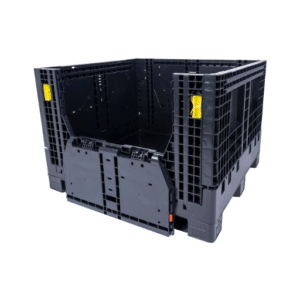
Sustainable plastic pallet boxes are one-time use chests that are often used during the transportation of goods requiring high protection and are majorly used within industries. They are made out of high density polyethylene ( HDPE), or polypropylene (PP), thereby reducing the use of wood, cardboard, and metal in packaging across the basic supply chains. Such, most of the ecological options include products that contain more than 50 percent recycled content that lasts 50 and more reuse cycles with a take back policy at the end of use stage, which cuts packaging waste by transportation by 30 – 60 %.
In March 2024, a dairy farm that had its main operations in France had to conduct assessment within their costs of using wooden crates fleet. The costs of replacement had grown up in the last three years by forty percent. The product was contaminated with splinters. The sustainability Report needed another evaluation. Due to reusable plastic pallet boxes obtained from a partner in China, they managed to save on transport packaging by 47 percent for 18 months. More importantly, they cut down the damaged-product incidents by one third.
Narratives akin to that one elucidate why the term “sustainable plastic pallet boxes” is forecasted to be one of the top procurement searches by the year 2026. Just between us, surely, wood is cumbersome, it decays and contributes to scope 3 emissions. Simple promises are not only understood by the readers of this guide; they include a systematic way of doing things in a way that is eco-friendly as opposed to greenwashing tactics, all the steps that you would need to take in order to support the decision and a set of items that one can use during the next supplier evaluation.
Importantly, this article will describe the external pressures coming from the existing global manufacturing landscape in regard to using transport packaging systems, namely those which are reusable. It will also discuss sustainable and non-sustainable plastic pallet boxes and explain how and why plastic can compete with wood and corrugated material in terms of utility. As well as assessment of the associated numbers and how to select a manufacturer equipped to function in 108 different countries.
Key Takeaways
- Sustainable plastic pallet boxes combine recycled HDPE or PP, 50 or more reuse cycles, and full end-of-life recyclability. These are the three traits that matter most.
- The EU Packaging and Packaging Waste Regulation (PPWR) sets binding reuse targets for transport packaging from 2030, making the switch a compliance issue, not a preference.
- A reusable plastic pallet box typically reaches carbon footprint parity with wooden crates after 8 to 15 trips, then keeps reducing emissions for the rest of its 5 to 10 year working life.
- Collapsible designs cut return-leg trucking volume by up to 75 percent, which often matters more than the box itself in the total emissions picture.
- Verify recycled content percentage, ISO 14001 certification, and take-back commitments before signing any supply agreement.
What Are Sustainable Plastic Pallet Boxes?

Sustainable plastic pallet boxes are large, reusable industrial containers, typically sized to the standard pallet footprint of 1200 x 1000 mm or 1200 x 800 mm, engineered for repeated use across industrial supply chains. They are made from recyclable HDPE or PP, designed for 50 or more service cycles, and recovered through closed-loop or open-loop recycling at end of life.
That definition matters because “sustainable” gets used as a marketing flourish far more often than it deserves. A box is not sustainable because it was produced once with a recycled-content claim on the label. It is sustainable when its full lifecycle, from resin sourcing to washing to repair to recovery, demonstrably reduces waste and emissions versus the alternative it replaces.
Three common variations sit under this umbrella:
- Rigid plastic pallet boxes: fixed-wall construction, high load capacity, ideal for heavy or bulk goods.
- Collapsible plastic pallet boxes: fold flat for return logistics, reducing empty-trip emissions.
- Vented plastic pallet boxes: designed for produce, fish, and goods that need airflow during transit.
Why Sustainability Matters in Industrial Packaging in 2026
For most of the last two decades, sustainability in transport packaging was a nice-to-have. That ended in 2024. Three forces have moved sustainable plastic pallet boxes from optional to essential.
Regulation Is Now the Floor, Not the Ceiling
The European Union’s Packaging and Packaging Waste Regulation (PPWR) entered into force in early 2025 and sets binding reuse targets for transport packaging starting in 2030. Article 26 requires that 40 percent of pallets, crates, and boxes used between economic operators be reusable by 2030, rising to 70 percent by 2040.
China’s GB/T 34344 standard tightens specifications on recycled-content claims and lifecycle reporting. In the United States, extended producer responsibility (EPR) laws in California, Oregon, Colorado, Maine, and Minnesota now apply fees to single-use packaging, with reusable systems exempt.
Looking for a region-by-region compliance brief? Our team at Shandong Lile maintains one for global manufacturers navigating these rules. Talk to our packaging specialists to get the current version.
Scope 3 Emissions Are the New Procurement KPI
Roughly 70 percent of a manufacturer’s emissions sit in scope 3, the upstream and downstream activities outside their direct control. Transport packaging is one of the most addressable lines in that ledger. According to the Reusable Packaging Association, switching from single-use to reusable transit packaging typically reduces packaging-related carbon emissions by 30 to 60 percent.
Customers and Investors Are Asking Harder Questions
Global buyers now request lifecycle assessment (LCA) documentation and recycled-content certificates as a standard part of vendor onboarding. Sustainability scorecards from CDP, EcoVadis, and major retailers reward demonstrable circularity. The Ellen MacArthur Foundation and other industry bodies have moved circular packaging from a niche topic to a board-level priority. A “we use plastic instead of wood” answer no longer holds.
6 Features of a Truly Sustainable Plastic Pallet Box
Not every plastic pallet box deserves the sustainable label. These six features separate genuine circular products from marketing-driven imitations.
- High recycled content. Look for at least 30 percent post-industrial or post-consumer recycled HDPE or PP, with traceability documentation.
- Long service life. A box engineered for 50 to 200 trips and a 5 to 10 year working life amortizes its production footprint across hundreds of shipments.
- 100 percent recyclability at end of life. Single-resin construction, with no foam fillers or mixed plastics, keeps the box recyclable when it finally retires.
- Repairable, modular design. Replaceable runners and lids extend service life by years instead of retiring an otherwise good box over a single cracked component.
- Closed-loop take-back. A supplier that recovers, grinds, and reuses retired boxes closes the loop in a way open-market recycling cannot match.
- Optimized return logistics. Collapsible or nestable designs slash empty-trip cube and the diesel that goes with it.
Materials, Lifecycle, and the Sustainability Math
The sustainability case for plastic pallet boxes lives or dies on the math. Here is what actually drives the numbers.
Recycled HDPE vs. Virgin HDPE
High-density polyethylene is the main ingredient used in pallet container manufacturing for industrial applications. Strengths of recycled HDPE (rHDPE) are 70-80% of that of virgin material whereas the embedded carbon is only about half. Modern-day recipes incorporate a recycling element in the core along with the food or pharmaceutical friendly virgin exteriors.
Polypropylene (PP) Options
Polypropylene is weaker than HDPE, however it is stable at higher temperatures, an important fact when considering sterilizing processes in the pharmaceutical and dairy industry. Furthermore, PP allows for higher manufactured recycled content in products that are not in direct contact with food.
Reinforcement Without Compromising Recyclability
With such structural enhancements, the load-bearing capacity of the runners (whereby steel reinforcement is added) increases to 1,500 kg or more but do not render the box non-recyclable at its end of service life. There shall be no foam filled storage containers called pallets, etc., of any shape, as it creates button plastics and other materials which will be locked to each other forever.
The Reuse Math vs. Wood and Corrugated
A wooden crate’s environmental impact is low and it can be recycled quite a bit, however it can be used on average only for 8 to 12 trips before it requires serious repairs or is decommissioned. In contrast, high quality reusable plastic pallet boxes handle 75 to 150 trips. The CO2e per trip break even point is usually between trip 8 and trip 15. This is where the plastic boxes start to pay off.
Corrugated bulk containers have it worse. These containers barely make it through 3 trips before they make it to the waste streams and these waste streams still like America and Asia send to konteyner or burn. On the lifecycle, we are able to conclude this that reuse is more effective as opposed to recycling every single time.
Watch a Quick Lifecycle Comparison
[YouTube embed placeholder] Insert a verified video URL here covering reusable transit packaging lifecycle analysis. Prefer a Shandong Lile channel video if available; otherwise, link to an authoritative industry source.
Ready to test the math against your own operation? Our engineering team will run a lifecycle comparison using your real shipment data. Request a custom quote and LCA review.
Industries Leading the Switch to Sustainable Pallet Boxes

Adoption is moving fastest in industries where regulatory, hygiene, and cost-of-failure pressures combine.
Food and Beverage
The introduction of eco-friendly, reusable and recyclable material answers today’s sustainability issues on food supply chain for dairy, meat, sea foods and fresh produce as hygienic, washable surfaces and food grade resins are features of such sustainable plastic pallet boxes. With a move from single-use wooden crates to reusable ones in 2023, a citrus exporter based in Spain could reduce transport packaging waste by 51 percent and product damage claims by 22 percent.
Automotive and Industrial Manufacturing
The tasks at the end of the assembly line are always done at the right time thanks to identical and reusable containers which are suitable for standard automation. In one case, a tier one German automotive supplier introduced an in-house plant-to-plant returnable collapsible-pallets solution, which reduced return-load volumes by 73 per cent.
Agriculture and Horticulture
Cut out air holes in a plastic pallet box design for ventilation when fresh produce fills them up. These boxes are more resistant to wet conditions, cold storage and rough use whereas wooden boxes absorb water and promote the growth of mold.
Pharmaceuticals and Cold Chain
Sustainable plastic pallet boxes actually focus on GxP supply chains. Hence, ISO-certified versions provide them with what they demand – all elements of cleanness, identification although with unstained accuracy too. Moreover, they are able to withstand use in autoclaves, leave them cold and hard however flexible, or any other application which puts them to work but more importantly without breaking them down – cleanly.
E-commerce and Retail Returns
Closed-loop reusable boxes for returns reduce per-trip packaging cost and emissions for retailers handling large return volumes.
How to Choose Sustainable Plastic Pallet Boxes
Use this six-step checklist when evaluating sustainable plastic pallet boxes for your operation.
- Verify recycled content percentage. Ask for the post-consumer and post-industrial split, with a traceability statement.
- Request LCA or EPD documentation. A genuine sustainability claim should come with a life cycle assessment or Environmental Product Declaration.
- Confirm recyclability and take-back. Single-resin construction and a documented recovery program separate real circularity from marketing.
- Match design to return-leg logistics. If your route has long empty returns, collapsible wins. If trips are short and dense, rigid usually wins.
- Validate supplier global capacity. A box that ships to one country is a product. A box your supplier can deliver to 108 is a system.
- Pressure-test customization. Custom sizes, colors, or integrated RFID should not force the supplier to compromise on recycled content or recyclability.
When Akira’s team at a Japanese electronics OEM ran this checklist against four suppliers in 2024, only one cleared all six criteria. The winning supplier was not the cheapest. It was the only one that could prove 35 percent recycled HDPE, deliver to plants in Vietnam and Mexico inside the same quarter, and commit to take-back at end of life. Two years later, that decision is showing up in their sustainability scorecard and their per-trip packaging cost.
The Shandong Lile Approach to Sustainable Packaging
At Shandong Lile Holding Group, we have spent over 14 years engineering reusable plastic pallets and pallet boxes for global manufacturers across 108 countries. Our approach to sustainability rests on three commitments.
Manufacturing capacity at scale. Our 178,000 square meter production facilities house 18 large-scale injection molding machines, allowing us to deliver consistent recycled-content products in volumes that match enterprise demand.
Custom engineering, not catalog compromise. Through our 16 subsidiaries, we design plastic pallet boxes and plastic pallets to your dimensions, load requirements, automation footprint, and sustainability targets, without sacrificing recyclability.
Global logistics, regional service. With Qingdao Port operations and a worldwide distribution network, we deliver on time across regions, which makes a real closed-loop possible at international scale.
Our commitment is straightforward: high quality, high standards, strict requirements, applied to every product that leaves our factories.
Frequently Asked Questions
Are plastic pallet boxes recyclable?
There is a possibility. These plastic pallet boxes that are designed for sustainability because they are made from a single resin, either HDPE or PP, can be recycled fully at the end of its useful life. Manufacturers such as Shandong Lile engage in A number of takeback programs and shred the boxes to reuse them for other produce.
How long do reusable plastic pallet boxes last?
A well designed plastic pallet box for multiple uses can be in operation for 50 up to 200 cycles, usually within 5 to 10 years. In addition to that, repair designs achieve even more cycles as it is possible to repair just one part instead of replacing the entire figure.
Are sustainable plastic pallet boxes more expensive than wooden crates?
In terms of per unit, yes. In terms of every individual trip, almost never. This is because the straight cost benefit is usually realized between trip number 8 and trip number 15.
Collapsible or rigid: which is more sustainable?
Whichever option results in a greater reduction of total emissions. Collapsible variations allow for 75 percent reduction of return-legs which tends to be higher than the level that is common for rigid ones due to reduced mass of material per unit.
Do plastic pallet boxes meet food-grade and pharmaceutical requirements?
If ordered to specific specifications and suitable plastic is used, then yes. Food-grade resin, EU 10/2011 and its FDA equivalent, not limited to food safe plastic pallet boxes if they save water, or if they are plastic pallet boxes that can be used for beverages or pharmaceuticals, meaning they are washable, are options that you have when ordering sustainable plastic pallet boxes.
The Bottom Line on Sustainable Plastic Pallet Boxes

Sustainability in industrial packaging is no longer about swapping one material for another. It is a system decision that touches resin sourcing, design for reuse, return logistics, and end-of-life recovery, audited against tightening regulation and rising buyer expectations.
To summarize the buyer’s perspective:
- Sustainable plastic pallet boxes earn the label only when recycled content, long service life, recyclability, and take-back all align.
- The reuse math favors plastic over wood and corrugated after 8 to 15 trips, then keeps compounding savings for a decade.
- EU PPWR, US EPR laws, and China GB standards turn the switch from a choice into a compliance schedule.
- Collapsible designs and global logistics often matter more than the box itself in total emissions.
- A supplier’s recycled-content traceability, LCA documentation, and take-back commitment separate real partners from marketing.
The companies winning the sustainability conversation in 2026 are the ones treating transport packaging as a strategic system, not a line item. Shandong Lile partners with global manufacturers to design reusable plastic pallet boxes that hit hard sustainability targets without forcing trade-offs on durability, cost, or delivery.
Ready to engineer the right sustainable plastic pallet boxes for your operation? Request a custom quote and lifecycle review. Our team will run the numbers against your real shipment data and recommend a system built for the next decade of your supply chain.