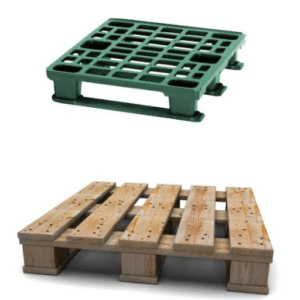
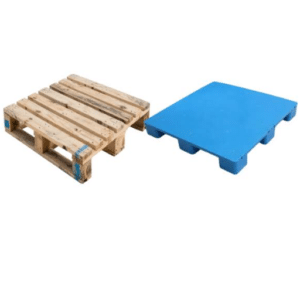
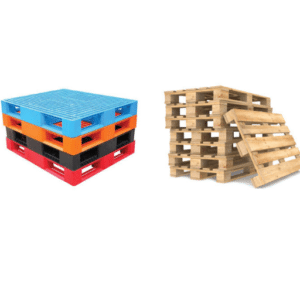
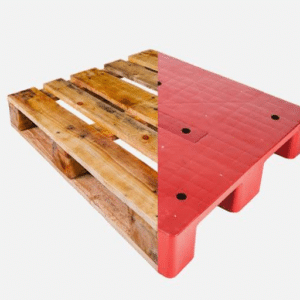
For returnable, closed-loop operations, plastic pallets win on total cost, hygiene, and export compliance. For one-way shipments where the pallet never comes back, wood pallets remain the cheaper, simpler choice. Everything else in this guide explains why, and how to tell which camp your operation falls into.
Here is the part most comparison articles get wrong. They lead with the sticker price, and the sticker price alone makes wood look unbeatable: 12forastandardGMAwoodpalletversus12forastandardGMAwoodpalletversus60 to $150 for plastic. But a pallet is not a one-time purchase. It is a repeated cost that you pay for every single trip, repair, replacement, and customs inspection.
Mike runs regional distribution for a beverage co-packer in Ohio. When he first priced pallets in 2024, he bought 8,000 wood pallets because the upfront math was obvious. Eighteen months later, he was spending more on repairs, splinter-related product damage, and replacement boards than he had saved on the original purchase. The moment he switched his returnable retail loop to plastic, his per-trip cost dropped by more than half.
This guide gives you the same comparison Mike eventually ran, only without the trial and error. It weighs plastic pallets vs wood pallets across cost, lifespan, load capacity, hygiene, export compliance, sustainability, and automation, using third-party test data rather than manufacturer claims. By the end, you will know exactly which material fits your operation, and when the answer is genuinely still wood.
Key Takeaways
- Cost is won or lost per trip, not at purchase. Wood runs 0.80to0.80to3.00 per trip; plastic runs 0.20to0.20to2.00. Plastic breaks even around 25 to 32 trips, then saves money every cycle after.
- Plastic outlasts wood by roughly 18 to 36 times. Independent Virginia Tech testing recorded a plastic pallet surviving 400 cycles versus 11 for a wood stringer pallet.
- Export tips the scales hard. Wood needs ISPM-15 heat treatment at 7to7to25 per pallet plus stamping; plastic is fully exempt.
- Wood still wins for one-way shipping. If the pallet does not come back, cheap wood is usually the right call.
- There is a third option most buyers miss: pallet pooling. Renting from CHEP or PECO can beat owning either material in the right scenario.
The Core Differences at a Glance

If you only remember one thing from this article, make it this table.
| Attribute | Wood Pallet | Plastic Pallet |
|---|---|---|
| Upfront cost (48×40 GMA) | 10to10to16 | 40to40to200 (nestable 40to40to80, rackable 80to80to160) |
| Typical trips before failure | 5 to 11 | 100 to 400+ |
| Cost per trip | 0.80to0.80to3.00 | 0.20to0.20to2.00 |
| Weight | 30 to 70 lb | 20 to 55 lb |
| Moisture resistance | Absorbs water, warps, rots | Impervious, no absorption |
| Hygiene / washable | No (porous, splinters) | Yes (non-porous, washable) |
| ISPM-15 export | Treatment required | Exempt |
| Recyclable | Yes (downcycled) | Yes (100% recyclable HDPE/PP) |
| Automation fit | Inconsistent dimensions | Consistent, ±1 to 2 mm |
| Fire safety | Combustible | Requires FM Global / UL 2335 compliance |
The table answers the headline question in one glance. But the decision rarely lives in a single row. It lives in the math underneath. Let us walk through each column, starting with the one everyone asks about first.
Cost: Initial Price vs. Total Cost of Ownership
Upfront Purchase Price Ranges
There is no dispute about the sticker price. Wood is cheaper, full stop.
A standard 48×40-inch GMA wood stringer pallet costs 10to10to16 new, depending on lumber prices, which swing with supply. A plastic pallet costs 40to40to200 depending on design. Lightweight nestable plastic pallets sit at the low end around 40to40to80, while heavy-duty rackable plastic pallets run 80to80to160 or more.
That is a 3x to 10x gap at the register. If your decision stops there, you buy wood every time. The problem is that a purchase price is not a cost of ownership. A 12palletthatsurvivesfivetripscostsmoreperusethana12palletthatsurvivesfivetripscostsmoreperusethana90 pallet that survives 200.
Cost Per Trip and Break-Even Point
The only honest way to compare plastic pallets vs wood pallets on cost is cost per trip: purchase price divided by the number of usable trips.
Independent testing gives us the trip counts to plug in. Virginia Tech’s Center for Packaging and Unit Load Design put pallets through FasTrack testing, a 10-step sequence that simulates forklift handling, trailer loading, and racking, including drops from five feet every ten cycles.
In the ORBIS Odyssey study, a plastic pallet completed 400 cycles without failure, while a wood stringer pallet failed after an average of 11 trips. A separate RackoCell study recorded 200 trips for plastic versus 11 for wood.
Run the math with those numbers:
- Wood: 12÷11trips=about12÷11trips=about1.09 per trip.
- Plastic (rackable): 100÷400trips=about100÷400trips=about0.25 per trip.
Even a mid-range plastic pallet at 80over200tripslandsat80over200tripslandsat0.40 per trip, less than half the wood figure. Across the industry, wood lands at 0.80to0.80to3.00 per trip while plastic lands at 0.20to0.20to2.00, depending on design and duty cycle.
The break-even point sits around 25 to 32 trips. Before that, wood is cheaper. After it, plastic pulls ahead permanently, because wood keeps generating replacement cost while plastic keeps working.
Hidden Costs: Repair, Disposal, and Loss
Wood’s real expense is what happens between trips. A wood pallet in a returnable loop needs constant attention: nails back out, boards split, and a percentage of every load needs reconditioning before it can ship again. NWPCA-linked Virginia Tech research notes that lower-grade wood pallets are increasingly hard to repair multiple times and often end up in landfill.
Then there is the cost nobody budgets for: product damage. Splinters and protruding nails puncture cartons and contaminate loads. In food and pharmaceutical operations, a single damaged unit can cost far more than the pallet carrying it. Plastic pallets, by contrast, do not splinter, do not shed nails, and when they eventually retire, they are 100% recyclable into new pallets.
Durability, Lifespan, and Load Capacity

Trip and Cycle Life
The lifespan gap is the single largest driver of the total-cost difference, so it deserves its own section. As covered above, independent testing puts wood at 5 to 11 trips and plastic at 100 to 400 trips.
Why the gap? Wood is an organic material. It absorbs moisture, which causes warping and accelerates fastener failure. It splinters under forklift impact. Plastic, typically high-density polyethylene (HDPE) or polypropylene (PP), is a homogenous thermoplastic that flexes under load and returns to shape instead of cracking. For a deeper explore the two plastic materials, see our HDPE vs polypropylene pallet comparison.
Static, Dynamic, and Racking Loads
Load capacity is where wood’s reputation often overstates its reality. Both materials can be engineered for heavy loads, but they fail differently.
A standard wood stringer pallet typically carries a dynamic load of 2,000 to 3,000 lb and a static load up to 6,000 lb, but those figures degrade as the wood dries, absorbs moisture, and loses fastener integrity. Plastic pallets span a wider engineered range, from lightweight 1,500 lb dynamic models up to heavy-duty and steel-reinforced pallets rated for 5,000 lb or more.
The difference shows up in racking. In unsupported or span racking, a wooden pallet’s top deck can bow and eventually fail under sustained load, while a properly rated rackable plastic pallet holds its deflection within tolerance for years. If racking is central to your warehouse, our durable plastic pallets are engineered specifically for that duty cycle.
Moisture, Chemical, and Temperature Resistance
Wood rots, warps, and grows mold in wet or humid environments. It also absorbs chemicals, which can contaminate the next load. Plastic is impervious to moisture, resists most acids and solvents, and holds its dimensions across a broad temperature range, which is why it dominates cold storage, food processing, and chemical handling.
Weight, Freight, and Handling Efficiency
Tare Weight and Freight Cost
Weight is money in freight. A wood GMA pallet weighs 30 to 70 lb depending on moisture content, and wet wood can weigh significantly more. A plastic pallet typically weighs 20 to 55 lb, and because it does not absorb water, that figure stays constant.
A 10 lb difference per pallet, multiplied across a 40,000 lb truckload, is real fuel and freight savings. Lighter pallets also mean less strain on forklift operators and fewer ergonomic injuries over a shift.
Nesting and Truck-Fill Density
Here is where plastic’s advantage compounds. When empty pallets return to their origin, a nestable plastic pallet stacks vertically, fitting roughly 1,500 units per truckload. A comparable load of wood pallets, which stack flat, fits closer to 450. That is a three-to-one difference in return-freight cost, and it is a major reason ORBIS and other reusable-packaging advocates push plastic for closed loops.
Hygiene, Safety, and Regulatory Compliance
Food Safety and Cleanroom Use
For food, beverage, and pharmaceutical operations, hygiene often decides the plastic pallets vs wood pallets question on its own.
Wood is porous. It absorbs liquids, harbors bacteria, and sheds splinters into the product stream. Plastic is non-porous, washable, and dries quickly, making it the standard for FDA-regulated and HACCP-compliant environments. For a full breakdown of the requirements, see our guide to plastic pallets for the food industry.
Export Compliance: ISPM-15 and the IPPC Stamp
If you ship across borders, this section may decide the debate for you.
ISPM-15 is the international standard that governs wood packaging material in trade. Wood pallets entering most countries must be heat-treated or fumigated, then stamped with the IPPC mark. That treatment adds 7to7to25 per pallet, plus documentation and the risk of customs delay if a mark is missing or illegible.
Plastic pallets are completely exempt. As an inorganic material, they cannot carry wood pests, so no heat treatment, fumigation, or IPPC stamp is required. For exporters, that is both a direct cost savings and the elimination of a recurring customs-compliance headache.
Fire Safety and Worker-Injury Risk
This is the dimension almost no comparison article covers, and it matters more than most buyers realize.
Wood pallets are combustible. In a warehouse fire, a dense stack of wooden pallets is fuel. Plastic pallets are not fireproof, but they can be specified to meet fire-safety standards such as FM Global and UL 2335, which govern storage and sprinkler design. The key is to buy plastic pallets that carry those certifications, not just any plastic pallet.
On the injury side, wood’s splinters, protruding nails, and uneven boards are a documented source of worker hand injuries. Plastic’s smooth, consistent surfaces reduce that risk. Combined with lighter weight, plastic is easier on the people who handle it every shift.
Sustainability: Which Is Truly Greener?
The honest answer is: it depends on what you measure, and both sides have a defensible case.
Wood is renewable and biodegradable. A wooden pallet at the end of its life can be ground into mulch or downcycled. The problem is the lifespan: because wood fails after 5 to 11 trips, you are extracting, milling, and transporting many more pallets to do the same work.
Plastic has a heavier production footprint, since virgin HDPE and PP come from petroleum. But that footprint is amortized over 100 to 400 trips, and the material is fully recyclable at end of life. The most rigorous way to compare is a lifecycle assessment, which normalizes environmental impact per trip rather than per pallet. Under that lens, plastic’s long lifespan usually, though not always, wins.
The real environmental risk is greenwashing in either direction. A durable plastic pallet in a returnable loop is genuinely sustainable. A single-use plastic pallet shipped one-way is not. Conversely, wood is only “renewable” if the pallets are actually recovered and the lumber responsibly sourced.
Automation and Warehouse Compatibility

Dimensional Consistency and AS/RS Jamming
Automated storage and retrieval systems (AS/RS), conveyors, and robotic palletizers are unforgiving about tolerance. They need pallets that are square, flat, and dimensionally consistent every single time.
Wood pallets vary. Boards warp, dimensions drift, and a single out-of-spec pallet can jam a $2 million automation line. Plastic pallets are molded to a tolerance of ±1 to 2 mm, which is why automated warehouses overwhelmingly standardize on plastic. If you are investing in automation, the pallet is part of that capital decision, not an afterthought.
ESD, Anti-Static, and RFID
Plastic pallets can be manufactured with electrostatic-dissipative (ESD) or anti-static properties for electronics and cleanroom handling, and RFID tags can be embedded directly into the mold. Wood offers neither option. For electronics manufacturers and automated distribution centers, that capability tips the scale on its own.
The Third Option: Pallet Pooling
Most plastic pallets vs wood pallets debates assume you are buying pallets. But a meaningful share of the market rents them instead.
Pallet pooling companies like CHEP and PECO own the pallets and rent them per trip. You pay a fee to use and return the pallet, and the pooler handles repair, replacement, and recovery. Pooling removes the upfront capital cost and the burden of managing a pallet fleet, but it adds per-trip rental fees and, in some arrangements, loss and damage charges.
When does pooling win? When your operation is high-volume but you do not want to own and manage a fleet, or when your network makes return logistics complex. When does owning win? When you have a stable, closed loop and can capture the full cost-per-trip savings yourself. The point is that pooling is a legitimate third column in the decision, and it is one most comparison guides ignore.
Industry-Specific Recommendations
The right material depends heavily on what you ship and where.
| Industry | Recommendation | Why |
|---|---|---|
| Food & beverage | Plastic | Washable, FDA/HACCP-compliant, no splinter contamination |
| Pharmaceuticals | Plastic | Cleanroom-compatible, no particle shedding |
| Cold storage / agriculture | Plastic | Moisture-proof, no rot or warp in freezers |
| Automotive | Plastic (heavy-duty) | High load capacity, chemical resistance, dimensional consistency |
| E-commerce / retail | Depends on loop | Plastic for closed loops, wood for one-way domestic |
| Export / international | Plastic | ISPM-15 exemption, no customs delay risk |
| One-way, low-turnover | Wood | Lowest upfront cost, pallet does not return |
This table is a starting point, not a verdict. Your own duty cycle, network, and volume will refine it.
When Wood Still Makes Sense
We manufacture plastic pallets, and we will tell you plainly: wood is sometimes the right answer.
If your pallet ships one-way and never comes back, cheap wood is hard to beat. If you run a low-turnover domestic operation with a short pallet lifespan, the upfront savings are real. If you need to modify pallets on site, a nail and a saw beat a mold. And if you are under extreme budget pressure and cannot finance the higher upfront cost of plastic, wood keeps you moving today.
The dividing line is simple: does the pallet come back? If it does, plastic almost always wins on total cost. If it does not, wood usually does.
How to Decide: A Decision Framework
Work through these five questions in order. They will land you on a defensible answer faster than any feature list.
- Does the pallet return? No, it ships one-way. Buy wood.
- Is your loop closed and predictable? Yes, and you will hit 30+ trips. Plastic wins on cost per trip.
- Do you export? Yes. Plastic eliminates ISPM-15 cost and risk.
- Do you handle food, pharma, or run automation? Yes. Plastic is effectively required.
- Do you want to own the fleet or outsource it? Outsource. Explore pallet pooling before buying either.
Not sure which column you land in? Talk to our team and we will model your loop and give you a straight answer, even when that answer is wood.
Frequently Asked Questions
Are plastic pallets better than wood pallets?
For returnable, closed-loop operations, yes. Plastic pallets last 100 to 400 trips versus 5 to 11 for wood, cost less per trip, resist moisture, and are exempt from ISPM-15 export treatment. For one-way shipping, wood remains cheaper.
Are plastic pallets stronger than wood pallets?
They can be. Standard wood pallets carry 2,000 to 3,000 lb dynamic load, while engineered and steel-reinforced plastic pallets are rated to 5,000 lb or more. Plastic also holds its rating over time, where wood degrades with moisture and fastener wear.
How much do plastic pallets cost compared to wood?
A wood GMA pallet costs 10to10to16 upfront versus 40to40to200 for plastic. But per trip, wood runs 0.80to0.80to3.00 while plastic runs 0.20to0.20to2.00, so plastic breaks even around 25 to 32 trips.
How long do plastic pallets last compared to wood?
Independent Virginia Tech testing recorded plastic surviving 400 cycles versus 11 for wood, roughly 18 to 36 times longer depending on the study and pallet design.
Are plastic pallets more sustainable than wood?
It depends on the metric. Wood is renewable but short-lived. Plastic has a higher production footprint but is amortized over a much longer life and is fully recyclable. A lifecycle assessment per trip usually favors plastic in closed loops.
Are plastic pallets food grade?
Yes. Plastic pallets are non-porous and washable, making them the standard for FDA-regulated and HACCP-compliant food handling, where wood’s porosity and splinters are a contamination risk.
Conclusion
Choosing between plastic pallets vs wood pallets is not about which material is better in the abstract. It is about which material fits your operation, and the answer flows from a single question: does the pallet come back?
If it ships one-way and never returns, buy wood. It is cheap, and it gets the job done. If it lives in a closed loop, goes across a border, or touches food, pharmaceuticals, or automation, plastic wins on cost per trip, durability, hygiene, and compliance. Independent testing backs this up: 400 cycles versus 11, 0.25versus0.25versus1.09 per trip, and zero ISPM-15 treatment versus 7to7to25 per pallet.
Run the numbers for your own loop, and do not ignore the pooling option. Whichever column you land in, our team at Shandong Lile will help you model the real cost and, when plastic is the answer, supply pallets engineered for your exact duty cycle. Contact us today for a free total-cost-of-ownership assessment.