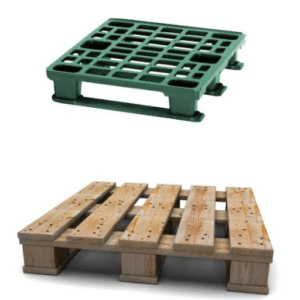
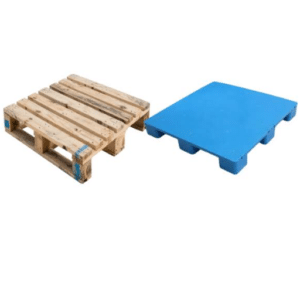
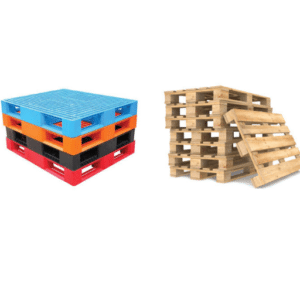
Plastic pallets are exempt from ISPM 15, which means they skip the heat treatment, fumigation, IPPC stamps, and rejection risk that wood pallets carry into every export lane. If you are weighing plastic vs wood pallets for export, that single fact drives most of the real cost difference.
Here is the number that makes it concrete: a $45,000 shipment was rejected at Australian customs because its wood pallets were missing ISPM 15 stamps. The delays and re-treatment costs erased the entire profit margin.
This guide is the precise one. Most suppliers tell you “plastic is ISPM 15 compliant,” which is technically wrong. Plastic is outside the scope of the standard entirely, and that distinction matters. Getting the terminology wrong on a customs declaration is exactly the kind of error that triggers inspection.
We will walk through what ISPM 15 actually requires, where wood goes wrong, what the exemption really covers, and when wood still makes sense.
Key Takeaways
- Plastic pallets are exempt from ISPM 15, so they need no heat treatment, fumigation, IPPC stamp, or phytosanitary certificate.
- Non-compliant wood packaging costs 800to800to2,500 in re-treatment and 3 to 14 days of delay, with over 95% detention probability in major markets.
- The exemption only applies if the pallet is completely wood-free, including blocks, runners, and spacers.
- Wood still wins for one-way, heavy, budget-sensitive lanes where the pallet never comes back.
- For Australia, New Zealand, the EU, food, pharma, and returnable lanes, plastic clears customs faster and costs less per trip.
What Is ISPM 15, and What Does It Actually Apply To?

ISPM 15 stands for International Standards for Phytosanitary Measures No. 15. It is a plant-health standard written by the International Plant Protection Convention (IPPC), and it is enforced by more than 180 countries.
The standard targets solid wood packaging material thicker than 6 mm. That covers wooden pallets, crates, dunnage, packing blocks, pallet collars, and skids. The goal is simple: stop wood-boring pests and plant pathogens from hitching a ride across borders inside untreated timber.
What the standard does not cover is just as important for this decision.
- Plastic pallets are exempt. HDPE and polypropylene are inorganic and cannot host pests.
- Plywood, OSB, MDF, and veneer are exempt because the glue-and-heat manufacturing process already kills anything living in the material. This confuses a lot of exporters who assume every “wood” pallet needs treatment.
So when a forwarder says “all wood packaging needs ISPM 15,” the accurate version is “all solid wood packaging needs ISPM 15.” That single word is where half of the confusion, and half of the rejections, come from.
How Wood Pallets Comply: Heat Treatment, Fumigation, and the IPPC Mark
If you ship on solid wood, compliance is not optional. Here is what it involves.
Heat treatment (HT)
The approved treatment is to raise the wood’s core temperature to 56°C for at least 30 continuous minutes. Many certified facilities hold 58°C for 35 minutes as a safety buffer. Heat treatment is the global standard because it leaves no chemical residue.
Methyl bromide (MB)
Fumigation with methyl bromide is the older method, and it is now banned or heavily restricted in the EU (since March 2010), Canada, China, and Australia. An MB-treated pallet shipped to one of those markets gets rejected on arrival, even if it is stamped correctly.
Reading the IPPC mark
Every treated pallet must carry the IPPC mark, branded into the wood on at least two opposite sides. The mark contains the wheat-stalk logo, a two-letter country code, a facility registration number, and the treatment code (HT or MB).
Here is the detail that is catching exporters out right now. As of January 1, 2026, US authorities resumed strict enforcement of the hyphen between the country code and producer code. A mark that reads GB 1234 instead of GB-1234 can hold a shipment, even though the treatment itself was valid. One missing character. That is the level of precision customs operates at.
A note on terminology: plastic pallets are not “ISPM 15 compliant.” They are exempt, because they are outside the standard’s scope. Saying a plastic pallet is “compliant” implies it underwent a wood treatment it never needed. Correct wording keeps your paperwork clean.
Do Plastic Pallets Need ISPM 15?
No. Plastic pallets do not need ISPM 15 treatment, stamping, or certification, because the standard only regulates solid wood. This is the core answer to “do plastic pallets need ISPM 15,” and it is what makes plastic pallets for export so attractive.
But the exemption has a condition most guides skip.
The wood-free verification requirement
To claim the exemption, your pallet must contain zero untreated wood. That includes the parts nobody thinks about: blocks, runners, skids, spacers, and any attached accessories. A single raw timber board bolted onto an otherwise-plastic unit invalidates the exemption and can trigger a full inspection.
Before you ship, confirm your supplier can provide a wood-free material declaration. Keep it on file. Customs officers and your end customer can ask for it, sometimes up to 12 months after the shipment clears.
What “exempt” still does not cover
The exemption applies to the pallet, not the cargo. Your goods still have to satisfy the destination country’s own import, sanitation, and documentation rules. Food and pharmaceutical shipments, for instance, may need FDA, EU 1935/2004, or SASO documentation regardless of pallet material.
Plastic removes the pallet risk. It does not remove the cargo rules.
If you want the full breakdown of sizing, regional standards, and cost for export pallets, our plastic pallets for export guide covers the complete picture.
The Real Cost of Non-Compliance: Wood’s Hidden Export Tax

Wood’s price advantage lives in the purchase order. Its disadvantage lives in the customs queue.
When border authorities intercept non-compliant wood packaging, they have three options: force re-treatment at the destination, destroy the pallets (sometimes the whole consignment), or refuse entry and re-export. All three happen at the shipper’s expense.
The numbers, drawn from forwarder guidance and enforcement records:
- Re-treatment costs run 800to800to2,500 on average, with emergency jobs priced two to three times normal rates.
- Delays run 3 to 7 days typically, stretching to 7 to 14 days without a certificate. For time-sensitive cargo, the downstream cost of a missed delivery window often exceeds the treatment bill.
- Detention probability for unmarked wood packaging in mainstream markets exceeds 95%. Only a handful of smaller markets exercise discretion.
- Fines reach up to $2,000 per shipment in some countries, and 5% to 20% of cargo value in others.
The most common failure is not a missing treatment. It is a faded or illegible stamp, an untreated piece of dunnage, or a repaired board swapped in from raw lumber. ISPM 15 is a system, and a single weak link voids it.
Consider Marcus, a Texas auto-parts exporter. Last spring he shipped a container to Melbourne on wood pallets his supplier had stamped years earlier. The stamps faded in transit. Australian biosecurity flagged the load, fumigated it on arrival, and billed him $1,900 plus five days of demurrage. His “cheap” wood pallets ended up costing more than the pallets themselves.
ISPM 15 Compliance: Plastic vs Wood Pallets Side by Side
The table below summarizes the compliance picture. This is the decision compressed to one view.
| Factor | Wood pallets | Plastic pallets |
|---|---|---|
| ISPM 15 status | Regulated (solid wood) | Exempt |
| Treatment required | Heat treatment or fumigation | None |
| IPPC stamp required | Yes, on two sides | No |
| Phytosanitary certificate | Often requested | Not needed |
| Rejection risk | High (stamps, dunnage, MB errors) | Near zero from pallet |
| Re-treatment cost if flagged | 800to800to2,500 | Not applicable |
| Wood-free declaration | Not applicable | Recommended |
| Customs clearance speed | Slower, inspection-prone | Faster |
For a deeper look at how those differences translate into total cost per trip, our plastic vs wood pallets data-driven comparison breaks down lifespan, load capacity, and freight weight in detail.
Ready to drop the ISPM 15 paperwork? Request a free export pallet quote and we will review your lanes for wood-free compliance.
When Wood Still Makes Sense
We are a plastic pallet manufacturer, so you’d expect us to push plastic on every lane. We don’t, because it isn’t the right advice.
Wood remains the pragmatic choice for one-way export shipments where the pallet is a lost asset. If you are shipping heavy, low-value cargo that will not return, a 9treatedwoodpalletbeatsa9treatedwoodpalletbeatsa40 plastic pallet on that single trip. You are not going to monetize plastic’s 50-plus-trip lifespan if the pallet never comes home.
Wood also wins for very heavy or unconventional loads where a custom wooden crate is cheaper than a custom mold, and for single-use engineering shipments where dimensional oddity matters more than reusability.
The rule is simple: compare total cost per completed trip, not unit price. In an open-loop lane, wood often wins. In a closed-loop or high-risk lane, plastic wins decisively.
Plastic earns its premium in specific situations:
- Strict biosecurity markets like Australia and New Zealand, where inspection is routine and tolerance is low.
- Food and pharmaceutical exports, where smooth, washable surfaces and no splinters matter as much as the exemption.
- Returnable and pooled lanes, where plastic’s durability and nestability pay off over hundreds of trips.
- The EU and Canada, where methyl bromide is banned and heat treatment is mandatory for wood.
Priya, a procurement manager at an Indian pharmaceutical firm, ran the numbers on her Europe lanes. Wood pallets cost 9upfront,butheattreatmentadded9upfront,butheattreatmentadded12 per pallet and paperwork another $3. A single rejected batch at Rotterdam wiped out a quarter’s margin. She switched to HDPE pallets and now ships to the EU with no treatment, no stamps, and no hold-ups. Her clearance time dropped from four days to same-day.
How to Choose: A Quick Export Decision Checklist

Run every export lane through these five questions.
- Does the pallet come back? If yes, plastic usually wins on lifetime cost. If no, wood may.
- How strict is the destination? Australia, New Zealand, the EU, Canada, and China inspect hard. Plastic removes the pallet risk entirely.
- Is the cargo food, pharma, or moisture-sensitive? Plastic’s non-porous surface and the ISPM 15 exemption both favor it.
- Are you already losing money to delays? If demurrage and missed windows are a recurring cost, the switch pays for itself fast.
- Can you prove wood-free compliance? If you are choosing plastic, lock in the material declaration before you ship.
Frequently Asked Questions About ISPM 15 and Export Pallets
Are plastic pallets ISPM 15 compliant?
No, and the distinction matters. Plastic pallets are exempt from ISPM 15 because the standard only regulates solid wood packaging. “Compliant” implies the pallet underwent a wood treatment it never needed. Exemption is cleaner: no heat treatment, no stamp, no certificate.
What happens if a wood pallet is missing its ISPM 15 stamp?
The shipment can be detained, re-treated, returned, or destroyed at the shipper’s expense. Re-treatment typically costs 800to800to2,500, and delays run three to seven days. In major markets, unmarked wood packaging faces over 95% detention probability.
Are plywood pallets exempt from ISPM 15?
Yes. Plywood, OSB, MDF, and veneer are manufactured with glue and heat, which kills pests, so they sit outside the scope of ISPM 15. Only solid wood packaging thicker than 6 mm requires treatment.
Do plastic pallets need a phytosanitary certificate?
No. Because plastic is exempt from ISPM 15, the pallet itself needs no phytosanitary certificate or treatment documentation. Your cargo may still need destination-specific paperwork for food, pharmaceutical, or other regulated goods.
How much does wood pallet heat treatment cost?
Heat treatment adds roughly 7to7to25 per pallet on top of the base price, plus the administrative cost of certificates and stamp verification. The bigger cost is the risk: a single rejected shipment can run thousands of dollars in re-treatment and delays.
Conclusion
The plastic vs wood pallets decision for export comes down to one question: how much is phytosanitary risk costing you? Wood pallets carry a mandatory compliance burden into every international lane, and the cost of getting it wrong runs into the thousands. Plastic pallets remove that burden at the pallet level entirely, because they are exempt from ISPM 15.
The accurate framing is the whole point. Plastic is not “ISPM 15 compliant.” It is outside the standard’s scope, which is better. No treatment, no stamp, no fumigation, no faded-mark rejection, and no wood-free headache as long as the unit is truly wood-free.
At Shandong Lile, we have manufactured plastic pallets for 14 years and ship to 108 countries from our Qingdao port operation. Our HDPE and PP pallets are engineered to clear strict markets faster, and we can provide the wood-free material declaration your customs broker will want on file.
Get a compliance-reviewed quote for your export lanes. Contact Shandong Lile today and tell us where you ship. We will help you choose the pallet that clears customs fastest and costs least per trip.