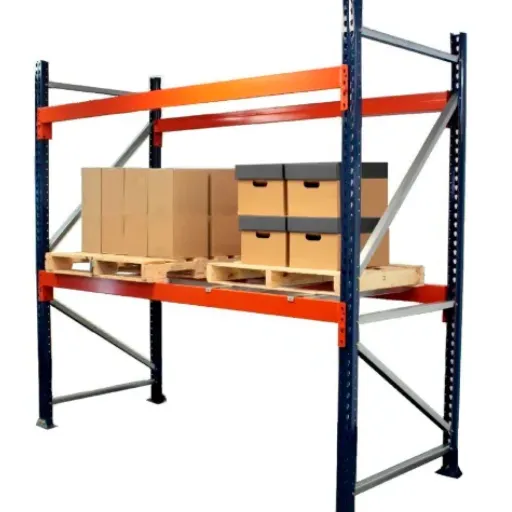

Pallet racking load capacity is the maximum weight a racking system can safely support, calculated at three distinct levels: per pallet position (unit load), per beam level (shelf load), and per bay (total frame load). Most standard selective pallet racks support 2, 000 to 4, 000 lbs per beam level and 10, 000 to 20, 000 lbs per bay, but the actual safe limit depends on your beam length, upright gauge, pallet construction, and how evenly the weight is distributed.
Last December, a turret truck struck an unprotected upright at a food distribution warehouse in the Midwest. The rack was not equipped with impact guards. Within seconds, three bays of fully loaded racking collapsed, killing one employee and sending another to the hospital. OSHA’s investigation revealed the rack had been overloaded for months. The posted capacity signs were faded and incorrect. The pallets were warped wooden units that concentrated weight on narrow skids instead of spreading it across the beam.
This is not an isolated story. Warehouse injuries in the transportation and storage sector rose 22% in recent years, and rack failures remain a leading contributor. The tragedy is that most overloads are preventable. When you understand how to calculate pallet racking load capacity correctly, you protect your people, your inventory, and your operation.
In this guide, you will learn the exact calculation method warehouse engineers use, the safety standards that govern racking design, and how your choice of pallets directly affects the safe working limit of your entire system. Whether you manage a small storage facility or a multi-acre distribution center, these principles apply.
Key Takeaways
- Pallet racking load capacity must be verified at three levels: unit load, shelf load, and bay load. The weakest component determines your system limit.
- The standard calculation formula is: (Product Weight + Pallet Weight) x Pallets per Beam Level x Safety Factor (1. 25x to 1. 35x).
- Beam deflection must not exceed L/180 (beam length divided by 180), per Rack Manufacturers Institute (RMI) standards.
- Steel-reinforced plastic pallets reduce deflection by 40-60% compared to all-plastic or wooden pallets, enabling safer racking at higher loads.
- OSHA does not have a standalone pallet rack regulation. Compliance falls under the General Duty Clause, with ANSI/RMI MH16. 1 as the referenced engineering standard.
What Is Pallet Racking Load Capacity?
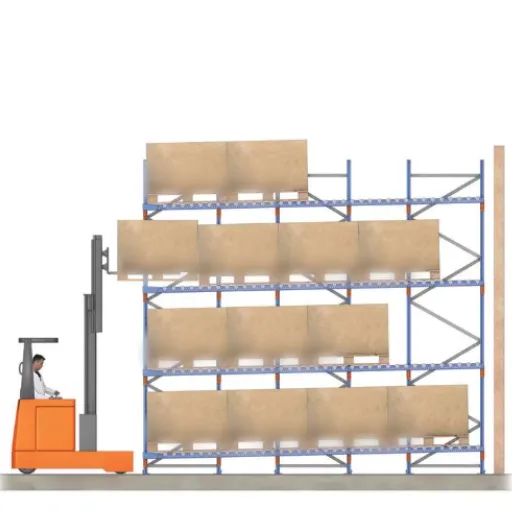
At its core, pallet racking load capacity is the maximum weight a storage rack system can hold without risk of structural failure. But this is not a single number. It is a set of three interrelated limits that must all be respected simultaneously.
Unit Load is the maximum weight of a single pallet and its contents in one storage position. Shelf Load is the total weight across one pair of beams, which may hold one or more pallets side by side. Bay load refers to the total mass acting downwards on the vertical frames of all levels within a particular bay.
Consider the scenario as a chain. A chain is as strong as its weakest link. Your rack system may have beams rated for 5, 000 lbs per level and uprights rated for 20, 000 lbs per bay. But if your floor slab can only handle 8, 000 lbs at each footplate, your true system capacity is 8, 000 lbs. Here, the weakest link is the floor.
This systems-thinking approach is where many facilities go wrong. They read the beam capacity chart from the manufacturer and assume that is their limit. In reality, capacity is an equation with multiple variables: beam profile, upright height and gauge, connection type, load distribution, seismic zone, floor strength, and yes, the pallets themselves.
Learn more about how pallet construction interacts with rack systems in our guide to rackable plastic pallets.
The Three Components That Determine Your Real Capacity
Understanding pallet racking load capacity starts with breaking the system into its three core structural components. Each has its own rating, its own failure mode, and its own set of variables.
Beam Capacity: The Span Problem
Beams are horizontal members that hold the weight of your pallets. Their capacity depends on four factors: length, cross-sectional profile, steel grade, and connection stiffness.
Longer beams hold significantly less weight. A 96-inch beam of the same profile may carry 20-30% less than an 84-inch beam. This is because deflection increases with the cube of the span length. The industry standard for maximum allowable deflection is L/180, meaning a 96-inch beam can sag no more than 0. 53 inches under full load.
Connection type also matters. A beam with a stiffer clip or pin connection will perform better than one with a looser fit because the connection resists rotational movement. Mixing beam brands or using mismatched components can invalidate manufacturer ratings entirely.
Frame and Upright Capacity: The Height Penalty
Upright frames carry the cumulative load from every beam level above them. Their capacity depends on height, vertical beam spacing, bracing pattern, steel gauge, and base plate size.
Taller uprights with wider spacing between beam levels lose capacity. At a 36-inch unsupported span, a typical frame may handle 27, 600 to 40, 400 lbs. Widen that span to 60 inches, and capacity drops to 19, 800 to 28, 800 lbs. Racks over 20 feet tall lose an additional 10-15% due to use effects. Any rack exceeding 30 feet typically requires a structural engineering review.
The Connector: The Hidden Weak Link
Here is a truth almost no consumer-facing content mentions: the beam-to-upright connector is often the actual limiting factor in your system. The connector’s moment resistance and tear-out strength determine how much load the joint can transfer before failing.
A three-pin connector performs differently from a four-pin connector. A worn or damaged clip may have lost significant capacity without any visible deformation. This is why mixing manufacturer components is dangerous. Each brand engineers its beams, uprights, and connectors as an integrated system. Swapping one brand’s beams onto another brand’s uprights can create a mismatch at the connection that reduces capacity far below either component’s individual rating.
How to Calculate Pallet Racking Load Capacity: A Step-by-Step Method
When Maria took over as operations manager at a pharmaceutical distribution center in New Jersey, she inherited a 20-year-old rack system with faded labels and no documentation. Her first task was simple: figure out how much weight the racks could actually hold. She spent three days measuring, weighing, and cross-referencing. By the end, she had a one-page capacity sheet for every bay in the warehouse. Her maintenance team still uses it today.
Here is the method Maria used, refined into a practical workflow any warehouse team can follow.
Step 1: Weigh Your Heaviest Unit Load
Do not use average weights. Design for your maximum anticipated load. Include every element: the product, its packaging, the pallet itself, and any stretch wrap or banding. A standard wooden pallet weighs 40 to 60 lbs. A rackable plastic pallet weighs 15 to 25 lbs. That difference matters when you are pushing against a capacity limit.
Step 2: Count Pallets Per Beam Level
Multiply your unit load by the number of pallets stored side by side on one beam level. This is your shelf load. A common and costly mistake is assuming a beam rated for 2, 000 lbs can hold two 2, 000-lb pallets. It cannot. Two pallets at 2, 000 lbs each require a beam rated for at least 4, 000 lbs.
Step 3: Apply the Safety Factor
Divide the calculated load by an appropriate safety factor to determine your safe working load:
| Application | Safety Factor | Example |
|---|---|---|
| Light duty (under 1, 500 lbs/pallet) | 1. 25x | 2, 000 lb load / 1. 25 = 1, 600 lbs safe |
| Medium duty (1, 500-3, 000 lbs/pallet) | 1. 30x | 3, 000 lb load / 1. 30 = 2, 308 lbs safe |
| Heavy duty (over 3, 000 lbs/pallet) | 1. 35x | 4, 000 lb load / 1. 35 = 2, 963 lbs safe |
Add an extra 10% margin for high forklift traffic areas or cold storage environments where dynamic loads and material brittleness increase risk.
Step 4: Verify Beam Capacity Against Manufacturer Specs
Compare your required shelf load against the manufacturer’s capacity chart for your exact beam length and profile. Remember that capacity charts assume uniformly distributed loads. Point loads, such as narrow pallet skids or drums, create higher stress concentrations and effectively reduce usable capacity.
Step 5: Calculate Total Bay Load on Uprights
Sum the shelf load from every level in a single bay. Verify this total against the upright frame rating at your specific beam spacing and rack height. If you have five levels each holding 4, 000 lbs, your bay load is 20, 000 lbs. Your uprights must be rated for at least that amount at your configuration.
Step 6: Check Floor Point-Load Capacity
Divide the total bay load by the number of upright footplates supporting it. A 20, 000-lb bay supported by two uprights with two footplates each means 5, 000 lbs per footplate. Your concrete slab must handle that concentrated load. If it cannot, the rack will crack, sink, or tilt regardless of how strong the steel is.
For a deeper look at how pallet weight and construction factor into your calculations, see our complete guide to plastic pallet load capacities.
How Your Pallet Choice Directly Affects Racking Capacity
Most capacity guides treat the pallet as an afterthought. They tell you to weigh it and move on. But the type of pallet you use changes how load transfers to the beams, how weight distributes across the span, and how predictable your capacity remains over time.
Wooden Pallets: Strong but Unpredictable
A new hardwood pallet can handle 1, 500 to 2, 000+ kg in a rack. But wood degrades. It absorbs moisture, warps, splinters, and weakens at the nails. A pallet that handled 2, 000 lbs last month may handle significantly less today if it sat in a damp loading dock over the weekend. This variability makes things dangerous. You cannot calculate a precise system capacity when one of your variables changes unpredictably.
Wooden pallets also concentrate load on narrow stringers or block feet. This creates point loads rather than uniformly distributed loads, which increases beam stress beyond what a simple weight calculation suggests.
Standard Plastic Pallets: Consistent but Deflection-Prone
Rackable plastic pallets made from HDPE or polypropylene offer major advantages over wood. They do not absorb moisture. Their dimensions stay consistent. They weigh less, which reduces your total unit load. And they last 10+ years in managed systems versus 1 to 2 years for wood under heavy use.
However, standard all-plastic pallets have racking capacities of 800 to 1, 500 kg. Over time, they can experience creep deflection, sagging gradually under sustained rack loads. One industry test found an unreinforced plastic pallet may sag 20 mm after six months under rated load. In a high-bay automated system where shuttle mechanisms operate with tight clearances, that sag can cause interference or jamming.
Steel-Reinforced Plastic Pallets: The Best of Both Worlds
This is where Shandong Lile’s engineering makes a measurable difference. Our steel-reinforced rackable plastic pallets integrate galvanized steel tubes directly into the primary load-bearing runners during the injection molding process. These tubes are not retrofitted. They are part of the pallet’s molecular structure.
The result is a racking load capacity of 1, 500 to 2, 000+ kg, rivaling hardwood pallets, with 40 to 60% less deflection under load. That same six-month sag test? A steel-reinforced equivalent sagged just 5 mm. The reinforcement also eliminates creep as a long-term concern, giving you predictable capacity year after year.
For warehouse managers operating AS/RS systems, high-bay racks over 8 meters, or any application where loads exceed 1, 000 kg per pallet, steel reinforcement is not a luxury. It is an engineering requirement.
Want to see how steel-reinforced pallets could upgrade your racking performance? Explore our rackable plastic pallet range and request specifications for your beam span.
Critical Factors That Quietly Reduce Your Capacity

Even after you have calculated your baseline capacity, real-world conditions can erode it. Here are the factors most likely to push your system toward failure.
Load Distribution: The UDL Rule
Beams are engineered for uniformly distributed loads (UDL). This means weight spread evenly across the full beam face. When a pallet’s feet sit on narrow skids, or when a load is off-center, the beam experiences higher stress than the total weight alone would suggest. Always center pallets on beams and avoid cantilevered overhangs.
Dynamic and Impact Loads
Forklifts do not place pallets gently. Impact forces from placement, retrieval, and accidental collisions can create loads two to three times the static weight. Add a 10% capacity margin in high-traffic aisles. Install upright guards at aisle ends and corners where impacts are most likely.
Temperature Effects
Cold storage changes everything. At -20°C and below, steel becomes more brittle. Plastic contracts. Bolt torque loosens as materials shrink at different rates. If you operate freezer racking, reduce your working capacity by an additional 10% and inspect connections more frequently.
Seismic Considerations
There is no such thing as a non-seismic zone. There are only lower and higher seismic zones. Seismic loads act horizontally on your rack, creating overturning forces that standard capacity charts do not account for. In seismically active regions, consult a structural engineer. In moderate zones, ensure your racks are properly anchored and consider derating capacity by 15 to 20%.
Component Damage
A dented upright can lose 20% or more of its capacity. A bent beam may look minor but can alter load paths in ways that stress connections. Establish a damage threshold: any visible dent, crack, or deformation means immediate unloading and assessment. Do not guess.
Safety Standards and Compliance: What the Rules Actually Say
OSHA and the General Duty Clause
There is no particular OSHA standard specifically dedicated to pallet racks. Rather, the issue comes under the General Duty Clause, which stipulates that an employer must ensure safety standards in their workplace. Specific rules that apply include 29 CFR 1910. 176(b), which mandates that storage systems safely accommodate the weight and distribution of stored materials, and 1910. 176(d), which requires regular inspection of material handling equipment and storage systems.
Technical considerations for the purpose mentioned above are specified by RMI and ANSI MH16. 1 which is a specification of industrial steel storage racks.
Load Capacity Labels
Every bay must display visible signage indicating three numbers: maximum unit load per pallet position, maximum shelf load per beam level, and maximum bay load. Labels should be affixed at eye level on the end of each racking run. If your labels are faded, missing, or based on outdated calculations, replace them immediately.
When You Need a Professional Engineer
Consult a licensed structural or rack engineer when: modifying existing configurations, reconfiguring used or orphaned racking without original documentation, installing racks over 30 feet tall, operating in a seismic zone, storing unusual loads such as bulk bags or loose drums, or when any component shows damage and you need a formal capacity reassessment.
Common Mistakes That Lead to Rack Failure
- Using average weights instead of maximum. Your capacity must handle your heaviest day, not your typical day.
- Ignoring the pallet in the calculation. A 50-lb wooden pallet across 500 positions adds 25, 000 lbs of dead weight you may not have counted.
- Mixing manufacturers. Beam and upright ratings assume matched systems. Swapping brands at the connection is a recipe for failure.
- Forgetting the floor. Strong racks on weak concrete will crack the slab, tilt the uprights, and cascade into collapse.
- Uneven loading across a beam. One heavy pallet on the end of a beam creates dangerous torsion.
- No load signage. If operators do not know the limit, they will exceed it.
- Operating with damaged components. A dent today becomes a buckle tomorrow.
Pallet Racking Load Capacity Quick Reference
| Product Category | Typical Weight per Pallet | Recommended Beam Profile | Best Pallet Type |
|---|---|---|---|
| Electronics, consumer goods | 600-1, 200 lbs | 4″ x 1. 5″ step beam | Standard rackable plastic |
| Food and beverage | 1, 000-2, 000 lbs | 4″ x 2″ step beam | Steel-reinforced plastic |
| Automotive parts | 1, 200-2, 500 lbs | 5″ x 2″ step beam | Steel-reinforced heavy duty |
| Chemicals, bulk liquids | 1, 500-3, 000+ lbs | 5″ x 2″ heavy duty | Steel-reinforced + custom specs |
| Cold storage, freezer | 1, 000-2, 000 lbs | 4″ x 2″ step beam | Steel-reinforced, low-temp HDPE |
Conclusion: Capacity Is a System, Not a Number
When David, a logistics director at a European automotive parts supplier, reviewed his warehouse after reading this same calculation method, he discovered his racks were operating at 115% of safe capacity. The beams were bowing. The uprights showed hairline cracks. The wooden pallets had absorbed moisture from a nearby humidity source and were sagging between the beams. He ordered an immediate offload, brought in a structural engineer, and replaced every pallet with steel-reinforced plastic units matched to his beam spacing. Six months later, his safety incident rate dropped to zero. His rack utilization actually improved because the lighter, consistent pallets allowed tighter level spacing.
That is the power of treating capacity as a system. It is not about finding one magic number. It is about understanding how beams, uprights, connectors, floors, and pallets interact under real-world conditions.
Begin with the calculations. Verify at all three levels: unit load, shelf load, and bay load. Apply appropriate safety factors. Inspect regularly. And choose pallets that maintain their rated capacity predictably over time.
Ready to maximize your racking system with pallets engineered for precision and performance? Contact Shandong Lile today for a free consultation on steel-reinforced rackable pallets tailored to your beam configuration and load requirements.
Frequently Asked Questions
What is the load rating on pallet racking according to OSHA?
OSHA does not publish specific load ratings for pallet racking. Rather than this, it is the duty of the employer under the General Duty Clause to ensure workplace safety, and under 29 CFR 1910. 176(b) requires storage systems to safely accommodate weight and distribution. For engineering load ratings, OSHA references ANSI/RMI MH16. 1 standards.
How much weight will standard pallet racking hold?
Standard selective pallet racking typically supports 2, 000 to 4, 000 lbs per beam level and 10, 000 to 20, 000 lbs per bay. However, the exact capacity depends on beam length, upright gauge, vertical spacing, load distribution, and floor strength. Always verify against manufacturer specifications for your exact configuration.
Can I use plastic pallets in pallet racking?
Yes, but only rackable designs with full-perimeter bases or three-runner skid structures. Nestable or nine-leg plastic pallets are designed for floor stacking only and offer zero racking capacity. Standard rackable plastic pallets handle 800 to 1, 500 kg in the rack. Steel-reinforced models reach 1, 500 to 2, 000+ kg.
What happens if I overload pallet racking?
Overloading causes beam deflection beyond the L/180 limit, connection stress, upright buckling, and potentially catastrophic collapse. Signs include visible beam sagging, popping sounds from connections, and upright deformation. OSHA reports that rack failures contribute to nearly 20% of warehouse injuries.
How often should pallet racking be inspected?
Conduct visual inspections weekly for obvious damage. Perform formal documented inspections quarterly. Engage a qualified rack inspector or engineer annually, and immediately after any forklift impact, seismic event, or reconfiguration. Damaged bays must be unloaded and assessed before reloading.
What is the L/180 deflection rule?
L/180 is the maximum allowable beam deflection standard set by the Rack Manufacturers Institute. It means a beam can sag no more than its length divided by 180. For a 96-inch beam, maximum allowable sag is 0. 53 inches. Exceeding this limit risks permanent deformation and connection failure.
Do I need load capacity labels on my racking?
Yes. OSHA requires visible load capacity signage under 1910. 176(b). Labels must show unit load, shelf load, and maximum bay load for each configuration. Labels should be posted at the end of each rack run at approximately eye level.