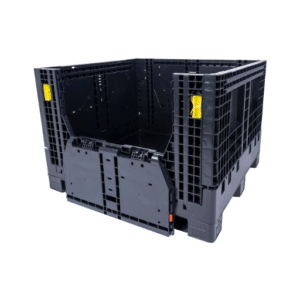
Knowing when to use plastic vs wood pallets starts with one question: does the pallet come back? Use wood when it ships out and never returns. Use plastic when it comes back for reuse, when hygiene is non-negotiable, or when it must run through automated equipment. The decision rarely comes down to price alone, and that is exactly what makes this question harder than it looks.
The cheapest pallet is rarely the cheapest pallet. A 12woodpalletthatsurvivesasingleone−waytripcosts12woodpalletthatsurvivesasingleone−waytripcosts12 per trip. A 60plasticpalletthatcompletes200tripsinaclosedloopcostsabout60plasticpalletthatcompletes200tripsinaclosedloopcostsabout0.30 per trip. Same purchase logic, opposite answers, because the right material depends entirely on how the pallet moves through your operation.
You already know plastic and wood both have real advantages. What most buyers want is a clear way to choose between them without wading through a full plastic pallets vs wood pallets comparison. That is what this guide gives you: a scenario-based decision framework, the pooling alternative everyone forgets, and a scorecard you can apply to your own fleet in minutes.
Not sure where to start? Browse our plastic pallets or talk to an engineer for a material recommendation based on your load, loop, and industry.
Key Takeaways
- The deciding factor is your logistics loop: open-loop (one-way) favors wood; closed-loop (returnable) favors plastic.
- Plastic pays for itself in closed loops through 100–400+ trips versus 5–15 for wood, breaking even around 25–32 cycles.
- Choose plastic when hygiene, moisture, automation, or ISPM-15 export compliance matters.
- Choose wood for one-way shipping, heavy static loads above roughly 1,500 lbs, or rough field circulation.
- Don’t forget the third option: pallet pooling (CHEP/PECO) can beat buying for high-volume open-loop retail networks.
The Rule That Decides Everything: Open-Loop vs. Closed-Loop

Before comparing materials, define your loop. This single question sorts most decisions instantly.
An open-loop system ships a pallet out and does not get it back. The pallet is effectively a consumable. Examples include one-way export shipments, deliveries to retailers that keep the pallet, and machine dispatch to remote sites.
A closed-loop system keeps pallets circulating between the same facilities. The pallet returns, gets cleaned or inspected, and ships again. Examples include a manufacturer shipping to its own distribution centers, a beverage producer moving bottles between plants, or a parts supplier in a just-in-time automotive flow.
Here is the rule that follows:
- Open loop, one-way shipping → wood. The low upfront cost of wood, typically 8–8–28 for a GMA pallet, wins because the pallet’s value is sunk after the first trip. Paying 40–40–200 for a plastic pallet that ships once makes no financial sense.
- Closed loop, returnable flow → plastic. The higher upfront cost of plastic, typically 40–40–120, is recovered over 100–400+ trips, where wood would need replacing after 5–15 trips. Independent testing at Virginia Tech recorded a plastic pallet surviving 400 cycles against 11 for a wood stringer pallet.
The math that matters is cost per trip, not purchase price. Wood runs roughly 0.80–0.80–3.00 per trip; plastic runs 0.20–0.20–2.00 per trip once the fleet reaches steady reuse, according to ORBIS’s cost analysis. Plastic typically breaks even around 25–32 cycles, then keeps saving on every cycle after. If you want the full total-cost-of-ownership breakdown, our guide to returnable plastic pallet ROI walks through the numbers.
Sarah, a supply chain manager at a regional beverage distributor, hit this exact fork in the road. Her wooden pallets were cheap to buy but kept coming back cracked after three or four trips. When she mapped her fleet, she realized every pallet returned to her plant on the backhaul. It was a closed loop pretending to be an open one. Switching to durable plastic, verified through pallet durability testing, cut her annual pallet purchases sharply within the first year. The loop type, not the material, drove the decision.
So before asking “plastic or wood,” ask “does my pallet come back?” That answer usually settles it. The sections below cover the exceptions and refinements.
When to Choose Plastic Pallets
Plastic is the right call whenever the pallet must perform beyond simply carrying a load once. Here are the five situations where plastic wins clearly.
Hygiene-critical operations
Food, beverage, pharmaceutical, and cosmetics operations cannot tolerate porous surfaces. Wood absorbs moisture and can harbor bacteria, mold, and debris, and it sheds splinters and loose nails. Plastic has a smooth, non-porous surface that washes clean and resists microbial growth.
Many pharmaceutical facilities ban wood pallets outright for cleanroom compatibility. Food processors moving to washable HDPE pallets eliminate splinter and nail contamination risk at the source. If your audit involves a washdown station, plastic is the answer.
Wet, humid, and cold-chain environments
Moisture is wood’s enemy. In seafood processing, produce washing, blast freezing, and cold storage, wood absorbs water, warps, and can grow mold. Plastic sheds water, resists most chemicals, and holds its dimensions through temperature swings. For a cold chain, plastic also avoids the wet-weight problem that drives up freight cost on the return trip.
Automated warehouses and AS/RS
Automated systems punish inconsistency. A wooden pallet’s variable dimensions, warping, and loose boards cause jams on conveyors and in automated storage and retrieval systems. Plastic pallets are molded to tight tolerances, typically within 1–2 mm, so they track straight through AS/RS, conveyors, and robotic handling. If a pallet must run unattended, dimensional consistency is not a nice-to-have, it is the whole game.
International export and ISPM-15
This is one of the most concrete cost levers. Wood pallets moving across international borders must comply with ISPM-15, which means heat treatment or fumigation plus an IPPC stamp and paperwork. Plastic pallets are fully exempt. For high-volume, multi-country shipping, plastic eliminates treatment cost, documentation, and the risk of a customs hold. For one-time export, heat-treated wood remains practical, which we cover below.
Fragile or high-value goods
Loose fasteners on wood can puncture or damage fragile products, from paint cans to electronics. Plastic offers a clean, uniform deck with no protruding nails or splinters. For brand-sensitive or high-value loads, plastic protects both the product and the brand presentation.
Plastic is not a single product, though. Material and design matter. If you are weighing HDPE against polypropylene or deciding between nestable and rackable designs, our plastic pallets page explains the options and load ratings.
Ready to test a plastic pallet in your loop? Request a free quote and we will recommend a design matched to your load and industry.
When to Choose Wood Pallets

Plastic is not always the answer, and a credible comparison has to say so. Wood remains the right choice in four situations.
One-way and single-use shipping
When the pallet never returns, you are buying a consumable. Paying a premium for a pallet built to last 400 trips is wasted money on a pallet that makes one. This is why wood still dominates outbound-only shipping, export staging, and machine dispatch. The pallet’s entire value is spent on the first journey.
Heavy static loads
Wood handles very heavy loads well, especially in static storage where pallets sit for long periods. Shipments above roughly 1,500–3,000 lbs are often best on wood, or on a heavy-duty or steel-reinforced plastic design if the load must be repeatable. Our guide to plastic pallet load capacity breaks down static, dynamic, and rack ratings if you are close to the line.
Rough industrial circulation and repairability
In rough environments where pallets get abused, wood has a genuine advantage: it is field-repairable. A broken board can be replaced on site. Plastic is not repairable in the same way; a damaged pallet is recycled or scrapped. If your operation runs on rough handling and in-the-field repair, wood’s repairability can keep it economical.
Budget-constrained, low-value freight
If capital is tight and the goods are low-value and non-sensitive, the low upfront cost of wood is hard to beat. For domestic freight without strict hygiene or automation requirements, wood remains the pragmatic default.
The Third Option: Pallet Pooling
Almost every “plastic vs wood” article misses a third branch: you do not have to buy either one. Pallet pooling means renting pallets from a provider like CHEP (blue pallets) or PECO (red pallets), who own, repair, and recover them. You pay per trip instead of per pallet, which turns the choice into a pallet pooling vs buying decision.12–$30 for pallets not returned, damage fees, and transfer and administration charges.
When pooling beats buying
- A retailer mandates it. Walmart, Kroger, Target, and Costco programs often require CHEP or PECO pallets. In that case, the decision is made for you.
- High volume through pooled networks. At very high volume with predictable flows, pooling’s scale can reduce your management burden.
- No storage space or seasonal surges. Pooling avoids tying up capital in a fleet you have to store and track.
When buying beats pooling
The open-loop math often favors ownership. One analysis of a 1,000-pallet-per-month operation found CHEP rental cost around 9,450permonth,versus9,450permonth,versus2,000–2,500permonthforownedGradeAGMApallets,asavingsofroughly2,500permonthforownedGradeAGMApallets,asavingsofroughly80,000–$90,000 per year. Pooling is priced by time, so slow-moving inventory with long dwell times gets expensive. Buying also wins when you need custom specs, have a closed loop with over 95% return rates, or already run reverse logistics.
Combining pooling with material choice
Here is the subtlety most teams miss. The pooling decision and the material decision are separate but connected. Tom’s team, a grocery supplier, pools CHEP pallets for national one-way lanes where retrieval is impossible, but owns a fleet of plastic pallets for its regional closed loop. That hybrid approach, pooling for open lanes and owning for returnable flows, is often the lowest-total-cost strategy. It is not “rent or buy”; it is “rent where you must, own where you can.”
For a deeper look at the rent-versus-buy economics, our plastic pallets vs wood pallets pillar covers pooling alongside the material comparison.
Industry-Specific Recommendations at a Glance
Use this table as a shortcut. It assumes a typical operation in each industry.
| Industry | Recommended | Why |
|---|---|---|
| Food & beverage | Plastic | Hygiene, washdown, contamination risk |
| Pharmaceutical / healthcare | Plastic | Cleanroom compatibility, regulatory compliance |
| Agriculture / cold storage | Wood (field) or plastic (processing) | Disposable wood for muddy field use; plastic for processing and cold chain |
| Automotive | Plastic (closed loop) | Dimensional consistency, just-in-time durability |
| E-commerce / retail | Plastic | Automated sortation, lighter weight |
| International export | Plastic (high-volume) or heat-treated wood (one-time) | ISPM-15 exemption vs. single-shipment cost |
How to Decide: A Step-by-Step Framework

Pull it all together with a decision tree and a scorecard.
The decision tree
Walk through these questions in order:
- Does the pallet come back? If no, use wood (or heat-treated wood for export). If yes, continue.
- Is hygiene, moisture, or automation involved? If yes, use plastic. If no, continue.
- Is the load above roughly 1,500–3,000 lbs in static storage? If yes, use wood or a steel-reinforced plastic design. If no, continue.
- Is a retailer requiring CHEP or PECO? If yes, pool. If no, continue.
- Is the loop high-turnover and controlled? If yes, use plastic and track the asset. If no, use wood.
The decision scorecard
For a more rigorous choice, score your operation across five factors. Each factor gets a simple rating: Wood, Plastic, or Either. Whichever material wins the most factors is your answer.
- Loop type: closed (plastic) or open (wood)
- Hygiene requirement: high (plastic) or low (either)
- Environment: wet, humid, or cold (plastic) or dry (either)
- Automation: automated (plastic) or manual (either)
- Load weight: under 1,500 lbs (either) or over (wood or heavy-duty plastic)
Want this as a printable worksheet? Contact our team and we will send you a decision scorecard and help you run the numbers for your specific fleet.
Frequently Asked Questions
Should I use plastic or wood pallets?
Use wood for open-loop, one-way shipping and heavy static loads. Use plastic for closed-loop returnable flows, hygiene-critical operations, automated warehouses, and high-volume export. The loop type is the deciding factor.
Are plastic pallets worth the extra cost?
In a closed loop, yes. Plastic costs more upfront but lasts 100–400+ trips versus 5–15 for wood, so cost per trip drops sharply after roughly 25–32 cycles. In an open loop where the pallet never returns, wood is usually cheaper.
Is it better to rent or buy pallets?
It depends on volume and return rates. Pooling wins when a retailer mandates it or when you need no capital outlay. Buying wins for closed loops with over 95% returns, slow-moving inventory, and custom specs. Many operations save by pooling open lanes and owning returnable lanes.
Which pallet is best for food or pharmaceuticals?
Plastic. Its non-porous, washable surface supports FDA, HACCP, and cleanroom requirements, and it eliminates the splinter and nail contamination risk of wood.
Which pallet is best for automated warehouses?
Plastic. Molding to tight dimensional tolerances, typically within 1–2 mm, prevents the jams that variable or warping wood causes in AS/RS and conveyor systems.
Do wood pallets need heat treatment for export?
Yes. Wood pallets crossing international borders must meet ISPM-15, which generally means heat treatment or fumigation plus an IPPC stamp. Plastic pallets are fully exempt.
Conclusion
Deciding when to use plastic vs wood pallets is less about which material is “better” and more about which fits your operation. Start with the loop: open-loop, one-way shipping favors wood, while closed-loop, returnable flow favors plastic. Then layer in hygiene, moisture, automation, load weight, and export requirements.
Plastic earns its higher upfront price in closed loops through durability, dimensional consistency, washability, and the ISPM-15 exemption. Wood keeps its place in one-way shipping, heavy static loads, rough circulation, and tight budgets. And don’t overlook pooling, renting from CHEP or PECO can beat buying in high-volume open-loop retail networks.
At Shandong Lile Holding Group, we have manufactured plastic pallets and plastic pallet boxes for more than a decade, serving logistics, food, pharmaceutical, automotive, and retail operations across 108+ countries. Our ISO 9001-certified production and direct factory pricing mean the plastic payback in your closed loop arrives sooner than you might expect.
Still weighing plastic against wood for your operation? Request a free quote and our engineers will recommend the right material, design, and load rating for your specific loop.