
When comparing selective vs drive in racking, the choice comes down to two priorities. Selective racking gives you direct access to every pallet and works best for high-SKU operations that need flexibility. Drive-in racking maximizes storage density up to 75% more pallet positions in the same footprint, making it ideal for bulk inventory with low SKU variety. The racking system you choose directly determines the pallet specifications you need, and getting either decision wrong can reduce your storage efficiency by 30% or more.
When Marcus Chen took over logistics at a mid-sized food distribution center in Ohio, he inherited a warehouse designed entirely around selective racking. The facility stored 2,400 SKUs ranging from spices to bulk rice.
His predecessor had installed selective racks everywhere, even in the bulk grain zone where only three products rotated through. After running the numbers, Marcus realized the bulk zone was using 40% more floor space than necessary. He reconfigured that section to drive-in racking and freed up 3,200 square feet for new product lines. The project paid for itself in 18 months.
That is the advantage of customizing your racking system according to your inventory needs. Most warehouse planners treat racking and pallets as separate decisions. They are not.
The rack determines how your pallets sit, how forklifts interact with them, and how much weight each position must handle. In this guide, you will learn exactly how selective and drive-in racking work. You will see how they compare across every factor that matters. And you will discover which pallet types maximize performance in each system.
Key Takeaways
- Selective racking offers 100% pallet accessibility and supports both FIFO and LIFO inventory rotation, making it the best choice for high-SKU operations.
- Drive-in racking delivers 75% more pallet positions per square foot by eliminating aisles, but operates on LIFO principles with limited individual access.
- Drive-in racking requires heavy-duty rackable pallets with precise dimensions; selective racking offers more flexibility but still benefits from purpose-built plastic pallets.
- Cold storage facilities see the highest ROI from drive-in racking combined with plastic pallets that resist moisture and maintain consistent dimensions in freezing temperatures.
- Many modern warehouses use a hybrid approach: selective racking for fast-moving SKUs and drive-in for bulk reserve storage.
What Is Selective Racking?
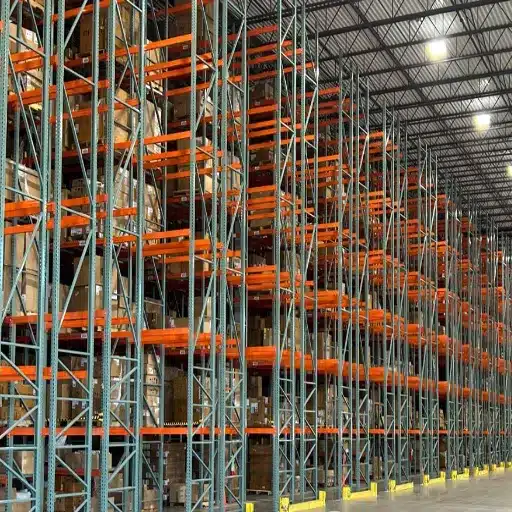
Selective racking is the most common pallet storage system in warehouses worldwide. It consists of upright frames connected by horizontal beams that create individual pallet positions. Forklifts access every pallet directly from an aisle without entering the rack structure itself.
How Selective Racking Works
Each pallet sits on a pair of beams between two upright frames. A standard bay typically holds one pallet per beam level, with multiple levels stacked vertically. Aisles run between every row of racks, giving operators clear sightlines and direct access to any pallet in the system.
This design makes selective racking incredibly flexible. You can adjust beam heights to accommodate different load sizes. You can reconfigure bays as your inventory changes. You can expand the system by adding more uprights and beams without dismantling existing structures.
Key Specifications
Most selective racking systems reach 8 to 40 feet in height, though some facilities push beyond 50 feet with specialized equipment. Load capacity per level typically ranges from 2,000 to 6,000 pounds, depending on beam construction and upright gauge. Standard aisle widths run 8 to 12 feet to accommodate counterbalance forklifts.
The system works with virtually any standard pallet size. That flexibility is both a strength and a potential weakness. Because selective racking accepts wood, plastic, or metal pallets without modification, some warehouse managers never consider whether a purpose-built pallet could improve performance.
What Is Drive-In Racking?
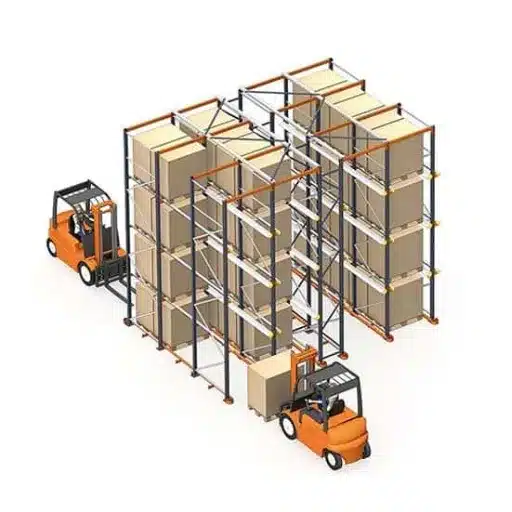
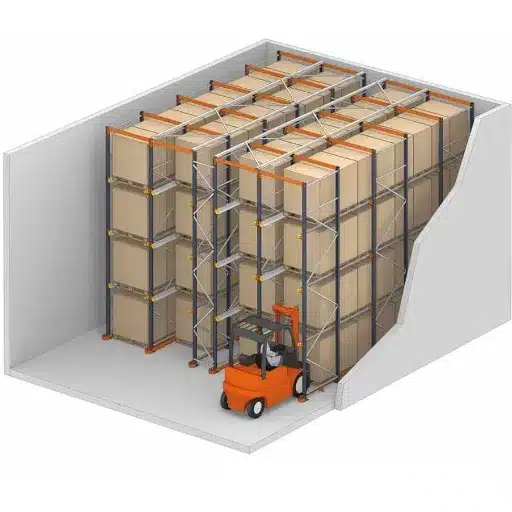
Drive-in racking operates on an entirely different principle of space management. Instead of individual pallet positions accessed from aisles, it creates deep lanes where forklifts drive directly into the rack structure to deposit and retrieve pallets.
How Drive-In Racking Works
Upright frames support continuous rails that run deep into the rack, typically 4 to 12 pallet positions. Forklifts enter the lane from one end, place a pallet on the rails, then back out. The next pallet is placed in front of the first one. This creates a Last-In, First-Out (LIFO) inventory flow because the most recently placed pallet blocks access to those behind it.
A drive-through variant exists with entry and exit points on opposite ends, enabling First-In, First-Out (FIFO) rotation. However, this requires separate loading and unloading aisles and reduces some of the density advantage.
Key Specifications
Lane depth typically ranges from 4 to 12 pallet positions, though some systems extend deeper. Each lane can hold 8,000 to 30,000+ pounds total, depending on rail and upright construction. The critical advantage is space efficiency. Drive-in racking eliminates aisles between racks, pushing floor space utilization to 75% or higher compared to 40-50% for selective systems.
The cost comes in the form of accessibility. The frontmost pallet can be accessed directly. If you need a pallet buried five positions deep, you must remove the four pallets in front of it first. That makes drive-in racking unsuitable for operations requiring frequent access to individual pallets.
Selective vs Drive In Racking: Head-to-Head Comparison
Choosing between these systems requires evaluating your operation across multiple dimensions. When you compare selective vs drive in racking side by side, the trade-offs become clear. Here is how they stack up.
Storage Density
Density-wise, drive-in is king. By eliminating aisles between racks and storing pallets multiple positions deep, it typically delivers 50% to 75% more pallet positions in the same footprint. For a facility paying $10 per square foot in annual rent, that density advantage translates to real savings. It also creates growth capacity without building expansion.
Selective racking sacrifices density for accessibility. Aisles between every row consume floor space. In facilities where real estate is cheap and SKU variety is high, that trade-off works. In expensive markets or tight spaces, it becomes a costly compromise.
Pallet Accessibility
Selective racking provides 100% direct access to every pallet. No other pallets need moving to reach the one you want. It is best suited for businesses where there is frequent picking, mixed inventory, and/or lot tracking.
With drive-in racking, access is limited to the front pallet per bay. Retrieving a pallet from deep in the lane requires removing all pallets in front of it. That operational constraint makes drive-in racking suitable only for inventory where entire lanes turn over together or where access frequency is low.
Inventory Rotation
Selective racking supports both FIFO and LIFO inventory methods. You can load from one side and pick from the other, or manage rotation through warehouse management software. This flexibility is essential for perishable goods, pharmaceuticals, and any product with expiration dates.
Standard drive-in racks only follow LIFO practices. The last pallet loaded becomes the first pallet retrieved. For bulk commodities, raw materials, or products with long shelf lives, this is acceptable. For perishables, it is a dealbreaker unless you invest in the drive-through FIFO variant.
Cost Per Pallet Position
Upfront material costs for selective racking are lower per bay. The structure is simpler, with fewer components. However, because each bay holds fewer pallets, the cost per actual pallet position is higher.
Drive-in racking requires a higher initial investment per lane due to its more complex structure. But because each lane holds 4 to 12 pallets, the cost per pallet position drops significantly. In high-density applications, the lower cost per position often offsets the higher upfront investment within two to four years.
Forklift Requirements
Selective racking works with standard counterbalance forklifts in conventional aisles. Operators need standard training. The risk of rack damage is relatively low because forklifts never enter the rack structure.
Drive-in racking is trickier to operate. Forklifts must enter narrow lanes and maneuver precisely within the rack structure. The risk of collision with uprights or rails is higher. Operator training requirements increase, and some facilities see higher maintenance costs from incidental rack damage.
SKU Flexibility
Selective racking excels when you manage hundreds or thousands of SKUs. Each pallet position can hold a different product. You can adjust beam heights to accommodate varying load sizes. Seasonal changes, new product introductions, and shifting demand patterns are easy to accommodate.
Drive-in racking is suitable where there are few SKUs. Each lane should hold the same product to avoid the operational nightmare of buried inventory. If your operation manages fewer than ten SKUs in bulk quantities, drive-in racking shines. If you manage hundreds of SKUs with partial pallet quantities, it becomes a bottleneck.
System Flexibility and Reconfiguration
Selective racking is inherently modular. You can add bays, remove sections, adjust beam heights, or reconfigure entire rows without major structural changes. This makes it ideal for growing operations or businesses with seasonal fluctuations.
Drive-in racking is more rigid. Lane structures are harder to modify once installed. Changing lane depth or reconfiguring for different pallet sizes requires significant dismantling and reconstruction. You need to design for your long-term needs rather than your current state.
| Factor | Selective Racking | Drive-In Racking |
|---|---|---|
| Storage density | 40-50% floor utilization | 75-85% floor utilization |
| Pallet accessibility | 100% direct access | Front pallet only per lane |
| Inventory rotation | FIFO or LIFO | LIFO (FIFO with drive-through) |
| Cost per pallet position | Higher | Lower |
| Forklift requirements | Standard | Specialized, higher skill |
| Best SKU count | High (100s-1000s) | Low (1-10 per lane) |
| Reconfiguration | Easy and modular | Rigid, harder to modify |
| Cold storage fit | Good | Excellent |
Which Pallet Types Work Best With Each System?
Here is what no competitor in the top ten search results will tell you: your racking system and your pallet choice are inseparable decisions. The rack determines how your pallet sits, how much load it transfers to the rails or beams, and how forklifts engage with it. The wrong pallet reduces racking effectiveness by 15% or more.
Best Pallets for Selective Racking
Selective racking offers the most flexibility in pallet choice. Standard rackable plastic pallets in common sizes like 1200x1000mm or 1200x800mm work perfectly. The open structure of selective racking means you can use lighter-weight pallets without compromising stability.
However, facilities maximizing selective racking performance often choose HDPE plastic pallets over wood. Plastic maintains consistent dimensions over time, unlike wood which warps, splinters, and absorbs moisture. Consistent dimensions matter because uneven pallets create load distribution problems that stress beams and uprights.
For operations running 24/7 with high throughput, lightweight plastic pallets reduce forklift fuel consumption and operator fatigue. A plastic pallet weighing 15 pounds versus a wood pallet at 35 pounds adds up across thousands of moves per day.
Want to see which plastic pallets perform best in selective racking configurations? Explore our rackable plastic pallet range.
Best Pallets for Drive-In Racking
This type of rack system requires your pallets to work harder. Pallets rest on rails, not full beams. This concentrates load at specific contact points. Deep lanes mean pallets sit undisturbed for long periods. Dimensional stability becomes critical. Forklifts also push pallets along rails during placement and retrieval. This creates friction and abrasion.
Heavy-duty rackable plastic pallets are the recommended choice for drive-in applications. Steel-reinforced options provide the load capacity and rigidity needed for deep-lane storage. The precise, consistent dimensions of injection-molded plastic pallets ensure smooth travel along rails without snagging or jamming.
Wood pallets create problems in drive-in systems. Warped boards catch on rails. Splinters litter the lanes. Moisture absorption changes dimensions, causing pallets to bind in deep positions. One jammed pallet in a ten-deep lane can shut down an entire storage zone until resolved.
Plastic pallets also outperform in the cold storage environments where drive-in racking dominates. Wood absorbs moisture and can freeze to rails, making retrieval difficult. Plastic pallets maintain their properties across temperature ranges and clean easily to meet food safety standards.
The Cold Storage Connection
Cold storage warehouses represent the highest-ROI application for combining drive-in racking with plastic pallets. Refrigerated space costs 150to150to300 per square foot to build, three to five times standard warehouse construction costs. Maximizing every cubic foot is essential.
Drive-in racking pushes density to the limit inside expensive cold storage space. Plastic pallets complement this by eliminating the moisture and contamination issues that wood introduces in refrigerated environments. Together, the system delivers maximum space efficiency with minimum maintenance burden.
Need pallets engineered for your drive-in cold storage system? Contact our team for a custom recommendation.
Advantages and Limitations by Use Case
The right choice depends entirely on what you store, how often you access it, and what constraints your facility faces.
When to Choose Selective Racking
When you have high SKU diversity and need frequent access to pallets, selective racking is your best option. E-commerce fulfillment centers, retail distribution hubs, and spare parts warehouses fall into this category. If your operation requires FIFO inventory rotation for perishable goods or regulated products, selective racking is essentially mandatory.
Facilities expecting growth or seasonal fluctuations also benefit from selective racking’s modular flexibility. You can reconfigure bays, adjust heights, and expand without major structural changes. Operations with standard forklift fleets avoid the specialized equipment and training costs that drive-in racking demands.
When to Choose Drive-In Racking
Drive-in racking makes sense when you store large volumes of homogeneous products. Beverage distributors, raw material warehouses, and seasonal goods storage are classic use cases. If your facility faces space constraints or high real estate costs, the density advantage can delay or eliminate expensive expansion projects.
Cold storage and freezer applications particularly favor drive-in racking. The density gain inside expensive refrigerated space delivers outsized returns. Manufacturing facilities holding bulk components for production runs also benefit from the high-density, low-access model.
The Hybrid Approach
Many modern warehouses do not choose one system exclusively. They zone their facility strategically. Fast-moving SKUs live in selective racking near shipping docks. Bulk reserve inventory sits in drive-in racking deeper in the warehouse. Seasonal overflow occupies drive-in lanes until demand shifts.
When Sarah Kim redesigned the warehouse for a Midwest automotive parts distributor, she mapped every SKU by pick frequency and volume. Fast-moving brake pads and filters went into selective racks within 50 feet of the packing stations. Slow-moving bulk engine components occupied drive-in lanes at the rear. The hybrid approach improved overall picking efficiency by 22% while increasing total storage capacity by 35%.
Cost Analysis and ROI
Understanding the financial implications helps justify the investment to stakeholders and ensures you select the system that delivers the best long-term value.
Upfront Investment
Selective racking is cheaper on an individual bay basis. The components are simpler: upright frames, horizontal beams, and wire decking or pallet supports. A basic selective rack bay might run 200to200to400 depending on height, capacity, and configuration.
Drive-in racking costs more per lane due to the rail system, heavier upright construction, and additional bracing required for structural integrity. A drive-in lane might cost 1,500to1,500to3,000 depending on depth and capacity. However, that lane holds 4 to 12 pallets, so the per-position cost drops substantially.
Operational Costs
Labor costs differ between the systems. Selective racking is done by trained forklift drivers. Drive-in racking requires more skilled operators who can maneuver precisely inside rack lanes. Some facilities report 10% to 15% higher labor costs for drive-in zones due to slower operation speeds and higher skill requirements.
Maintenance costs also vary. Selective racking sustains less damage because forklifts never enter the structure. Drive-in racking sees more upright and rail impacts from forklift maneuvering inside lanes. Budget 20% to 30% higher maintenance costs for drive-in systems.
Break-Even and Long-Term Value
The critical financial variable is your real estate cost. At 6to6to8 per square foot annually, selective racking often remains the better choice because flexibility and lower operational costs outweigh density savings. At 10to10to15 per square foot, drive-in racking’s space savings create compelling returns.
Consider a 50,000 square foot warehouse at 12persquarefootannually.Thatis12persquarefootannually.Thatis600,000 in real estate cost every year. If drive-in racking increases effective capacity by 50%, you either avoid expanding into additional space or gain $300,000 worth of effective capacity within the same footprint. Against that backdrop, the higher upfront and operational costs of drive-in racking fade in significance.
Conclusion
When deciding between selective vs drive in racking, remember that no single system works for every warehouse. Selective racking is key for flexibility, accessibility, and SKUs variety. Drive-in racking wins when density, space efficiency, and bulk storage are the priorities. The decision hinges on your specific inventory profile, operational requirements, and facility constraints.
What most guides miss is the pallet connection. Selective racking works with a wider range of pallet types, but still performs better with consistent, dimensionally stable plastic pallets. Drive-in racking demands heavy-duty, precisely engineered pallets that can handle concentrated rail loads and deep-lane storage without degradation.
At Shandong Lile, we engineer plastic pallets that perform in both configurations. Our rackable HDPE pallets maintain precise dimensions for smooth drive-in lane operation. Our steel-reinforced options handle the concentrated loads that deep-lane storage creates. With over 14 years of experience serving 108 countries, we understand how racking systems vary across industries and regions.
The warehouse managers who get the best results do not treat racking and pallets as separate decisions. They design the entire storage ecosystem as an integrated system. If you are evaluating a new racking installation or reconsidering your current setup, start with the full picture.
Ready to match the right plastic pallets to your racking system? Request a free consultation and our team will recommend custom plastic pallet specifications tailored to your warehouse configuration, load requirements, and operational goals.
Frequently Asked Questions
What is the main difference between selective and drive-in racking?
SWith selective racking, all individual pallets are directly accessible from the aisle, thus being perfect for variety of SKUs and frequent picking. Drive-in racking stores pallets multiple positions deep in lanes that forklifts enter, maximizing storage density but limiting direct access to individual pallets.
Which racking system provides higher storage density?
Drive-in racking provides significantly higher storage density, typically 50% to 75% more pallet positions than selective racking. It eliminates aisles between racks and stores pallets deep in lanes, pushing floor space utilization to 75% or higher.
Does drive-in racking support FIFO inventory rotation?
Standard drive-in racking operates on a LIFO (Last-In, First-Out) basis. If FIFO is required, selective racking is the better choice. A drive-through variant exists with separate entry and exit points, but this reduces some density advantages.
Which system has a lower cost per pallet position?
Drive-in racking typically has a lower cost per pallet position because each lane holds 4 to 12 pallets. While the upfront investment per lane is higher, the cost per actual storage position drops substantially. In high-density applications, the investment often pays back within two to four years.
Which racking system is better for cold storage warehouses?
Drive-in racking is commonly preferred for cold storage because it maximizes cube utilization inside expensive refrigerated space. When paired with plastic pallets that resist moisture and maintain dimensions in freezing temperatures, the combination delivers the highest ROI.
Can I use a mix of selective and drive-in racking in one warehouse?
Yes. Many modern warehouses use a hybrid or zoned approach. Fast-moving SKUs typically live in selective racking near shipping docks for quick access. Bulk reserve inventory sits in drive-in racking deeper in the facility. This approach balances accessibility with density.
Which pallet types work best with drive-in racking?
Drive-in racking demands heavy-duty, rackable pallets with precise dimensions. Steel-reinforced plastic pallets are recommended because they handle concentrated rail loads, resist abrasion from sliding, and maintain consistent dimensions over time. Wood pallets tend to warp, splinter, and bind in deep lanes.