When it comes to the management of warehousing and transportation sectors, the aspect of pallets is of great importance in ensuring convenience, organisational culture, budget, and functionality. However, in most cases, the restrictions on the use of A, B, and C grade pallets can be misunderstood or underestimated in a quest to find a more appropriate solution for one’s needs. It is the main purpose of this paper to present a comprehensive review of these grades and provide the readers with a clear understanding of the differences, as well as needs, associated with each of these grades. In the course of this guide, the reader will have gained insight into the influence of those categories on operational aspects, such as the resistance of pallets to certain environmental conditions, as well as most importantly, their cost effectiveness and other aspects of their competencies, for better analysis and choice of the pre and post-operation phases.
Section 01
Introduction to Pallet Grading
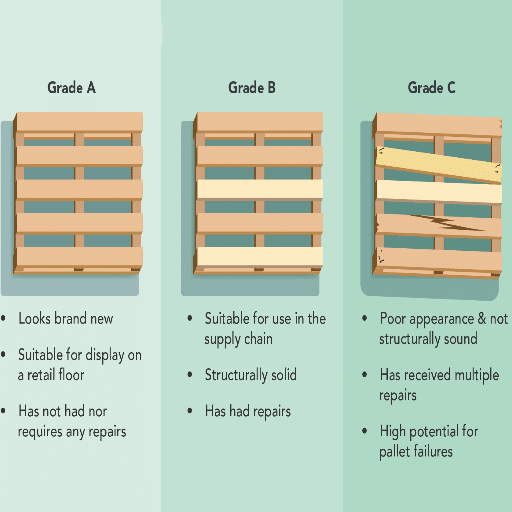
The phrase “pallet grading” is used to explain the process of categorizing pallets into levels based on their qualities, such as their state, how well they are made, and where they can be used functionally. These levels help in determining the extent and the restrictions of pallets on the functioning of the business. Usually, these levels start at new high-quality long-lasting pallets that can be used multiple times and end at either used or refurbished pallets that have certain wear, but are still usable in certain circumstances. The concept of pallet grades is an important one as it helps in saving up on costs while at the same time enhancing the logistics and ensuring that the products are transported safely.
Importance of Understanding Pallet Grades
Comprehending different pallet grades is crucial for companies that aim to improve their economic and operational performance. Heavy-duty and premium-grade pallets made for companies and industries for automotive or pharmaceutical purposes, where the pallets are expected to be in heavy use and are often reused, can be expensive — they are usually made of high-quality material. However, the scale of wear and rework determines the type of used and recycled pallets needed for distribution, mainly for low-priority or single-trip shipments at low costs.
Several key issues have to be considered by any business when deciding which pallet grades to use, such as the product weight, how it is spread out, and what exactly would comprise the article to be transported. There is also a need to comply with some standards peculiar to the industry, for instance, standards related to heat treatment during export, which is also referred to as ISPM-15.
A particular grade of pallet is adopted for a reason; it helps in not only reducing loss of products during transportation but also improves the supply chain management by minimizing waste, enhancing reusability, and efficiency. Using what has been learned means better handling, compliance with rules, and more efficient functional responses.
Section 02
Overview of GMA Pallet Grades
Pallet Grades are divided into three common categories, which include Grade A, Grade B & Grade C. These pallets come with different operational applications depending on the extent of wear and structural soundness, and how well they can be reused.
Distinguishing these pallet grades helps businesses match pallets’ quality to operating needs, which balances costs without affecting the safety or functioning.
Section 03
Impact on Logistics and Cost Management
The type of pallet grades used in an operation has a great effect on logistic efficiency and the management of costs. Pallets of the low-ranked grades, in some cases, may be less durable and sometimes are considered for applications that require a single use and are less important, which reduces costs but may contain an element of risk of items being damaged while in transit. However, good quality pallets for the most part would be much more durable, therefore eliminating the chances of product breakage, supporting the stacking, and facilitating the automated systems to perform in a smooth manner. But the cost for the acquisition of these pallets may be high initially.
Considering it from a logistics point of view, using the correct pallet grades simplifies the supply chain as it allows the utilization of transport and storage devices without worrying about possible delays due to pallet breakdown or incompatibility. Managing costs is efficiently enabled, whereby pallet choice is selected according to the operations with necessities for strong pallets and limitations of expenditure set. Additionally, many companies encourage the practice of recycling or refurbishment of pallets, so as to increase the usefulness in the operation of pallets, so as to cut on waste, thereby promoting the environment and obtaining savings in the long-run costs of the operation.
Section 04
Detailed Pallet Grade Specifications

Section 05
Comparison of Pallet Grades

While selecting pallet grades, three key considerations have to be made in the form of structural stability, price efficiency, and applications to be used. For instance, pallets Grade A, which have the best condition, are used for maximum strength, uniform bearing weight, and containment of the products where looks and safety are paramount in areas such as retail and food distribution. Pallets classified as grade B have been used somewhat and need minor repairs in order for them to remain safe for use. Such pallets are advisable in settings such as milling industries since the outlook will not matter. Pallet grade C is known to be the cheapest, and it is mostly reserved for applications with high control of cost and where stability or strength is of little importance. Such pallets are useful in situations such as recycling or holding in stock relatively less costly inventories since they are made for single usage. All of these different grades are used in the operations for different purposes, and hence none is more important than the other; the cost ratio against benefits in operations determines the most appropriate pallet use grade.
| Feature | Grade A | Grade B | Grade C |
|---|---|---|---|
| Condition | Like new, minimal wear | Visible wear, minor repairs | Heavy use, extensive repairs |
| Load Capacity | 2,500 – 3,000 lbs | 2,000 – 2,800 lbs | Lightweight loads only |
| Cost | Highest | Moderate | Lowest |
| Reusability | Multiple uses | Several uses | Single use |
| Best For | Food, pharma, retail | Warehousing, manufacturing | Recycling, low-value goods |
| Aesthetics | Uniform, clean, consistent | Discolored, visible fixes | Heavily worn, deformed |
Key Differences Between Grades A, B, and C
Different pallet grades have different characteristics and purposes, which also include the differences in terms of structural condition and repair condition. Grade A pallets have superiority in quality, remain unbroken despite usage, have not suffered any repairs, and are of uniform size across. They are appropriate in applications such as retail or exhibits where longevity and aesthetic appeal are important features. Grade B pallets have superficial damage and can be composite or mixed pallets. These kinds of pallets tend to be used in storage areas or for transportation, as such aberrations are least noticeable. Now, C-grade pallets are characterized by heavy usage, ingrained repairs, are often made with cheaper materials, and are used for consumption recycling or for creative storage where the contents are not very valuable. It also comes down to what goals are meant to be accomplished, as uniforms of one beauty or the other are selected. Thus, there is an optimal balance between price, strength, and use.
Visual Comparison: Appearance and Integrity
From the point of view of their physical appearance, Grade A pallets are clean, sturdy, and barely used, thus, perfectly fitting high-end or trade outlets. Most of them are often never repaired and have a consistent outlook. As for Grade B pallets, they contain wear and tear like discolorations, some cracks, and fixes or other components alterations most of the time, and are predominantly used in the back end or for general transport purposes. However, the weakest pallet of all is the Grade C, which is highly damaged and has several cracks, holes, or deformations with repairs as well. Because they have lower strength, these pallets are used only once or with very small lifts. This understanding of grades is vital in making an informed decision on which pallet grades to use for the intended operation or beautification purposes.
Section 06
Choosing the Right Pallet Grade for Your Needs
Choosing an appropriate pallet grade involves assessing the specific requirements of the operations. For industries where hygiene, uniformity, and a high level of endurance are critical, for example, the food or the pharmaceutical industry, Grade A pallets are most suitable. Such pallets are often made to very high standards and are very durable; they best fit warehouses or environments where pallets must last long or work fast. The economical selection and use of the Grade B pallets may also be applied for ordinary storage purposes, local movements in the defined spaces, or other containers when the appearance of the pallet is not the most significant concern. Pallet grades include other highly economical grades like Grade C, which would in actual cases mostly be used for one-off shipments, waste minimization, and less ‘stressed’ storage. The durability is less, but there are more lightweight or shorter jobs that can be performed with them sufficiently.
Ultimately, deciding which option is most suitable will require evaluation of load capacity, ongoing usage requirements, budget limitation and any other regulations specifically present in your industry. All of these aspects address productive and economical operation, without any loss of safety in handling and transportation.
Quick Selection Guide
A
Choose Grade A when hygiene, uniformity, and high endurance are critical — ideal for food, pharmaceutical, retail, and closed-loop distribution chains.
B
Choose Grade B for ordinary storage, local transport, and warehousing where appearance is secondary but structural integrity still matters.
C
Choose Grade C for one-off shipments, waste minimization, and lightweight short-distance storage where minimal cost is the priority.
Section 07
Repair and Maintenance of Wooden Pallets

Consistent repairs and positional replacements of broken wooden pallet parts enable recycling without compromising operational reliability and safety. Among the specific considerations for ensuring proper usage of the wooden palette is ensuring that there are no broken pieces, or that they do not have loose nails or are not structurally weak. In cases where some boards are damaged, these can be changed and no more, since there are pallet repair kits and tools. Pallets that are repaired must conform to the standards in terms of the load-bearing capacity or other safety regulations, including those of new pallets.
As a form of preventive maintenance, measures such as cleaning, regularly checking for any damages that need repair, and proper storage have been put in place to control the effects of pests or water on the structures. Quick fixing and adequate repair ensure safe use of pallets through the supply chain process with minimal wastage, and in this way, pallet grades that determine reuse are adhered to.
Repairing Grade B and C Pallets
Correction processes of Grade B or C pallets include step-by-step restoration methods in order to prevent further damage while ensuring provisions in the industry all the way to safety. Grade B pallet grades will usually have minor repairs, which may include a few deck boards or runners replaced. Grade C pallets, on the other hand, will need extensive work as some parts could be severely damaged or missing. Some of the methods employed would be supporting weak boards, cutting every straw, and nailing them down, replacing damaged components with companion components and insertions, securing weak nails back in place, among many other things, to reinforce the structure.
For these two levels, any sensible repairing methods should include making maximum use of parts reclaimed from unserviceable pallets, since these will always be cheaper. This helps to minimize costs and also preserve the environment by trying to use the available materials again. Automation and repair tools that can be automated to some extent can facilitate more effective and efficient large-scale operations. Sufficiently trained personnel, on the contrary, may be utilized to address specific repair concerns.
For reconditioned pallets, it is a must to carry out detailed inspections to ensure they do not fall short of heavy-weight operational and safety structural requirements. Repair is followed using an existing repairs outline by the maintenance log, thus ensuring personal responsibility and allowing for prompt detection of any problem reoccurring sparing unnecessary waste of resources and time. In view of such age-repairing schemes for grade B and C pallets, their applications within the repair system help to sustain and prolong the lifetime of any pallet, even grade B, which has already been used, so in turn achieving economic and environmental aims.
Benefits of Using Recycled Pallet Grades
Within recycled pallet grades, any article based on grade B and grade C provides economically priced solutions for businesses attempting to provide supply chain optimization. New pallets are notorious for being more expensive than these pallets, thus enabling a business to cut down its costs when purchased for non-critical uses without compromising usability. In addition, the re-use of pallets encourages and supports the sustainability approach by conserving resources, avoiding excessive reliance on raw materials, and cutting down on waste disposal efforts to achieve environmentally targeted operations.
Recycled pallets remain functional and efficient across different businesses, as such pallets are often tested and repaired whenever necessary in order to conform to quality assurance and safety guidelines as provided by the international bodies. These come in variable designs, making them a best fit for a range of packaging and shipment purposes.
What is more, the applications of the recycled pallet grades are a good example of companies indulging in sustainability, as it helps in enhancing the image and economic benefits of the enterprises.
Section 08
When to Consider a Plastic Pallet
Plastic pallets are some of the best when strength, cleanliness, and multiple-use are key factors. They are mostly ideal for industries such as pharmaceuticals and food processing, as they do not allow moisture, bacteria, and chemicals to compromise the quality or standard of good health and hygiene. For instance, plastic pallets are useful in cases where pallets are frequently exposed to harsh environments, since their useful life is proven to outlast wooden pallets, and they neither fracture nor decay. Exporting them is easy as well because there is no need to fumigate them or even provide the complicated ISPM-15 wood pallet grades certification. Due to their low weight, air transport becomes cheaper and more efficient since these designs are similarly compatible with automated processes in both warehouses and other logistics services. These pallets may be more expensive at the outset; however, the savings from utilizing them together with the improvement in operations for organizations favoring more precision render the investment justifiable.
Section 09
Industry Standards and Regulations

For the purposes of general categorization, all pallets manufactured in compliance with appropriate rules and operational measures, and so on, are enhanced for the purposes of efficient performance of the operational measures and international trade. It also includes the use of different types of pallets, including wooden pallets that have to meet the ISPM 15 stipulations, which regulate the treatment of wood packaging materials in order to prevent infestation by pests. Besides that, with globalization, there is ISO-15, which includes cross-beams of convenience made out of metal or plastic pallets, and it eliminates pallets that need ISPM-15 and that certification is needed when shipments within the whole world are made out of wood pallets. Moreover, the standard sizes based on the ISO 3044 standard allow for smooth integration of the various activities involved in supply chain management, like handling, storing, and shipping. Such standards reduce possible disruptions and facilitate cheaper and greener logistics.
Heat Treatment and ISPM 15 Compliance
Heat treatment is an essential procedure, as stipulated by ISPM 15 guidelines, that is done to avert the spread of dangerous pests in the international trade of wood packaging materials. The procedure requires that wood be heated to at least 56°C (132.8°F) at the core for a minimum of 30 minutes. This is done to kill any eggs, larvae, or fungus spores that may be transported and harm the native environment. Upon reaching the heat treatment threshold, the wood packaging is marked with the ISPM 15, thus confirming that it has been treated as required by the standard.
This regulation applies to wooden crates, pallets, and their dunnage, as well as any other form of wooden packaging used for shipping goods. Failure to comply may result in penalties, delays of shipments, and even refusal of the goods at the receiving country’s port of entry. Other alternatives, such as plastic, metal, composite, and other such materials, do not need treatment because they are not capable of hosting any pests, and hence, such treatment measures are not necessary. Firms must ensure that they are conversant with ISPM 15 and the compliance of the packaging materials that they use, so as not to cause any hindrances in shipping and so on. It is also important that they use trusted suppliers of materials that are fit for use in the making of such packaging materials.
ISPM 15 Key Requirement
Wood must be heated to at least 56°C (132.8°F) at the core for a minimum of 30 minutes to meet international compliance standards for wood packaging materials.
Standard Dimensions for Pallets
The most popular of the standard sizes of pallets for countries across the world is the 48-inch by 40-inch pallet, otherwise referred to as the GMA pallet in North America. This standard is preferred as it enhances the transportation efficiency and makes it convenient to use in many of the existing warehouse facilities. Nevertheless, this can change depending on the location; European consumers generally opt for EUR-pallets with dimensions of 1200 mm by 800 mm. The importance of selecting appropriate pallet grades cannot be overemphasized, as it is critical for the efficient functioning of supply chain systems, even as they vary by region.
| Pallet Type | Dimensions | Primary Region |
|---|---|---|
| GMA Pallet | 48″ × 40″ | North America |
| EUR-Pallet | 1200 × 800 mm | Europe |
Section 10
Food Grade Pallets and Safety Standards
Food-safe pallets are manufactured intentionally to comply with rigorous standards essential for safe food handling and transport. Such pallets are commonly manufactured with workable, clean materials that are dense and impermeable to degradation, for example, plastic, and sometimes even certain metals that are processed. Specific guidelines in relation to the FDA, the HACCP, and the food-grade pallet grades include the chemical, building, or other policies and norms that are put in place in order to ensure food protection.
In addition, food-grade pallet makers usually comply with standards like ISPM-15 to treat wooden pallets and ensure that they are either heat-treated or fumigated in order to avoid pest invasion. It is also noted that in those industries where sterilization or moisture and bacteria resistance is a must, plastic food pallets are more reliable than wooden pallets since they do not provide shelter for more pathogens. Inspections, washing, and subsequent pallet maintenance are significant issues in all attempts to maintain and reduce the food chain risk or to achieve risk-free compliance with the food safety objectives.
✓ HACCP Standards
✓ ISPM-15
✓ ISO 3044
✓ Heat Treated
Summary
Matching Pallet Grade to Operational Need
Understanding pallet grades — A, B, and C — is fundamental to any business operating within warehousing, logistics, and supply chain sectors. Grade A delivers precision, durability, and compliance for high-stakes industries. Grade B offers a practical balance of function and economy for general-purpose operations. Grade C serves as the budget-conscious option for single-use or low-priority shipments.
By aligning grade selection with operational requirements, load capacity, budget limitations, and regulatory compliance, businesses can achieve efficient, safe, and sustainable logistics operations — without unnecessary expenditure or compromise.
Reference Sources
Quality distribution of pallet parts from low-grade lumber
Key Findings: The study examines the quality distribution of pallet parts derived from low-grade lumber, focusing on material sorting and grading.
Hardwood pallet cant quality and pallet part yields
Key Findings: This study evaluates the quality of hardwood pallet cants and their yields, using preliminary grading to segregate materials based on unsound wood volume.
Assessing the life-cycle environmental impacts of the wood pallet sector in the United States
Key Findings: The research identifies optimization strategies for the wood pallet supply chain, focusing on environmental impacts and production efficiency.
Frequently Asked Questions (FAQs)
How do grade A pallets differ from those of grade B variety?
The differences are in the pallet’s grade condition: this may be virtually unused pallets ready for use, also known as top-grade pallets, or pallets that have gone through more than one cycle requiring repairs, multiple replaced deck boards and stringer components, or worn-out grade B pallets. Grade A pallets offer more guarantee for customers in the food & beverage or retail industry, where pallets need to be in better condition; while grade B pallets are an economical solution when the goods are not necessarily display worthy but still functional for the business operations.
What standards do warehouses use when picking pallets for their daily activities?
Firms engaged in managing warehouses need to analyze numerous aspects that include the available resources, cost-effectiveness, and the durability of the pallet. There are standard-sized pallets that are used in order to ensure that they perform their function accordingly: Most pallets are constructed using wood and consist of stringers or blocks on which items rest. Most people usually go for fresh or higher quality pallets in warehousing, but when the cost and recycling are more important, it is best and cheaper to use grade B pallets or reused pallets.
In which way do the form and dimensions of pallets laid in the supply change in their efficiency?
Pallet sizes determine how many pallets can be stacked together, how many can fit in a truck or container, and whether or not they can be used with certain material handling equipment. In the local economy, several basic pallet sizes are universal norms, but in the case of exports, Iso norms come into play for shipment. Carefully measuring the pallets before loading the truck lowers the travel expenses, service delivery time, and efficiency of the supply chain cost.
What is the significance of wood pallet stringers when we are talking about the longevity and robustness of the pallets?
The most important part of a wood pallet is the pallet itself; they have stringer or block designs that impact the effectiveness of the load and the durability of the pallets. The structure, especially stringers, extends the life span and ensures the recovery efficiency of the pallets. The presence of wear indicates the need for either repairing a pallet, so that it doesn’t become unusable, or replacing it, as in cases of stringer crack or deck board cracking.
Why are wood pallets considered the best combination of distribution and supply chain?
Wood Pallets are believed to be attractive as they assist satisfy cost effectiveness, especially for user organisations or distributors. In addition, wood pallet materials are cheaper, easier to repair, and last longer than their alternatives. There exists the possibility often, and there will be the need to either balance the cost and reliability, in which grade pallets will be considered based on the requirements of fresh wood, price effectiveness, and the use of grade pallets.
What is the effect of government directives and industry guidelines – if any – to select pallets in food marketing and production sectors?
Foods and beverages, in most cases, are stored on pallets that bring hygiene as well as structural standards, sanitized, treated with chemicals, and toughened. Acceptable types of pallets are also affected by the Grocery Manufacturers Association (GMA) and the International Organization for Standardization Recommendations (ISO 14022). Direct food contact or export could specify premium-grade pallets, or international pallet shipment could require treated or certified pallets to hinder the spread of pests.
To make the appropriate selection. How would one evaluate the availability of the pallets and their supplier?
Choosing a provider requires checking cohorts, transparency (such as CBA and others), available products and services, and the dimensions of necessary pallets. A trustworthy vendor will stroll through pallet grades, disclose if they are graded based on their state, sell new wooden crates, used tyres, and state how long each will last. Other things to note include cost, recycling options, the availability of ‘a’ grade and ‘b’ grade pallets, and how efficient the vendor’s supply chain boosters will be to your own.