When choosing pallets, it becomes crucial for businesses to make a distinction between Grade A and Grade B pallets for supply chain optimization. At face of it, the two grades somehow do look similar; however, the quality, durability, cost, and application suitability between the two grades could not differ more. The choice between the grades could cause poor operational efficiency, safety workarounds, or high costs. Thus, this article explores the spirit of A vs. B, in what way, so that you can form the most competent choice for shipping, storage, or milling purposes. For present or future warehouse managers, supply chain professionals, or those in charge of businesses: This comprehensive overview is the kind of approach that provides you with the necessary knowledge resources for selection based on the respective applications required.
Introduction to Pallet Grading
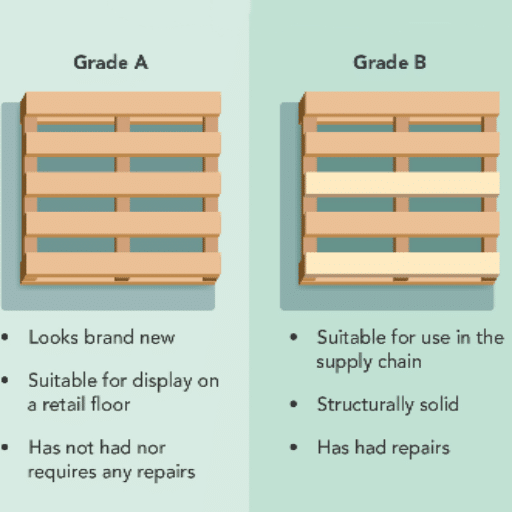
Pallet grading stands as the standard procedure to gauge the quality and condition of wooden pallets. Grade A pallets wear better, need less repair, and provide consistent structural integrity, hence making them suitable in places like retail industries, where the highest possible standards of appearance and cleanliness must be maintained. On the other hand, grade B pallets typically carry such visible repairs, are well past their life cycles, but they do still continue as useful under heavy loads and for lower-cost shipping needs. Understanding these differences is crucial in pursuing the right balance between the economic considerations and operational requirements for any business.
What are Pallet Grades?
Pallet grades refer to the classification of a pallet based on its condition, repair status, and overall quality. These grades allow the manufacturer/shipper to pick the right pallet for their particular operational needs. Grade A pallets are usually graded “premium” or better by some but not by others, as they are of very good quality and condition with very few repairs, meaning they are purpose for durable and roseate appearance. Grade A is the option for the majority of industries that have very strict cleanliness standards, like food and retail. Grade B pallets, while more affordable, have a visual charm as a result of being repaired and, in cases, worn or damaged. Still, their structural integrity ensures they are still efficient in tough working conditions for industrial or commercial usage. The level system improves efficiency in supply chain management, promoting competitiveness in cost-related activities.
Importance of Pallet Grading
Pallet grading is fundamental where operational efficiency, cost-effectiveness, and product safety are concerned in supply chains. Categorization of pallets according to their condition, structural integrity, and appearance ensures appropriate use of each pallet type in line with relevant applications and, in turn, reduces the risk of damage or shackled transport. Quite often, in the case of high-grade industries, the standard of pallets is indispensable as a means of satisfying hygiene and safety regulations while at the same time offering an economical solution to low-grade pallets that require a lower quality standard for non-critical applications or one-way leaders. Such an approach ensures quick operation as well as a safe loading process while allowing optimal use of resources by extending the life cycle of reusable pallets and thus reducing waste.
Overview of GMA Standards
The Grocery Manufacturers Association (GMA) standards are taken as the official standards for pallet size and quality in the US, providing compatibility among industries and supply systems. Standard GMA pallets measure 48 x 40 inches; traditionally, GMA pallets are made of wood. However, plastics have been employed in some special case requirements. GMA pallets can carry a load of up to 2,800 pounds and normally provide 4-way forklift and hand pallet-jack entries for operational efficiency.
Good Manufacturing Practice (GMA) Standards are a uniform guide for pallet Engineers. Furthermore, stringency is set on uniformity in material quality, nail placement, and robustness to withstand the trials of repeated use. The pallets are identified for use in food and beverage, consumer goods, and retail markets, where they are used to integrate with automated systems and ease logistical operations. Equally significant are the substantial reductions in machine downtime, better protection for warehouse personnel, and simplified operations for any warehousing or distribution center that warrants full GMA compliance.
Grade A Pallets

“Grade A products are quickly selected and turned into high-quality COMP pallets that have not only been inspected and repaired but also reinforced to meet the mechanical-repair standards under rigorous conditions. Ideally, they are not damaged in any way and show very little wear. Such pallets prove durable and fully reliable for repeated use, making them well-suited for industries that call for consistency and dependability in their supply chain operations, such as retail or manufacturing. Their higher quality means they are often compatible with automated systems and less likely to fail mischievously.”
Key Characteristics of Grade A Pallets
- Structural Stability: The trademark of Grade A quality pallets is that they are well-built and almost completely structurally undamaged. The construction ensures that all of its components, such as the deck boards and stringers, are totally intact–the very best in strength and durability.
- Minimal Repair: The treated pallets under this Grade A classification are genuinely minimal in the sense that minimal repairs are done professionally to match some replacement wood. Hence, the goods are still in good condition in terms of operation and appearance.
- Clean and Suitable for Use: The condition of Grade A pallets is that they are clean and neat, with every effort made to eliminate or cover up significant stains, dirt, grease, or other strong contaminants. The Grade A labeled pallets are suitable for usage in industries, such as food and medicines, which put serious constraints on the requirement of hygiene.
- Standard Size: They are always kept in any size, which makes operational integration within an automated system or any storage and logistical frameworks. It matters a great deal because it ensures proper stacking and safe handling.
- Highest Quality: Made of tough wood that minimizes splitting or cracking, Grade “A-Grade” pallets are used under repeat applications. This quality makes these pallets durable and reliable.
- Compliance: These pallets often adhere to industry and regulatory standards, such as ISPM-15 for international shipping, ensuring global compatibility and safe transportation.
Durability and Lifespan
Grade A pallets are manufactured to endure a great deal of wear and tear, with generally a 3-5 average lifespan when regularly employed. Their durability relies on factors such as the quality of their material, loading factors, and usage environment. Proper maintenance, which includes repairing minor damages, storing pallets in a dry place, and adjusting load-pallets, is essential in extending their periods of use. Hardwood pallets particularly have high strength and moisture resistance compared to their softwood alternatives. Recycling either or both is generally possible, which would contribute to further sustainability, both financially and ecologically.
Cost Considerations
Many factors greatly influence the cost of pallets, such as material types, wood size, production volumes, etc. Hardwood pallets often command a higher price than softer wood or plastic alternatives. The reason behind this is almost guaranteed performance through hardness and strength. But generally, they offer better long-term value in terms of reusability and durability. Plastic pallets, even if a bit pricier, are very suitable for industries dealing with wet conditions and hygiene standards, providing a long-term financial benefit to some sectors of the manufacturing industry, such as pharmaceutical and food. Customized pallets made for particular load requirements or dimensions may commonly incur higher costs. Buying in large quantities or considering buying recycled or what is termed “refurbished” pallets greatly reduces the costs. As such, these are the more viable options for businesses whose aim is cost-saving in supply chain spending.
Grade B Pallets

Grade B pallets are normally refurbished pallets capable of fulfilling secondary use potentialities by undergoing minor repair works to fix the damage or defect. They still are strong in structural strength but may show off some corroborating signs of wear, such as color tone or visible repairs. Such pallets offer an economical option, and are therefore regularly used in industries where aesthetics are hardly a consideration but where durability and reliability are critical. Due to their cost, they are highly useful for many businesses that seek a middle ground in the performance of the pallet against frugality.
Understanding Grade B Pallets
Grade B pallets are slightly remanufactured pallets recovered and repaired to eradicate structural defects. In contrast to Grade A pallets, mendings are perceptible and comprise plug-and-patch, stringer insertion, or companion boards. These repairs primarily concern the heavy items that a given pallet may entail and are a means to keep the pallets structurally sound while keeping down material wastage.
Grade B pallets are mainly used in industries where appearance is not important, and these pallets are usually ordered to make heavy carry/transport loads quite regularly. Growing as a viable solution for those looking to set up lower-cost measures without relatively reducing the durability of packaging, B-grade pallets are not only economical but also extremely useful in networks for minimizing resource use and enhancing reusability, as they present far more cost-effectiveness due to their repeated performance.
Key Characteristics of Grade B Pallets
- Rectified and Re-usable Design: Grade B pallets generally consist of reclaimed or repaired components (e.g., with new stringers, deck boards, or nail plates) to maintain the elements of the pallet in such a way as to safeguard their life span through real-time repeated use purposes.
- Cost-effectively: Our Grade B pallets are way more reasonably priced than new and superior category pallets, because they have usually undergone prior repairs. This additional dimension benefits any cost-conscious business striving to embrace recycling and, hence, sustainability.
- For Heavy Loads Durability: Grade B pallets, some of the earlier abused pallets, probably carry a reinforcement plate or maybe a little wear pattern, and still find themselves involved in assisting heavy loads. It is good for logistics, appearing to provide true service under several rotations.
- Standardized at All: Grade B pallets are usually standard-size models with dimensions typically at 48″x40″ and compatible with most transportation and storage systems. Again, standardization promotes increased operational efficiency in supply chain workflows.
- Tagged Repairs: Some generalized repairs include fixing variously located damage with metal plates, nails, or plug-in stringer boards. Such repair jobs are meant for resistance to the stresses anticipated, while in many cases altering the once astoundingly decent visual appeal: these pallets are preferred for industrial handling or back-end utilization.
Repair and Recycled Options
Pallet refurbishing and repairing provide an eco-friendly solution to material-handling needs. It may lead to the replacement of boards wherever damaged or improvement at the point of weakness to ensure it meets industry standards and carries out the intended purpose while increasing the lifespan of the pallet. Repairs often conform to standardized GMA (Grocery Manufacturers Association) specifications for the pallet, guaranteeing that repairs are fully compatible for use across the numerous chains of supply.
On the opposite side, recycled pallets are obtained from previously used pallets, which are repaired and given a new purpose. Recycled pallets serve as an environmentally friendly alternative to waste that eschews new materials and adds a significant offset to all operational costs. Grades of recycled pallets vary: from almost new and virtually new pallets to rugged, industrial-grade pallets. Both repair and recycling activities preserve the integrity of pallets, thus illustrating the examples of the circular economy by practicing resource use efficiently and reducing greenhouse gas emissions in the sector.
Comparing Grade A and Grade B Pallets

A-Grade pallets are refurbished under better quality with the least damage and nearly a hundred percent uniform appearance. Boards may be replaced. There is no defect to write home about. These pallets are suitable for industries where aesthetics and consistency are of the essence, for instance, in the retail and food distribution sectors.
Conversely, B-Grade pallets are more durable, being heavy-duty with multiple repairs or visible wear marks evident. These pallets are sound in functionality, while appearances may vary to a large extent, which earns them applications for heavy, massive work situations or those where aesthetics are not of high importance.
Both grades fulfill particular operational requirements and offer economic solutions according to their use.
Differences in Quality and Appearance
A well-refurbished Grade A pallet requires minimal repairs and adheres to more or less uniform dimension requirements. Such a pallet would be damaged to a minimum, with no spills or structurally undermined sections, and hence in mint condition, which is usually expected in industries ensuring the features of uniformity and sophisticated appearance, like in retail, etc.
On the contrary, Grade B pallets would display a lot of evidence whether they are repainted, have been repaired frequently, discolored, or mostly blemished on their exterior surface. A few pieces might have been substituted, such as twin stringers replacing original support stringers. The pallets still serve well structurally while not being very becoming initially at all, thus earning a place in plucky industrial quarters that don’t fret choosey customers.
Load Capacity and Usage
Dynamic load: 2,500 to 3,000 pounds; static load limit: above 4,000 pounds based on pallet specifications. Hyper-strong requirements need custom-made or reinforced pallets to withstand even higher weights because they are used in heavy industrial environments.
The usage scenarios will largely depend on the pallet type and design. Stringer pallets or block pallets, or recycled pallets might be more beneficial for weightless cargo. Nevertheless, the block pallets or plastic pallets are especially suitable for relatively heavy goods, including machinery and automated merchandise packing, since they are more expensive and robust due to their weight and composition, offering better load-carrying capacity. Consideration must also be given to use type and pallet load capacity occasionally encountered to choose long-term factors such as the handling (forklifts or pallet jacks), storage system (racking or stacked storage), and conformity with industry standards (built to prevent injury and serious accidents).
Cost-Effectiveness for Your Business
Furthermore, having pallet type selected in accordance with your operation scale and handling equipment implies that small to medium-sized companies, with some moderate loads, may find standard GMA wooden pallets even more cost-effective. However, for those applications that require heavy or high cycling, consideration is given only to plastic or block pallets that offer maximal longevity and less breakage. Compliance with industry and regulatory standards, such as using ISPM-15-compliant pallets for international shipments, must be considered, as their use may result in extra financial penalties or logistics-related problems.
It is through these analyses focusing on sourcing possibilities, repair and replacement cycles, and the eco-efficiency of disposing materials that can confer cost leadership, actually.
Choosing the Right Pallet for Your Needs

- Focus on Load Capacity: Ensure the pallet can cope with the weight of your goods without being damaged or failing. The manufacturer’s specifications must be looked up for the weight limits.
- Material Type: Wooden pallets are normally easy to get hold of and cheap; plastic pallets are robust, long-lasting, easily cleaned, and good for sectors such as pharmaceuticals or food due to their resistance to moisture and contamination hazards.
- Handling and Storage Requirements: Select the dimensions and design that make the best sense for your equipment, storage systems, and transportation methods to avoid misunderstandings.
- Regulatory Compliance: For global shipping, make sure your pallets meet industry standards like ISPM-15 for wood pallets to avoid any delays or fines.
- Towards Sustainability: If you’re keen on sustainability in your business, consider reusable pallets and materials able to be recycled once their life cycle is finished.
Pick the pallet that best suits the operational, cost, and compliance needs you have for optimal logistics.
Factors to Consider When Choosing
In choosing pallets for your operation, several essential factors must be considered for an evaluation with respect to the imperative of effectiveness, compliance, and sustainability. Below are the major considerations in this respect:
- Material Type: Pallets are often made of wood, plastic, or metal. Wood pallets are cost-effective and widely available, while plastic pallets are durable, lightweight, and suitable for hygienic environments. Metal pallets are ideal for heavy towing purposes, even though they are rarely seen, mainly due to their higher costs.
- Load Capabilities and Durability: Look closely at the weight that will be carried by the pallet and the conditions the pallets will be experiencing, which may include extreme temperature and humidity. They must be able to carry their loads safely under normal conditions without being damaged.
- Application and Standard Compliance: Different industries have different standards. For example, some accept food- and pharmaceutical-industry standards while others focus on international shipping using pallets built according to the ISPM-15 standard. Ensure that the type of pallet you choose meets the standards.
- Cost and Efficiency: Balance initial costs against long-term usability. Wood pallets may cost less upfront, but plastic or metal pallets may provide less total cost of ownership due to their longer operability and reusability.
- Environment: Take into consideration environmentally friendly options, such as pallets made from recyclable materials, or participate in a pallet pooling system to further sustainable practices and reduce waste.
- Customization Needs: Sometimes, specific operations require certain pallet sizes, types of materials, or special load-handling criteria. Find out whether your provider offers customization to meet your unique logistics requirements.
Selecting the appropriate pallet system for any supply chain-from optimal functionality to meeting regulatory requirements, to costing less in running the operation-can be affected by all of these reasons.
Benefits of Grade A vs Grade B
When compared, Grade A pallets are bigger beneficiaries for the shopper when maximum resilience and a nice-looking finish are requested. Grade A pallets routinely hail from newer newcomers, giving rise to them being less depreciated. Enhanced structural integrity, required for high-beat loads or stringent applications and industries, is definitely what differentiates Grade A from the rest. On the other hand, Grade B are definitely more budget-efficient and are ideal for less important applications. High usage may have items breaking down on them, not just having beat-up, unwanted pallets; honestly, a little scuffing does not represent a serious problem for non-critical applications. Would I go for the cheaper alternative here, or would I rather hold on to quality and consider them for my higher-grade contracts?
Maintaining Your Pallets for Longevity
The maintenance of pallets in the right way is necessary to realize their optimal life span and continued usefulness in your activities. Periodic checks are considered essential to determine instances of structural damage, such as ugly splinters, loose boards, or splits. When any of these situations show up in your fortnightly stock checks, damaged pallets should be repaired as fast as possible with the prescribed replacement materials, such as heat-treated wood for wooden pallets, to maintain the structural integrity.
Pallets should be stored in a clean, dry environment where there is hardly any moisture, as it can weaken and destroy wooden pallets or make them a haven for molds. Care should be taken not to expose a plastic pallet to excessive sunlight, for that can cause UV damage and material degradation. One useful strategy for pallet rotation would be to use the older pallets before the newer ones, so the wear is evenly distributed among all the pallets.
Always ensure that pallets are correctly handled in order to avoid unnecessary stress. That would involve using the appropriate lifting equipment, distributing the weight evenly across the pallet surface, and refraining from loading well beyond the manufacturer-listed weight capacity. All these measures will considerably increase the life of pallets.
| Feature | Grade A Pallets | Grade B Pallets |
|---|---|---|
| Condition | Minimal damage, excellent structural integrity | Visible repairs, some wear and tear |
| Appearance | Clean, uniform, professional looking | Visible repairs, discoloration, and blemishes |
| Repairs | Minimal, professional repairs | Multiple repairs, visible patches |
| Cost | Higher initial investment | More affordable, budget-friendly |
| Best For | Retail, food industry, automated systems | Industrial use, heavy loads, back-end operations |
| Lifespan | 3-5 years with proper maintenance | Shorter lifespan, but still durable |
| Load Capacity | 2,500-3,000 lbs dynamic, 4,000+ lbs static | Similar capacity with reinforcements |
| Hygiene Standards | Meets strict cleanliness requirements | May not meet the highest hygiene standards |
Reference Sources
Frequently Asked Questions (FAQs)
The differences between grade A and grade B pallets are what is being idly discussed?
Guaranteed to be stronger and higher quality, grade A pallets hardly bear any scars of wear and lead, whereas these are harder to come by for grade B pallets. Grade A pallets are good for carrying high-value cargo due to their prime condition. On the contrary, Grade B pallets are suitable only for moderate work.
How does one distinguish a grade when it comes to pallets?
Structure must be the main decisive factor; Identify the harder tasks. For the load, the grade B equipment is used, generally only for lesser or transient work. But in the making of the judgment of selection, bear in mind the lifespan and durability of the pallet, so that abruption can’t ruin its efficiency.
What are the key features in a grade A pallet that make it better?
Grade A pallets are recognized for the highest quality structural integrity and minimum wear. Usually crafted from solid wood, Grade A pallets meet very careful specifications set forth by the Grocery Manufacturers Association (GMA). Grade A pellets are ideal for the food and beverage industries because of their good service record and cleanliness.
Can Grade B pallets be repaired?
Grade B pallets can be repaired for further use most of the time. Repairs usually consist of replacing damaged stringers and deck boards. The key to a repair is ensuring that the pallet is not weakened and that the pallet’s structural integrity will not fail during use.
What are the categories of pallets commonly available in the industry?
The market provides various types of pallets, such as grade A, grade B, and grade C; each type has a different application, except for C pallets, which are considered a good choice for less-demanding applications. This can help you to specifically identify the kind of pallet needed.
What about the extended durability of my pallets?
The longevity of your pallets eventually rests upon you in several ways: thorough and frequent inspection for wear and tear; conscientious advice on storage intended to elude moisture damage; prompt repairs before conditional growth; the idea is to recycle and reuse pallets, guaranteeing enhanced cost-effectiveness and economy when delivery of your supply chain needs may require such.
What are the benefits of recycling pallets?
Recycled pallets offer several benefits, including reduced costs and environmental sustainability. They can be cheaply used by companies whose goal is to cut costs, along with satisfying loading requirements. Moreover, at the supply chain level, using recycled pallets is beneficial as it decreases waste and encourages recycling.
What should I look for in a pallet supplier?
While searching for a pallet supplier, always consider the reputation of a business that offers top-quality pallets, the range of pallet types that it stocks, and adherence to industry grading criteria. A reputable supplier must provide telling insight into the expected practicality and life of its pallets in order to help clients find the appropriate grade for their business needs.