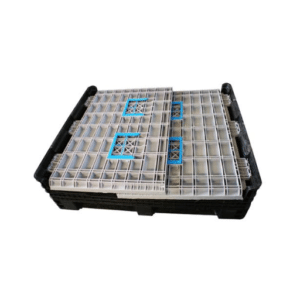
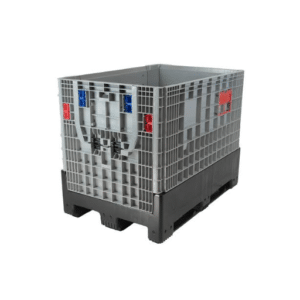
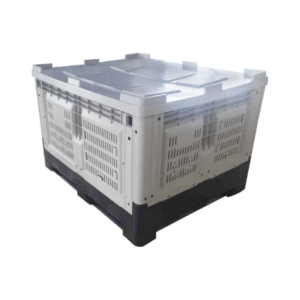
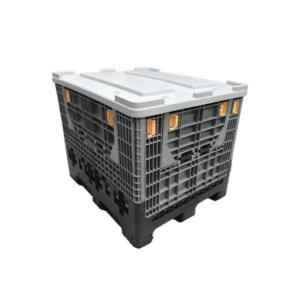
Introduction to Nestable Pallets

There is a type of plastic pallet, designed to nest, which lets these pallets rest against each other in an idle state, thus saving space. These nestable pallets are mainly made of lighter plastic materials. This makes them quite portable and economical. Under use at a warehouse or return logistics, these pallets are the most suitable for those businesses willing to save room. Due to their compact form, masses of empty pallets are able to be shuffled easily, thus cutting down on unnecessary transport expenses; this is especially useful for facilities with not much space available or where there is constant handling of pallets in and out.
Defining Nestable Plastic Pallets
Nestable plastic pallets are strong and lightweight platforms designed for more efficient storage and carriage of goods. Their characteristic becomes evident in the ease with which they can be put one into the other when empty, thereby minimizing the area used for storage. Such pallets are usually made of high-density polyethylene (HDPE) or polypropylene (PP), so they have high resistance to moisture, chemicals, and mechanical damage. Because of robustness, these pallets are applicable in many industrial operations, especially food and beverage, pharmaceuticals, and retail.
The major advantages of using such pallets are that they weigh less, making them easy to move around, and are cheap enough to return because they consume less volume during transportation, since the pallets become stackable. These also help in organization in the warehouses or in the distribution centers, thereby promoting effective workflow. Again, many of those nestable pallets made of plastic meet the regulations for export of products, which in most cases have pests, such that the pallets do not have to undergo heat or chemical treatment, unlike those made of wood. In a nutshell, nestable plastic pallets are a good option for those businesses that are concerned with saving space, improving health conditions, and, more importantly, cutting costs.
Primary Value Proposition of Nestable Pallets
Nestable plastic pallets contain durability, efficiency, and cost-effectiveness. Weighing light, they save a lot on transportation costs, yet very heavy loads can be placed on them. This makes them suitable for many industries. One of the main advantages is that they are economical due to their shape. Such pallets can be stacked back and placed one on another for nesting without eliminating approximately 66% of their storage space, in contrast to the other types of pallets.
They are also made from non-absorbent materials, hence do not provide food for moisture, bacteria, and pests, due to which maintenance of sanitary conditions, which, for example, is very key in the food industry, pharmaceuticals, and exports, is facilitated. Since nestable pallets do not require any fumigation or heat treatment, they can easily fulfil the conditions of international shipping like ISPM-15 thus reducing the complexity of the global distribution chain as well as promoting the environment by being reusable and also recyclable.
All these characteristics coalesce towards making nestable pallets an ideal logistics material for solving such contemporary challenges.
Efficiency and Space-Saving Benefits

Overview of Space-Saving Features
Understanding the efficiency of inventory management and transport, nestable pallets have a distinct advantage over other storage items. This is because their simple design allows them to be stacked within one another as closely as possible when not in use. Therefore, the storage space occupied by empty pallets would be reduced by up to 75% in comparison to basic pallets. This increased vertical space can be used to perform other activities or to store more inventory, and it enables the transportation of more pallets in a single load. On top of this, looking at the implementation of nestable pallets, most can carry their load while remaining lightweight, thereby facilitating easier carrying and reducing costs associated with the transportation of the pallets in question. All these factors shall entail why many industries rely on nestable pallets to rationalize economies and smooth out processes.
The structure of the nestable pallets helps to get the most out of the storage space available, as they require less room in storage when not in use. They are engineered to permit stacking, thus minimizing the space occupied in contrast to standard pallets. This aspect is quite advantageous, especially in congested warehouse situations or places with constrained storages which are often space-effective containers for additional essential activities in such places.
Maximizing Floor Space with Nestable Pallets
One of a kind advantage of nestable pallets is that they do not hinder free spaces during storage. Dual stacked pallets provide easy storage, usually taking half of the room that regular pallets take when placed around the open spaces within a hub facility or a warehouse. In their construction, the seating and the positioning are done while padding the sides that would otherwise lie between the supports with bags. While it sounds general, these waste ads are not made of fireproof waste. These free-standing space structures containing these firms reduce the number of pallets required for the goods in storage. A dominant opinion says: standard pallets take far more surface than nestable pallets, with the latter occupying only around 25 percent of the surface of the former. What is more, density controlling, bundling, and squeezing out of unused floor spaces allow businesses to reallocate existing space toward business activities, stock taking, and other improvements of process flow.
Efficiency in Backhauling Operations
When trucks have delivered the original cargo, and instead of returning empty, they have nestable pallets which have to be transported, referred to as Backhauling. Improvements in backhauling have a great potential where cost effectiveness is increased due to the lower costs of transportation, fuel, and reduction of the carbon footprint. It is recommended to use route planning and optimization software, which helps the driver to deal with backhauling and form alliances with other organizations; it is also suggested to apply dynamic load planning inside a truck for full utilization of the space. These methods decrease various expenses and help ensure the best logistics practices possible in terms of sustainability, thus making the process of backhauling a very essential logistics function for most companies.
Real-World Examples of Space Savings
One well-known advantage concerns space management within the distribution centers where automated storage and retrieval systems (AS/RS) are employed. Such systems utilize the available vertical space in full since palettes occupy the top order position, and robotic systems such as cranes perform the retrieval process with ease. Storage spaces are then compressed, and the contents of the storage spaces are compressed thousands per unit area.
Besides, some methods are beneficial, such as modular shelving encasements. The image –same idea is due to adjustments – such images inspire if layouts are adjusted to the needs at any specific point in time. Amazon and such companies functioning in this sector use ‘quick build’ type of shelves specifically for their warehouses, to increase volume and reduce unnecessary pick timings, correspondingly spatially and functionally.
Moreover, savings in terms of storage space can also be seen in cross-docking facilities that lessen the storage of goods for a long period. This means items are put in distributive clearance and put into storage for further processing in storage space clearance from wholesaler clearance, not storage space. An example of a large-scale retail store running operations in this manner is to illustrate examples such as the complex supply chain management released by the likes of Walmart in controlling warehouse inactive time and fully utilizing the resources as they receive very little time ollie capacity. This involves the utilization of nestable pallets for moving goods in and out of storage.
Comparing Nestable vs. Stackable Pallets
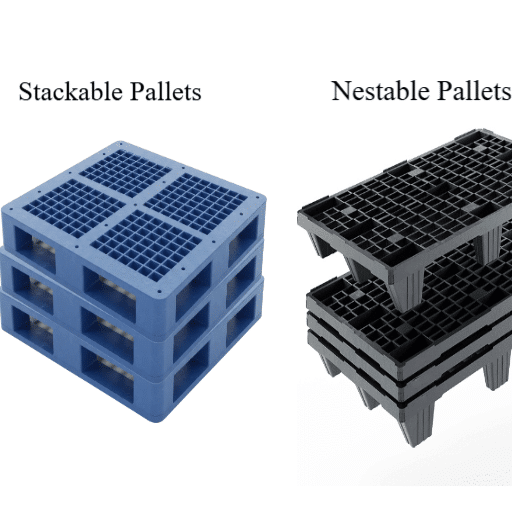
There exist nestable and stackable pallets that work in certain ways, especially when it comes to logistics and settings of the warehouse – each design has its positives per se, depending on the situation. Nestable pallets, on the other hand, are in a shape to fit or nest one inside the other. In other words, they minimize the volume occupied when there is no palette inside them. For these, it makes sense that they would be preferred for the processes that need minimum space during storage or inactivity. Most of these products are produced from lightweight materials, for example, plastics, so that they can be carried around without much difficulty.
Alternatively, stackable pallets are manufactured to enhance storage and transportation by making it possible to pile goods securely while they are stacked. Stacking pallets have robust designs that consist of, in most cases, wooden materials or strong plastics for heavy-duty purposes. Unlike nestable pallets, the usage of stackable pallets is exemplary in cases where vertical space is required, and stacking of the load is methodically done and is ideal in warehouse applications, or even in transport vehicles.
It is worth understanding, however, that the said discontinuation in the use of nestable pallets as opposed to stackable pallets with nesting tasks ought to be nuanced because these two deep lines are utilized for optimal space, operation, and load in different supply chains. Costs can then be effectively reduced, and better organized processes can also be made possible by choosing the right pallet for the right function.
Design Differences Between Nestable and Stackable
According to the purpose of the authors, nestable pallets are constructed so that they are tapered or undercut and easily compressed one into the other when the pallet is empty, and it is not in working condition, thus minimizing their weight during empty storage and return transportation. This type of pallets reduces very much the costs involved in the objective from and storage since they occupy very little space, which otherwise would be used in bulky pallets that have to be situated separately. Many of them are also made in lightweight plastic materials, which makes forklifting even easier.
Contrary to this, pallets provide for the construction of plain or reinforced sheets that have flat bottoms. In this regard, there is no need to worry about the durability and the status of the full loads while the pallets are being piled up. It is better to use them in warehouses and distribution facilities with heavy or breakable cargoes since a quay made from such pallets is stronger. Pallets can be composed of either plastic or metal, depending on the weight of the load.
At the end of the day, operational requirements dictate which design will be most exhaustive—nestable pallets are optimized for storage management, as opposed to stackable pallets, which are designed for stability and ease of stacking.
Best Applications for Nestable vs. Stackable Pallets
| Parameter | Nestable | Stackable |
|---|---|---|
| Storage | Space-saving | High stability |
| Weight | Lightweight | Heavier |
| Material | Often plastic | Plastic/metal |
| Cost | Lower | Higher |
| Durability | Moderate | High |
| Usage | Lightweight loads | Heavy/fragile loads |
| Transport | Cost-effective | Less efficient |
| Stability | Low when stacked | High when stacked |
| Reusability | High | High |
| Best Area | Limited spaces | Warehouses |
Material Considerations for Pallets

There are generally two categories of pallet materials to consider based on their materials: plastic and metal. Plastic pallets, being light, come with the advantage that they are moisture-proof, which means that they are good for general transportation needs. They are also economically affordable for applications such as for one use or even for the closed-loop system. Metal pallets, on the other hand, are infinitely better in terms of how heavy they can be used and how many times in a rough environment. The application of each material should be determined by the use, the weight it will carry, and the working environment for efficient use without incurring unnecessary expenses.
Plastic vs. Wood: A Comparative Analysis
In order to make a comparison between wooden and plastic pallets, one needs to pay attention to a whole range of aspects, such as their durability, their weight, their hygienic properties, their effects on the environment, as well as their cost. Plastic pallets have proven to be very sturdy against most factors, including water, chemicals, and pest attacks, hence making them preferred, especially in the pharmaceutical and food industries, where aseptic conditions are of great importance. They are of uniform size, light, and also clean very easily. On the contrary, they come with a higher purchase price, which may be a drawback as some organizations cannot afford it, although the longevity of plastic nestable pallets usually pays off this kind of expenditure.
In contrast to the latter, the wood pallets have the advantages of being cheaper, more available, and very much repairable, which makes them usable in instances where cost and maintenance are paramount. They can decompose naturally and are made out of renewable materials, yet they too have disadvantages in that they absorb moisture and can easily be germinated; as a consequence, some industries do not prefer them. More so, wood pallets do not last as long as plastic ones, tend to be brittle, and are prone to splinters.
In essence, a practitioner is better off making a choice of either plastic or wooden pallets in a schematic operational environment that is based on factors such as purpose of use, load, or industry standard. Could be used in cases like a rigid controlled environment where the plastic pallets can be reused, as opposed to the wood pallets, which may be used when there are not many return trips required.
Durability and Maintenance of Plastic Pallets
Plastic pallets are widely regarded as more durable and less maintenance-intensive than their wooden counterparts. Made from either high-density polyethylene (HDPE) or polypropylene (PP), plastic pallets can withstand moisture, toxic substances, and most corrosive factors, making them an ideal option for lasting under adverse conditions. These substances do not absorb water and, hence, do not encourage the growth of molds or pests, and don’t get contaminated easily for use in specific niches. It’s very easy to maintain plastic pallets since they can be washed with pressure water or sprayed with disinfectants; hence, they suit medicines and foods, as such industries require high levels of hygiene. Moreover, due to their regular design, all of them have almost the same performance, and they remain cost-effective in the long run since some parts of these nestable pallets can be repaired or recycled.
Cost Implications of Different Materials
When considering the economic impact of different materials for pallets, both short-term and long-term cost benefits need to be assessed. In most cases, wooden pallets are the cheapest because their initial purchase price is lower than the other alternatives, but they tend to require significant repairs or replacements due to deterioration in structure, at least after a certain period, which renders this option unfavorable. Plastic pallets, on the contrary, are costly at the start, but they last longer, require less maintenance, and justify the cost in the long run. Finally, metals are more expensive than the aforementioned two, especially in the case of nestable pallets, since they can carry almost unrivalled weight and stress and thus increase their applicability in industry. The mix of factors that make each type of pallet optimal depends on the needs, such as loading capacities, tolerance levels towards damage, and adherence to rules of the market. Comprehending these elements is essential and leads to a conclusion for the most suitable solution for your business.
Buying Guide for Nestable Pallets

- 1
MaterialPick the proper material you believe will match the requirements of your operational needs. Lightweight reusable plastic boards are preferable for working light duties, while heavy duties are done with metallic pallets.
- 2
Load CapacityConsider the maximum load that the pallet shall bear, including its use as a dynamic or storage pallet.
- 3
Storage EfficiencyThink about the use of the nestable pallets to enhance their space functions in order to cut down on storage and therefore costs in the warehouse.
- 4
DurabilityIt is advisable to invest in reinforced pallets if they are likely to be used over a long period of time or in the case of a supply chain.
- 5
ComplianceCheck whether the pallets are in a position to comply with their safety, hygiene, or any industry-specific principles of work in case of the advancement of the pallets being used, for example, in international transport or supply of foodstuffs.
After considering these elements, you clearly choose in their favor, as they contribute to optimizing the use of nestable pallets for your business goals.
Key Factors to Consider When Purchasing
During a purchase, I care about specific aspects such as cost-effectiveness to make sure that I do not go beyond the budget, durability to ensure the product will not wear out while on operations, and sometimes compliance with all the necessary regulatory bodies. Furthermore, I look into functionality to assure myself that the purchased item meets the necessary logistical requirements, and space efficiency in order to maximize the storage capacity of the premises. By focusing on these aspects, it becomes easy for me to make proper choices that contribute to performance and the aims of the organization.
Checklist for Selecting the Right Pallet Size (48 x 40, 48 x 18)
- Minimum Load Weight Considerations — Assure yourself that the pallet can accommodate the weight of the load without endangering its own structure in the process of usage. A 48 x 40-sized pallet can hold more weight, whereas a 48 x 18-sized pallet can only accommodate light and small things.
- Dimensional Suitability — Ensure that the pallet’s dimensions fit the dimensions of the goods stack and within the logistics of work, forklifts, racks, etc., including within the transportation systems. In many sectors, the 48 x 40-sized pallet is often considered normal as it offers an adequate amount of space, all the while being simple to manage.
- Choosing the Right Material — Determine if it looks more optimal to use wood, plastic, or metallic pallets. Wood is cheaper, plastic is stronger and can be used again, whereas metal is used to preserve weight, and is best suited for intense and sterile areas.
- The Ability to Operate — Analyze the effect of pallet dimensions on storage optimization and warehouse processes. Whereas the 48 x 40 format is an architect’s dream when it comes to stacking objects in a matter-of-fact warehouse, 48 x 18 may find favor in cool-room applications or spaces utilizing shallow shelving.
- Observance of Rules and Regulations — Make sure that the dimensions of the pallets are legal within the boundaries of the country in question, or international borders, especially in respect to food, drugs, or the trade industry. With regards to wooden pallets and their exportation, ISPM-15 is a very important law.
Evaluating Reusable Plastic Pallets
Due to their durability, dimensional stability, and reduced environmental degradation, reusable plastic pallets have gained more applications. The following are factors that one considers when reviewing these pallets:
Resilience and Sustainability
This is convenient as plastic pallets are not only impervious to liquids, scathing, and insects, but they also last much longer than ordinary ones made out of wood. Most of the time, the number of uses per disposable pallet is not as much as it is in cases of reusable pallets, which can bear 10 such cycles; hence, they are economically advantageous in the long run.
Hygiene and Maintenance
Essentially, plastic pallets cannot absorb liquids into their surfaces as wooden pallets do, and they can be washed without difficulties, which makes them suitable for use in applications that operate under very high hygiene levels, either food, drug, or electronic-related. They help in the prevention of contamination and in compliance with the laid down rules, for example, the FDA or the European Union guidelines.
Capacity and Weight Consideration
Usually, plastic pallets allow high loads while still being easy to move. This feature helps in making transportation easier and less costly, while no accidents occur due to weak materials.
Environmental Responsibility
Made from easily recyclable materials, such as plastic pallets, they are many times designed such that they can be reused. Towards the end of their useful runtime, these can be re-crushed and laid again as new pallets, aiding towards a buyer’s linear sustainability policy, addressing issues of eco cost as well.
Initial Outlay Versus Savings Over Time
Since the wooden pallets may be cheaper initially than the plastic type, a significant cut in the cost of their frequent replacements due to enhanced durability and little or no maintenance levels of the materials can be realized. Organizations have to carry out a cost versus benefit consideration of various options, depending on the specific issues and circumstances of their logistics and usage.
Modification Capabilities
Plastic pallets could also be crafted in various dimensions and additional functionalities, such as glue application on the surface to prevent slips or incorporation of a smart chip, amongst others, for enhancing good stock control.
Conclusion
By examining these aspects carefully, enterprises could establish if non-depletable nestable pallets are the best viable option according to their operations on the basis of effectiveness, environmental concerns, and value for money.
Reference Sources
Dynamic Stability of Stacked Pallets
This research proposed a framework to analyze the dynamic stability of stacked pallets. It concluded that dynamically stable pallets ensure static stability, but not vice versa.
Management and Logistics of Returnable Transport Items
This study reviewed the pallet supply chain, focusing on sustainability and decision-making. It highlighted the environmental and economic benefits of reusable pallets and identified gaps in research, particularly in the perspectives of pallet manufacturers and repairers.
Frequently Asked Questions (FAQs)
How do nestable pallets across the supply chain enhance efficiencies?
The standard wooden pallets in the supply chain can be efficiently replaced by space-saving, returnable, and easy-to-handle nestable pallets. There is little loss of space during storage or transport when they are stored, as they have the ability to nest in their designs. This means that with the size of a normal pile, only a quarter of the usual empty wooden pallets can be expected to be filled with this arrangement. Lessen the cost and provide for vertical storage inside the warehouse, and reduce appropriated for flat floor space as well as increasing conveyor system and pallet jacking applications.
What types of pallets are used for storage in warehouses and other operations that require material handling?
Pallets, such as those used in a warehouse, are helpful in standardizing the storage or use of racking or forklifts. Good quality plastic or HDPE nestable pallets are easy to handle manually because they are lightweight but strong enough to bear the load of racking storage if needed. This helps with the selection of the appropriate pallet for the problem at hand, whether it is protecting the product on conveyor systems, space saving in racking systems, or simply ensuring easy maneuverability by hand with a guide bar or forklift.
In what ways do nestable pallets help economize space as well as reduce storage costs?
Nestable pallets have been developed such that they are very easy to fit one within another when empty, saving a lot of return floor space and expenses. Given their nesting ability, the transport and storage of more empty pallets is enabled—often around four times more empty pallets—per single truck or storage space than flat stacked wooden pallets, which is cost-effective for fleets and distribution centers that aim to minimize the cost of logistics.
Do nestable pallets permit matting or mechanisms that support load-bearing items?
None of the load-bearing nestable pallets, yet some types of nestable pallets would function in load-bearing environments. Go for rackable pallets if you need shelf units or selective rack units, since nestable pallets are made specifically for this purpose. For more strenuous applications, utilize high-grade plastics or reinforced plastics with construction that is intended to hold up to forklift and pallet jack stresses, or find other types of pallets or a combination of pallets.
What is the environmental benefit of nestable pallets, and do they promote recycling?
Since nestable pallets tend to be produced with recyclable plastic material (PE) or puncture-proof HDPE, they provide improved collection issues in post-spectre collectively as compared to wooden pallets, of which some may be treated, disrupted, or otherwise. On the other hand, the use of returnable platform pallets limits the trend of persistent tree felling and takes a step back from the sore sight of heaps of broken wood pallets, hence introducing another level of ‘greenness’ among the activities of the stackable pallets-oriented warehouse and or supply chain managers.
What factors should be considered when looking for nestable pallets to be used in a warehouse?
If you are looking to choose the nestable pallets for your warehousing, ensure that aspects such as the volume of pallets for storage, the relationship with the forklifts, pallet jack, and conveyor systems alike, or the capability to pack in racks are achieved, in addition to the HDPE or polyethylene component for longevity and recyclability are contemplated. Determine if the need is for a simple and bogged down for procession of a given material by the worker or a ond instanceof heavy duty loads. In addition, consider how cost-effective the process is, whether there is an economy as far as paying the returning freight goes, and also if your pallets will provide better protection to the contents compared to the other types of crates, like the wooden pallets or even skids.