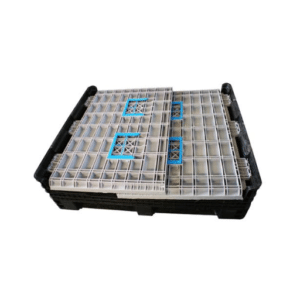
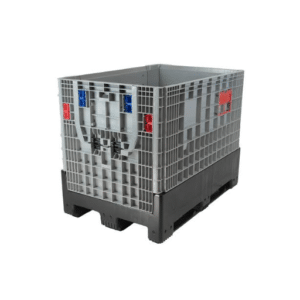
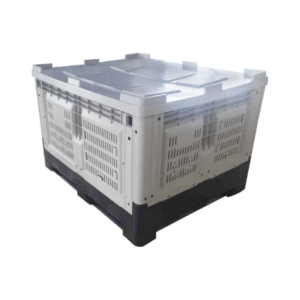
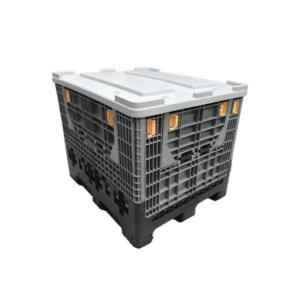
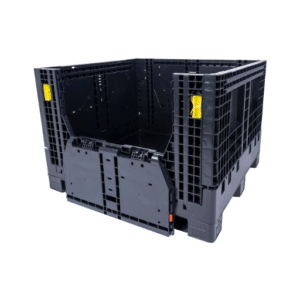
A collapsible pallet box with a lid is a foldable bulk container whose top panel protects the load from dust, moisture, contamination, and theft, and in most cases the lid is an add-on, not a default. If you’re weighing one, the real question isn’t “do I want a lid?” but “which lid, and what does it cost my return loop?”
Here’s the part most spec sheets don’t tell you: the lid is the cheapest component on the box, and the easiest place to lose container efficiency. A lid adds folded height, which quietly trims how many collapsed boxes you fit into a 40-foot container. Get the lid decision right and you protect product and profit in the same move. Get it wrong and you either ship contaminated goods or pay freight on air.
Key Takeaways
- Most collapsible pallet boxes are open-top by default; lids are a configurable add-on, not a given.
- Six lid types cover nearly every loop: drop-on, hinged, interlocking, lockable, insulated, and vented.
- A lid typically cuts container-load efficiency by roughly 10–12% (a 40HQ that fits ~150 folded boxes fits ~132 with lids).
- Spec a lid when you face dust, moisture, outdoor storage, theft, or food/pharma hygiene rules, and skip it in clean, dry, one-way loops.
- Food-grade (FDA / EU 10/2011) and insulated PU-foam lids exist for cold chain and hygiene-sensitive cargo.
Why Put a Lid on a Collapsible Pallet Box?

Open-top collapsible pallet boxes do a fine job for bulk parts and dry goods. The moment you add a lid, you buy four things: protection, security, hygiene, and stacking stability. Understanding which one you actually need is the whole decision.
Protection is the most common driver. Dust settles on automotive components, condensation ruins bagged flour, and rain-soaked cardboard cartons collapse in transit. A lid turns an open bin into a closed, weather-resistant container. Security matters for high-value or pilferage-prone loads; a lockable lid with a tamper-evident seal is a visible deterrent that an open top simply isn’t.
Hygiene drives food and pharmaceutical buyers toward lids with smooth, easy-to-clean surfaces that satisfy auditor requirements. And stacking stability improves because an interlocking lid locks into the box top, letting you stack higher and more securely than open-top rims allow.
Elena, a logistics manager at a mid-sized food distributor in Ohio, learned the protection lesson the hard way. She shipped bagged flour in open-top collapsible boxes for two years without issue, until a humid August, when a load arrived with condensation beading inside the boxes.
The contamination claim came to 14,000.Thefixwasafood−gradelidcostingabout14,000.Thefixwasafood−gradelidcostingabout9 per box. She specs lids on every box now.
So before you look at lid types, ask what you’re protecting against. The answer points you straight at the right lid, and tells you whether a lid pays for itself.
Explore how Lile configures lids on its collapsible plastic pallet boxes →
Types of Collapsible Pallet Box Lids
Not all lids are the same, and the differences matter more than most buyers expect. Here are the six types you’ll encounter, what each is best for, and the trade-offs to watch.
1. Drop-on (removable) lid
A simple panel that sits over the box’s top walls and lifts off when not in use. It’s the cheapest and easiest to replace. The trade-off: no locking, so it relies on weight and gravity to stay put. Best for light dust and moisture protection in low-security loops.
2. Hinged lid
Attached along one edge for quick open-and-close access without removing the panel. It’s convenient for frequent loading. Watch the hinge: two-piece hinged lids can deflect at the hinge over time and let small gaps open up. That’s a real durability caveat, not a marketing footnote.
3. Interlocking lid
A lid with a shaped edge that locks into the box top. EVOPACK’s “crocodile tooth” edge is the best-known example, and it’s built specifically for stacking resistance. This is the lid to choose when you stack boxes several high in storage or transit.
4. Lockable lid
A lid with integrated lock points, commonly 2-lock (two on base, two on lid) or 8-lock (four and four) configurations, as Kite Packaging describes. Lockable lids add tamper-evidence for high-value or sensitive cargo. Match the lock count to your pilferage risk; more locks mean more handling time.
5. Insulated lid
A lid with a PU-foam core that holds temperature. Cold-chain seafood and pharmaceutical shipments lean on these, paired with an insulated box body, to keep product within range across a return loop.
6. Vented (perforated) lid
A lid with airflow holes for produce and fresh goods that need to breathe. The vent pattern lets air circulate while still keeping debris and pests out.
Lid types at a glance:
| Lid type | Best for | Security | Stacking | Typical material |
|---|---|---|---|---|
| Drop-on | Light dust/moisture | None | Low | HDPE |
| Hinged | Frequent access | Low | Medium | HDPE/PP |
| Interlocking | High stacking | Medium | High | HDPE |
| Lockable | High-value cargo | High | Medium | HDPE/PP |
| Insulated | Cold chain | Low–Medium | Medium | PU-foam core |
| Vented | Produce/fresh goods | Low | Medium | HDPE |
Most lids are molded from the same materials as the box: HDPE for chemical and UV resistance, or polypropylene for rigidity. Twin-skin vacuum-formed HDPE lids, like those in Dolav’s sleeve-pack systems, lock onto the sleeve and offer a strong hygiene story against wooden alternatives. If you’re choosing between materials, our HDPE vs. polypropylene comparison guide walks through the trade-offs.
The Lid Trade-Off: Fold Ratio, Container Load & Cost

Here’s the number most suppliers won’t volunteer. A collapsible box folds flat by design, and its fold ratio (how many folded boxes fit into the space of one erected box) is a core selling point. The lid changes that math.
Every lid adds folded height. That extra thickness stacks up across a fleet, and it shows up in container loads. A 40-foot high-cube container that fits roughly 150 folded boxes without lids fits about 132 with lids. That’s a 10–12% penalty on return-freight efficiency, per Enlightening Pallet’s container-load data.
Marcus, a packaging engineer at an automotive Tier-1 supplier, hit this wall directly. He added lids to all 400 collapsible boxes in his closed-loop return run without re-checking the folded-height math. The lids added about 40 mm to each collapsed box, and his next empty-return shipment carried 12% fewer units.
The lids were still worth it, since dust protection on precision components is non-negotiable, but he’d budgeted for 40 containers and suddenly needed 45.
The cost side works the same way. A lid adds to unit cost, but you should judge it by cost-per-trip, not sticker price. If a lid prevents one contamination claim, one theft incident, or one weather-damaged load, it has usually paid for itself several times over within a single loop. The real discipline is this: spec lids fleet-wide only where the loop genuinely needs them, and let clean, dry, low-security lanes run open-top.
Does a lid affect the fold ratio? Yes. A lid adds folded height and reduces the number of folded boxes you can load per container, typically 10–12% fewer in a 40HC, and its own stack of nested lids takes up separate return space. If you’re sizing a return loop, that detail belongs in the freight math before you commit.
Ready to run the lid numbers against your own loop? Request a lid-and-configuration review →
Food-Grade & Cold-Chain Lids
If your product touches food, pharmaceuticals, or temperature-sensitive goods, the lid isn’t just about protection; it’s a compliance surface.
Food-grade lids are molded from FDA- and EU 10/2011-compliant HDPE or polypropylene, with smooth, non-porous surfaces that clean easily and resist bacteria buildup. This is the difference between a lid that “looks clean” and one that satisfies a food-safety auditor. When you’re choosing, confirm the certification applies to the lid material specifically, not just the box, because the two can be molded from different resins.
For cold chain, insulated lids with PU-foam cores hold temperature alongside an insulated box body. A seafood co-op in Norway ships chilled salmon in these boxes, with lids that carry handles and wipe down in seconds. Moving from wooden crates to collapsible boxes with insulated lids cut their product loss on the return journey and cleared their cold-chain audit in a single change.
Hygiene is also where plastic wins decisively over wood. Wooden lids and collars harbor moisture and are hard to sanitize; a vacuum-formed HDPE lid locks cleanly onto the sleeve and stays mold-resistant. If you ship food, pharma, or cold cargo, the food-grade or insulated lid isn’t an upgrade; it’s the default.
For a deeper look at food and cold-chain boxes specifically, see our guide on plastic pallet boxes for food storage.
When to Spec a Lid on a Collapsible Pallet Box
By now the decision should feel straightforward, but let’s make it explicit. Run this checklist before you add lids to any fleet.
- Dust, dirt, or moisture in your environment? Spec a drop-on or hinged lid.
- Outdoor or open-yard storage? Spec a weather-resistant lid, sealed and UV-stable.
- High-value or pilferage-prone product? Spec a lockable lid, and match the lock count to the risk.
- Food, pharma, or hygiene-sensitive cargo? Spec a food-grade (FDA / EU 10/2011) lid.
- Stacking boxes high in transit or storage? Spec an interlocking lid for stability.
- Running a tight closed loop on empty-return freight? Weigh the 10–12% container-load penalty before adding lids fleet-wide.
- Clean, dry, one-way, low-security loop? Skip the lid; an open top is cheaper and perfectly adequate.
The through-line is simple: the lid is protection you only sometimes need. Matching it to the loop, rather than defaulting to “yes” or “no,” is where the savings live.
Lids and Other Accessories: Wheels, Doors, Drain Holes

A lid rarely works alone. The same box can carry a mix of accessories, and it’s worth knowing how they interact.
- Wheels and casters turn a stationary box into a movable bin for line-side use, often paired with a lid to keep contents contained while rolling.
- Drop doors (0–4) give forklift or hand access without removing the lid. This is a common pairing on food and automotive boxes.
- Drain holes let wash-down water escape, important for hygiene loops that also use food-grade lids.
- RFID and barcode slots ride on the lid or box for tracking, and dividers organize mixed loads inside.
None of these change the core lid decision, but they change how you use it. If you need a specific footprint, material, or accessory combination that isn’t standard, custom plastic pallet design is the fallback, and the place where Lile’s OEM/ODM capability does its best work.
Frequently Asked Questions
Do collapsible pallet boxes come with lids?
Usually no, lids are an add-on option on most collapsible boxes. A few models are sold with lids included, but you should assume you’re specifying the lid separately.
What types of lids are available for collapsible pallet boxes?
Drop-on (removable), hinged, interlocking (“crocodile tooth”), lockable, insulated (PU-foam), and vented lids cover nearly every loop.
Do I need a lid on my collapsible pallet box?
You need one if your loop involves dust, moisture, outdoor storage, theft risk, food/pharma hygiene, or high stacking. In a clean, dry, low-security, one-way loop, an open top is usually fine and cheaper.
How does a lid affect the fold ratio and container load?
A lid adds folded height, so fewer folded boxes fit per container, typically 10–12% fewer in a 40-foot high-cube. Nested lids also occupy separate return space.
Are collapsible pallet box lids food grade?
Yes, food-grade lids molded from FDA- and EU 10/2011-compliant HDPE or PP are available. Confirm the certification applies to the lid resin specifically.
Can I get an insulated lid for cold chain?
Yes, insulated PU-foam-core lids pair with insulated box bodies for temperature-sensitive cargo like seafood and pharmaceuticals.
Are collapsible pallet box lids lockable?
Yes, in 2-lock, 4-lock, and 8-lock configurations, with tamper-evident options for high-value loads.
Can lids be replaced separately from the box?
In most systems, yes, the lid, sleeve, and pallet base are separate components, so a damaged lid can be replaced without buying a new box.
Conclusion: Spec the Lid Your Loop Actually Needs
The lid is the cheapest part of a collapsible pallet box and the easiest to get wrong. Get it right and you protect product from dust, moisture, theft, and contamination while keeping your return loop efficient. Get it wrong and you either eat a contamination claim or pay freight on air you didn’t need to ship.
Three things to remember. First, lids are an add-on, not a default, so decide deliberately. Second, the six lid types exist to solve different problems, so name the problem before you pick the panel. Third, every lid carries a hidden container-load penalty of roughly 10–12%, which only matters if you run a closed loop, so match the lid to the loop, not the spec sheet.
At Shandong Lile, we help you make that call with real numbers, not guesswork. Tell us your product, your environment, and your return loop, and we’ll tell you which lid, if any, actually earns its cost.