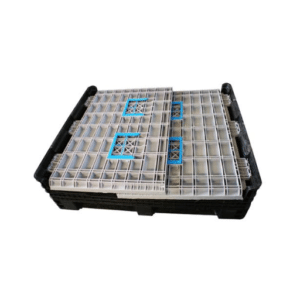
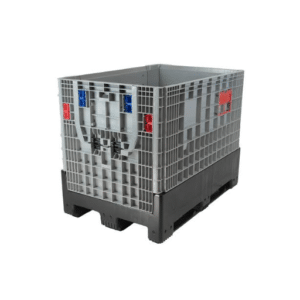
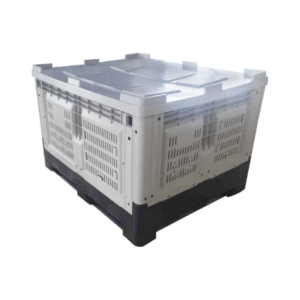
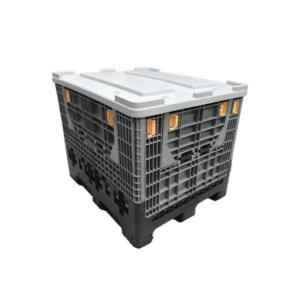
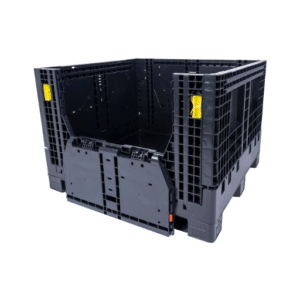
The standard collapsible pallet box dimensions are 1200×1000 mm, 1200×800 mm, and 48×40 inches (1219×1016 mm), with overall heights from 590 mm to 1000 mm. The figure that actually decides whether your product fits is the internal dimension, which runs about 40 to 80 mm smaller than the external footprint on every side.
Here’s what most buyers miss. A collapsible pallet box ships two sizes at once: the size it carries in, and the size it folds down to for the return trip. Get the footprint right but the fold ratio wrong, and you still pay full freight to move empty space back across a border or a continent.
You’re here because a spec sheet mixes three different numbers: external, internal, and folded. This guide walks you through all three. You’ll learn the standard sizes, why the internal number matters more than the external one, how to read a fold ratio, and how to pick the right box for your pallet, racking, product, and return loop.
Key Takeaways
- Standard footprints are 1200×1000 mm (UK/block), 1200×800 mm (Euro), and 48×40 in / 1219×1016 mm (US GMA).
- Internal dimensions run 40–80 mm smaller than external, and that’s the number that decides real fit and usable cube.
- Fold ratios reach 5:1, meaning five folded boxes occupy the space of one erected box and cut empty volume by up to 75%.
- Folded height, not box height, drives container loads: a 40 ft container holds roughly 126–195 folded boxes.
- Choose a size in this order: footprint, internal clearance, required liters, then fold ratio.
Standard Collapsible Pallet Box Dimensions

Collapsible pallet boxes are built to sit on the same footprints as the pallets they replace. Under ISO 6780, the principal pallet footprints are 1200×1000 mm and 1200×800 mm in Europe, and 48×40 inches (1219×1016 mm) in North America. A box on one of these footprints drops cleanly onto a standard pallet or into a racking bay.
Heights vary far more than footprints. A collapsible box for fresh produce might stand 760 to 810 mm tall with vented walls. A general industrial box runs 975 to 1000 mm. The height you choose sets the box’s volume in liters, which is covered in the selection section below.
Here is a consolidated view of common sizes. All figures are manufacturer-published examples, not a single universal standard:
| Footprint | Typical external (L×W) | Typical internal (L×W) | Common heights | Folded height (typical) |
|---|---|---|---|---|
| 1200×1000 mm | 1200×1000 mm | 1116–1160 × 920–960 mm | 760, 810, 975, 1000 mm | 240–370 mm |
| 1200×800 mm | 1200×800 mm | 1120–1160 × 720–760 mm | 745, 800, 973 mm | 240–465 mm |
| 48×40 in (1219×1016 mm) | 1219×1016 mm | ~1160×960 mm | 40–48 in | ~11–16 in |
A note on the US footprint: the 48×40 in GMA size differs from the metric 1200×1000 mm box by only 19 mm in length. Many buyers use them interchangeably for floor storage, but confirm racking and AS/RS clearance before you mix the two.
Not sure which footprint your pallets actually use? We can help you match it. See our plastic pallet boxes →
External vs. Internal Dimensions: Why the Difference Matters
The external dimension is what fits your pallet and racking. The internal dimension is what fits your product. The gap between them is wall thickness, and it’s larger than most people expect.
For a 1200×1000 mm box, the internal space is typically 1116 to 1160 mm long and 920 to 960 mm wide. That’s a 40 to 80 mm loss on each axis. On a 1200×800 mm box, internal dimensions commonly fall around 1120 to 1160 mm long and 720 to 760 mm wide.
Why this matters: 40 mm is the difference between a part lying flat and standing on edge. 80 mm can drop you below the clearance a robotic arm or AS/RS shuttle needs. If you build the spec from external dimensions, your product may not fit at all.
In 2024, Ana, a packaging engineer at a central European appliance plant, specced a 1200×1000 collapsible box from the external number in a catalog. The washing-machine pumps fit the box fine, until the dividers went in. The internal width was 48 mm narrower than she had planned, and the third divider row would not close. The plant ran two months on a workaround before reordering a custom box. The lesson is simple: always build the spec from the internal dimension.
The internal number also sets your usable volume in liters. A 1200×1000 mm box at a 975 mm height holds roughly 900 liters at the top end, while a produce box at 760 mm holds closer to 600 liters. If you need a specific volume, work backward from internal dimensions, not the nameplate size.
Folded Height and Fold Ratios Explained

A fold ratio tells you how many folded boxes fit in the space of one erected box. A 5:1 ratio means five collapsed boxes occupy the same volume as one standing box. That’s why suppliers also describe collapsible boxes as cutting empty volume by 70 to 75 percent.
You’ll see three ways of saying the same thing. Enlightening Pallet advertises knock-down ratios as high as 5:1. CHEP describes a folding container that “packs 5 into 1 pallet space.” ORBIS phrases it as a “1:2.5” return ratio. All three describe the same physics from different directions.
Folded height is the concrete number behind the ratio. It varies by design and wall thickness:
| Box style | Folded height | Source example |
|---|---|---|
| Double-layer blow-molded box | ~240 mm | Liangc C1210 |
| 810 mm tall box | ~290 mm | Huading HDFPC1210H810 |
| 975–1000 mm tall box | 320–325 mm (295 mm stacked) | Transoplast MAGNUM |
| Heavier industrial box | 350–406 mm | Huading / cnpalletplastic |
| Perforated EU box | 293–465 mm | IP-Group |
Why the fold ratio matters: it’s not the box height that fills a container, it’s the folded height. Two boxes with the same capacity can fold to very different heights, and that difference shows up directly in your return freight bill. If you’re still weighing collapsible vs. rigid pallet boxes, the fold ratio is the number that decides any closed loop.
Container Load Quantities: 20 ft and 40 ft
When you ship folded boxes back internationally, folded height determines how many fit. Shorter, lower-profile folds pack more per container.
Here’s how it breaks down by box height, using manufacturer-published container counts:
| Box height | Folded height | 20 ft GP | 40 ft GP | 40 ft HQ |
|---|---|---|---|---|
| 810 mm | ~290 mm | 75 | 160 | 195 |
| 975 mm | ~400 mm | 56–60 | 126 | 144 |
The spread is wide enough to change your budget. An 810 mm box folding to 290 mm loads about 195 units in a 40 ft high-cube, while a 975 mm box folding to 400 mm loads roughly 126 to 144. That’s a 30 to 35 percent difference in the number of empties you move per container, all from a folded-height gap of about 110 mm.
Lids add a penalty too. Enlightening Pallet notes a 975 mm box loads about 150 per 40 ft HQ bare, but around 132 with lids. If your loop needs lids, factor that into the container math.
Marcus runs a produce cooperative that ships collapsible bins to growers each season. The first year, he ordered tall 975 mm boxes for maximum capacity per trip. But the co-op’s empties came back 400 mm tall when folded, and they loaded 144 to a 40 ft container instead of the 195 a 290 mm fold would allow. Switching the return-heavy lanes to an 810 mm box cut two empty-return truck movements a month. Folded height, not capacity, was the number that mattered.
How to Choose the Right Collapsible Pallet Box Size

Work through these six steps in order, and the size nearly picks itself.
- Match the footprint to your pallet and racking. Start with 1200×1000 mm, 1200×800 mm, or 48×40 in. Confirm racking clearance before committing.
- Confirm internal dimensions fit your product. Measure your largest item, add divider and orientation clearance, and check it against the internal length and width.
- Pick the height for your required liters. Common heights hold roughly 606 to 905 liters. Taller isn’t automatically better.
- Check folded height against your return and storage constraints. A taller box with a poor fold ratio can cost you a container position.
- Verify container-load efficiency for international empties. Use the folded-height table above if you ship folded boxes back by sea.
- Go custom only if no standard size fits. Non-standard footprints and heights exist, but they carry tooling and MOQ trade-offs.
For the full buying decision beyond dimensions, read how to choose plastic pallet boxes.
Priya, a supply-chain analyst at a frozen seafood distributor, ran this checklist before her last purchase. Her products fit a 1200×800 mm footprint with internal clearance to spare, she needed 700 liters, and her closed loop shipped empties back on the same trailers. She chose an 800 mm box that folded to under 300 mm, and the return lane that used to need two trailers now needs one.
Ready to spec a box that fits your loop? Send us your product, pallet, and return details for a size-and-fit review. Get a free quote →
Frequently Asked Questions
What are the standard dimensions of a collapsible pallet box?
The three standard footprints are 1200×1000 mm, 1200×800 mm, and 48×40 inches (1219×1016 mm). Overall heights typically range from 590 mm to 1000 mm, with folded heights from about 240 mm to 465 mm.
What is the difference between external and internal dimensions?
External dimensions describe the outside of the box and what fits your pallet or racking. Internal dimensions describe the usable space inside, and run 40 to 80 mm smaller due to wall thickness. Always spec product fit from the internal number.
What is a fold ratio?
A fold ratio tells you how many folded boxes occupy the space of one erected box. A 5:1 ratio means five collapsed boxes fit where one stood, cutting empty volume by up to 75 percent.
How many folded collapsible pallet boxes fit in a 40 ft container?
Depending on folded height, a 40 ft container holds roughly 126 to 195 folded boxes. An 810 mm box folding to 290 mm loads about 195, while a 975 mm box folding to 400 mm loads about 144.
What size collapsible pallet box do I need?
Choose by footprint first, then internal clearance, then required liters, then fold ratio. Confirm your pallet and racking, measure your largest product against internal dimensions, and match folded height to your return loop.
Can I get a custom size collapsible pallet box?
Yes. When no standard footprint or height fits, manufacturers can build custom dimensions. Expect tooling and minimum-order-quantity trade-offs. Learn how custom sizing works →
Conclusion: Spec the Size, Not the Guess
Choosing collapsible pallet box dimensions comes down to three numbers read together: the external footprint, the internal cube, and the folded height. Get all three right, and you ship full boxes out and thin stacks back.
Here’s the short version. Match the footprint to your pallet and racking. Build the product fit from internal dimensions, which are 40 to 80 mm smaller than the nameplate. Pick a height for the liters you actually need, then check the folded height against your return lane and container budget.
The boxes that save you the most are rarely the tallest ones. They’re the ones whose folded height fits your loop. If you’re not sure where to start, we’ll run the numbers with you.
Get a free quote → and tell us your product dimensions, pallet footprint, and return loop. We’ll help you pick a collapsible pallet box that fits on the first try.