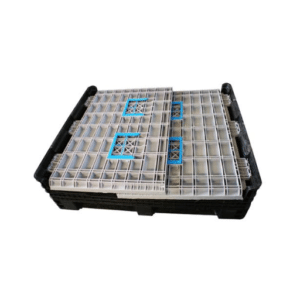
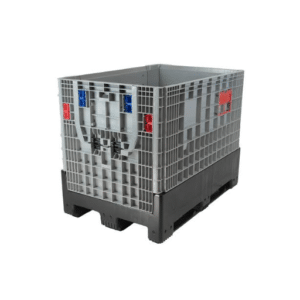
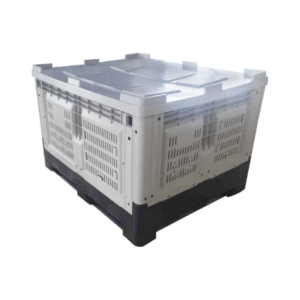
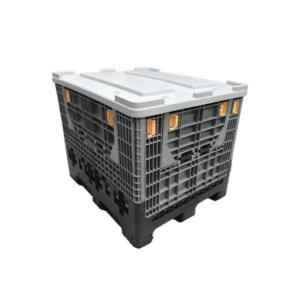
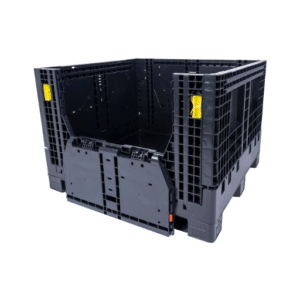
Most collapsible pallet boxes hold 500 to 1,650 kg while being moved by forklift (dynamic load) and 1,200 to 7,000 kg when stacked at rest (static load). The exact number depends on the footprint, the material, the base design, and whether the box will sit on the floor, be lifted, or live in pallet racking.
Priya, a procurement lead at a food-processing plant in Gujarat, learned this distinction the expensive way. Her supplier’s datasheet showed a bold “4,000 kg” figure. She assumed it applied everywhere. Six weeks later, a forklift lifted a 1,100 kg load of frozen concentrate, and the box’s side walls bowed under the forks. It did not collapse, but it came close enough that her safety team pulled the entire fleet.
The problem was not the box. It was the rating she had used. The 4,000 kg was a static stack figure. Her forklift lift needed the dynamic rating, which was far lower.
If you buy or specify collapsible boxes, you already suspect the truth. A single “load capacity” number rarely tells the whole story. This guide explains exactly how collapsible pallet box load capacity is rated, where foldable boxes lose strength compared to rigid ones, and how to specify a rating that will not fail in your operation. We will also show where collapsible plastic pallet boxes fit into the picture.
Key Takeaways
- Collapsible pallet box load capacity is always three numbers: static (stacked at rest), dynamic (being moved), and racking (spanning beams). Using the wrong one is the most common cause of failure.
- Typical ratings run 500 to 1,650 kg dynamic per box and 1,200 to 7,000 kg static stack, depending on footprint and material.
- The fold mechanism is the weak point. Hinges and latches wear at 8,000 to 15,000 cycles, and a collapsible box is usually rated below a rigid box of the same footprint.
- HDPE holds roughly twice the static stack of polypropylene (to 7,000 kg versus 2,800 kg in comparable models).
- Apply the 80% safe-working-load rule, and add a 1.5x safety factor for racking before you commit.
What Is Collapsible Pallet Box Load Capacity?

Collapsible pallet box load capacity is the maximum weight a foldable pallet box can safely carry under a specific set of conditions. Those conditions include how the box is supported, how it is moved, and the temperature of the environment. Manufacturers publish capacity as multiple ratings because the same box behaves very differently on a warehouse floor, on a forklift, and on rack beams.
The fold itself adds a complication that rigid boxes and flat pallets do not have. A collapsible box carries load through its hinged side walls and latches, not just through a solid deck. That means its true load capacity depends on the hinge, the latch, and the wall thickness as much as on the base.
At Shandong Lile, we treat this as an engineering value, not a marketing claim. Our standard collapsible box is rated at 1,000 kg dynamic and 4,000 kg static, derived from controlled testing rather than optimistic brochure numbers.
The Three Load Ratings: Static, Dynamic, and Racking
If you remember one section from this guide, make it this one. The three load ratings are the foundation of every safe specification, and they are not interchangeable.
Static Load Capacity
Static load capacity is the weight a collapsible box can support when it is sitting still, usually stacked on the floor. This is the highest rating because the floor and the boxes beneath it support the entire base.
Typical static stack figures:
- Lightweight wall-fold boxes: 1,200 to 2,200 kg
- Standard HDPE collapsible boxes: 4,000 to 7,000 kg
- Heavy-duty sleeve-pack systems: 5,000 to 7,000+ kg
Static ratings matter most for floor stacking and long-term storage where the box will not be lifted or racked.
Dynamic Load Capacity
Dynamic load capacity is the weight a box can carry while it is being moved by forklift, pallet jack, or conveyor. Motion introduces vibration, impact, and stress at the fork entry points. This rating is always lower than the static rating.
Typical dynamic figures:
- Standard collapsible boxes: 500 to 1,000 kg
- Heavy-duty HDPE boxes: 950 to 1,650 kg
- Industrial foldable containers: 1,000 to 3,000 kg
This is the number you need for day-to-day handling. If your forklift routinely lifts 1,000 kg loads, your box’s dynamic rating should sit comfortably above that.
Racking Load Capacity
Racking load capacity is the weight a box can support when it spans two rack beams with no center support. It is usually the lowest and most critical rating because the box must resist bending across an open span. Only boxes with a runner or full-stringer base are rackable at all.
Here is how the three ratings compare for a typical 1200 x 1000 mm collapsible box:
| Load Type | Typical Range | What It Means |
|---|---|---|
| Static | 1,200 to 7,000 kg | Weight held while stationary and stacked |
| Dynamic | 500 to 1,650 kg | Weight held while lifted or moved |
| Racking | 400 to 1,000 kg | Weight held across rack beams |
Priya’s near-miss happened because she read a static figure and applied it to a dynamic lift. It is the single most common mistake in reusable packaging specification.
Want help matching the right rating to your operation? Explore our collapsible plastic pallet boxes or contact our team for a load-capacity assessment based on your actual loads.
How the Fold Mechanism Limits Load Capacity
Here is the part most spec sheets will not tell you. A collapsible box is typically rated below a rigid box of the same footprint, and the reason is the fold.
A rigid box distributes load through continuous walls. A collapsible box routes that same load through hinges, latches, and drop walls. Those moving parts are the weak point. A hinge rated for 8,000 to 15,000 open-close cycles gradually wears, and a worn hinge reduces the effective load the wall can carry.
Tomás, an engineer at a tier-one automotive supplier in Monterrey, saw this in the real world. His line ran foldable boxes on a 40-trip-per-year loop with heavy stamped steel parts. After eighteen months, the latches on several boxes had worn loose. The boxes did not break. But under full dynamic load, the walls started to deflect visibly, and his team pulled the fleet for inspection.
The lesson is not to avoid collapsible boxes. It is to understand the trade-off. The fold that saves you freight on the return trip also concentrates stress in the hinge. Buyers who need maximum load capacity should look for reinforced hinges, thicker walls, or a rigid box instead. Our collapsible vs. rigid pallet boxes guide walks through that decision in detail.
Stacking Limits and the 1+N Notation

Collapsible box spec sheets often show stacking capacity as a “1+N” figure, and it trips up first-time buyers. The notation tells you how many loaded boxes can sit on top of one box.
ORBIS lists its HDB1210 collapsible box as 1+5 static and 1+2 dynamic. That means five loaded boxes can stack on top while stationary, but only two while the stack is being moved. The same box holds 900 kg of product.
| Model (footprint) | Capacity | Static Stack | Dynamic Stack |
|---|---|---|---|
| ORBIS HDB1210 (1200 x 1000) | 900 kg | 1 + 5 | 1 + 2 |
| Kruizinga box (1200 x 1000) | 2,750 kg static | VDA 4520 | 1,650 kg dynamic |
| Schoeller Maxilog (1200 x 1000) | 450 kg | 4,500 kg stack | 500 kg dynamic |
| Lile standard (1200 x 1000) | 1,000 kg dynamic | 4,000 kg static | 1 + 2 |
Why the gap between static and dynamic stacking? Because a moving stack sways, and each lower box must absorb the weight plus the motion of everything above it. Never assume a “6-high stack” claim means 6-high while moving.
Materials: How HDPE vs PP Changes Load Capacity
Material choice moves the load rating more than most buyers expect. The two common plastics behave very differently under load.
High-density polyethylene (HDPE) is the workhorse for heavy loads. It is softer but more impact-resistant, and it holds its strength down to about -40°C. In comparable 1200 x 1000 mm models, HDPE boxes reach 6,050 to 7,000 kg static stack, as seen in the Schoeller Allibert Smartbox range.
Polypropylene (PP) is stiffer and lighter, but it carries less. A PP Magnum Optimum box of the same footprint holds roughly 2,800 to 4,000 kg static. PP also becomes brittle below about -20°C, which rules it out for freezer use.
A cold-storage operator in Rotterdam named Anna learned this difference on a seafood line. She switched her fleet from HDPE to PP boxes to cut empty weight. They worked fine in the chilled dock. When she moved them into the -22°C freezer, the PP walls cracked under the same loads the HDPE boxes had carried for years.
Recycled content lowers the number further. A box made from 100% recycled resin typically loses 10 to 20% of its rated load capacity, so it should be specified with a heavier design. For a fuller breakdown of the material trade-offs, see our HDPE vs polypropylene comparison.
Base Design and Racking Compatibility
A collapsible box’s base decides whether it can be racked at all, and how much it can hold there.
Boxes come on three base types. Feet are the cheapest and lightest, but they cannot span rack beams, so feet-based boxes are floor-stack only. Runners (two or three parallel skids) let a box sit in racking and move through forklift tunnels. A full stringer or solid base gives the stiffest span and the highest racking rating.
The racking figure always sits below the static figure. Rotom’s foldable box, for example, carries 800 kg dynamic and 1,200 kg static, but only 400 kg in racking. The unsupported span is what does the damage.
If you plan to move collapsible boxes into racking or automated storage, specify the base up front. A three-runner or full-stringer base is the difference between a safe 1,000 kg racking load and a box that deflects and fails. Many bulk plastic pallet boxes are built this way from the start.
How Load Capacity Is Tested: ISO 8611 and VDA 4520
Credible manufacturers do not guess their ratings. They test to recognized standards.
ISO 8611 is the international standard for flat pallets, and its methods are adapted for pallet boxes. It defines static, dynamic, and racking tests, plus creep testing for long-term storage. Because plastic deforms slowly under sustained load, the creep test matters most for boxes that will sit stacked for months.
VDA 4520 is the automotive-industry standard specific to load carriers and boxes. The Kruizinga collapsible box, for instance, lists VDA 4520 compliance alongside its 2,750 kg static and 1,650 kg dynamic ratings. If you supply automotive or manufacturing customers, a VDA 4520 rating is often a hard requirement.
Test conditions change the number. A racking rating tested across a 900 mm beam span will be higher than the same box tested across 1,200 mm. Temperature, load distribution, and cycle count all shift the result. Always ask for the test report summary, not just the headline figure. Our plastic pallet load capacity guide covers this testing methodology in more depth.
Safety Factors and Safe Working Load

Published ratings are maximums. Safe working load is what you actually use. Industry practice applies a margin on top of the manufacturer’s number.
The 80% rule. Use no more than 80% of the published rating as your working load. A box rated 1,000 kg dynamic should carry a maximum planned load of 800 kg.
The 1.5x racking factor. For racking, many engineers apply a formal safety factor of 1.5, since a rack collapse is far more dangerous than a floor spill:
Required racking rating = (product weight + box weight) x safety factor
If your product weighs 600 kg, the empty box weighs 45 kg, and you use a 1.5 factor, you need a box rated for at least 968 kg in racking.
Derate further for real-world conditions. Point loads concentrate stress, so a 600 kg casting on four small feet behaves like a much heavier evenly distributed load. Cold environments stiffen some plastics. Old, worn hinges reduce effective capacity. Account for all of it before you buy.
How to Specify the Right Load Rating
Use this checklist to match the box to the job:
- What is the maximum product weight per box?
- Will the box sit on the floor, be moved frequently, or live in racking?
- How high will the stack go, and will it be moved while stacked?
- What is the operating temperature range?
- Is the load evenly distributed or concentrated?
- How many open-close cycles will the hinges see per year?
- Do you need ISO 8611 or VDA 4520 test documentation?
If your answer to any of these pushes you past a standard rating, that is where customization earns its keep. At Lile, we engineer reinforced walls, steel inserts, and custom base runners to raise the load rating of a collapsible box to match the application.
Ready to specify the right box? Request a quote and share your load details. We will recommend a capacity-rated collapsible box for your operation.
Frequently Asked Questions
How much weight can a collapsible pallet box hold?
Most collapsible pallet boxes hold 500 to 1,650 kg while being moved and 1,200 to 7,000 kg when stacked stationary. The racking rating is usually the lowest, from 400 to 1,000 kg, and depends on the base design.
What is the difference between static and dynamic load?
Static load is the weight a box holds while sitting still, usually stacked. Dynamic load is the weight it carries while being lifted or moved by forklift. Dynamic is always lower because motion adds vibration and stress.
Can collapsible pallet boxes be racked?
Yes, but only with a runner or full-stringer base. Feet-based collapsible boxes are for floor stacking only. Racking capacity sits below static capacity because the box must span unsupported beams.
Does folding weaken a pallet box over time?
Yes. The hinges and latches are the load-bearing weak point, and they wear at 8,000 to 15,000 cycles. Worn hinges reduce the effective load the walls can carry, so inspect and replace them on a schedule.
HDPE or PP, which holds more weight?
HDPE holds more. Comparable HDPE boxes reach 6,050 to 7,000 kg static stack, while PP models reach 2,800 to 4,000 kg. HDPE also performs better in cold storage.
Conclusion
Collapsible pallet box load capacity is never a single number. It is a set of ratings tied to how the box is supported, plus the hidden influence of the fold mechanism, the material, and the base. The buyers who avoid accidents are the ones who look past the bold figure and ask how it was tested.
Start with three actions:
- Match the rating to the job. Use dynamic for handling, static for floor stacking, and racking for beam storage.
- Apply a safety margin. The 80% rule is simple, and a 1.5x factor protects your racking.
- Ask for test documentation. ISO 8611 or VDA 4520 reports separate engineering ratings from marketing claims.
At Shandong Lile, we engineer collapsible boxes for real-world loads. Our standard box carries 1,000 kg dynamic and 4,000 kg static, and our custom program can raise those numbers with reinforced walls, steel inserts, and runner bases. Whether you are stocking a cold room, feeding an automotive line, or planning a return loop, we can help you specify the right capacity for the job. Get a free load-capacity assessment today.