
A standard 48 x 40 inch North American pallet holds 72 to 100 cases of beer, with roughly 100 cases serving as the practical upper limit for safe transport. The exact count depends on your case size, container type, stacking height, and pallet dimensions.
That one number determines how many truckloads you book, how much warehouse space you need, and whether your product arrives intact. Yet most breweries and distributors treat pallet loading as an afterthought. They’ll reuse whatever pallets are available, stack until the load looks full, and hope nothing shifts in transit. The result? Damaged inventory, rejected shipments, and freight spend that eats into already thin margins.
In this guide, you’ll learn exactly how many cases of beer fit on a pallet for every common packaging format. You’ll also discover why pallet size and material matter, how to calculate safe weight limits, and which loading practices keep your product secure from brewery to retailer.
Key Takeaways
- A standard 48 x 40 inch pallet holds 72-100 cases of beer, depending on packaging and stacking height.
- 24-pack cans typically allow 80-100 cases per pallet, while glass bottles often drop that range to 48-72 cases because of weight and fragility.
- Loaded beer pallets usually weigh 1,500-2,500 lbs, so weight limits and center of gravity matter as much as case count.
- Plastic pallets outperform wood for beverage logistics because they resist moisture, maintain consistent dimensions, and last 10+ years.
- The right pallet choice can lower freight costs, reduce product damage, and simplify compliance with retailer and export requirements.
The Short Answer: How Many Cases of Beer Fit on a Standard Pallet?
For a standard 48 x 40 inch North American pallet, the answer most logistics managers use is about 100 cases. That assumes 24-pack cans stacked 10 cases per layer across 10 layers, totaling roughly 2,200 lbs.
But “about 100” isn’t a rule. It’s a ceiling. In practice, breweries and distributors load 72 to 84 cases to improve stability, reduce damage, and stay safely below weight limits. Glass bottles, heavier packaging, and smaller pallets all push the number lower.
| Pallet Type | Dimensions | Typical Case Capacity |
|---|---|---|
| North American standard | 48 x 40 inches | 72-100 cases |
| Euro pallet | 1200 x 800 mm | 60-90 cases |
| Australian standard | 1165 x 1165 mm | 90-110 cases |
| Asia/export pallet | 1100 x 1100 mm | 85-100 cases |
| Square pallet | 42 x 42 inches | 64-84 cases |
The safer question is not “how many cases fit?” but “how many cases can we ship safely and profitably?” That reframe changes everything from stacking patterns to pallet material selection.
Why Pallet Size and Region Affect How Many Cases of Beer Fit on a Pallet
Pallet dimensions aren’t arbitrary. They reflect regional logistics infrastructure, racking standards, and shipping container widths. Load a North American pallet into a European distribution center and you’re likely to face handling problems, chargebacks, or refused deliveries.
The most common standard beer pallet size in North America is 48 x 40 inches, but that changes once you cross borders.
North American Standard: 48 x 40 inches
The 48 x 40 inch pallet is the default in the United States, Canada, and Mexico. It fits efficiently in 53-foot trailers and standard warehouse racking. For 24-pack beer cases measuring roughly 16 x 11 x 9 inches, a common layout is 5 cases across by 2 cases deep, giving 10 cases per layer. Stacked 8 to 10 layers high, that yields 80 to 100 cases.
Euro Pallet: 1200 x 800 mm
The Euro pallet measures approximately 47.2 x 31.5 inches. It is narrower than the North American standard, so it typically holds 60 to 90 cases depending on case size. Euro pallets are widely used in the EU and are required by many European retailers.
Australian Standard: 1165 x 1165 mm
Australia uses a square pallet that is larger in footprint than both North American and Euro pallets. That extra width allows 90 to 110 cases in many configurations, making it efficient for domestic beverage distribution.
Asia/Export Pallet: 1100 x 1100 mm
The 1100 x 1100 mm pallet is common in Asia and optimized for shipping containers. These beer pallet dimensions hold roughly 85 to 100 cases and are often used for export shipments because they maximize container cube utilization.
When Marcus opened a craft brewery in Portland in 2023, he shipped his first export order to Japan using 48 x 40 inch pallets. The Japanese distributor rejected the load because their racking was built for 1100 x 1100 mm pallets. Marcus spent three weeks and thousands of dollars re-palletizing the shipment. His next order used Asia/export pallets from the start, and the delivery cleared customs and warehousing without issue.
How Beer Packaging Affects How Many Cases of Beer Fit on a Pallet
Not all beer cases are the same size or weight. A 30-pack of cans takes up more space than a 12-pack of bottles. Glass weighs more than aluminum. These differences change how many cases of beer fit on a pallet before you hit dimensional or weight limits.
Cans vs. Bottles
Aluminum cans are lighter and more uniform, so you can stack more cases per pallet. A typical 24-pack of 12 oz cans weighs 12 to 15 lbs, while the same count in glass bottles weighs 20 to 25 lbs. That weight difference means glass bottle pallets are usually stacked 3 to 5 layers high, while can pallets can reach 8 to 10 layers.
Case Size Variations
| Package Type | Cases per Pallet | Typical Weight per Case | Notes |
|---|---|---|---|
| 12 oz cans, 24-pack | 80-100 | 12-15 lbs | Most common bulk format |
| 12 oz cans, 30-pack | 48-60 | 18-22 lbs | Larger footprint per case |
| 16 oz cans, 24-pack | ~70 | 18-20 lbs | Fewer cases due to larger size |
| 12 oz bottles, 24-pack | 48-72 | 20-25 lbs | Heavy and fragile |
| 12 oz bottles, 12-pack | 72-84 | 10-13 lbs | Lighter but bulkier per unit |
| 500 ml bottles, 12-pack | 64-80 | 18-22 lbs | Common for imports |
| 750 ml bottles, 12-pack | 42-48 | 28-32 lbs | Premium and specialty beers |
Brand-Specific Examples
Major domestic brands often optimize packaging for pallet efficiency. Reports from suppliers show Budweiser, Coors, and Busch Light commonly shipping 84 to 98 cases per pallet. Heineken 330 ml cans in 24-packs are listed at 108 cases per pallet. Craft breweries, which often use heavier glass and smaller batches, frequently land in the 60 to 72 case range.
The packaging decision made by your marketing team directly affects your logistics costs. A heavier bottle with premium labeling might look great on a shelf, but it could cost you 20 to 30 percent more in freight per case if it reduces pallet density.
Weight Limits and Safe Stacking: How Many Cases of Beer on a Pallet?
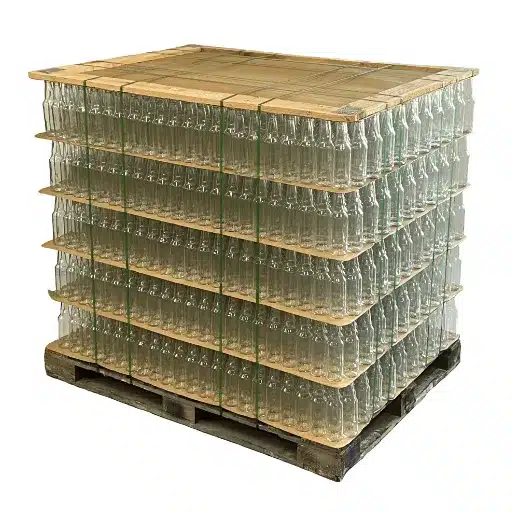
Case count is only half the equation. A fully loaded beer pallet can weigh 1,500 to 2,500 lbs, and exceeding safe limits creates risks for workers, equipment, and product.
How Much Does a Pallet of Beer Weigh?
For a standard 48 x 40 inch pallet loaded with 100 cases of 24-pack cans:
- 100 cases x 15 lbs per case = 1,500 lbs of product
- Pallet weight: 20 to 25 lbs
- Stretch wrap and corner boards: 5 to 10 lbs
- Total: approximately 1,525 to 1,535 lbs
For the same pallet loaded with 60 cases of glass bottles:
- 60 cases x 24 lbs per case = 1,440 lbs of product
- Pallet and packaging: 25 to 35 lbs
- Total: approximately 1,465 to 1,475 lbs
Most warehouses and carriers cap beer pallet loads at 2,200 to 2,500 lbs including the pallet. Glass bottle shipments often hit weight limits before they hit dimensional limits, which is why breweries rarely stack bottle pallets as high as can pallets.
Safe Stacking Height
Industry guidance from the National Beer Wholesalers Association emphasizes that improper stacking is a leading cause of warehouse injuries and product damage. For beer specifically:
- Cans: 8 to 10 layers is standard, with 10 layers as the upper safe limit.
- Bottles: 3 to 5 layers is typical, depending on bottle weight and carton strength.
- Mixed loads: Place heavier items on the bottom and never exceed the lowest-rated component in the stack.
Sarah runs the warehouse for a regional beer distributor in Florida. Last summer, her team stacked glass bottle pallets 7 layers high to clear a rush order. Humidity softened the corrugated cases, and the bottom layer collapsed during forklift transport. The damaged shipment cost her company $14,000 in product loss and retailer chargebacks. Now her standard operating procedure limits glass bottle pallets to 4 layers and requires humidity checks before loading.
Best Practices for Loading and Shipping Beer on Pallets
Getting the case count right won’t help if the load tips over in transit. These beer pallet shipping practices protect your product and your people.
Use Interlocking Stacking Patterns
A brick or interlocking pattern alternates case orientation layer by layer. This creates a more stable cube than column stacking, where every case sits directly above the one below it. Interlocking distributes weight more evenly and reduces the chance of a vertical collapse.
For a 48 x 40 inch pallet with 24-pack cans, a common pattern is:
- Layer 1: 5 cases across x 2 cases deep
- Layer 2: 2 cases across x 5 cases deep
- Repeat through 8 to 10 layers
Secure the Load Properly
| Method | Purpose |
|---|---|
| Stretch wrap | Holds cases together and anchors load to pallet |
| Corner boards | Reinforce edges and increase vertical compression strength |
| Strapping/banding | Adds structural support, especially for heavy glass bottles |
| Layer sheets | Distribute weight between tiers and reduce case-to-case friction |
The Reusable Transport Packaging beer shipping guide recommends using strapping plus stretch wrap as a “security blanket” for mixed loads and long-distance hauls.
Control Temperature and Humidity
Beer is sensitive to heat, cold, and moisture. Pasteurized packaged beer stores best at 40 to 60 degrees F, while non-pasteurized beer should stay between 33 and 38 degrees F. Humidity should remain at or below 65% to prevent corrugated cases from weakening. In humid climates, plastic pallets have a clear advantage because they do not absorb moisture like wood.
Plan for Retail Compliance
Big-box retailers maintain strict delivery requirements. According to Buske Logistics, beverage shipping is “one of the most expensive categories” because of pallet weight, cube utilization, and fuel costs. Retailers often penalize suppliers for incorrect pallet heights, damaged product, or missed delivery windows. Building pallets to the right specification the first time avoids costly chargebacks.
Choosing the Right Pallet Material for Beer Distribution
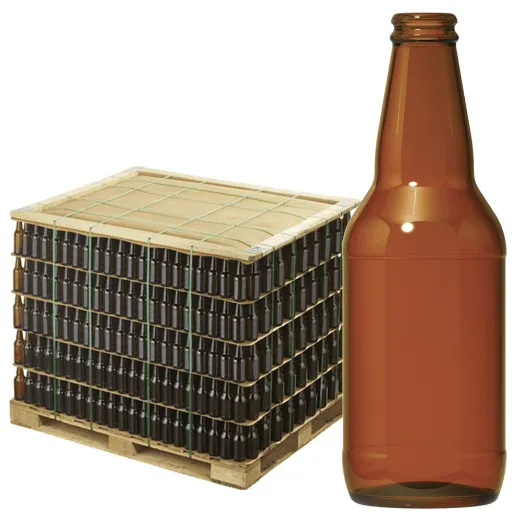
The pallet itself is part of the load calculation. Wood and plastic behave very differently under weight, moisture, and repeated handling.
Wood Pallets
Wood pallets have a lower upfront cost and are widely available. However, they absorb moisture, splinter, and degrade over time. In beverage warehouses, wet wood can harbor mold and bacteria. That’s a real problem for facilities handling food-grade products. Wood pallets also vary in weight and dimensions, which can affect automated systems.
Plastic Pallets
Plastic pallets offer consistent dimensions, smooth surfaces, and resistance to moisture and chemicals. They typically last 10 years or more, compared to roughly 3 years for wood pallets. For beverage operations, the hygiene advantage is significant: plastic pallets are easy to wash, do not absorb spills, and meet food-contact safety standards.
Plastic pallets are also lighter, which means more of your truck’s legal weight capacity goes toward product rather than packaging. Over thousands of shipments, that weight savings adds up to measurable fuel and freight cost reductions.
Total Cost of Ownership
| Factor | Wood Pallet | Plastic Pallet |
|---|---|---|
| Upfront cost | Lower | Higher |
| Lifespan | ~3 years | 10+ years |
| Moisture resistance | Absorbs water | Waterproof |
| Weight consistency | Variable | Consistent |
| Hygiene | Harder to sanitize | Easy to clean |
| ISPM-15 export requirement | Required | Exempt |
| Repair needs | Frequent | Minimal |
A distribution director we work with in California switched his beer operation from wood to plastic pallets and tracked the results over two years. Damage claims dropped by 34 percent, pallet replacement costs fell by 60 percent, and his warehouse team reported fewer splinter injuries and nail pops. The higher purchase price was recovered within 14 months.
Want to see how plastic pallets could improve your beverage operation? Explore our plastic pallet range and request a quote tailored to your load requirements.
How Shandong Lile Supports Beer and Beverage Logistics
At Shandong Lile Holding Group, we engineer pallet solutions for companies that move products across 108 countries. Our experience in food, beverage, pharmaceutical, and cold-chain logistics gives us a clear understanding of what beverage distributors need from their pallets.
Custom Sizing for Your Case Dimensions
Not every brewery uses the same case size. We design plastic pallets to match your specific product footprint, whether you ship 12-packs, 24-packs, 30-packs, or mixed configurations. Custom sizing improves cube utilization and reduces movement in transit.
Features Built for Beverage Handling
- Anti-slip deck surfaces reduce case shifting during transport.
- Drainage channels allow water and cleaning fluids to run off easily.
- Four-way entry simplifies forklift and pallet jack handling from any side.
- RFID integration supports traceability and inventory management.
Global Compliance and Export Readiness
Our plastic pallets are manufactured under ISO 9001 quality standards and are exempt from ISPM-15 heat-treatment requirements. That means faster customs clearance and fewer headaches for export shipments. We also produce pallets in regional dimensions including Euro, Australian, and Asia/export sizes.
Cold-Chain and Temperature-Controlled Options
For breweries shipping non-pasteurized beer, cider, or other temperature-sensitive beverages, we offer cold-storage pallet boxes and freezer-grade plastic pallets designed for reliable performance from 25 degrees C down to cryogenic temperatures.
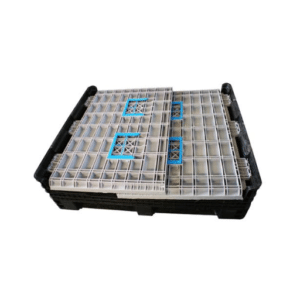
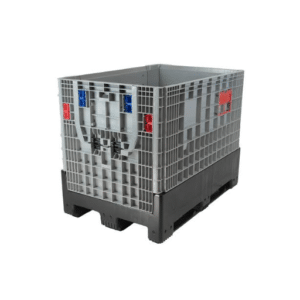
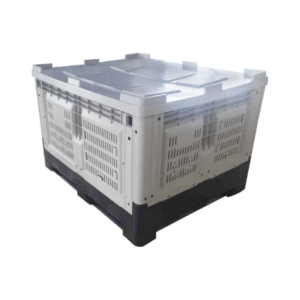
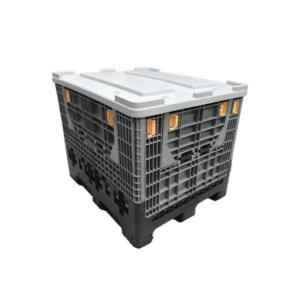
If your operation needs bulk storage between production runs, our plastic pallet boxes provide a hygienic, stackable option for ingredients, empties, or finished goods.
Frequently Asked Questions
How many 24-packs of beer are on a pallet?
A standard 48 x 40 inch pallet holds 60 to 100 24-packs of beer. The exact number depends on whether the packs contain cans or bottles and how high the load is stacked.
How many 12-packs of beer fit on a pallet?
You can fit 72 to 100 12-packs on a standard pallet. Smaller cases allow tighter packing, but the total weight and stack height still need to stay within safe limits.
How many 30-packs of beer fit on a pallet?
A pallet typically holds 48 to 60 30-packs because each case has a larger footprint and weighs more than a 24-pack.
How much does a pallet of beer weigh?
A fully loaded beer pallet weighs between 1,500 and 2,500 lbs, depending on case count, container type, and packaging materials.
How many beer kegs fit on a pallet?
Kegs use different math than cases. A standard pallet holds 20 sixth-barrel kegs, 14 quarter-barrel kegs, or 8 half-barrel kegs.
Can you mix beer cases and kegs on one pallet?
Yes, but kegs should always go on the bottom and cases on top. Use strapping and stretch wrap, and keep the total weight within your equipment and carrier limits.
Are plastic pallets better than wood for beer?
For most beverage operations, yes. Plastic pallets resist moisture, maintain consistent dimensions, last longer, and are easier to sanitize than wood.
What is the maximum height for a beer pallet?
Most warehouses and carriers limit beer pallet height to 72 inches including the pallet itself. Stack height may be lower for glass bottles or humid conditions.
Conclusion
Knowing how many cases of beer fit on a pallet is the starting point, not the finish line. The real goal is to build a load that arrives intact, complies with retailer requirements, and makes the best use of your freight budget.
A standard 48 x 40 inch pallet holds 72 to 100 cases of beer in most configurations. That gives you roughly 80 to 100 cases of beer per pallet for 24-pack cans, and 48 to 72 for glass bottles. Cans let you stack higher than bottles. Regional pallet sizes change your capacity. Weight limits often matter more than case count. And the material beneath your load, whether wood or plastic, affects durability, hygiene, and total cost of ownership over time.
At Shandong Lile, we help breweries and distributors choose pallets that match their products, regions, and operational goals. If you are shipping beer domestically or exporting internationally, the right pallet can reduce damage, lower freight costs, and simplify compliance.
Ready to optimize your beer pallet strategy? Contact our team for a custom quote or explore our plastic pallets designed for beverage logistics.