Efficient pallet storage is at the very center of maximizing warehouse operations so that businesses can maximize their space utilization, improve workflows, and reduce operational costs. Warehouses and warehouses are under more and more pressure every day to handle increasing volumes and diversified inventory. Thus, the need to apply best practices to pallet storage has never been more necessary. This article tackles the best ways and strategies to organize palletized goods, ranging from high-tech racking to space-conscious layouts. Whether you are prepared to put forth time and effort to enhance productivity or gear yourself for future scalability, this guide indeed offers actionable insights that would streamline your storage and operational excellence.
Pallet Storage Solutions
For a perfect pallet-storage scheme, the market ideally in its present state fixes in on space optimization, accessibility, and security. These include:
Selective Pallet Racks
By far, the most popular rack system; it offers unhampered access to each pallet and is best for a facility with high inventory turnover and broad product selection.
Drive-In and Drive-Through Racking
Both systems maximize the utilization of floor space, allowing the forklift trucks to enter within the racking area. Drive-in racking is applied for large quantities of similar items, while drive-through racking allows rotation of stocks on a first-in, first-out basis.
Pallet Flow Racking
Through the use of inclined tracks, this system maintains a continuous flow of pallets, thus minimizing handling time and ensuring first-in, first-out operation. This is mostly used for the stocks of perishable goods.
Push-Back Racking
Push-back systems are known for their compact storage density. They store pallets on a set of rails that permit storing and retrieval from one side.
Key Success Factor: Choosing the right solution with load and weight capacity management can help warehouses significantly improve their operations and ensure safety within the facility. Periodic inspections and observance of storage guidelines will certainly prove even more important to the business over time.
Understanding Pallet Types
Pallet types differ greatly in design, material, and application, each catering to specific warehouse or logistics needs. The hardest classifications would be wood, plastic, and metal pallets:
| Pallet Type | Characteristics | Best Use Cases | Considerations |
|---|---|---|---|
| Wood Pallets | Economy in price and durability; most common type | General-purpose storage and transportation | May be vulnerable to damage in moist environments |
| Plastic Pallets | Lightweight, moisture-resistant, and reusable; outlast wood pallets | Food and pharmaceutical industries with hygienic standards | Higher upfront investment cost |
| Metal Pallets | Steel or aluminum construction; strength and durability | Heavy-duty work or long-term outdoor storage | Higher cost and weight discourage widespread use |
It’s so vital to understand the compatibility of pallet dimensions with racking systems and forklift equipment. Any specific requirement in an operation dictates the choice of a suitable pallet type: load capacity, environmental conditions, or any industry-standard specification, like ISO or perhaps GMA specifications. Benchmarked original selection assures efficiency, safety, and viability in warehousing operations.
Common Pallet Storage Methods
Effective pallet storage methods are critical for efficiently utilizing warehouse space, providing a smooth workflow, and taking care of the goods in storage. The three predominant types of pallet storage include selective racking, drive-in racking, and pallet flow racking.
Selective Racking
This is the most preferred form of pallet storage for its versatility and accessibility. It can provide direct access to any pallet and, hence, is useful where the need for inventory rotation exists. However, a selective racking system tends to use more aisle space, which reduces the amount of overall storage density.
Drive-In Racking
Best employed in high-density settings are space and cost maximization are the prime concerns, allowing forklifts inside the racking system to either place or retrieve pallets. Since it maximizes space utilization, its LIFO method of inventory might not be good for stores dealing with perishable goods. It is suited more for bulk storage of uniform products.
Pallet Flow Racking
This technique uses inclined tracks with rollers, enabling pallets to move automatically forward into the picking spot by way of gravity. It promotes a First-In, First-Out (FIFO) inventory system whereby older stock has to be utilized first. Hence, pallet flow racking is best suited for perishable stock, albeit with a potentially high installation cost.
Important Note: Depending upon operational needs, storage options optimally selected would ensure greater efficiency, maximize warehouse spaces, and hence the well-being of inventory.
Choosing the Right Storage Solution
Selecting the storage option depends on several factors that one has to keep in alignment with one’s particular operational requirements. First, consider the nature of your inventory: size, weight, perishability, and duration of storage. For either high-density spaces or environments where a high turnover rate exists, pallet flow racking or drive-in racking might have been ideal choices that would allow optimal use of space and timely access.
Second, evaluate the space availability in your station for storage. Mezzanine storage systems or vertical shelving solutions maximize cubic footage when floor space is lacking. And then, you must think about your actual workflow: how often do you access inventory, and how are you going to get it? Are you maybe going to need a FIFO-type approach or a selective racking system that allows for easier stock picking?
Third, think about scalability and future requirements. If growing is in the future, then modular or adjustable types must be chosen to accommodate changes over time. These are also of paramount importance for budgeting: from the purchase price to the mounting maintenance cost. Generally, considering expenditures, a high-quality, durable system usually translates to lower operational expenses, even if the installation cost is lower for cheaper systems.
Key Takeaway: In the end, the chosen means of storage should maintain an equilibrium between efficiency, cost-efficiency, and potential for meeting the demands confronting businesses now and in the near future. When these factors are evaluated, warehouses will be fine-tuned for excellence in operations.
Optimizing Space in Warehouses

Once warehouse space is optimized, efficiency is maximized, and cost is minimized. First, go for vertical storage; taller shelving systems should be used in order to fully utilize the space. Then get the inventory sorted with a logical and categorized layout to facilitate pick-and-pack operations. Modular racking systems afford flexibility with changing demands. Analyzing inventory patterns can also reveal the slow movers that can be placed out of reach, putting prime locations to work for their fast-moving brethren. Then, evaluate the layout effectiveness on a continual basis and adopt warehouse management software for the best use of space.
Best Practices for Space Optimization
Install Vertical Storage Systems
Make use of vertical space by installing tall storage racks or mezzanines. This will provide more storage, meaning that the warehouse size does not have to be increased. Ensure all safety codes are considered and that one uses proper equipment to reach any elevated storage.
Use Efficient Slotting Practices
Slot items as per demand, size, and rate of turnover. Items that have high demand must be placed in locations that are very accessible and close to packing areas, whereas bulk and slow-moving items can be stored much farther away.
Utilize Warehouse Management Systems
A good WMS will help simplify the tracking of inventory and further improve task allocation while facilitating detailed reports on space utilization, adjusting inventory on the fly, and layout reorganization based on hard data toward achieving the highest efficiency.
Standardized Packaging and Storage
Optimize packaging dimensions so that wasted space is reduced and storage containers or pallets are of uniform size. Standardized sizes will allow a greater number of items to fit into available shelving and allow for easier stacking.
Conduct Regular Audits and Reassessments
From time to time, review your warehouse layout and storage configurations to accommodate changes in inventory requirements or expansions in business. Early identification of inefficiencies becomes necessary for continuous optimization of space and the avoidance of the wastage of resources.
Using Rack Systems for Efficient Storage
Rack systems play a key role in optimizing warehouse storage by providing shelving for vertical and horizontal space. Selecting from different types of rack systems depends on the size, weight, and turnover of inventory. Common pallet-type racks include selective racks, drive-in racks, and push-back racks. The main advantage is the ability to easily store loads of various sizes. The modular design lets the warehouse manager configure racks according to operational preferences, contributing to flexibility as storage needs evolve.
Maximization of operational efficiency demands due consideration to factors, such as weight capacity, aisle width, and compatibility with forklifts, during the implementation of rack systems. Appropriate identification and classification of items will further enhance their accessibility and cut down retrieval time. Advanced shelving systems, such as automated pallet racks or mobile racking, increase density significantly without compromising on inventory accuracy. An up-to-date rack system that is well-maintained and properly designed allows the safest and most efficient use of available space, which in turn aids productivity and long-term scalability.
Modular Pallet Storage and Its Benefits
With maximum versatility and built around varying types of inventory and operational needs, modular pallet systems employ modular components that can easily be changed and reconfigured for storage. These include benefits such as increased storage efficiency, a safer working environment, and reduced downtime for operations. Since modular modifications allow facilities to increase and decrease their available storage space dependent on the storage needs being entertained, this same storage space can be optimized for use rather than being left inefficient due to large infrastructure works. Modular systems may better organize a good inventory, as well, equipment visibility, and time for retrieval. With much dynamism about their placement, their inherent traits include adaptive qualities of adjustable rack height and load-bearing capacities.
Pallet Racking Systems

Pallet rack systems provide storage by utilizing proper warehouse space in producing horizontal rows and vertical levels. It increases the accessibility and efficiency of an inventory, supporting easy retrieval and storage. Various types exist for different storage needs: selective racking, drive-in racking, and push-back racking. Its modular nature will allow customization for load weight, type of product, or available space, making it suitable and adaptable for different industries.
Types of Pallet Racking Systems
Selective Pallet Racking
The most common type of pallet racking, this system offers direct access to every pallet with a high degree of versatility. Ideal for companies that store different kinds of products with easy inventory turnover. Compatibility with forklifts is a plus, and aisles are usually wide for an access-optimized warehouse with mixed goods.
Drive-In and Drive-Through Racking
Such high-density storage systems serve well when large quantities of similar products need to be stored. With drive-in racking, forklifts enter from one side only, servicing the LIFO principle, while drive-through systems provide access from both ends, applying the FIFO method. Going for large capacity at the expense of individual pallet access seems to be their strongest point.
Push-Back Racking
Push-back storage of racking is meant for the efficient storing and retrieval of medium-density goods. Here, LIFO occurs in that a pallet is moved onto inclined rolling rails for smooth movement of the pallet upon loading or unloading. This system saves the aisle space, so it is suitable for a warehouse where the floor area is limited.
Pallet Flow Racking
Being a dynamic storage system, pallet flow racking uses gravity and roller tracks to move pallets automatically from one rack end to the other. Operating on the FIFO principle, it is good for time-sensitive materials, such as perishable goods, scanning the continuous rotation of inventory. It offers high-density storage, but it may require a heavier capital.
Cantilever Racking
Used to store bulky items such as pipes, lumber, or steel rods, cantilever racking consists of horizontal arms anchored to vertical columns. This system offers maximum flexibility and accessibility for goods of irregular shape. It is not suitable for usual palletized items but serves well for those niche storage requirements.
Summary: Thus, the different kinds of pallet-racking systems are designed so that businesses can customize their storage operations according to the type of product, the turnover, and the warehouse space available, all tied to specifications of individual industries.
Automated Pallet Handling Solutions
Automated pallet-handing systems use everything from automatic guided vehicles to automated storage and retrieval systems to conveyor systems, adding another dimension to the optimization of warehouse operations. Such a system brings in efficiency through less manual intervention, less human error, and higher throughput. AGVs are employed mostly for the transport of pallets over relatively long distances with high precision. On the other hand, an AS/RS is concerned with quickly storing and retrieving items in a relatively high-density environment. Conveyor systems create a very smooth flow of materials from one workstation to another, thereby integrating the rest of the process. Companies, by way of automation, can strive to achieve greater scalability, better inventory control, and hence fewer operating costs, which clearly reflect upon modern supply chain needs.
Designing an Efficient Warehouse Layout
To create a truly fine warehouse layout, one must analyze in detail the operational procedures, ones with the limitations imposed by space and business considerations. First, check the kind of storage needs related to the types of goods or volumes of goods being handled against the area available. In flow terms, therefore, trajectories must be well-defined for the workers, equipment, and goods to minimize travel time and avoid bottlenecks.
Warehouses must then be zoned into defined areas for receipt, storage, picking, packing, and shipping. Rather, the faster-moving items go near the picking and packing stations, while the bulkier inventory can take up that more distant space or vertical areas. Make use of this vertical space in any way possible to store inventory, using equipment like pallet racks or mezzanines.
Automation tools such as conveyors, AGVs, or robotic systems will further improve efficiency in the facility by accomplishing the repetitive tasks that are labor-intensive manual activities. Also, ensure safety by following all OSHA guidelines, especially regarding the spacing of equipment and storage of materials to stay compliant and avoid accidents.
Design Flexibility: Lastly, the layout design needs to be flexible so that it can accommodate variations in product mixes or business expansion. Storage solutions that are modular and work areas that can be easily reconfigured can help operational changes without interfering with workflows. Proper assessment of these key considerations will help develop a warehouse layout that meets the criteria of lowest cost and highest throughput while remaining strategic.
Managing Idle Pallets
Efficiently handling the idle pallets becomes necessary to keep the warehouses efficient and prevent the wastage of space. Full-scale inventory tracking should identify pallet usage trends and binned pallets when excess and unused. Inspections of pallets should be undertaken regularly. Make sure that those pallets that are found to be damaged beyond repair go into the reject category and are disposed of immediately. For excess pallets, one may consider repurposing or recycling in programs certified for sustainable disposal. Idle pallets should be stored in different areas that do not interfere with active operations in order to optimize floor space and maintain safety. Reducing waste, organizing better, and increasing overall operational performance are some of the advantages of practising these.
Strategies for Storing Idle Pallets
The proper storage of pallets can enhance the space and make it safe and efficient. To implement the most efficient methods of pallet storage, one needs to consider the following suggestions:
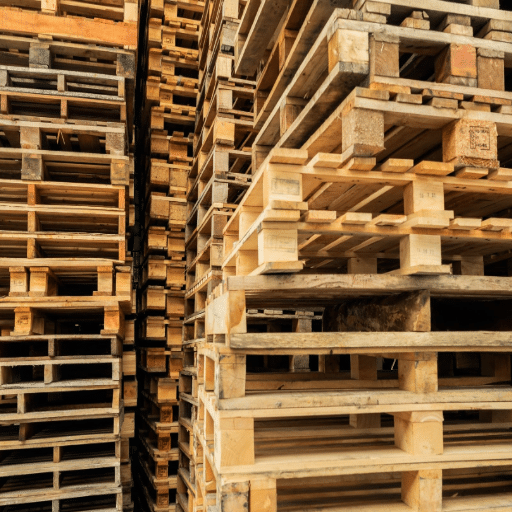
- Stacking and Organization: At all times, stack pallets in uniform, stable configurations to minimize hazards and save on space. By standardizing pallets, companies can ensure compatibility and stability when stacked. Follow local fire codes in terms of clearance between the stacks and walls or sprinklers.
- Pallet Rack Systems: Install industrial pallet racks if sufficient vertical space exists. This ensures that the pallet is stored safely while at the same time maximizing warehouse storage space and allowing for ease of pallet retrieval.
- Periodic Inspection and Maintenance: Inspect stored pallets for damage, wear, or infestation regularly. Immediately remove damaged pallets from storage to avert safety concerns and possible contamination of other materials.
- Zoning and Designated Areas: Establish specific zones or designated areas for idle pallet storage, clearly marking boundaries and ensuring they do not obstruct pathways or active work zones. This organization improves workflow and maintains order in high-traffic environments.
Best Practice: Safe pallet storage methods enhance warehouse efficiency and promote organized operations.
Impact of Idle Pallets on Warehouse Efficiency
Idle pallets exert a significant impact on warehouse operations by grabbing valuable floor space, obstructing workflows, and contributing to heightened accident risks. Overstocking of pallets either in a storage or operational area creates less usable space for stocks and equipment and acts as a hurdle in material handling. Improper management of pallets obstructs lean processes and constrains the free movement of goods, thereby slowing down products and order fulfillment. Besides, illegal storage of pallets can subject the noncompliance topples hazard to workplace hazards and damage stock.
Smooth pallet management works wonders in laying out the desired operations. Regular audits concerning an inventory of pallets, making sure unused pallets are returned to stock, and following zoning policies all discourage stacks of idle pallets. In adopting these systems, warehouses increase space utilization, limit bottlenecks, and create a safer and more orderly working environment, thus improving land-based processes and cost allocations.
Euro Pallets vs. Standard Pallets
When one compares Euro pallets with standard ones, several key differences emerge, the majority being dimensions, standards, and regions of use. Euro pallets, or EUR-pallets, are those that are standardized by the European Pallet Association (EPAL) at dimensions of 1200mm x 800mm. They comply with stringent quality standards, guaranteeing uniformity and durability. These pallets, because of this acceptance across Europe for cross-border trade and logistics, have enjoyed widespread application.
Standard pallets are typically North American in nature. The most common size for a pallet in this definition is 48″ x 40″ (1219mm x 1016mm) according to GMA standards. There is no universal standard for their quality, so greater inconsistencies may appear in their material and mode of construction.
| Feature | Euro Pallets (EUR) | Standard Pallets (GMA) |
|---|---|---|
| Dimensions | 1200mm x 800mm | 48″ x 40″ (1219mm x 1016mm) |
| Standardization Body | European Pallet Association (EPAL) | Grocery Manufacturers Association (GMA) |
| Weight Capacity | Up to 1500kg maximum static load | Varies based on construction quality |
| Primary Region | Europe – widespread for cross-border trade | North America |
| Quality Standards | Stringent quality standards ensuring uniformity | No universal standard; inconsistencies possible |
| Treatment Requirements | Often use treated wood (ISPM-15 compliant) | May need treatment for international shipping |
Another notable distinction is weight capacity. Euro pallets usually allow up to 1500kg maximum static load capacity, whereas standard pallets might allow higher or lower capacities depending on construction qualities. Moreover, Euro pallets often use treated wood to comply with regulations for international shipments, for example, ISPM-15, whereas standard pallets may sometimes need that treatment in order to satisfy those regulations.
Decision Factor: The choice between the two will depend on operational requirements such as the trading region, dimensional compatibility for the storage system, and shipping compliance standards.
Improving Supply Chain Efficiency

In maximizing efficiency in supply chain configuration, emphasis must be put on streamlining procedures and eliminating any form of operational waste. Critical strategies may involve the purchase of an advanced inventory management system so as to keep track of stock levels in real time, maximizing its accuracy as orders are placed and minimizing overstocking or shortages. Parallel to this, maintaining good relationships with dependable suppliers will guarantee on-time deliveries and lower disruptions. Shipping and logistics automated solutions may further increase enhancement speed and accuracy while decreasing human errors. Regularly analyze the performance of your supply chain operation to allow identification of bottlenecks and areas for improvement, thus supporting informed decision-making and continuous optimization.
Integrating Pallet Storage in the Supply Chain
Modern supply chains depend on pallet storage for utilizing space optimally, keeping the inventory management very orderly, and facilitating smooth handling operations. Thus, they can offer a standardized method of storing goods, enabling proper stacking and efficient use of vertical space, especially useful for warehouses with smaller footprints. Alongside, a palletized storage system helps to speed up loading and unloading, which reduces lead times and promotes faster turnaround.
On the other hand, integrating pallet storage systems also presents challenges that must be considered. The initial costs for installing pallet racks and making them compatible with material handling equipment, such as forklifts, can be considerable. Both maintenance and safety inspections need to be performed regularly to avoid any structural failures and accidents, and to adhere to industry regulations. To make the most of a pallet storage system, supply chain managers should keep certain factors in mind, such as storage capacity, product characteristics, and turnover rates. With the support of automation and warehouse management software, firms will be more accurate in tracking inventory and optimizing the use of pallets.
Key Considerations for Supply Chain Integration
- Storage capacity requirements and scalability
- Product characteristics and handling needs
- Inventory turnover rates and rotation strategies
- Automation compatibility and technology integration
- Regular maintenance and safety inspection schedules
- Compliance with industry regulations and standards
Monitoring and Managing Pallet Inventory
From my point of view, the whole pallet inventory ought to be monitored and managed through scheduling and with the assistance of technology. Real-time inventory tracking serves as one of my priorities when using warehouse management software, reducing errors and improving inventory accuracy. Another set of inspections is scheduled to determine any potential problems with the pallets, such as damage, or the storage itself, such as an inefficient utilization strategy. Finally, through measuring key metrics such as turnover rate and capacity, I can find solutions to further optimize storage and improve operational efficiency.
Future Trends in Pallet Storage Solutions
Industrial and warehouse evolutions of pallet storage occur with developments in technology and new designs prompted by constraints faced by modern-day supply chains. One major trend is getting AS/RS accepted through the drilling of operational efficiencies-robots, and conveyor systems are there to take care of palletized commodities accurately. These storage systems aim to maximize vertical space and throughput rates while minimizing manual labor.
Another big trend is the integration of IoT and real-time tracking technologies. Smart sensors and RFID tags work together to let the warehouse track its inventory with a level of accuracy it never had before-everything is tracked in an instant: stock levels, locations, and conditions. This information scene allows for the prediction of demand and storage allocation optimization.
In addition to being a growing concern in pallet storage, sustainability is being considered by companies seeking environmentally friendly pallet materials, and, along with that, warehouses are designed with an energy-conscious layout. Modular rack systems are being appreciated for their scalability and flexibility, as businesses can adjust their storage options on demand to accommodate inventory necessities.
Emerging Technologies in Pallet Storage
- Automated Storage and Retrieval Systems (AS/RS): Robots and conveyor systems handling palletized commodities with precision
- IoT Integration: Smart sensors providing real-time tracking of inventory levels, locations, and conditions
- RFID Technology: Enhanced accuracy in inventory tracking and management
- Predictive Analytics: Demand forecasting and storage allocation optimization
- Sustainable Materials: Environmentally friendly pallet options and energy-conscious layouts
- Modular Systems: Scalable and flexible storage solutions adapting to changing needs
Future Outlook: Collectively, these trends emphasize the paradigm shift towards smart, adaptable, and environmentally conscious pallet storage solutions, ensuring warehouses remain agile and competitive in an increasingly complex supply chain scenario.
Key Takeaways and Conclusions
Summary of Pallet Storage Best Practices
- Solution Selection: Choose the right pallet storage system based on inventory type, turnover rates, and space availability – options include selective racking, drive-in/through systems, pallet flow racking, and push-back racking
- Pallet Type Matters: Select between wood, plastic, or metal pallets based on environmental conditions, hygiene requirements, load capacity, and industry standards (ISO, GMA, EPAL)
- Space Optimization: Maximize vertical storage, implement efficient slotting practices, utilize warehouse management systems, and conduct regular audits
- Automation Integration: Consider automated pallet handling solutions, including AGVs, AS/RS, and conveyor systems to reduce manual labor and improve accuracy
- Layout Design: Create efficient warehouse layouts with defined zones for receiving, storage, picking, packing, and shipping while maintaining flexibility for future growth
- Idle Pallet Management: Implement strategies for stacking, organizing, and storing unused pallets in designated areas to prevent workflow obstruction
- Regional Standards: Understand the differences between Euro pallets (1200mm x 800mm) and standard GMA pallets (48″ x 40″) for international compliance
- Technology Adoption: Embrace IoT, RFID tracking, and predictive analytics for real-time inventory management and optimization
- Sustainability Focus: Consider environmentally friendly materials and energy-conscious designs to meet modern sustainability goals
Final Recommendations for Warehouse Operators
For New Warehouse Setups: Begin with a comprehensive assessment of your inventory characteristics, expected volumes, and growth projections. Invest in modular systems that offer flexibility and scalability. Prioritize safety compliance and ensure all storage solutions meet OSHA guidelines and industry regulations.
For Existing Operations: Conduct regular audits to identify inefficiencies in current storage configurations. Consider upgrading to automated systems where ROI justifies the investment. Implement warehouse management software to gain real-time visibility and data-driven insights for continuous improvement.
For Supply Chain Managers: Integrate pallet storage strategies with broader supply chain objectives. Focus on reducing lead times, improving inventory accuracy, and maintaining strong supplier relationships. Monitor key performance indicators such as storage density, turnover rates, and retrieval times.
For Future Planning: Stay informed about emerging technologies and industry trends. Prepare for the shift toward smart warehouses with IoT integration, predictive analytics, and sustainable practices. Build flexibility into your storage infrastructure to accommodate evolving business needs and market demands.
Achieving Operational Excellence
Efficient pallet storage is not just about maximizing space—it’s about creating a cohesive system that enhances productivity, reduces costs, ensures safety, and supports business growth. By implementing the strategies and best practices outlined in this guide, warehouses can transform their operations to meet the demands of modern supply chains while positioning themselves for future success. Regular evaluation, continuous improvement, and adaptation to new technologies will ensure your pallet storage solutions remain effective and competitive in an ever-evolving industry landscape.
Ready to Optimize Your Warehouse?
With the right pallet storage solutions and strategic implementation of best practices, your warehouse can achieve significant improvements in efficiency, safety, and profitability. Use this comprehensive guide as your roadmap to building a world-class storage operation that supports your business objectives and adapts to future challenges in the dynamic logistics landscape.
Reference Sources
“Behavior of Steel Storage Pallet Racking Connection – A Review”
“Pick-Up Plan in the Case of a Shuttle Racks Warehouse – An Optimization Approach”
“Design of Intelligent Weighing and Picking System Based on Sensing Technology”
Frequently Asked Questions (FAQs)
What best practices can be followed for pallet storage?
Pallet storage best practices include arranging pallets to maximize vertical storage space and facilitating direct access to full pallets when needed. Pallets should be regularly inspected to maintain their best condition for use. Using pallet racking systems helps optimize warehouse space and can bear several thousand pounds of weight-allowing easy storage and retrieval.
How can I make the warehouse better for pallet storage?
Modular pallet systems that can automate pallet movement while efficiently utilizing vertical space should be considered to optimize the warehouse for pallet storage. Also, separating pallets by size and type enhances flow for easier handling and storage of goods.
What are the common sizes of pallets used in storage?
Common pallet sizes include the standard 48×40-inch pallet, which is widely used in distribution centers, and other smaller sizes like 36×36 inches. Knowing about the various pallet sizes can help in determining the most appropriate storage method for your specific requirements.
Pallet rack systems can help with storage in what ways?
Pallet racking systems hold many pallets, and access to the stored articles is straightforward. The systems maximize airflow around these pallets to prevent any form of water accumulation, mold growth, and in effect, keep your products in optimum shape.
What are the ideas for pallet storage in small warehouses?
For small warehouses, think about vertical pallet storage options such as high-density racks or mobile shelving. This maximizes vertical storage space and enables you to store more pallets in limited floor space.
How should I arrange pallets in the warehouse?
Warehouse pallet organization involves categorizing pallets by product types or sizes and stacking them properly. Also, the sections can be labeled for easy access, thereby facilitating the process of transporting and storing goods.
How can I treat or prevent mold growth on stored pallets?
Thus, if one intends to treat or prevent mold growth on stored pallets, they should allow for airflow around their stored items, keep humidity low inside the storage, and keep inspecting their pallets for any signs of moisture. Mold prevention is also achievable by keeping pallets in good shape, which, in return, may increase the life span of the pallets.
What considerations should I take into account relevant to using a pallet jack to move a pallet?
One should consider the weight capacity of their pallet jack and how many pallets they would want to move at one time. Unlike ensuring that the pallet jack weighs within the load it can safely carry, it is equally important to ensure that the pallets being moved are in good condition to minimize the risk of injury. One should also ensure to use the right techniques and be trained on pallet handling for safety reasons.