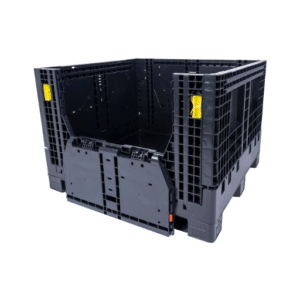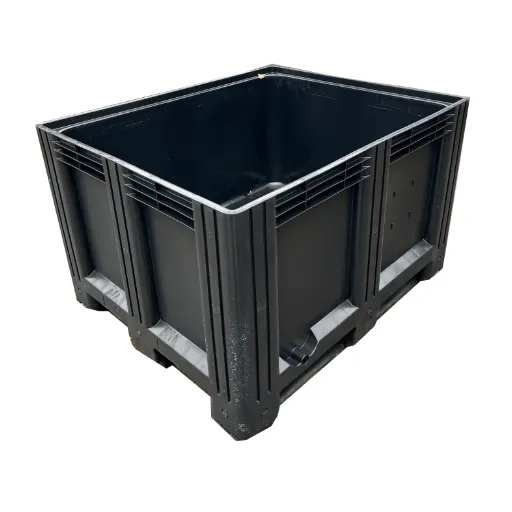

Bulk plastic pallet boxes function as industrial storage containers which occupy standard pallet dimensions. Their design enables bulk cargo storage and transportation while safeguarding product security. The product exists in two forms which include rigid solid-wall units that provide maximum durability and collapsible designs which enable space-efficient return logistics.
The specification sheets create misleading information about product performance. A container rated for 1,500 kg might fail in your actual racking environment. The collapsible box which creates space for the warehouse needs to replace its hinges because its replacement cost exceeds its freight savings. The overseas supplier offers products at a low unit price which fails to account for certification gaps that result in shipment delays at the port.
The procurement director from a Tier 1 automotive supplier in Detroit learned this lesson through personal experience. The team of OEM plastic pallet boxes made their transition from wooden crates to plastic pallet boxes. The warehouse operational base needed to discard their first vendor’s collapsible units which failed to meet 4-layer stacking requirements for their automated warehouse system before they achieved 30% savings. The difference in material between the two options did not create a distinction between them. The specification created the difference between the two options.
The guide provides instructions which help you choose the appropriate bulk plastic pallet box type. You must select the right material and load rating for your requirements while choosing the specifications that match your business needs. The guide shows you how to determine actual return on investment through your procurement process. You will gain a complete framework which serves you during your upcoming procurement process.
Key Takeaways
- Rigid solid-wall boxes deliver maximum stack strength for heavy static loads, while collapsible designs reduce empty return volume by up to 70%.
- HDPE handles cold storage and chemical exposure down to -40 degrees C; PP offers higher rigidity at ambient temperatures for 10-15% less cost.
- Always verify three load ratings: static (stationary), dynamic (in motion), and racking (on warehouse shelves).
- Most operations break even on plastic pallet boxes within 12 to 24 months when total cost of ownership replaces unit price as the buying criteria.
- Match your supplier to your scale: ISO certification, custom molding capability, and proven global logistics matter more than the lowest quote.
What Are Bulk Plastic Pallet Boxes?
Industry Terminology You Should Know
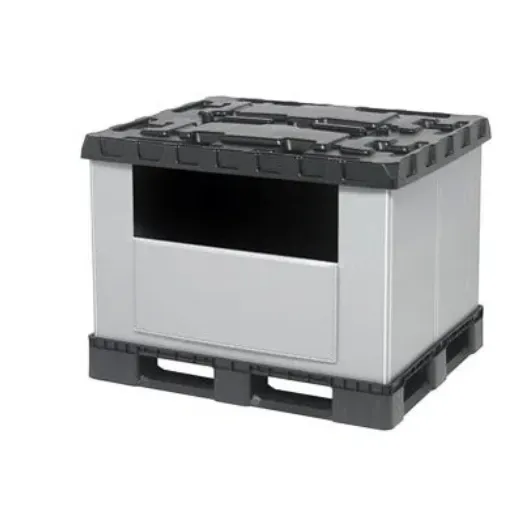
Bulk plastic pallet boxes go by several names depending on the region and industry. You may hear them called pallet containers, bulk bins, skid boxes, or octabins. In Europe, pallet sleeve boxes are common, where a corrugated or plastic sleeve sits on a pallet base to create a variable-height container. In North American automotive supply chains, the term bulk box usually refers to a solid-wall or collapsible unit with a footprint matching standard GMA pallet dimensions.
Regardless of the name, the defining feature is the same. These are not flat pallets. They are three-dimensional containers with sidewalls ranging from 300 mm to over 1,000 mm in height, built on a pallet base that accepts forklift tines from all four sides.
How They Differ from Standard Pallets
A standard plastic pallet carries goods that are already packaged, bagged, or boxed. A bulk plastic pallet box contains loose, bulk, or unpackaged goods directly: metal stampings, produce, powders, liquids in liners, or assemblies. The sidewalls protect contents from shifting, contamination, and weather. Many designs include lids, dividers, or internal fittings that standard pallets cannot accommodate.
The Shift from Wood to Plastic
The global pallet box market is projected to grow from approximately 12.61billionin2024to12.61billionin2024to26.42 billion by 2035, according to Market Research Future. Plastic is the dominant material within this growth, driven by three forces: hygiene regulations in food and pharma, automation compatibility in warehouses, and total cost of ownership advantages over wood.
Wooden crates splinter, absorb moisture, and require ISPM-15 heat treatment or fumigation for international shipping. Plastic pallet boxes eliminate all three problems. They are non-porous, easy to sanitize, and exempt from phytosanitary restrictions. For operations running closed-loop supply chains, the economics become undeniable.
Types of Bulk Plastic Pallet Boxes: Which One Fits Your Operation?
Not every bulk plastic pallet box serves the same purpose. Choosing the wrong type creates hidden costs in storage, transport, and replacement. Here is how the four main categories break down.
Rigid (Solid-Wall) Pallet Boxes: Maximum Strength, Zero Compromise
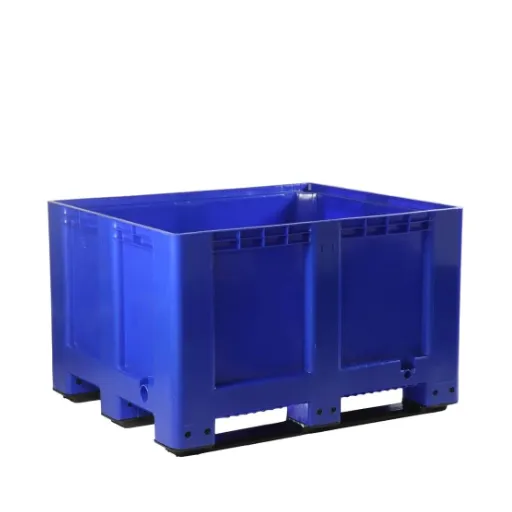
The rigid pallet boxes function as permanent containers which maintain their fixed sidewalls throughout their entire life span. The system provides maximum load capacity which enables stable stacking performance and maintains structural integrity for an operational period of 8 to 10 years under typical industrial conditions.
The boxes provide best performance in situations where containers remain empty for long periods. The solution serves as the most suitable option to handle heavy manufacturing and recycling processes and to support extended warehouse storage. The product maintains highest load capacity and withstands intense automated handling because it lacks both hinges and folding joints and removable panels.
Shandong Lile constructs its rigid industrial boxes with solid-wall design which maintains its shape when subjected to weight. The system enables safe stacking of five layers in both open yard areas and high-bay warehouse spaces.
Collapsible and Foldable Pallet Boxes: Space Efficiency for Return Logistics
Collapsible designs feature hinged sidewalls that fold down onto the base when empty. A standard unit might collapse from 800 mm height to 250 mm, reducing empty storage and return-shipment volume by 60% to 75%. Some sleeve-based systems achieve even higher compression ratios.
The trade-off is mechanical complexity. Hinges and locking mechanisms are wear points. Under extreme abuse or high-cycle folding, these components can fail before the base or walls show significant wear. Service life typically ranges from 5 to 7 years, depending on fold frequency and operating conditions.
The economic trigger for collapsible boxes is your empty return rate. If more than 40% of your container trips involve backhauling empties, the space savings on return freight usually offset the higher unit price within the first 18 months. The U.S. foldable plastic pallet box market alone reached approximately $1.04 billion in 2026, driven largely by automotive JIT supply chains and e-commerce reverse logistics, per Future Market Insights.
Our foldable and collapsible boxes fold flat for a smaller footprint, cutting both storage costs and return-shipment expenses.
Pallet Sleeve Boxes: Flexible Height for Variable Loads
Pallet sleeve systems combine a rigid pallet base with a detachable sleeve, typically made from corrugated plastic or polypropylene sheet. The sleeve folds flat to roughly one-eighth of its assembled volume. You can vary container height by swapping sleeve sizes, which makes these systems ideal for operations handling mixed SKU profiles.
The downside is lower structural rigidity compared to injection-molded solid walls. Sleeve boxes are not suited for heavy point loads or high-stack racking without additional reinforcement. They work best in light-to-medium duty distribution, retail replenishment, and fragile-goods transport.
Vented and Food-Grade Boxes: Hygiene and Perishables
The design of vented pallet boxes includes perforated and slotted sidewalls which create pathways for air to flow through the container. The products serve as vital components which agricultural operations and fresh produce distribution and seafood handling and cold-chain facilities demand to maintain consistent temperatures and control moisture throughout their storage processes. Solid-wall boxes create humidity accumulation while vented designs enable cooling air to move freely through the stored materials.
Food-grade and hygienic boxes go further. The product contains smooth non-porous surfaces which prevent bacterial growth because it uses virgin HDPE and PP materials that comply with FDA and EU 10/2011 standards. The design includes drainage holes and sloped floors which effectively eliminate standing water. These certifications serve as essential requirements which all meat and dairy and pharmaceutical products must meet. The criteria will determine which suppliers you choose to work with.
Shandong Lile manufactures vented boxes which include optional lids and dividers together with food-grade containers that meet certification standards for direct contact use.
| Feature | Rigid Boxes | Collapsible Boxes | Sleeve Boxes | Vented Boxes |
|: — |: — |: — |: — |: — |
| Best for | Heavy loads, static storage, automation | Return logistics, backhauls, space limits | Variable heights, light duty, fragile goods | Produce, seafood, cold chain |
| Empty space saved | None | 60-75% | Up to 87% | None |
| Service life | 8-10 years | 5-7 years | 3-5 years | 8-10 years |
| Stack height (loaded) | Up to 5 layers | Up to 3-4 layers | 2-3 layers | Up to 4 layers |
| Maintenance | Minimal | Hinge inspection | Sleeve replacement | Minimal |
| Relative cost | Lower | Higher | Lowest | Medium |
Material Matters: HDPE vs. PP for Bulk Containers
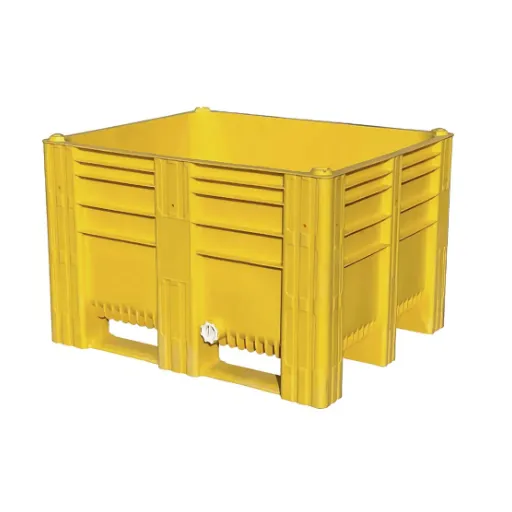
The two dominant materials for bulk plastic pallet boxes are high-density polyethylene (HDPE) and polypropylene (PP). Both are recyclable. Both are durable. But they behave differently under stress, temperature, and chemical exposure.
When to Specify HDPE
HDPE offers superior impact resistance and remains tough at low temperatures. It stays ductile down to approximately -40 degrees C, which makes it the standard choice for frozen food, cold storage, and outdoor applications in harsh climates. HDPE also resists most common chemicals, acids, and cleaning agents, so pharmaceutical and chemical operations often specify it for container longevity.
If your operation involves freezers, blast chillers, or chemical handling, HDPE is the safer specification. It costs slightly more than PP, but the performance gap in extreme environments justifies the premium.
When to Specify PP
PP exhibits higher stiffness and greater rigidity than HDPE when both materials exist at standard room conditions. The material maintains its structural integrity through temperatures reaching 100 degrees Celsius. The U. S. market for foldable plastic pallet boxes shows that PP commands a 36.9% market share because its hinges provide better durability than other materials used in automotive and electronics industries that require containers to operate between room temperature and heated factory environments.
For general warehousing applications and ambient distribution needs which require containers with high rigidity, PP material offers a 10% to 15% cost advantage over HDPE while meeting most load requirements.
Recycled Content and Sustainability Credentials
Sustainability functions as a vital requirement for procurement processes. A 33% surge in recycled HDPE usage for pallet manufacturing has been observed across the industry as EU Packaging and Packaging Waste Regulation compliance tightens. Many buyers now require post-consumer recycled (PCR) content reporting and lifecycle assessment (LCA) documentation.
At Shandong Lile, we use both virgin and recycled HDPE and PP, and our products are 100% recyclable at end of life. Your organization needs to provide details about sustainability documentation requirements when customers or regulators need such information. Only a few suppliers can demonstrate their validated PCR content percentages together with ISO 14001 environmental management certification.
Load Capacities Demystified: Static, Dynamic, and Racking
Every bulk plastic pallet box carries three load ratings. Misunderstanding them leads to collapsed stacks, racking failures, and damaged inventory.
Understanding the Three Load Ratings
The static load measurement designates the maximum weight capacity of a container which its floor surface base can carry when the container rests on the ground. The maximum weight capacity which industrial equipment designs can achieve reaches 2000 kilograms to 4000 kilograms because the building structure distributes all weight throughout the space.
The dynamic load measurement determines the weight which a system can hold while it operates, including the weight which a forklift moves when it carries a shipping container. The rating decreases to a range of 500 kilograms to 1500 kilograms because stress points develop from both uneven ground conditions and the process of moving the container.
The racking load measurement applies when a container rests on warehouse rack beams which lack any support from other containers situated underneath. The ability to achieve substantial racking loads requires only reinforced designs which use either steel or composite rod inserts as structural components. Standard pallet boxes do not provide any racking rating because they lack this certification.
How to Calculate Your Actual Load Requirements
Do not use the label number for your size determination. Your actual operational conditions should be used for determining size requirements. Your research should start with the maximum weight which one SKU product reaches in an individual container. You should include an additional 15% to 20% in your calculations to account for load changes and pallet weight and unexpected overloading. Your current number should be matched against the corresponding rating that applies to your material handling system.
The static load establishes the weight limit for your operation when you stack items directly on the floor. The dynamic load establishes your weight capacity when you use a forklift to move goods between different areas on the site. You must obtain an official racking load documentation from your manufacturer if you plan to keep containers on rack beams.
Safety Margins: Why the Label Number Is Not Your Real Limit
Manufacturers test load ratings in ideal conditions: level floors, evenly distributed loads, ambient temperatures, and no structural wear. Your warehouse has none of these conditions perfectly. Always apply a safety factor of at least 1.5 for dynamic loads and 2.0 for racking applications.
A container rated at 1,000 kg dynamic load should not routinely carry more than 650 kg to 700 kg in your operation. This margin absorbs the real-world variables that lab tests cannot replicate.
Industry-by-Industry Application Guide
Automotive and JIT Supply Chains
The automotive industry accounts for 23.7 percent of U. S. demand for foldable plastic pallet boxes. OEMs now require their Tier suppliers to use returnable packaging systems in their operations. The industry uses collapsible boxes because they provide empty return volume for their light-to-medium part logistics operations which include interior trim and electronics and subassembly kit distribution.
Rigid boxes handle the heavy side: engine castings, axle assemblies, and metal stampings that would destroy folding hinges. Footprint standardization matters intensely in this sector. The majority of North American automotive facilities need their operations to support 48-inch by 40-inch GMA standards or 1,200 mm by 1,000 mm Euro dimensional specifications.
Food and Beverage and Cold Chain
Food and beverage leads overall pallet packaging end-use with a 29.8% market share. The meat and dairy and bakery and beverage distribution industry uses plastic pallet boxes as a replacement for wooden crates and corrugated gaylords because they can be easily washed.
Wooden crates harbor bacteria in pores and cracks. Corrugated gaylords disintegrate in wet environments. HDPE pallet boxes withstand pressure washing, steam cleaning, and chemical sanitizers. HDPE material is the only option that retains impact resistance when used in frozen conditions.
The international shipping process becomes more efficient because ISPM-15 fumigation requirements do not apply to your shipments which results in lower costs and faster processing times because you no longer need wood treatment documents for customs.
Pharmaceuticals and Chemicals
The trackability needs to be maintained while all pharmaceutical products must remain protected from contamination and all regulations must remain followed. In 2024 the logistics manager Sarah Okonkwo from a Lagos-based generic pharmaceutical distributor converted her API bulk shipments from wooden crates to rigid HDPE pallet boxes. Product damage from splinters and moisture dropped by 45%. Her customs clearance time reduced by two days per shipment because she stopped using phytosanitary certificates.
Chemical operations require facilities to design equipment that meets chemical resistance requirements. HDPE material provides resistance against most acids and bases and solvent solutions. Always request a compatibility chart from your supplier before specifying the material for aggressive chemicals.
Agriculture and Fresh Produce
Agricultural exports face a unique challenge. The container should provide strength to support field harvesting while offering ventilation for product respiration and enabling collapsibility to maintain delivery efficiency when returned. The solution to this requirement exists in vented rigid boxes and vented collapsible boxes.
Zhang Wei operates an apple export cooperative in the Shandong Province. His operation ships 40-foot containers to Southeast Asia weekly. He switched to vented collapsible pallet boxes with slotted sidewalls and found that airflow reduced core temperature variation during the 14-day sea voyage. The boxes can be folded flat which enables their return trip to packing houses while spoilage claims dropped by 15%.
E-Commerce and Distribution Centers
E-commerce fulfillment centers move fast. The seasonal peaks create a need for additional container capacity to handle increased demands. The off-seasons require facilities to store empty containers in a compact manner. The operators can adjust their container inventory through collapsible pallet boxes and sleeve systems which enable them to peak their inventory without needing to use permanent storage space for non-active rigid containers.
Automation compatibility stands as a vital requirement. The conveyor systems and automated guided vehicles and robotic pick cells need to operate with containers that have standardized dimensions. Plastic pallet boxes maintain tighter tolerances than wood, which warps and splinters unpredictably.
The ROI Case: Total Cost of Ownership for Bulk Plastic Pallet Boxes
Unit price is the wrong metric. Total cost of ownership is the right one.
Upfront Cost vs. Cost Per Trip
A rigid plastic pallet box might cost 80to80to150. A comparable wooden crate might cost 30to30to50. But the wooden crate lasts 5 to 10 trips. The plastic box lasts 200 to 500 trips. The cost per trip drops from roughly 8.40forwoodtounder8.40forwoodtounder1.80 for plastic in high-cycle operations.
According to industry ROI models aggregated from logistics consultants, the net savings from switching to plastic over a multi-year analysis can exceed $395,000 for mid-size operations. The exact figure depends on trip frequency, damage rates, and freight distances, but the directional advantage is consistent.
You can calculate your own total cost of ownership using our framework.
Hidden Savings: Maintenance, Disposal, and Fumigation
The wood procurement process incurs additional expenses which remain unrecorded in the purchase order. The costs for splinter repairs and nail replacement and disposal fees continue to accumulate. Every international shipment requires ISPM-15 fumigation or heat treatment which costs 2to2to4 for every crate. The majority of regions cannot recycle damaged wood therefore it gets disposed of through landfills or industrial chippers.
Fumigation costs vanish when companies switch to plastic pallet boxes. The need for repairs occurs infrequently. The manufacturing process accepts HDPE and PP which become ground down after their operational period ends. Some suppliers, including Shandong Lile, offer take-back programs for large-volume customers.
Break-Even Scenarios by Industry
The majority of closed-loop systems achieve their financial return on investment through plastic pallet boxes within a period between 12 to 24 months. High-turnover distribution centers achieve their financial return on investment through daily container operations which last less than 12 months. The break-even point for one-way and low-frequency shippers never occurs which makes wood an appropriate material for single-use export to locations without return shipping options.
Your break-even math calculations become more advantageous when your annual container trips exceed 50 per unit and your wood damage rate surpasses 10 percent and your company conducts international shipping or your business uses automated systems that discard warped or inaccurate containers.
Specifying Custom Features for Bulk Orders
Off-the-shelf containers work for standard applications. Custom specifications separate optimized operations from ones that accept compromise.
Dimensions and Footprint Standards
The three dominant footprints are 1,200 mm by 1,000 mm (Euro), 1,200 mm by 800 mm (half-Euro), and 48 inches by 40 inches (GMA). Your choice needs to match the existing pallet racks and the forklift tine spacing and the truck loading patterns. The operation footprint needs to remain fixed because switching it creates multiple compatibility issues.
Custom base dimensions for non-standard applications require injection molding as the only method for creation. Shandong Lile uses 18 major production machines which can create custom molds for their OEM and ODM manufacturing needs.
Lids, Dividers, and Internal Fittings
The attached lids protect high-value content while stopping weather damage from outdoor storage. The internal dividers separate mixed loads without any need for additional packaging. Some designs include drainage valves for liquid contents or liner retention systems for powders.
The application of dividers in your mixed-SKU load operations will decrease your packaging labor requirements because they eliminate the need for individual boxes inside the pallet container.
RFID Tracking and IoT Integration
About 22 percent of new pallet containers now include RFID tags and IoT sensor mounts which factories embed during the production process. Real-time location tracking and temperature monitoring and shock detection have become essential features for both pharmaceutical cold chain operations and high-value automotive parts shipments.
Your supplier needs to confirm their RFID integration methods because some companies embed their tags during the molding process while others attach them after production finishes. Molded-in tags provide superior durability against pressure washing and impact damage compared to adhesive-mounted tags.
Branding and Color Coding
Color-coded containers reduce sorting errors in multi-SKU warehouses. Custom colors also support brand visibility in retail distribution and customer-facing logistics. At Shandong Lile, we offer Pantone color matching and logo embossing for bulk orders, turning functional containers into brand assets.
What to Look for in a Bulk Plastic Pallet Box Supplier
The right supplier is not the cheapest. It is the one that matches your scale, quality requirements, and geographic needs.
Manufacturing Scale and Capacity
A supplier running three injection machines cannot fulfill a 10,000-unit order on a reasonable timeline without outsourcing, which introduces quality inconsistency. Verify production capacity before you commit. Shandong Lile operates 16 subsidiaries and maintains a 178,000-square-meter production complex with the capability to handle high-volume, consistent-output contracts.
Certification and Quality Assurance
ISO 9001 is the baseline for quality management. SGS or equivalent third-party testing adds credibility for load rating claims. For food and pharmaceutical applications, demand FDA or EU 10/2011 compliance documentation, not verbal assurances. Ask for actual test reports with batch numbers.
Customization Capabilities
If your operation needs non-standard dimensions, steel reinforcement, custom colors, or embedded RFID, confirm that your supplier owns mold-making capability. Brokers and trading companies often promise customization but subcontract to unrelated factories with no quality continuity.
Shandong Lile offers direct custom molding and OEM solutions without middlemen. Our engineering team works from your specifications or CAD files to produce tailored designs.
Global Logistics and Delivery
Manufacturing capacity means little if the supplier cannot deliver reliably to your region. Qingdao Port is one of the busiest export hubs in northern China, with direct shipping lanes to major ports in North America, Europe, Southeast Asia, and the Middle East. A supplier with established port logistics and customs documentation experience reduces lead time variation and shipping surprises.
Our global supply chain serves clients in over 108 countries, with standard production lead times of 15 to 20 workdays for catalog items and quoted timelines for custom projects.
Conclusion
The selection of bulk plastic pallet boxes functions as a strategic procurement decision which goes beyond ordinary product acquisition. The container you specify affects warehouse density, freight cost, product damage rates, regulatory compliance, and labor efficiency for years after the invoice is paid.
Begin with your current operational situation. Your empty return rate needs measurement because it will help you choose between rigid and collapsible design options. Your temperature and chemical environment needs matching with either HDPE or PP materials. You should calculate loads through dynamic and racking ratings while not relying solely on static numbers. The next step requires you to match your supplier capacity with your volume and customization needs.
Companies that successfully implement these operations achieve more than just packaging cost savings. They create stronger supply chain systems. All packaging-related line stoppages at Marcus Chen’s automotive plant stopped occurring. The pharmaceutical shipments from Sarah Okonkwo reached customs clearance within a shorter period. Zhang Wei’s produce reached export markets with less waste. Their common thread was a specification decision made with the right framework.
If you are evaluating a bulk plastic pallet box procurement, explore our industrial pallet box range to see specifications for rigid, collapsible, and custom designs. For tailored recommendations based on your load requirements and industry, contact our team for a specification consultation or bulk quote.