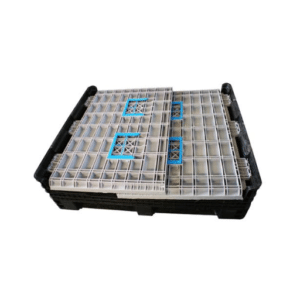
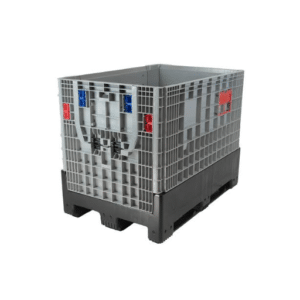
Custom collapsible pallet boxes are foldable bulk containers built to a non-standard size, color, branding, or feature spec when an off-the-shelf box doesn’t fit your product or return loop. They fold flat for empty return, then open into a rigid sleeve-pack container on a pallet base. This guide walks through when to customize, what you can change, and what the tooling really costs.
Priya runs inbound packaging for a Tier-2 automotive supplier. Last spring she tried to fit a brake-rotor kit into a stock 1200×1000 collapsible box. The parts nested fine, but they left a six-inch gap of dead space along one wall.
Over a single truckload, that gap became 14 pallets of air she paid to move every week. She spent three weeks pricing a custom-height sleeve before she realized the real fix was simpler than she thought.
You probably already believe collapsible boxes save money on empty-return freight. That part is true. What most buyers miss is that the savings only show up when the box matches the product, the footprint, and the tracking needs. By the end, you’ll know how to decide between standard and custom, which levers are worth paying for, and how to write a spec a supplier can quote against.
Key Takeaways
- Custom collapsible pallet boxes make sense only when a standard spec genuinely fails: non-standard dimensions, dividers, branding, or traceability.
- The highest-impact customizations are internal height and internal dividers; they recover dead space and cut sort time.
- Branding methods vary in durability: a silk-screen logo won’t survive the washdown a food-grade box endures.
- Tooling is the hidden cost. MOQs differ by customization type, and a new mold can take roughly two months.
- The best spec is a written one: product dimensions, access, ventilation, branding, and volume in one RFQ.
What Are Custom Collapsible Pallet Boxes?

A custom collapsible pallet box is a foldable bulk container, usually a sleeve pack made of a pallet base, hinged or removable walls, and a lid, engineered to specifications that fall outside a standard catalog. That customization can touch the footprint, the internal height, the wall and door configuration, the color, the branding, or the tracking features.
The “custom” part matters for one reason. A standard collapsible box is already flexible, it folds, it stacks, it returns flat. Custom only adds value when the fit requirement is itself non-standard. If your product, your rack, your washdown line, or your depot doesn’t match the catalog, that’s when you customize.
For more on how these boxes work and fold, start with our guide to collapsible plastic pallet boxes.
Not sure if your spec needs a custom build? Tell us your footprint and product, and we’ll tell you what’s worth customizing →
When to Choose Custom Over a Standard Collapsible Box
The cheapest mistake in returnable packaging is tooling a custom mold you didn’t need. The second cheapest is forcing a standard box that damages product or wastes cube. This checklist separates the two.
Choose custom when any of these is true:
- Your footprint or internal height doesn’t match a catalog size.
- Your product needs internal organization, like dividers or dunnage.
- You need ventilation, drainage, or insulation for produce or cold chain.
- You need branding, Pantone color matching, or traceability like RFID.
- You need a drop-door or access configuration that isn’t standard.
- Your annual volume is high enough to amortize the tooling.
Choose standard when a catalog box already fits and you mostly care about speed and unit price. Stock boxes ship in days, not weeks.
The gray zone is height. Most suppliers offer a range of heights on a fixed footprint, so a “custom” box is often just a non-stock sleeve height rather than a whole new mold. That’s the fastest and cheapest customization lever, and it’s where Priya ended up: a standard footprint with a shorter sleeve, no new tooling required.
Not sure whether collapsible is even the right design for you? See our comparison of collapsible vs. rigid pallet boxes.
What Can Be Customized on a Collapsible Pallet Box?
Nearly every part of a collapsible box is a lever. Here’s the full taxonomy, from cheapest to most tooling-intensive.
Dimensions and Height
The footprint is usually the most expensive thing to change because it means new base-pallet tooling. The internal height, by contrast, is often just a different sleeve or coaming height. Reference ranges run from roughly 760mm up to 1200mm tall on a 1200×1000 footprint, with several stock heights in between.
The trade-off to watch is fold ratio. A taller box still knocks down, but its folded height grows, and that quietly erodes the space savings you bought it for. Spec the height to the product, not the other way around.
Walls, Doors, and Access
You can choose solid or vented walls, add drop doors for easy picking, and cut drainage holes for washdown or wet products. Drop doors are the most underused option in parts handling: a door on the long side lets an operator pick without reaching over a meter-high wall.
For a deeper look at lids, wheels, and doors, see our guide to collapsible pallet box accessories.
Internal Organization
This is the customization most buyers forget, and it’s the one that often pays back fastest. Dividers, dunnage, and molded inserts hold parts in place so they arrive sorted and undamaged. It’s a gap in most manufacturers’ catalogs, which makes it a genuine differentiator if you’re sourcing a parts-in-box system.
Marcus manages a kitting line for appliance fasteners. His team used to pack small parts loose in a big collapsible box, then hand-sort them at the assembly plant. Adding molded dividers cut the sort time from 18 minutes to 4 per box, and it cut the count errors that were holding up the line.
Materials and Finish
HDPE handles heavy loads and cold temperatures. PP offers more rigidity and handles washdown and steam. Recycled content cuts cost and carbon but may not suit extreme-load or food-contact applications. Anti-static and UV-stabilized grades exist for electronics and outdoor storage.
Material selection is a topic on its own. Read our comparison of custom plastic pallet materials before you commit to a resin.
Branding and Identification
Color, logo, and traceability turn a generic container into a controlled fleet asset. Stock colors are usually grey, blue, or black. Pantone-matched custom colors need a higher MOQ.
Logos can be silk-screened, hot-stamped, embossed, or molded in. RFID tags can sit in a reserved slot, a label holder, or be molded directly into the wall.
Logo Printing and RFID: How to Brand and Track a Custom Box

Branding is where durability really diverges. The method you choose determines whether your logo survives the first season or the fifth.
| Method | Durability | Cost | Best For |
|---|---|---|---|
| Silk-screen printing | Low to medium | Lowest | Short-life, low-wash applications |
| Hot stamping | Medium | Low to medium | Permanently marked fleets |
| Embossing / molding | High | Medium, plus tooling | Long-life, high-value assets |
| In-mould label (IML) | High | Higher | Branding fused into the wall |
RFID follows a similar ladder. A reserved slot or label holder is cheap and lets you retrofit tags later. An RFID in-mould label, the approach DOLAV uses, gives each box a unique, non-removable ID that survives washing and rough handling. If you track a large, shared fleet, the in-mould option is worth the premium.
A beverage distributor lost 1,100 boxes over two years, not because they broke, but because no one could tell whose they were. Every grey box looked like every other grey box at the shared depot. When they embossed their logo and added an RFID in-mould label, the annual loss dropped by nearly half within a year.
Want to spec branding and tracking that survives your washdown line? Tell us your application and we’ll map the right method →
How a Custom Collapsible Box Is Engineered and Validated
A custom box doesn’t start at the mold. It starts with your requirements, then moves through design, tooling, prototyping, and testing before production.
The process usually looks like this:
- Requirements: product dimensions, weight, environment, access, volume.
- Design: CAD layout of base pallet, sleeve, walls, and doors.
- Tooling: new base-pallet or wall tooling, or a re-cut sleeve.
- Prototype: sample build to confirm fit and fold.
- Validation: load testing against standards like ISO 8611.
- Production: full run with dimensional checks.
The step most buyers underestimate is tooling time. A new mold commonly takes about two months, per suppliers like Weihong, which is why a “custom box” is rarely a fast order. If you’re prototyping, ask about short-run samples before committing to production tooling.
What a Custom Collapsible Box Costs: Tooling, MOQ, and Lead Time
Cost is where transparency varies most between suppliers. Here’s what to expect, framed as ranges rather than a single number.
| Order type | Tooling needed | Typical MOQ | Typical lead time |
|---|---|---|---|
| Stock box | None | 2 to 3 pieces | 3 to 15 days |
| Customized (color, logo, height) | Often none, or a re-cut sleeve | 50 to 500 pieces | 15 to 20 days |
| Full custom footprint | New base-pallet mold | Highest | Two-plus months with tooling |
The unit price of a box is one line. Tooling is the other, and it’s the one nobody quotes up front. A custom footprint means new base-pallet tooling.
A custom height or wall feature may only need a new sleeve or wall mold. Ask which tooling, if any, your spec actually requires.
Minimum order quantities move with the customization type. Stock color and a simple logo might start around 50 to 300 pieces. Pantone-matched color often jumps to 500 pieces or more. A fully custom footprint with new tooling is the highest threshold of all.
Lead times follow the same curve. Stock boxes ship in roughly 3 to 15 days. Customized boxes run 15 to 20 days after deposit. New tooling adds weeks on top of that, with roughly two months for the mold itself.
The honest way to think about it is cost per trip, not unit price. A custom box that fits your product and returns flat for years beats a cheap standard box that wastes cube and damages product every cycle. Read our guide to return logistics and ROI to run the full math.
How to Spec a Custom Collapsible Pallet Box

The difference between a good supplier and a bad one is how they respond to a clear spec. This is the checklist to send.
- Footprint and internal height, with tolerances.
- Product dimensions and weight, including any overhang.
- Access needs: drop doors, hand grips, open or closed top.
- Ventilation, drainage, or insulation requirements.
- Dividers or dunnage for internal organization.
- Branding: color (Pantone), logo method, placement.
- Tracking: barcode, RFID, or in-mould label.
- Volume and annual usage, to determine MOQ and tooling.
- Environment: temperature, washdown, chemical exposure.
Then ask three questions before you sign: What test evidence do you have for the load rating? What’s the warranty and remove-from-service criteria? And what tooling, if any, does this spec require?
For the full design process from concept to production, see our custom plastic pallet design guide.
Frequently Asked Questions
How much does a custom collapsible pallet box cost?
It depends on the unit spec and whether new tooling is needed. Unit price is one line; tooling is separate. Stock-color, stock-height boxes cost less than a custom footprint with new base-pallet tooling.
What is the MOQ for a custom collapsible box?
MOQ rises with the customization type. A simple logo might start near 50 to 300 pieces, custom color around 500, and a fully custom footprint higher still.
How are logos printed on collapsible plastic pallet boxes?
Four common methods: silk-screen (cheapest, least durable), hot stamping, embossing or molding, and in-mould labeling (most durable). The right choice depends on washdown and lifespan.
Can collapsible pallet boxes include RFID or barcodes?
Yes. Options range from a reserved slot or label holder you retrofit later, to an in-mould RFID label molded permanently into the wall for a unique, non-removable ID.
Can I get internal dividers in a collapsible box?
Yes. Dividers, dunnage, and molded inserts are available and are often the highest-value customization for parts handling, since they cut sort time and damage.
Can custom collapsible boxes be food-grade or for cold storage?
Yes, with the right resin and finish. Food-grade HDPE and insulated wall variants exist, but insist on documentation for any food-contact or cold-chain claim.
Conclusion: Spec the Fit, Don’t Force It
The right custom collapsible pallet box isn’t the one with the most features. It’s the one that matches your product, your footprint, and your return loop, with branding and tracking that survive your environment.
Here’s what to take away. Customize only when a standard spec fails, and start with the cheap levers first: height, dividers, doors, and branding. Treat tooling as a separate line item and ask which tooling your spec actually needs. Write a complete spec before you request quotes, and demand test evidence and warranty terms in return.
The wrong box costs you twice: once in wasted cube and damaged product, and again in the tooling you rushed to buy. Get the spec right the first time.
Request a custom collapsible pallet box specification review → Tell us your product, footprint, and volume, and we’ll map the levers that matter and what the tooling will cost.